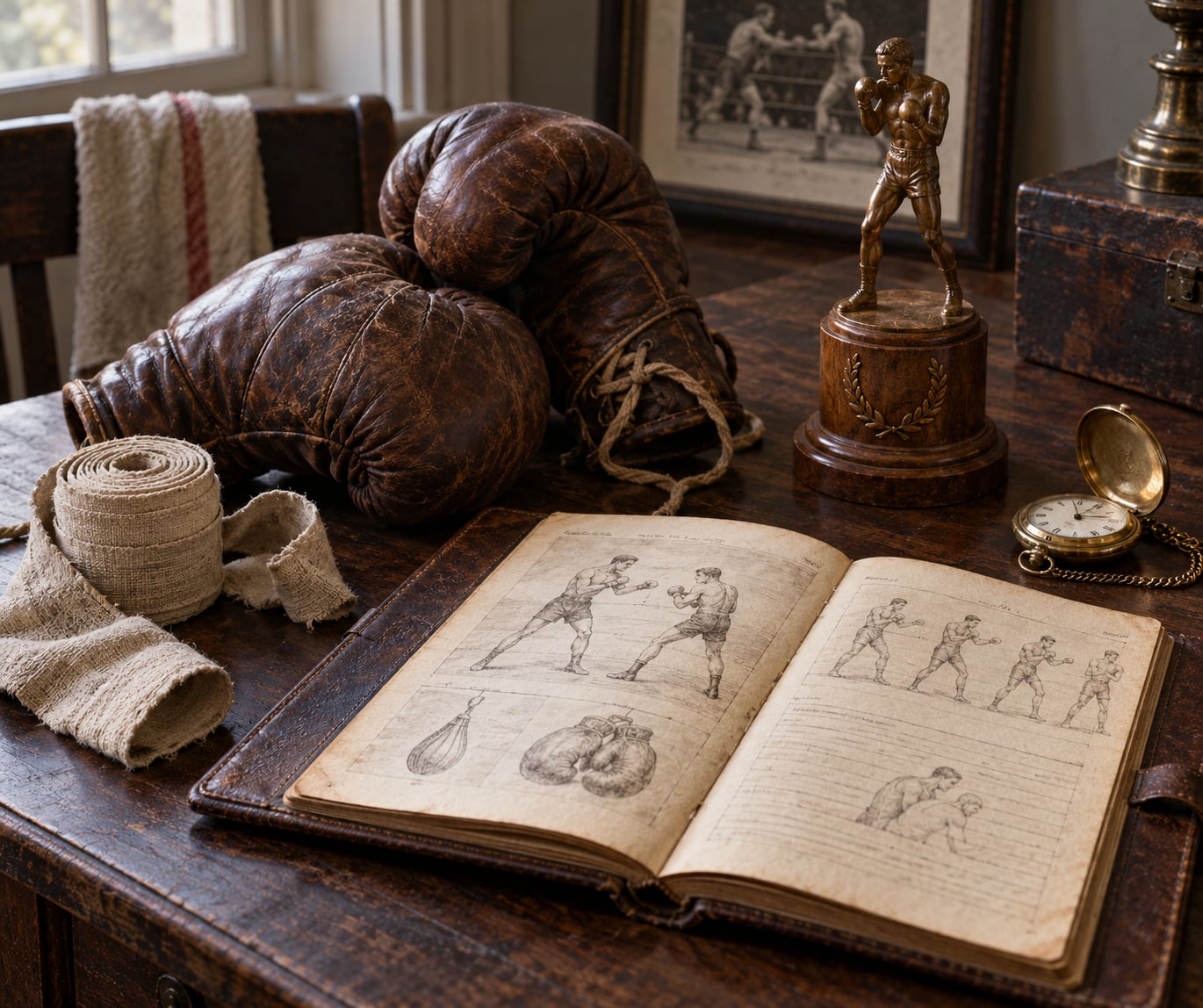
Boxing gloves were not one invention but a long argument that took about a hundred and fifty years to settle. Fighters wrapped their hands for centuries and padded them for sparring long before anyone allowed them in a championship. The glove became compulsory in the ring only when rule bodies started writing equipment clauses, and even then the best professionals ignored it for three more decades.
That gap between gloves existed and gloves were legal is where most histories of this story go wrong. They usually give a single date, credit one aristocrat with inventing the glove, and skip the part that actually explains the change: champions testing gloves in public, promoters wanting longer fights, and a culture that thought padding the fist was an admission of weakness.
What follows is the sequence: why bare fists were considered respectable in the first place, what damage they caused, the dated rule changes, the fighters who forced the sport forward, and why bare-knuckle boxing never actually disappeared.
Last updated: October 2026
Table of Contents
- Did Boxing Really Start Without Gloves?
- What Problems Did Bare-Knuckle Fighting Create?
- When Did Boxers Begin Wearing Gloves?
- What Role Did Boxers and Champions Play?
- How Did Gloves Change Fighting Strategy?
- How Did Gloved Boxing Spread Around the World?
- Why Does Bare-Knuckle Boxing Still Exist?
- What Legacy Did the Change Leave?
- Frequently Asked Questions
- Conclusion
Did Boxing Really Start Without Gloves?
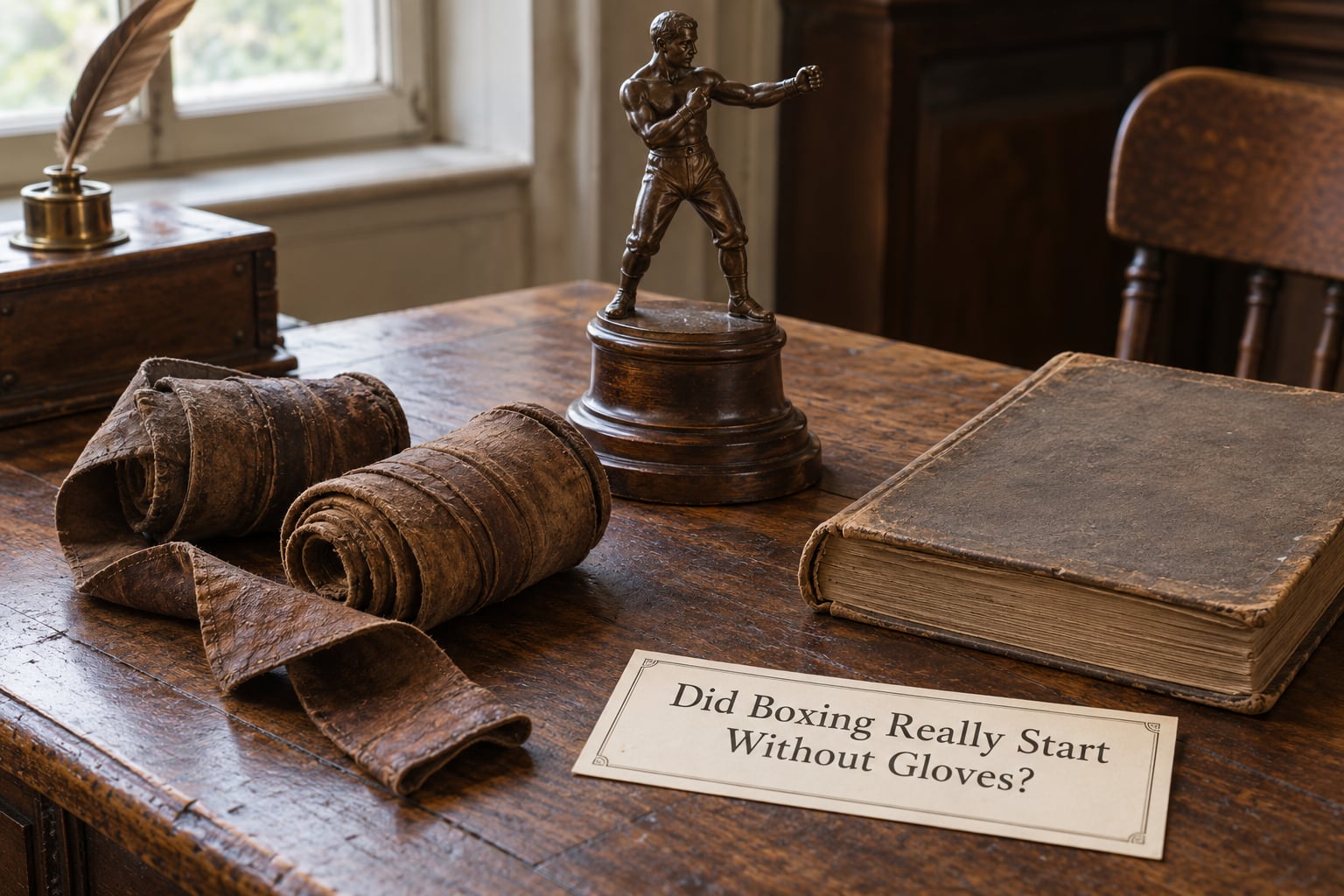
Boxing has always had hand protection of some kind, which is the first thing worth clearing up. Greek athletes wrapped their knuckles in strips of ox hide, and the Romans added the cestus, a leather glove studded with metal, which was closer to a weapon than to sports equipment. Leather bands recovered from the Vindolanda fort on Hadrian’s Wall, dating to roughly 120 AD, are the oldest surviving boxing gloves anyone has dug up.
None of that made modern boxing. Those wraps and studs were thin, and the object was to cut and crush rather than cushion. Formal prizefighting, the kind fought in public for money and rules in 18th and 19th century England, was a very different animal from a street brawl. It had seconds, a referee, agreed rounds, and a betting public. It was also fought with bare fists, and that was deliberate.
Fighters argued that a glove was an unnecessary prop. The bare knuckle was read as manly, economical and honest, while covering the hand looked like a way of avoiding the consequences of a punch. A champion’s standing, and the size of the crowd, both rested on that reputation. So bare-knuckle fighting survived not because it was safer or more comfortable, but because the culture around it said a man who needed padding could not hit like a man who did not.
What Problems Did Bare-Knuckle Fighting Create?
The bare fist damaged the puncher as much as the target. Fighters fought with split knuckles, swollen fingers and wrist injuries, and Quora answers and BoxRec forum regulars both describe broken hands as the fear that hung over every bare-knuckle engagement. A punch that lands hard on a jaw often hurts the hand that threw it just as much.
The head took the rest. Deliberate head contact with bare knuckles, and the chopping blows that landed on the soft skin above the eye, produced cuts that closed the fighter’s eye within rounds. Clenched hands and forearms also turned the ear into a target, which is where the battered cauliflower ear of the era comes from. Amateur authorities eventually banned the ear attack outright, a rule change that reads as quaint now but was a real concession that bare-knuckle fighting was injuring people in ways gloves would not.
Fights went on too long to be survivable. Many prize-ring battles were scheduled for sixty rounds or more, with a contestant allowed to be helpless for a full minute before being counted out. Late rounds of that kind produced exhaustion-based decisions rather than knockouts, and one contest can leave a career permanently altered.
The clearest cost came in 1863. The American champion John C. Heenan travelled to England to fight Tom King in a bare-knuckle championship, and he died within days of being knocked unconscious. Later in the century, injuries suffered without gloves were the background reason physicians began attending championship bouts, an ancestor of the ringside doctor who still sits at every modern fight.
None of this makes gloves a clean fix. Padding clearly reduces cuts, eye damage and hand fractures. It does nothing about the force moving through the skull when a punch lands on a jaw, which is the injury that ends modern careers.
When Did Boxers Begin Wearing Gloves?
Nobody can point to the day boxing gloves arrived, because they arrived in layers. Hand wraps came first, then padded sparring gloves, then written rules, and finally acceptance in championship fights.
| Year | Event | Effect on glove use |
|---|---|---|
| c.120 AD | Leather bands recovered at Vindolanda | Oldest surviving boxing gloves; hand protection, not padding |
| 1743 | Jack Broughton issues Broughton’s Law and adopts padded mufflers | Gloves accepted in sparring and some matched fights |
| 1818 | A bout in France recorded with padded gloves | Early recorded competitive use outside Britain |
| 1838 | London Prize Ring Rules drafted | Bare-knuckle championship rules consolidated in Britain |
| 1863 | Heenan fights Tom King bare-knuckle in England | Shows championship boxing still bare-knuckle mid-century |
| 1865 and 1867 | Marquess of Queensberry rules drafted, then adopted by the Amateur Athletic Association | Glove clause written into amateur competition rules |
| 1870s | Padded gloves appear in American matches | Gloves spread unevenly through US prizefighting |
| 1889 | Sullivan and Corbett fight bare-knuckle for the heavyweight title | Last major bare-knuckle championship fight |
| 1892 | Hall fights Coburn under the new rules in London | Gloved heavyweight title decided in Britain |
| 1892 | Sullivan fights the Corbett rematch in London wearing five ounce gloves | Gloves become normal in championship boxing |
The 1865 and 1867 dates confuse a lot of readers, so it is worth separating them. The Marquess of Queensberry’s rules were written in the mid-1860s and adopted by the Amateur Athletic Association for amateur bouts in the later part of that decade. Their glove clause, which required fair-sized gloves of the best quality and new, applied to amateurs. Professionals carried on fighting bare-knuckle for roughly thirty years after that.
How Bare Knuckle Boxing Became Gloved Boxing
The mechanism was not a ruling; it was a sequence of demonstrations that rule bodies eventually wrote down. Three things made gloves stick once champions started using them in public.
First, sparring proved the functional case. Pads let a fighter train hard without wrecking his hands, so the same boxer could spar on Monday and fight a full contest on the next Saturday. That reliability argument sold gloves to professionals faster than any safety argument did.
Second, gloves extended contests. A bare-knuckle punch that stops landing halfway through a fight is a fight decided by accident. A padded glove keeps its shape and its target through long sessions, so fights that used to be stopped by damage to the puncher’s hand often ran to the scheduled distance. Promoters like long fights, and champions who had built careers on surviving them had no reason to refuse.
Third, governing bodies standardised rather than banned. The London Prize Ring Rules of 1838 and the Queensberry rules never declared bare-knuckle prizefighting illegal in every setting. They set the equipment and conditions for recognised matches. Bare-knuckle contests therefore continued in parallel, sometimes for decades, which is exactly why the history is a transition rather than a switch.
What Role Did Boxers and Champions Play?
The rules existed long before the change. Champions did not cause it, but they made it unavoidable, and they did it by fighting in public rather than in committees.
John C. Heenan took the American heavyweight crown across the Atlantic in 1863 and put the bare-knuckle standard on display in British rings. Tom King beat him, and Heenan’s death a few days later became the argument that carried through every newspaper in both countries. King himself kept fighting bare-knuckle for years afterwards, which shows that even the winners of the old school did not immediately convert.
John L. Sullivan is the hinge figure. He was the last bare-knuckle heavyweight champion, and he gave the sport something no rule could: he fought anyone, anywhere, for any stake. When James J. Corbett beat him in 1889, and then won the rematch under the glove rules in 1892 with Sullivan wearing five ounce gloves, the transition had a headline and two named participants. Sullivan’s willingness to lose a championship fight in gloves did more to normalise them than any legislation.
Jack Fitzsimmons did the quieter work. He had spent years as a bare-knuckle champion and then won the heavyweight title under the new rules, which told the public that glove rules did not automatically weaken a bare-knuckle fighter’s punch. Jack Johnson went one step further and beat James Jeffries for the heavyweight title in 1908 in a staged bout on a remote island, with no referee stopping the action and terms the older champion wanted. By then, gloves were the accepted default and bare-knuckle terms were the exception that had to be negotiated.
How Did Gloves Change Fighting Strategy?
Gloves did not produce modern tactics on the spot, and bare-knuckle technique survived them for years. What changed was the balance between offence, defence and durability, and that shows up in how fighters held their hands and where they aimed.
In bare-knuckle sparring and early prizefighting, boxers held their hands higher and further forward, with the knuckles presented and the elbows tucked, because an unprotected hand needs guarding. People who have studied the period describe a guard that looks almost alien beside a modern stance. Once gloves took over, the hand could be held in a conventional position without the fighter risking a fracture for the privilege.
The clinch changed too. With padded hands, leaning on an opponent in a clinch became survivable and then strategic, because the glove spreads a punch over more surface. Gloves made clinch work cheap, and clinches stayed central to championship boxing for decades afterwards.
Body work benefited most. A bare-knuckle fighter could aim at the body with real risk, since a hard body shot costs as much to throw with a bare fist. Gloved fighters could throw to the ribs without that penalty, so fights moved toward the body while head-on-head exchanges got shorter. Round strategy followed, with three-minute rounds becoming the standard unit and pacing to twelve or more of them requiring serious conditioning.
Hand fighting became a permanent part of the craft, since a glove can be turned, smothered and stripped as well as struck. The result was less a new style than a rebalanced one, where defence and durability mattered as much as the punch itself.
How Did Gloved Boxing Spread Around the World?
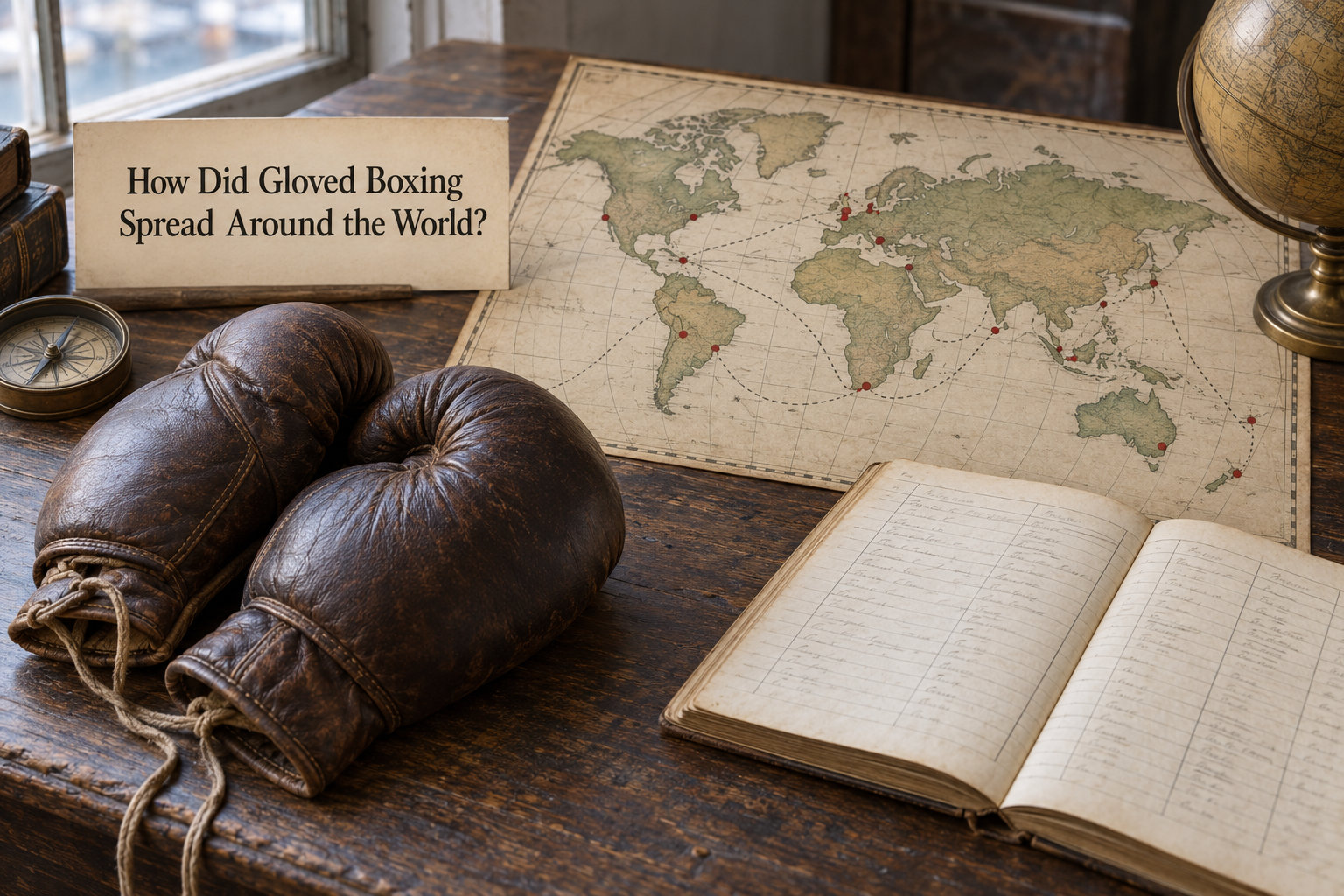
Glove rules travelled through institutions rather than individuals. The Amateur Athletic Association in London and then the Amateur Athletic Union in the United States ran amateur competition under the glove clause, which meant that clubs, colleges and local associations trained people in gloved technique before those people ever fought professionally. Lonsdale, the London rules body, and Lloyd’s of London both moved in the 1890s, giving the glove rules a formal home in British boxing.
Championship promotion did the rest. Once a gloved world title was worth money, promoters had a reason to build bouts around it, and newspapers across Britain and America carried reports and illustrations that made the new rules legible to readers who had never seen a glove. Periodicals such as Punch turned the shift into politics and theatre, treating the padded fist as both safety measure and foreign influence.
Local bodies filled in the details. Weight divisions, round counts, timekeeping and the size of the glove were all set by whoever sanctioned the bout, which is how a fairly uniform sport grew out of thousands of local decisions. Bare-knuckle fighting stayed alive as a spectacle on the stage and at unlicensed matches even as the recognised championship standard moved to gloves.
Why Does Bare-Knuckle Boxing Still Exist?
Modern bare-knuckle boxing is not a return to the old prize ring. It is a different sport with a different risk profile, and conflating the two is the most common error in the modern conversation.
In the old era, championship fights meant unprotected fists, rounds running to sixty or more, and a knockdown followed by a full minute count on the floor. Today’s bare-knuckle rulesets use small gloves or open-finger wraps, short two-minute rounds, a limited number of rounds, and in many cases standing eight counts instead of knockdowns. Fighters are typically required to land a certain amount of legal offence, so a passive fighter loses on the cards.
The promotion side grew fast. BKFC was founded in 2016 and gave the format television exposure, with Triller running its own version alongside it. State athletic commissions started licensing the sport around 2017, and Pennsylvania’s approval of its first sanctioned bouts, held in Philadelphia, extended that list. Fighters now arrive from mixed martial arts, kickboxing and amateur boxing, which is why BoxRec forum regulars point to figures such as Kimbo Slice as the bridge between the two forms.
The appeal is straightforward. Fighters see it as the version of their sport with the padding taken out, and audiences see a contest that looks more honest and more dangerous than the standard gloved card.
What Legacy Did the Change Leave?
What the glove rules produced is the sport we recognise today: a standardised ring, weight classes, fixed rounds, a scorecard, and a technical vocabulary built around defence, the clinch and body punching. None of that arrived at once, and a lot of it was carried over from bare-knuckle technique rather than invented fresh.
Two corrections are worth making, because both are repeated constantly. The Marquess of Queensberry did not invent the boxing glove. Hand protection is ancient and padded mufflers were in use for sparring well before his clause. And gloves did not solve the safety problem. They cut down bleeding, eye damage and broken hands; they did not reduce the force travelling through the skull, which is why concussions remained the central safety issue in the modern ring.
So did the change represent progress? Partly. It extended careers, reduced grotesque facial injuries and made the sport watchable and governable at scale. It also created a lasting split, where glove sport and bare-knuckle boxing sit side by side as separate traditions with different rules, different risk and different audiences. Neither has ever replaced the other.
Frequently Asked Questions
Who invented boxing gloves?
No single person invented the boxing glove. Hand wraps are ancient, and padded leather mufflers were used in sparring by Jack Broughton by 1743. The Marquess of Queensberry’s rules, written in the mid-1860s, wrote gloves into amateur competition, and John L. Sullivan’s 1892 gloved title fight is what made them normal in championship boxing.
When did boxing gloves first become legal in prizefighting?
Gloves were legal well before they were mandatory. Broughton’s 1743 code accepted them in matched fights in Britain, and a bout in France in 1818 was recorded with padded gloves. They became compulsory in recognised championship boxing under the Queensberry rules adopted in 1892, after professionals had ignored the earlier amateur clause for roughly thirty years.
Why did bare-knuckle boxers originally refuse to wear gloves?
Culture, mostly. A padded fist was read as a hiding place, and champions risked their standing and their crowds by appearing to need protection. Early gloves were also bulky and poorly fitted, so many professionals preferred the bare hand for power and for the reputation that came with it.
Did boxing gloves make matches safer?
They made matches safer in a specific way. Gloves sharply reduced cuts above the eye, ear injuries and broken knuckles, which extended careers and made fights governable. They did not reduce the force passing through the skull on a clean head shot. Most safety gains since came from rounds, weight limits, the count, and the ringside doctor rather than from padding.
What is the difference between boxing gloves and modern bare-knuckle gloves?
Modern bare-knuckle rules allow only very small gloves or open-finger wraps, so there is little padding and the punch is thrown differently. Those rulesets also use short rounds, a fixed round count and often standing eight counts instead of knockdowns. The old prize ring was unprotected fists with up to sixty rounds and a full minute on the floor.
Conclusion
Boxing gloves emerged from practical need, were proved in sparring and in public fights by champions willing to risk their reputation, and were finally written into the rules of championship boxing once governing bodies decided that standardised equipment beat bare-knuckle chaos. Nothing about that was sudden, and the thirty-year gap between the rules existing and the gloves being normal explains most of the confusion people hit when they look this up.
The same pattern continues today. New formats, new gloves and new limits get argued over for years before anyone settles on them, and the bare-knuckle revival shows there is still no agreement on how much protection a fight actually needs.