
Boxing matches are scored with the 10-point must system: three ringside judges score every round, giving 10 points to the fighter they scored it for and 9 or fewer to the opponent. Those round scores are added up at the end of a bout, and the fighter who wins the most rounds on the most judges’ cards takes the decision. Understanding how boxing scoring works comes down to one question per round: who did more of the right things for longer?
The tricky part for newcomers is that nobody is counting punches. A judge is not tallying landed shots on a clipboard, they are comparing two fighters’ overall quality of work over three minutes. That is why a fighter who throws far more punches can lose, and why a fighter who barely gets hit can still get dropped.
Table of Contents
- How Boxing Scoring Works: The Basic Point System
- How Do Boxers Earn Points?
- What Do Boxing Judges Look For?
- What Happens After a Knockdown?
- How Do Deductions Affect the Score?
- How Do Boxing Scorecards and Decisions Work?
- What Is the Difference Between Professional and Amateur Boxing Scoring?
- Frequently Asked Questions
- Conclusion: What to Watch First When Following a Score
How Boxing Scoring Works: The Basic Point System
The core rule is called the 10-point must, and it works like this. The judge who scored a round better gets 10 points. The other fighter gets 9. Nobody receives less than 9 unless something happened in the round, such as a knockdown or a foul.
The name comes from the obligation it places on the winner of each round: they must be awarded 10. Without that rule, a judge could hand out a strange total and the arithmetic would break. The scale starts at 9 for the loser of the round because one clear point of superiority, by the standards judges use, is the smallest gap they can describe.
Those standards are deliberately coarse. Judges are not measuring fractions of a round. They are deciding which fighter controlled the three minutes more convincingly.
| Round score | What it means | When it happens |
|---|---|---|
| 10-9 | One fighter clearly did more | The standard score for almost every round |
| 10-8 | Dominance, no knockdown needed | A fighter was dropped, or was given a 10-point count |
| 10-7 | Near-shutout | A knockdown plus heavy punishment in the same round |
| 10-10 | Even round | Judges feel the round was genuinely level |
| 10-6 | Maximum deduction | A foul so severe it is treated as worth several points |
Professional boxing and amateur boxing both use this scale, but they arrive at round scores in completely different ways. Amateur judges do count each landed action; professional judges do not.
| Feature | Professional | Amateur and Olympic |
|---|---|---|
| Headgear | None | Required |
| Gloves | 8 oz to 10 oz, larger for heavier divisions | 10 oz to 12 oz |
| Round length | 3 minutes, with the first and last round often cut to 2 | 3 minutes |
| Rounds | 12 for titles, fewer for shorter bouts | 3 |
| How points are awarded | Judge compares overall work and assigns 10-9 or lower | Each clean punch is counted and added to a total |
| Scoring sheet | Ten for the better fighter, nine for the other | Numerical totals, e.g. 39 to 37 |
How Do Boxers Earn Points?
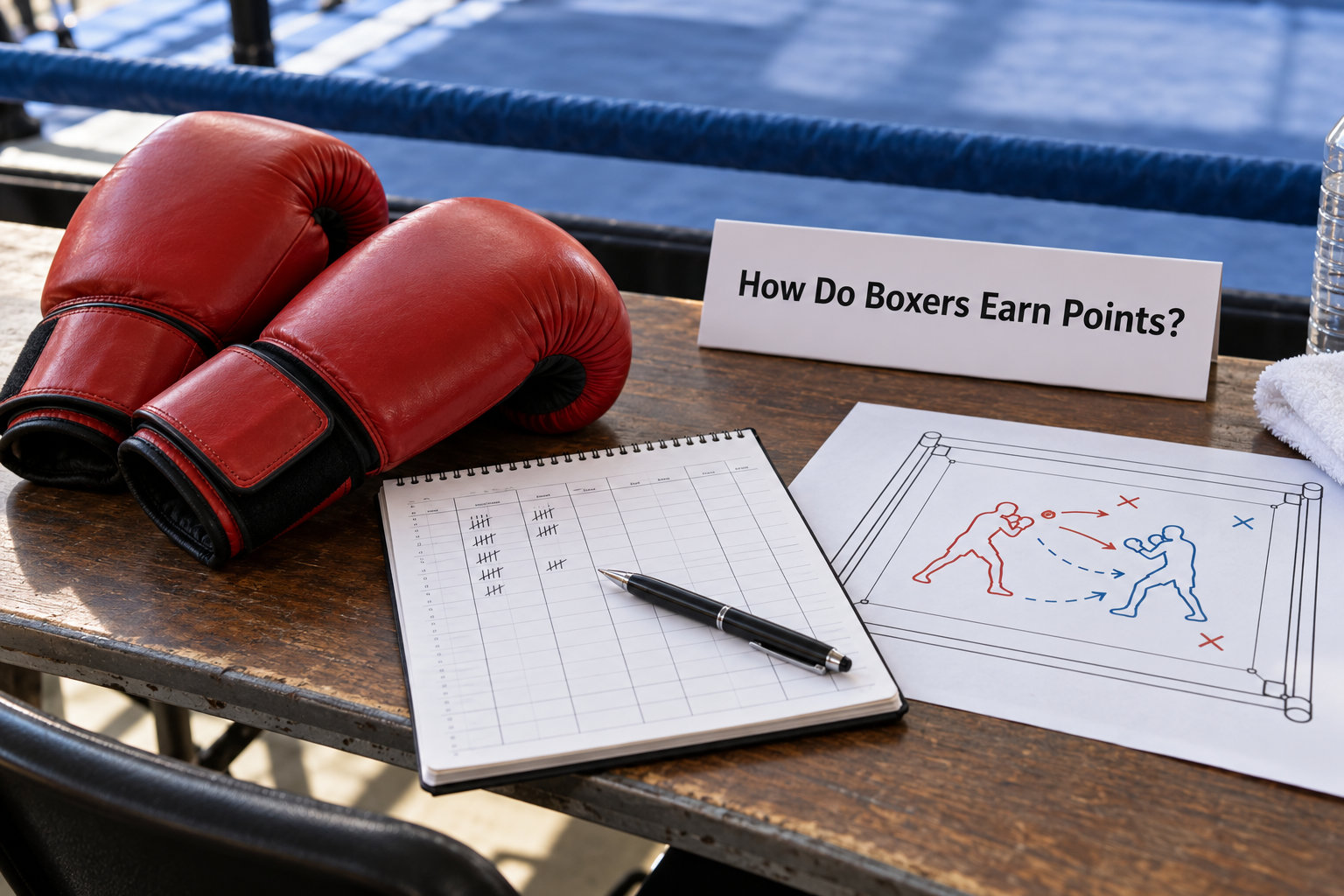
Points come from quality, not volume. A jab that snaps the opponent’s head back and a jab that lands on his gloves while he is already backing up are both shots, but only one of them does anything.
Here is how boxing scoring works in practice, round by round, with the kinds of exchanges judges reward.
How clean punches outrank landed ones
A punch lands clean when it reaches its target with the knuckle part of the glove, with the shoulder and hip behind it, and with the opponent’s head or body not already turning away. It has to hurt, or at least look like it does. Three weak shots that the fighter blocks with both gloves will never outscore one shot that snaps the head sideways.
How combinations build a round
Judges respond to punches that force reactions. A jab to the body followed by a straight left that the opponent cannot get out of the way of is worth more than the same two punches thrown two minutes apart. Combinations show that a fighter is dictating the distance and the pace, and that is the core of how boxing scoring works.
A counter is the clearest example. When a fighter absorbs a jab, slips it and answers with a hook that lands as the opponent’s hand is still coming back, that punch carries more weight than a routine jab, because it punished an obvious mistake.
Why defense earns credit
Slipping punches, blocking without getting hit, moving off the ropes and making the opponent miss all count. The old idea that boxing is about hitting and not getting hit is the standard fans come away with, and it is close to what judges are doing. A fighter who is missing everything may out-work the other fighter all night, and that can hold a round even without damage.
Pressure also counts, but only when it produces something. Backing someone to the ropes and throwing twenty punches while the opponent covers up and escapes is not effective aggression, because nothing came of it.
What Do Boxing Judges Look For?
Judges work from four named criteria, and every rulebook version of the sport lists them in the same order.
- Clean punching: accurate, correctly delivered shots with power and precision, landing on the target rather than on gloves or forearms.
- Effective aggression: pressure that achieves something, whether that is a landed shot, a knockdown, or forcing the opponent to give ground.
- Ring generalship: controlling the fight, dictating the distance, cutting off the ring and deciding where the action happens.
- Defense: avoiding punches, making the opponent miss, and not getting caught.
On top of those four, judges also watch how a fighter adjusts during the contest. Corner instructions between rounds are not scored, but what happens after them is. A fighter who fixes the cross he was eating in round four and stops eating it in round six will find that reflected on the card, because the judge watched the same thing happen.
Judges are seated at ringside on the apron, one on each side plus one at a neutral corner, usually with a commission representative nearby. They work alone. They do not confer during the fight, and they are given no statistics, no punch counts and no replay feeds unless the rules of that specific bout allow it.
How judges are appointed varies by state commission and country. In the United States they are licensed by the commission that governs the event, and a bout can be assigned several months ahead. It is not unusual for one official to work a single card and another to never appear at that venue, which is one reason fans sometimes believe the home crowd plays a role. There is no evidence that venue influences scoring, but there is no way to rule it out when the judge pool is unfamiliar to you.
What Happens After a Knockdown?
A knockdown changes the arithmetic of the round immediately. The fighter who was dropped is given a 10-point count if the referee believes he cannot continue safely, and the round is scored 10-8 or lower regardless of what else happened.
Some fighters object to 10-8 rounds where nobody was dropped, and the confusion is understandable. It happens when a fighter is so clearly overpowered that a judge takes the liberty of widening the gap. The scale allows it; it is uncommon and it should not be your default expectation.
Once a fighter is down, the referee begins a count of one through ten. The count is not a fixed number of seconds, it is how quickly the referee can reach and count to ten. There is no minimum count and no maximum count either, a referee who believes a fighter will never get up may wave the fight on without completing it. What matters to the judges is the fighter’s condition, not how many the referee got to.
If the fighter rises before ten, the round continues and the knockdown stays on the card. If he does not, the fight is stopped. That is the difference between a knockdown and a stoppage: one fighter was dropped and got back up, the other was dropped and the contest ended.
There is also the three-knockdown rule, which under the unified rules can end a bout on the third knockdown in the same round, or on the second in some jurisdictions. Whether the rule applies depends on the governing commission, so fans should check the specific rules before a fight rather than assume.
How Do Deductions Affect the Score?
Fouls are the other thing that moves points off a scorecard, and they get less attention than they deserve. Judges score what the referee reports, so a foul that the referee misses has no effect on the card at all.
- Low blow: the most common foul with a real scoring consequence. A referee who rules it accidental sends the fighter to a neutral corner, the round is restarted, and judges may deduct a point.
- Headbutt: frequently treated more severely than a low blow because it is difficult to prove intent during the action. A single headbutt has ended more than one title fight.
- Holding or pushing: usually a warning first. Repeated holding costs a point, and judges do deduct points for it.
- After the bell: hitting after the round has ended can bring a disqualification rather than a deduction.
- Disqualification: when a foul is severe enough, or when a fighter is unable to continue and the bout cannot be safely resumed, the result can be recorded as a loss by disqualification with no scorecards at all.
Deductions matter most in exactly the situations fans care about most. A one-point drop turns a 10-9 round into a 10-8 round, which can flip a close card. If two judges deduct a point in the same round, the fighter who was fouled is now down two rounds on those cards, and no amount of punching well recovers it.
The floor is 10-6, which represents multiple deductions in a single round. It is used when a fighter is behind badly and the referee keeps stopping the action to penalize fouls.
How Do Boxing Scorecards and Decisions Work?
Each of the three judges writes a card during the fight and signs it before it is read. The scorekeeper collects them, checks the arithmetic, and hands them to the announcer, who reads one judge at a time so nobody hears a running total until the end.
A 116-112 decision means one judge scored 116 points for the winner and 112 for the loser across 12 rounds. Read it round by round, that fighter won eight rounds and the opponent won four, every round being scored 10-9. The same arithmetic explains most cards you will see, because 116-112 and 115-113 are both 228 total points, which is 12 rounds at 19 points each.
| Round | Judge A score | Round | Judge A score |
|---|---|---|---|
| 1 | 10-9 fighter B | 7 | 10-9 fighter B |
| 2 | 10-9 fighter A | 8 | 10-9 fighter A |
| 3 | 10-9 fighter B | 9 | 10-9 fighter B |
| 4 | 10-9 fighter B | 10 | 10-9 fighter B |
| 5 | 10-9 fighter A | 11 | 10-9 fighter A |
| 6 | 10-9 fighter B | 12 | 10-9 fighter B |
Totals: fighter B 116, fighter A 112.
A 114-114 card is the same arithmetic landing on even. Six rounds each, every one of them a 10-9, and the fight is a draw.
The five ways a fight ends on the cards
- Unanimous decision: all three judges picked the same fighter. Overwhelmingly the most common outcome.
- Majority decision: two judges picked the winner and the third scored it level.
- Split decision: two judges picked one fighter, the third picked the other.
- Unanimous draw: all three scored the bout level.
- Split draw: one judge scored a draw, the other two disagreed on a winner.
No contest and technical decision are separate outcomes rather than scoring results. A no contest usually follows a bout stopped for a foul severe enough to protect a fighter, and nobody wins. A technical decision is recorded when a fighter cannot continue, most often because of a cut, and the judges score the rounds completed up to that stoppage.
Why one round can flip a result
Close rounds are called swing rounds, and they are where cards are decided. If a fighter leads on the cards going into the final three minutes and loses two of them, the lead can evaporate. This is why fights regularly change style in the last round of a championship, and why a fighter who is clearly ahead sometimes gets dropped while defending a lead and loses everything in the last ninety seconds.
Most commissions now use open scoring, where each judge’s running total is announced after rounds four and eight. It was introduced to cut down on the arguments that end after the cards are read. Fans who dislike it argue it pressures judges toward the fighter the crowd has decided is winning, and it has been debated for years, including by the major sanctioning bodies, without being settled.
What Is the Difference Between Professional and Amateur Boxing Scoring?
The distinction is the single most useful thing for a new fan to hold on to. In professional boxing, judges compare two fighters and assign 10 and 9. In amateur boxing, judges count punches and add them up.
Amateur scoring rewards volume in a way professional scoring never does. A fighter throwing a high number of clean shots with little power can win an amateur bout comfortably. In professional boxing that same fighter would get hit harder, hurt more often and lose the decision, because punch count is not one of the criteria.
Amateur bouts are three rounds of three minutes with headgear and larger gloves, and every scoring punch is credited with a value that depends on which part of the body it landed on. Three judges work independently in most competitions, and a bout is scored out of 100 points rather than out of 120, with each round carrying a maximum of 30.
Which system a fighter should build for depends on the plan. A boxer heading to the Olympics optimizes for clean volume over three rounds. A professional has to survive pressure and rounds nine through twelve, and the scoring follows that requirement.
Frequently Asked Questions
What does 116 to 112 mean in boxing?
It is the winning fighter’s total score followed by the loser’s, as recorded by one judge across 12 rounds. A 116-112 card means the winner was scored 10-9 in eight rounds and 9-10 in four, since 12 rounds at 19 total points equals 228. The same judge wrote and signed that card independently of the other two judges in the ring.
Why is boxing scored 9 or 10?
Because the 10-point must system treats 10 points as owed to the fighter who did the better job in a round, and the other fighter receives one point less. The loser of a round never drops below 9 unless a knockdown or a foul happens in it, at which point the gap widens to 10-8, 10-7 or lower. The scale is deliberately coarse because judges cannot measure fractions of a round.
How do they count punches in boxing?
In professional boxing, they do not. Judges never tally landed shots, and punch statistics published by broadcasters are produced separately by tracking systems and play no part in the decision. Judges score clean punching, effective aggression, ring generalship and defense. Counting individual actions happens in amateur and Olympic boxing, where each landed punch is credited and added to a total.
What does 1, 2, 3, 4, 5, 6 mean in boxing?
It is the referee’s count of a fighter who has been knocked down, used to decide whether that fighter is able to continue. The count runs to ten and the referee waves it on at whatever number the fighter rises, or stops the contest if ten arrives first. It is not a fixed number of seconds, and the count is separate from the judge’s 10-point difference.
What is a split decision in boxing?
A split decision means two judges scored the fight for one fighter and the third scored it for the other. It is the most questioned outcome in the sport because the three cards are written independently, no judge explains a reasoning, and a single round given the wrong way can be enough to create it. Reading the three cards round by round usually shows one or two contested rounds that produced it.
Conclusion: What to Watch First When Following a Score
Boxing scoring works because it forces a comparison every three minutes instead of a running punch tally. When you watch a round go into a scorecard, look for one thing first: whose punches made the other fighter react.
Watch the quality of the shots rather than the number of them, notice whether the pressure is producing anything, and track what each fighter does after being hurt or after a corner change. Knockdowns and deductions will move a card far more than anything else, so those are the moments to mark down round by round. Over twelve rounds, that pattern is the decision.