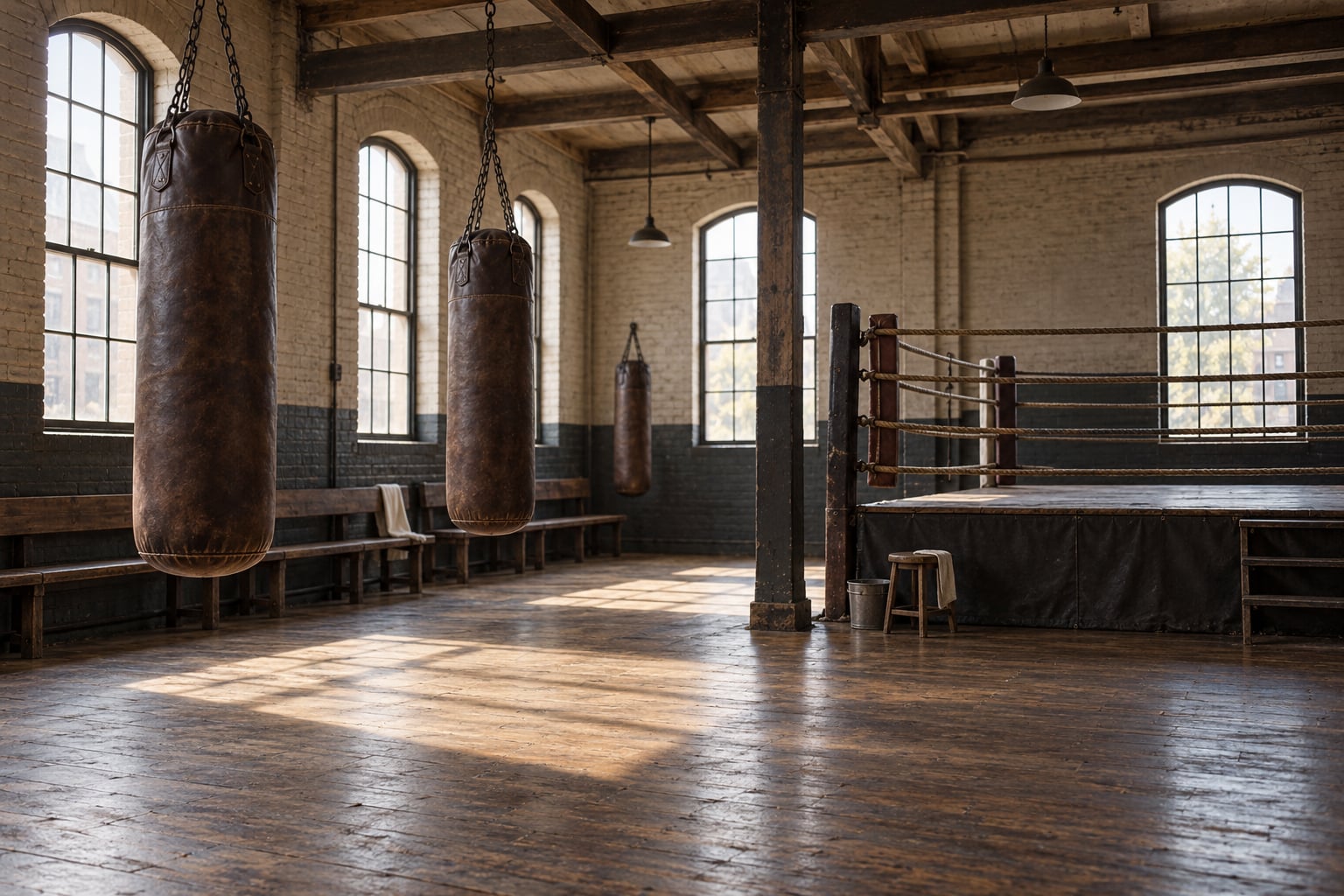
How boxing gyms looked a century ago is easier to describe than you might expect: a 1920s boxing gym was usually one corner of a shared gymnasium, with a bare wooden floor, canvas punching bags swinging from ceiling hooks, a rack of Indian clubs, dumbbells and skipping ropes, and a roped ring pushed against a wall. There were no speed bags in any quantity, no focus mitts, no interval timers and no wall of mirrors. What filled the room instead was noise, chalk dust and other people’s workouts happening at the same time.
That short answer holds well for metropolitan clubs, YMCA gymnasiums, ethnic community clubs and the odd upstairs room over a shop. It holds less well for the private camps and hotel training rooms where champions worked behind closed doors, which looked nothing like a neighborhood gym. What follows covers what those rooms actually contained, what the photographs of them do and do not prove, and how to check the ones you find yourself.
The honest version of this history is messier than a single photograph, and that turns out to be the interesting part. What follows separates what the evidence supports from what we tend to assume about the era.
Table of Contents
- How Boxing Gyms Looked a Century Ago: A Quick Guide
- Which Period in the Title?
- What Did Training Rooms Contain?
- How Boxing Gyms Looked a Century Ago in Period Photographs
- How Did Fighters Dress and Train?
- What Was the Atmosphere Like?
- How Different Were Major Clubs, Neighborhood Gyms, and Private Camps?
- What Survives From Those Gyms Today?
- Frequently Asked Questions
- Conclusion
How Boxing Gyms Looked a Century Ago: A Quick Guide
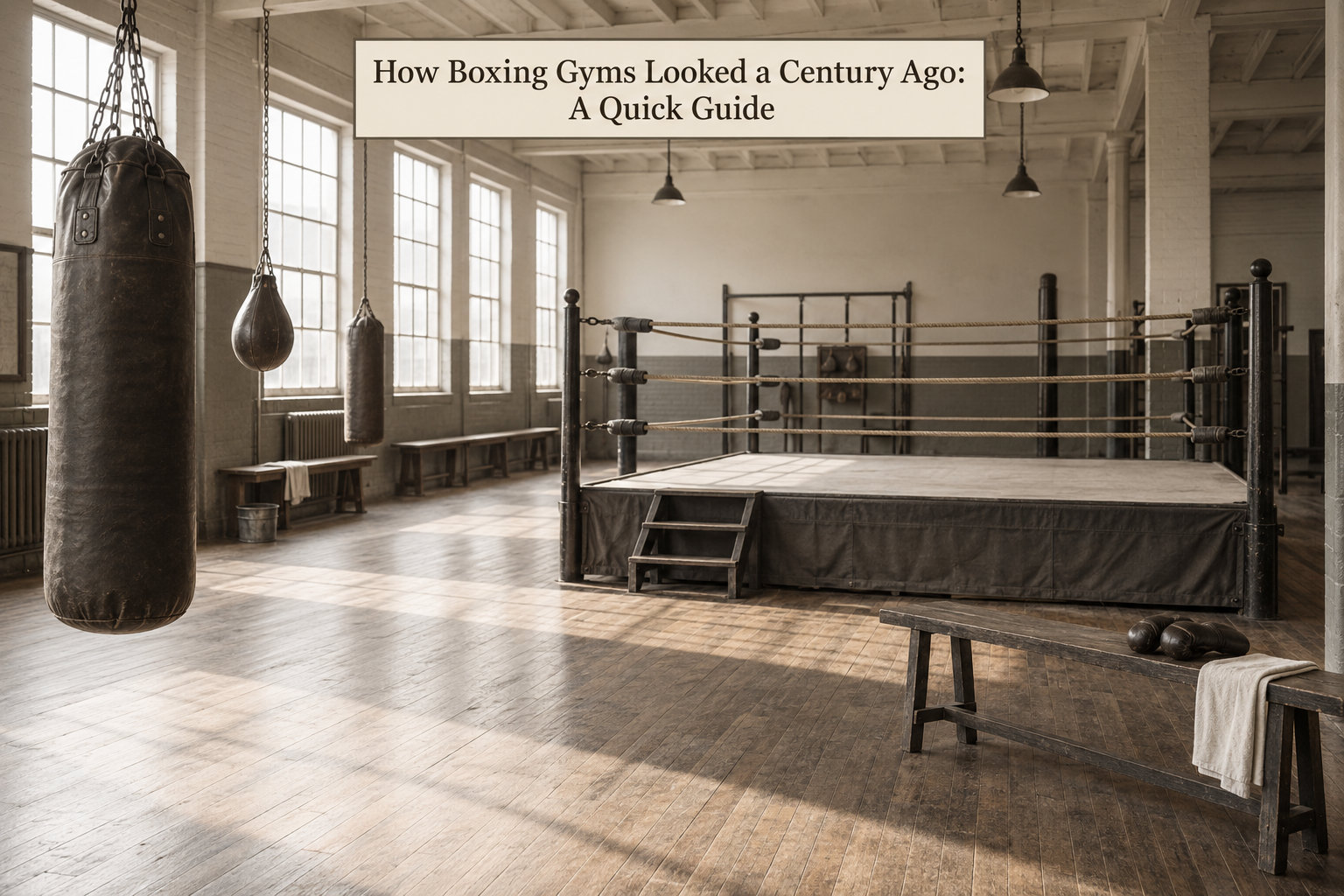
The five features that show up in nearly every credible period image are: a ring, hanging bags, wooden apparatus, a shared room, and almost nothing that needs a plug.
The last point matters more than it sounds. Electrical light existed in a fair number of municipal gymnasiums by the 1920s, but the fixtures were sparse, high up, and shaded. Rooms that look evenly lit in period prints were often lit by a bank of windows plus a handful of bulbs, and a working photograph is a posed thing.
1920s boxing gym at a glance
- The room was usually shared with gymnastics, basketball, weightlifting and track work, not given over to boxing alone.
- Floors were varnished hardwood or, in basements, concrete sealed with oil. Canvas on the ring floor, wooden ring frame, sagging ropes.
- Bags were leather or heavy canvas, hung on chains or short ropes from beams and wall brackets, often with the floor scuffed beneath them.
- Conditioning came from skipping rope, road running, callisthenics and Indian clubs rather than from machines.
- Work was run in informal rounds called out by the trainer or counted, not by a bell and a clock.
- Hot showers, cold plunges and a locker room were where the money went, when there was money at all.
- Gloves existed and were commonly worn for bag work and sparring, but they were not the padded 8, 10 and 12 ounce gloves most people picture.
| Feature | Common in the 1920s | What period evidence can support |
|---|---|---|
| Ring | One per room, often in a corner or against a wall | Strong: rings are unmistakable in photographs and club records |
| Heavy bags | Leather or canvas, chain-hung, scuffed floor below | Strong: visible in almost every gym interior photo |
| Speed bags | Rare, mostly in larger clubs | Weak: absence in a photo may mean it is out of frame |
| Focus mitts and pads | Not part of the standard kit | Strong by absence across multiple dated images |
| Mirrors | Uncommon in the boxing room | Moderate: gymnasium mirrors belonged to the drill hall |
| Timers and bells | Trainer or count, not a clock | Strong from coaching manuals and memoirs |
| Floors | Hardwood or concrete, varnished or oiled | Strong: floor surface is visible in most room shots |
| Showers and cold plunge | Where the money was spent | Moderate: often documented in YMCA annual reports |
The last column is the part most retellings skip. A photograph reliably tells you about floor, bags and ring. It tells you very little about the corners outside the frame, the entrance, the changing rooms, or what happened in the room the morning the picture was not being taken.
Which Period in the Title?
“A century ago” here means roughly the 1910s through the 1930s, with the 1920s carrying most of the surviving photographs. Boxing did not stand still across that span, and it did not look the same in every country.
Regulation changed underneath the sport the whole time. In the United States, boxing was effectively banned around the turn of the century, and New York’s Walker Law in 1920 is usually treated as the moment prizefighting became legal again in the state. Amateur boxing under the Queensberry rules ran alongside it, on lighter gloves, shorter bouts and strict weight classes. A London club, a Chicago amateur gym and a New York professional gym were three different institutions, not regional variants of one.
So any photograph of how boxing gyms looked a century ago needs a date and a location before it is worth much. An undated gym print is a mood, not a source.
What Did Training Rooms Contain?
The standard inventory is short, and it is worth separating the items we can document from the ones we simply expect to find.
Well-evidenced across many dated images and club records: a boxing ring with a canvas floor, wooden posts and ropes that dipped as the canvas settled; hanging punching bags, leather where the club could afford it and heavy canvas where it could not; Indian clubs on a wall rack; adjustable dumbbells and barrel weights; skipping ropes hung on hooks or coiled on benches; parallel bars and a horizontal bar; a stool or two in the corner; towels over a rope; and a bucket or barrel of water.
Consistently absent or rare: wall mirrors in the boxing room, focus mitts, a bank of modern heavy bags, treadmills or any aerobic machine, rope-and-pad work, and any electronic timing device.
A word on Indian clubs, because photographs of them cause confusion. A pair of turned wooden clubs with a weighted shaft is not exotic equipment. Every gymnasium in the period had a rack of them for general physical culture work, and boxing clubs used them the way a modern gym uses a foam roller. Club records and annual reports list them as standard apparatus.
The corner of the room people rarely photograph is the washroom area. YMCA annual reports from the period repeatedly put money into showers, hot water and cold plunges, which tells you what members actually complained about.
How Boxing Gyms Looked a Century Ago in Period Photographs
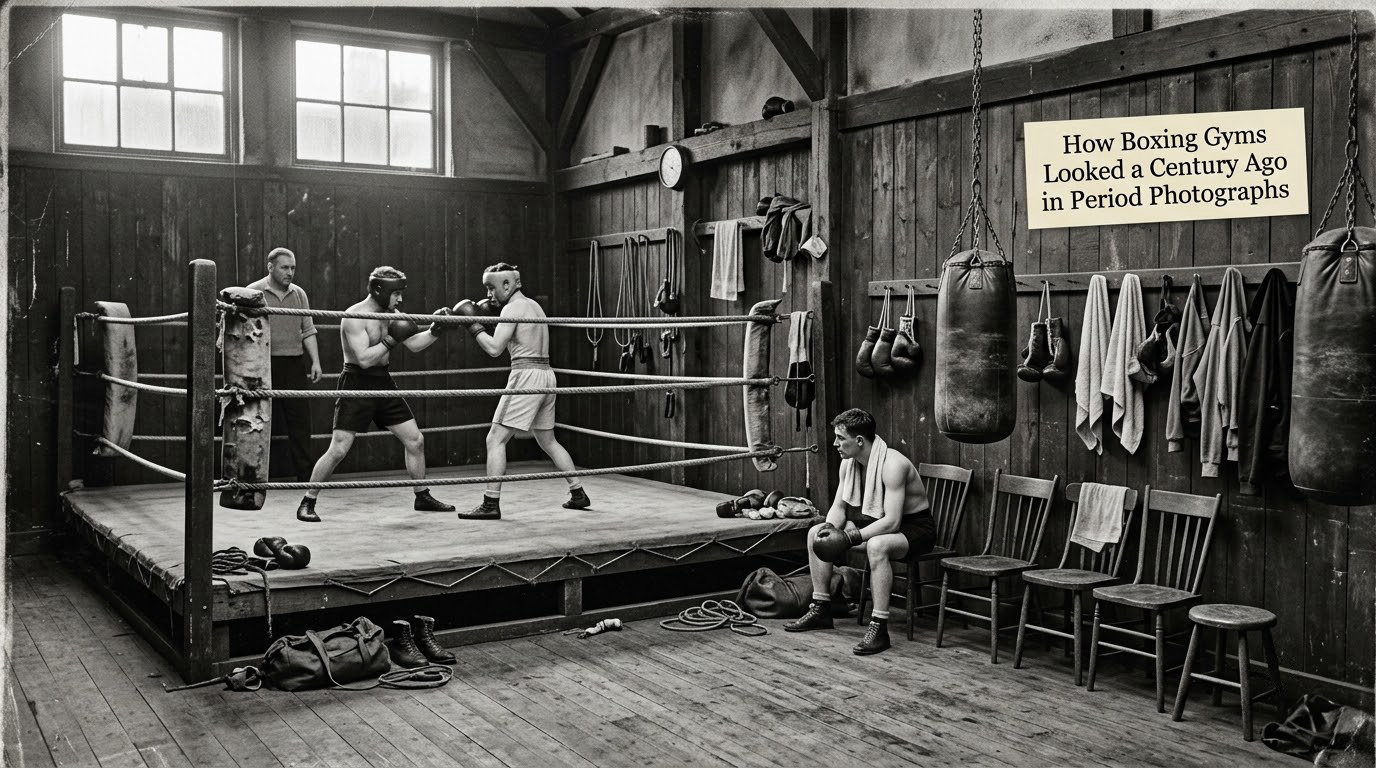
Three kinds of image come up again and again, and they show three very different rooms.
Major metropolitan clubs. Stillman’s Gym in New York and the Olympic Auditorium in Los Angeles are the two names that turn up most, and both were built for public events rather than for quiet training. Expect a bigger room, a raised or roped platform, seating, an audience and a working ring. These are the rooms behind the best-known photographs of Jack Dempsey, Gene Tunney and the fighters who trained around them.
Neighborhood and community gyms. These are the honest middle of the sport, and the hardest to photograph because nobody was hiring a photographer. An upstairs room, a YMCA gymnasium corner, a boys’ club hall or an armory drill hall. One ring, several bags, benches along a wall, wooden floor. Winnipeg’s YMCA branches on Vaughn Street and Selkirk ran exactly this kind of program, and a study mapping more than a dozen early twentieth-century boxing clubs there found they clustered in working-class districts, often near immigrant neighborhoods, and shared space with basketball, gymnastics and weightlifting.
Private or hotel training rooms. Title camps in the 1920s were frequently worked in a small rented room off a corridor, a hotel suite or a secondary floor nobody else was allowed into. Thin equipment, a single bag, no crowd, and a coach who controlled the door. This is the setting that produced a good share of the most quoted training anecdotes, and the one least likely to be photographed.
What a period photograph cannot tell you
Cropped and retouched prints hide more than they show. A camera held above a ring rope cuts off the storage corner where gloves and wraps lived. It excludes the entrance, where a hundred men could be waiting. It removes the changing rooms entirely, and with them the entire question of hygiene. Prints were often posed on a quiet afternoon, or hired out to a fighter with a good record rather than a typical member of the gym.
Period photographs are full of small traps, and readers on boxing forums fall into one constantly: they read a mismatched pair of gloves in a print as normal practice. Two different gloves on two different men in one frame usually means the picture was taken on a training day when not everyone was sparring that round, not that anyone was allowed to hit a bag in a saucepan.
How Did Fighters Dress and Train?
A working boxer in a 1920s gym wore ordinary working clothes: trousers, a shirt, sometimes a vest. Some trained in a singlet and some in a long-sleeved top. Shoes were the weak point in period photographs, and it shows, more shabby footwear on the floor than anywhere else in the room.
Hand wraps were standard. Gloves were standard for bag work and sparring by the end of the decade, which is the single most common misconception about the period, and it runs in the opposite direction from most modern writers’ assumptions. Bare-knuckle bag work is now sold as hardcore practice; in the 1920s it was ordinary, and gloves came back on during the session for contact.
Gloves themselves were the main change. Padded mufflers existed from the 1880s, compulsory gloves and glove weights were written into regulation through the 1920s, and the eight-ounce glove became the reference point a professional fighter worked to. Compared with today, gloves were small, thin and badly made, and fighters inspected them and had them replaced far more often.
A session ran by count, not by clock. The shape of a typical day, drawn from coaching manuals and the memoirs of fighters from the period:
- Road work and skipping. A run before or after work, then five or ten minutes on the rope before anything else.
- Shadowboxing. Done against the light, against a shadow on the wall, or simply in open floor, with no mirror to work off.
- Bag work. Three-minute bursts, counted aloud, alternating punching, knee and knee-to-head. Coach watched from a chair and corrected by name.
- Indian clubs and callisthenics. A fixed block of the session, not a warm-up afterthought.
- Sparring. Shared ring, several pairs at once, a coach calling the rounds. This was the loudest part of the afternoon.
- Weigh-in, then home. Many amateurs trained around a job and needed weight down the same evening.
Not every gym ran the order like that, and public demonstrations looked nothing like it. A benefit show or an exhibition for a visiting dignitary was short, staged, and worked to a schedule, with a fighter who might never have run five miles in his life standing in the spotlight.
What Was the Atmosphere Like?
Loud is the word that comes back from every account. Bags on chains, a room of wooden floors, several pairs sparring in one ring, someone skipping, someone clanging dumbbells, and a coach shouting over all of it. Add echoes in a high-ceilinged gymnasium and the effect was closer to a workshop than a studio.
Heat was the other constant. Hot weather made worse by poor ventilation, by a room full of working bodies, and by radiators or stoves running in a space built for exercise rather than comfort. It explains the open windows, the fans, the cold plunge, and the towel culture that looks excessive until you understand how much warmer the room was than the street outside.
Smell is the detail people mention when they write about it. Chalk and leather, sweat, rope tar, the dust that maple floors kick up when shoes pivot on them, liniment in the corner. The gym floor was varnished or oiled precisely because bare wood was slippery and a gym full of fallers needed a floor that could be wiped.
There was also a clear hierarchy inside the room. A prizefighter’s kit and corner took precedence, amateurs filled the rest, and the boys who hung around the edges were tolerated if they stayed out of the way and eventually got their turn. Membership was a social fact as much as an athletic one. In many cities boxing clubs were the first thing a newly arrived family found, and in some of them the club limited how many members of a given background it would take. A Winnipeg study found one such club capping Jewish membership at about five percent of its roster. It is a useful corrective to the tidy idea of the boxing gym as a universal open door.
How Different Were Major Clubs, Neighborhood Gyms, and Private Camps?
The three types were less variations on one gym than three separate businesses with three different clients. Comparing them is the fastest way to see why a single photograph cannot stand in for the whole sport.
| Major metropolitan club | Neighborhood or YMCA gym | Private camp or hotel room | |
|---|---|---|---|
| Who trained there | Ranked professionals, hopefuls, hangers-on | Amateurs, first-timers, working men and boys | One fighter, a coach, a few sparring partners |
| Room | Large, seating, platform, event-ready | Shared gymnasium corner, often multipurpose | Small rented room, sometimes one bag |
| Equipment | Full kit, more bags, better ring, showers | Rings, bags, clubs, dumbbells, rope | Whatever the fighter brought or hired |
| Coaching | Full-time trainer, second, manager, cutman | Volunteer or part-time coach calling the work | One coach, direct supervision |
| Crowd | Spectators, press, bettors at sessions and shows | Other members, families, walk-ins | Nobody |
| Membership dues | Highest dues; management and promotion central | Low dues, often subsidized by the parent organization | Arranged privately, often part of a contract |
| What it represents | Prestige, public boxing, prizefighting | Boxing as a civic utility, amateur competition | Boxing as solitary craft |
London-based clubs and American metropolitan clubs dominate the surviving image record for a simple reason: they had the photographers, the newspapers and the money to be photographed. A working-class club with forty members and no paid staff rarely left anything behind but a membership card.
What Survives From Those Gyms Today?
Very few famous rooms survive as they were, and most of those have been repurposed more than once. Main Street Gym in downtown Los Angeles ran for around sixty years before closing in 1984, and when it went it took an entire lineage of downtown fighters with it. The Olympic Auditorium still stands as a Los Angeles landmark, but as a concert and event venue rather than a working fight club. The original arrangement of any of these rooms has been altered repeatedly by later use, which is why period photographs, not buildings, are the better record.
What survives more reliably is paper and glass plate:
- Newspaper photo archives, which hold the posed and unposed shots together with captions that give a date, a club and often a name.
- YMCA and Boys’ Club annual reports and finding aids, which list equipment purchases, membership counts and facility spending.
- University and state archive collections. The University of Florida finding aid system, for instance, catalogues a set of twenty-one small black and white negatives of Stillman’s Gym in New York, including a note that the gym changed its name in the late 1920s.
- National libraries and museum collections, including large photographic archives that hold period boxing interiors with identified dates and locations.
If you want to check a photograph rather than repeat it, four questions close most cases. What is the date, stated in the caption or the archive record? Which city and which club? Who took it and for whom? Was it made on a training day, an event day, or a staged afternoon? A print with no club name in the record is decoration, not evidence, and even a well-dated one should not carry a claim about every gym in the sport.
One more caution, since old coaching advice gets quoted as fact. The claim that weightlifting made a boxer slow, so common among twentieth-century trainers, is a period myth and historians of the sport have pushed back on it for years. The gyms that survived the period were full of men lifting heavy iron in the same room as the ring. Where a trainer’s advice conflicts with what everybody in his own gym was doing, treat it as an opinion.
Frequently Asked Questions
What did a typical boxing gym look like around 1920?
Usually one corner of a shared YMCA or municipal gymnasium rather than a dedicated boxing room. Expect a bare hardwood or sealed concrete floor, a roped ring against a wall, leather or canvas punching bags on chains, a rack of Indian clubs, dumbbells, parallel bars and skipping ropes, benches, and little else. Shelling out for hot showers and a cold plunge was where club money went when there was money at all. No mirrors, no pads, no timers, no machines.
Did boxers in the 1920s always wear gloves when training?
No, but the popular belief is backwards. Gloves were standard for bag work and sparring by the end of the 1920s, and regulation made glove weights compulsory through the decade. Bare-knuckle bag work was ordinary practice, not a hardcore flourish, and modern gyms sell it as an intensity choice. Period gloves were small, thinly padded and poorly made, so fighters inspected and replaced them far more often than fighters do now.
How were 1920s boxing gyms different from modern gyms?
The biggest differences are conditioning, structure and amenities. Conditioning came from rope skipping, distance running, callisthenics and club work rather than machines. Sessions ran in informal rounds called out or counted by a trainer, with no interval timer and often several pairs sparring in one ring. Membership ran through YMCA branches, ethnic community clubs and boys’ clubs, so the room was more socially mixed and more local than a modern commercial gym with a membership fee.
Why do old boxing photographs often show famous clubs?
Because famous clubs had photographers, newspapers and money. A professional gym in a major city could stage and distribute a photograph of a ranked fighter, while a working-class club with forty amateur members left nothing behind but a membership card. So the image record is biased toward the places that were already documented, which is exactly why an undated or uncredited print should be treated as atmosphere rather than as a typical gym.
Where can readers find reliable photographs of early boxing gyms?
Start with newspaper photo archives, YMCA and Boys’ Club annual reports, and university or state archive finding aids, which usually record the date, the club and the photographer. National library and museum collections hold interior shots with full documentation, and commercial photo libraries hold dated period boxing interiors. When you find one, check for a date, a city, a club name and a named subject before you use it to describe the era.
Conclusion
A boxing gym a century ago was simpler, noisier and more socially mixed than anything purpose-built today. One ring, canvas bags, Indian clubs, a wooden floor, hot water if you were lucky, and a room full of other people working at the same time. What looks modern about it is mostly what got layered on later.
If you want to go further, start with a single dated photograph. Find out which club it was, which city, who took it and whether it was a training afternoon or a staged one. One properly sourced room beats any amount of atmosphere, and it is the difference between knowing how boxing gyms looked a century ago and merely imagining them.