Boxing judges score a round using the 10-point must system: three judges sit ringside, watch each round on its own merits, and award 10 points to the fighter they judge to have won it and 9 or fewer to the other. Most rounds end up 10-9.
Below that simple skeleton sits a much subtler judgement. Judges are not counting punches, they are weighing four things — clean punching, effective aggression, ring generalship and defence — and every one of those has a grey area. That is why a fighter can visibly land more and still be given two rounds.
This guide walks through what happens in a judge’s head during a 60-second exchange, how knockdowns and fouls move the numbers, and how a card like 116-112 is actually worked out at the end of a fight. Updated for 2026, it is written for new fans, for amateur fighters trying to understand why rounds get taken away, and for anyone who watched a bout and could not make the cards match what they saw.
Table of Contents
- What Is the 10-Point Must System in Boxing?
- How Does a Judge Award Points in a Boxing Round?
- How Boxing Judges Score a Round Using the Three-Judge System
- How Are Knockdowns and Fouls Reflected on a Scorecard?
- Professional vs Amateur Scoring: How the Systems Differ
- How Do Boxers Maximize Their Score with Judges?
- Frequently Asked Questions
- Conclusion
What Is the 10-Point Must System in Boxing?
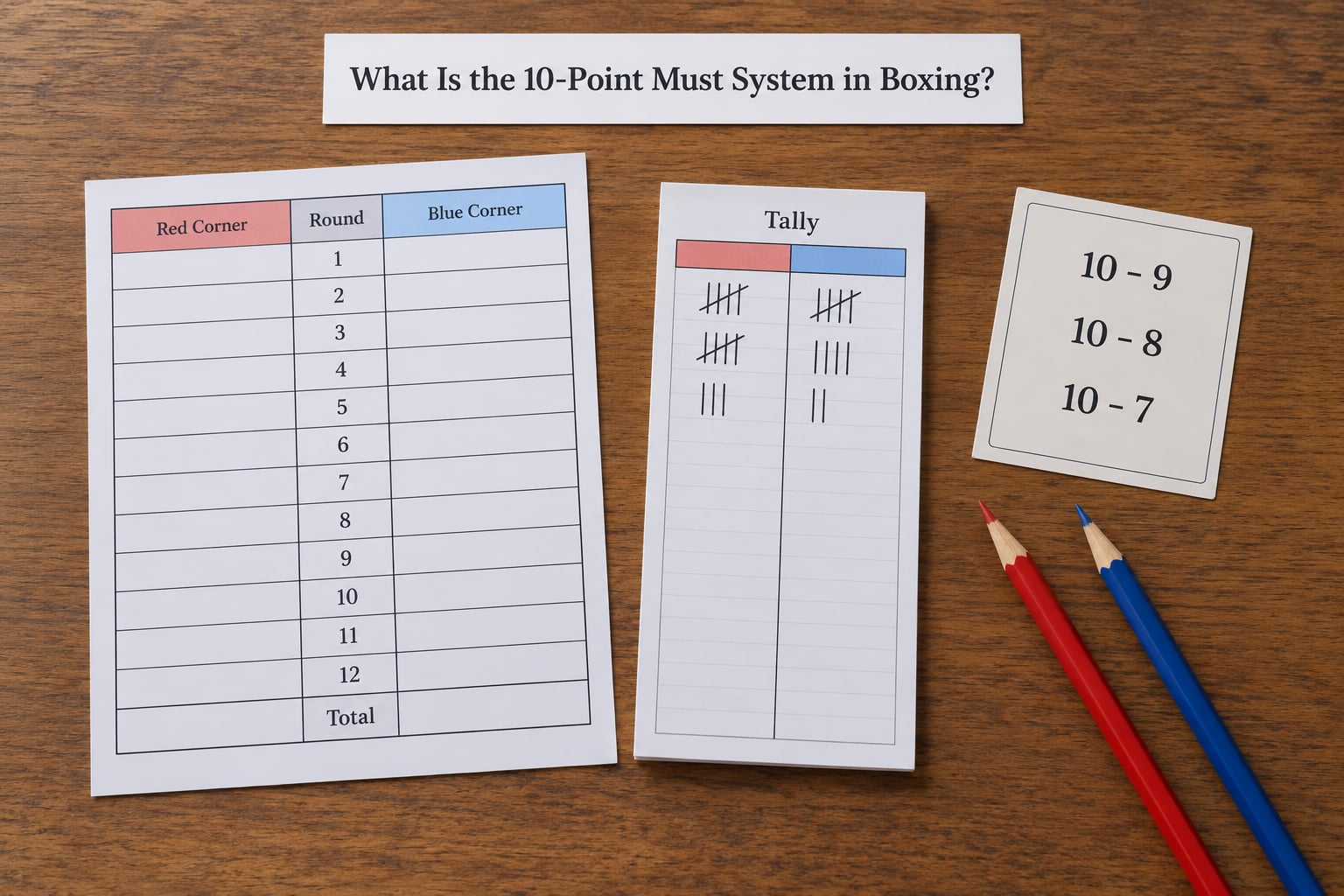
The 10-point must system is the standard scoring method used in professional boxing. Every judge must, in theory, award a maximum of 10 points to the fighter they consider the winner of the round. Nobody is permitted to give 11, and nobody may hand out a losing score of 10 to a fighter the judge thought dominated.
That “must” is the whole name. The winner of a round gets 10 because the judge has no choice. The loser gets 9, or fewer, depending on how lopsided the round was. When the judge finishes a round, the two numbers on the card are locked in — a 10-9 is a 10-9, and no later round can change it.
Because deductions stack on top of that baseline, the possible scores for a single round are few, and each one comes with a specific condition attached.
| Round score | What it means | When it is written |
|---|---|---|
| 10-9 | The ordinary round | One fighter is judged to have won the round cleanly, with no knockdown involved |
| 10-8 | One knockdown | The losing fighter was knocked down once, or the judge felt the round was one-sided enough to drop an extra point |
| 10-7 | Two knockdowns | The losing fighter went down twice in the same round |
| 10-6 | Three knockdowns | Rare, and usually the end of the fight rather than a completed round |
| 10-10 | An even round | A judge may record a round as even, and both fighters are then given 10 |
The system is also the reason boxing decisions look so close. If three judges each score twelve rounds, and most rounds differ by only one point, the margin on any decent contest is a couple of points across a whole fight. A fighter can look like he dominated for nine of twelve rounds and still lose the decision on the strength of three.
Rounds themselves vary by sanctioning body and event, but professional championship boxing most often runs twelve three-minute rounds, with title fights occasionally extended to twenty-four. Tournament formats on the amateur and women’s circuits regularly use shorter bouts, and the scoring has not changed with them.
How Does a Judge Award Points in a Boxing Round?
A judge works from four criteria in a fixed priority order. Clean punching is first, because the sport has always been decided by what lands, not by what is thrown.
- Clean punching. Number and quality of landed blows, judged from the position ringside rather than from a punch-count readout. A looping hook that lands on the shoulder is not worth what a jab on the chin is worth.
- Effective aggression. How often and how purposefully a fighter attacks. Pressing forward with nothing landing scores worse than absorbing pressure while landing the counter that ends the round.
- Ring generalship. Control of distance, tempo and position. Standing on the wrong side of a fighter, chasing rather than cutting, or getting pushed onto the ropes for most of a round all cost points.
- Defence. Slipping, blocking and parrying are credited, because a fighter who is hard to hit forces the opponent to work for everything. Constant retreat is not credited — that is running, not defence.
The 80/20 rule sits underneath all four of them. It is not written into the rulebook as a formula, and no judge carries a counter, but the guiding idea is that roughly 80% of a fighter’s output should be competitive and 20% can be harmless. Throw a hundred punches and land fifteen of them and you have almost certainly lost that exchange, no matter how busy you looked.
What judges do not reward
Volume alone, clinching to break momentum, showboating after a clean shot, and swinging wildly from the hip all cost more than they earn. Flash knockdowns and wild flurries are the classic example: a flurry can look spectacular and score nothing.
This is the single biggest source of frustration among fans. Forum threads on r/Boxing and r/amateur_boxing repeatedly raise the same complaint — a fighter who outlands his opponent round after round still gets the rounds lost, and nobody can tell from the broadcast exactly why. The answer is usually that the outlanding fighter’s punches were short, off-target, or dumped into a clinch, while his opponent’s were fewer and cleaner.
How Boxing Judges Score a Round Using the Three-Judge System
Every professional bout has three judges seated at ringside, each with a scorecard, a pencil and an unobstructed line of sight to the action. They score independently. There is no consultation, no conferring, and no mid-fight discussion — each judge forms and records their own numbers alone.
The mechanics during a round are repetitive. A judge watches from the first second of the bell, forms a running impression, and by the time the round ends has already decided who won it and by how much. The score is written down before the next round starts, along with a brief note if the round was close or if a knockdown was involved. Nothing written in round three carries forward into round four.
At the end of the fight, the three cards are added up separately, and only then combined. That combination produces one of four official results.
| Result | What the three judges must agree on | What it looks like in practice |
|---|---|---|
| Unanimous decision (UD) | All three scorecards favour the same fighter | A 116-112 card, 116-112, 117-111 — same winner on every card, different margins |
| Majority decision (MD) | Two judges favour one fighter, one goes the other way or scores a draw | 115-113, 115-113, 114-114 |
| Split decision (SD) | Two judges favour one fighter, one favours the other | 115-113, 116-114, 113-113 |
| Draw | All three cards are even, or two draw cards and one goes either way | 114-114 on all three cards |
The referee runs the fight, not the scoring. The referee’s job is safety, enforcing the rules, stopping the contest when someone cannot continue and giving a count. When the referee assesses a foul, the scorekeeper deducts points on every judge’s card at once — a deduction is not a judge’s decision and cannot be split. Keeping those two roles apart is the fastest way to stop confusing a deduction with a 10-8.
How Are Knockdowns and Fouls Reflected on a Scorecard?
How boxing judges score a knockdown round
A knockdown is the single most powerful event in a round, and it is handled by deduction rather than by the judges writing new numbers. If a fighter is knocked down, the referee tells the scorekeeper, and a point is deducted from that fighter’s card for that round.
The math is straightforward and consistent. One knockdown costs one point. Two knockdowns in the same round cost two points, taking that round to 10-8 if the opponent was not also down. A fighter who goes down in a round but was clearly winning it before the knockdown can still find that round scored 10-9, because the deduction happens on top of the judging rather than replacing it. And if both fighters go down, neither fighter is normally deducted.
Flash knockdowns are where fights get disputed. If a fighter is caught by a shot he never saw, lands on a glove, brushes the canvas with a glove and is ruled down, the judges still take the deduction — they did not see it either, and a knockdown stands once the referee calls it. Fans see it as a gift. Judges simply apply the same rule to everybody.
Fouls work differently from knockdowns because they are the referee’s call. Punching on the break, holding, elbowing, pushing the head down with the glove and striking below the belt all draw a warning first, and a warning costs nothing. Once the referee decides a foul has been repeated, the scorekeeper is instructed to deduct a point from the offender, usually from the current round.
The practical distinction is this: a knockdown deduction is arithmetic once the referee calls it, while a foul deduction is entirely the referee’s discretion about severity. Neither is something a judge can decide on their own card.
Why Can Two Judges See the Same Fight Differently?
Because they were watching different fights. Two judges seated apart see punches from different angles, and a hook that looks like a clean landing on the near side can look like a miss on the far side. Judges also weight the four criteria differently — one may value defensive work heavily, another treats it as neutral.
Fighter style magnifies it. A pressure fighter and a counter-puncher can produce a genuinely even round that leans one way for a judge who rewards work rate and the other way for a judge who rewards clean returns. Momentum compounds it too: a round that swings hard in the final 30 seconds can be written up two different ways, and there is a persistent belief among observers that judges drift toward giving later rounds to whichever fighter looked better closing them out.
None of this means one judge is wrong. It means the system is built on human evaluation, which is why every sanctioning body keeps a formal process for reviewing and scoring the judges themselves.
Professional vs Amateur Scoring: How the Systems Differ
Amateur boxing, which fans encounter constantly on Olympic-style broadcasts, uses a different system, and the confusion between the two is the most common source of bad-faith arguments online.
| Feature | Professional boxing | Amateur boxing |
|---|---|---|
| Scoring method | 10-point must, judged comparatively round by round | Points awarded per landed punch, counted by a referee or judge |
| Counted punches | No numerical count exists in the rules | Three points for a clean shot to the head, two for the body, one for a controlling or holding shot |
| Winner of a round | Decided subjectively by the judge | Simply whoever has the higher running total at the end of the round |
| Judges | Three ringside judges with cards | Typically one scoring official courtside, sometimes assisted |
| Knockdowns | One point deducted from the downed fighter | Counted and scored as points by the official |
An amateur bout produces a running number that climbs every time a punch lands, and the fighter ahead at the final bell wins. That is why amateur scoreboards look nothing like a professional card, and why an amateur fighter’s corner and a professional corner optimise for completely different things.
How Do Boxers Maximize Their Score with Judges?
For fighters and corners, scoring well is a matter of making the round easy to write down. Judges can only log what they can see clearly, so anything subtle is wasted effort.
- Land where they are sitting. Clean work at a consistent, readable distance beats spectacular shots from awkward angles. Judges at ringside need to see the glove make contact.
- Stay off the ropes. A fighter pinned against the ropes for a round has already conceded ring position, whatever he landed.
- Punch on the move, not in the clinch. Feet moving and distance being closed produces visible clean shots; tying up produces a foul or a broken exchange.
- Do not dump everything into one 20-second flurry. A flurry that ends the round is worth more than three of them spread thin across 60 seconds.
- Make the final minute of each round look decisive. Judges write their notes at the bell, and the closing images tend to be the freshest.
- Defend without backing up. Slipping, blocking and countering on the ropes scores. Backing straight out of range for a whole round does not.
Between rounds, corners argue for clarity rather than volume. Telling a fighter he landed 40 punches is not useful information if all 40 were short. Telling him the round was lost on position and defence is.
Frequently Asked Questions
How does boxing scoring work?
Boxing uses the 10-point must system. Each judge must award a maximum of 10 points to the fighter they judge to have won a round, and 9 or fewer to the other. Three judges score every round independently, and their cards are added up at the end to produce a unanimous, majority or split decision, or a draw.
How does 10-8 scoring work?
A 10-8 round is written when a fighter loses a round after being knocked down. Each knockdown costs the downed fighter one point, so one knockdown makes it 10-9 and two knockdowns in the same round make it 10-8. A knockdown deduction can also turn a 10-9 a judge was about to award into a 10-8 for the other fighter.
What is the 80/20 rule in boxing?
The 80/20 rule is the guideline that around 80 percent of a fighter’s offence should be competitive and 20 percent can be harmless. It is not a formula in the rulebook and no judge counts punches, but it explains why a fighter who throws a hundred shots and lands fifteen usually loses the round to one who throws forty and lands twenty cleanly.
What does 116 to 112 mean in boxing?
It is a scorecard total across twelve rounds. Each judge gave one fighter six rounds at 10-9 and the other five rounds at 10-9 plus a single 10-8, or an equivalent combination: 116-112 adds up to 116 for the winner and 112 for the loser, a four-point margin over twelve rounds.
Why do boxing judges disagree?
Judges sit at different positions ringside and see punches from different angles, they weight the four judging criteria differently, and different fighter styles suit different priorities. A round that swings late can be written up two reasonable ways, and no judge has the ability to check the other’s card during the fight.
How many rounds do professional boxers fight?
Most professional fights are scheduled for 12 rounds of three minutes each. Title fights occasionally extend to 24 rounds, while undercard and tournament bouts are more often six, eight or ten rounds. Rounds can also be shortened or stopped early when a fighter is stopped, time-expired or the referee intervenes.
Conclusion
How boxing judges score a round comes down to four things in a fixed order: clean punching, effective aggression, ring generalship and defence, with knockdowns deducted on top. Watch the clean shots first, then where each fighter stood, then whether the work at the back of each round was real or cosmetic.
If a card surprises you, the round that decided it is usually the one where the difference was position rather than punches. That is where to start looking, and it is the first thing worth asking about after a close decision in 2026.