
What does split decision mean in boxing? It is the result of a bout that went the scheduled distance where two of the three ringside judges scored the fight for one fighter while the third judge scored it for the opponent, and the fighter with two cards is declared the winner. One card on the losing side cannot overturn two cards on the winning side, no matter how wide the margin on that dissenting card is.
It trips up a lot of new fans, usually for one reason: the fight they watched and the numbers on the screen do not match. Once you know how the 10-point must system produces three separate scorecards, a split decision stops being confusing.
Table of Contents
- What Does a Split Decision Mean in Boxing?
- How Is a Split Decision Scored?
- What Happens When the Judges Disagree?
- Can a Split Decision Include a Drawn Round?
- What Is the Difference Between Split, Majority, and Unanimous Decisions?
- Does a Split Decision Mean the Boxer Did Not Win?
- Why Do Boxing Judges Sometimes Disagree?
- Frequently Asked Questions
- Conclusion
What Does a Split Decision Mean in Boxing?
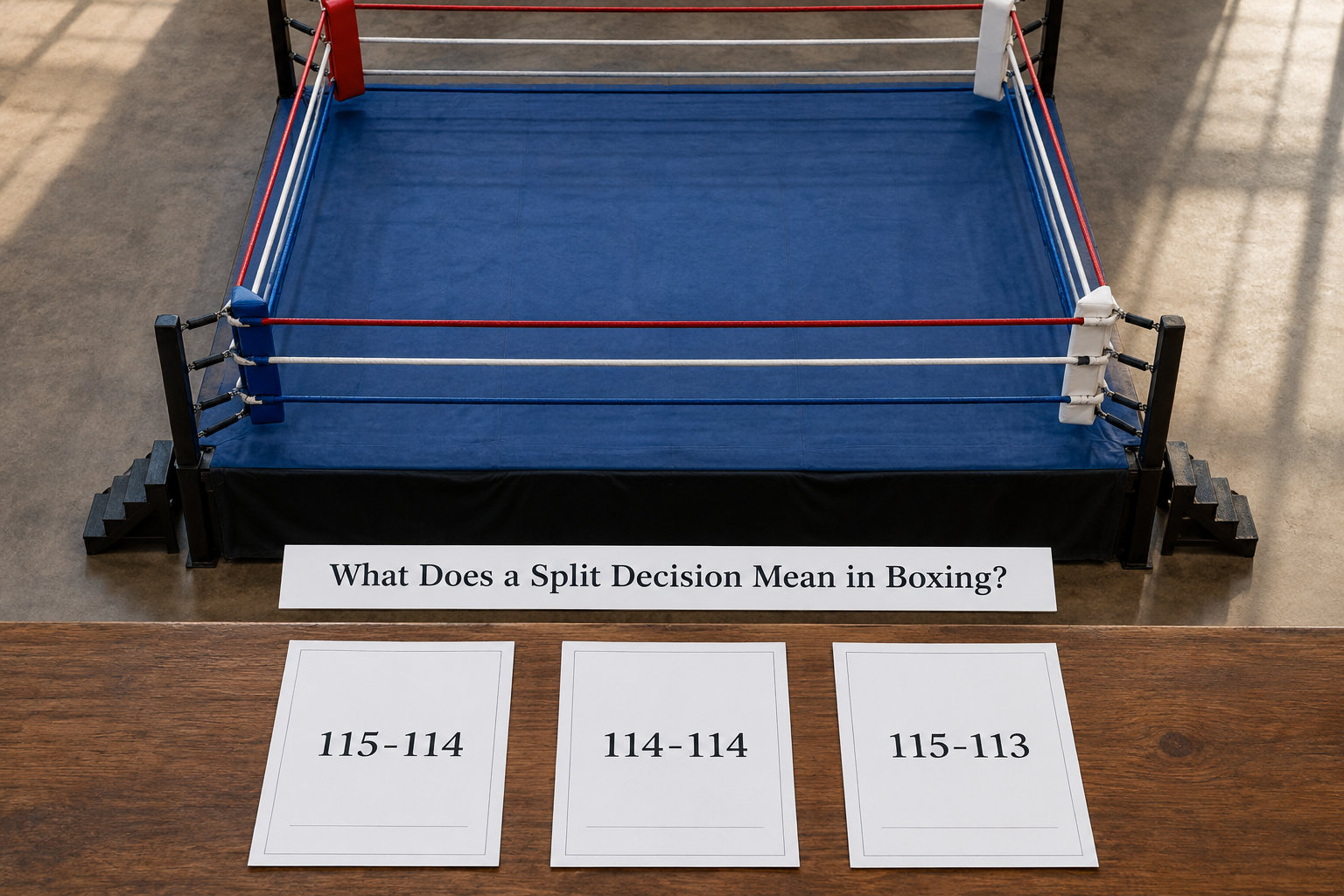
A split decision is a 2-to-1 verdict. Two judges picked the same fighter as the winner and the third judge picked the other one, so the majority of the panel decides. You will see it written as SD on a result graphic, and it is officially recorded as a win, not a draw.
It only exists when the fight ends with the final bell rather than a knockout, a stoppage or a disqualification. If the fight was stopped early, the judges never produce a split.
Here is the whole thing in three steps:
- Each judge scores every round on their own private card. They work at ringside, at separate tables, with no conferring.
- At the final bell the three totals are read separately. Nothing is averaged, nothing is added together, and no judge sees the other cards while scoring.
- The pattern of cards creates the verdict. Two cards for one fighter and one for the other is a split decision. Two and one where the single card is a draw is a majority decision instead.
How Is a Split Decision Scored?
Boxing uses the 10-point must system. The judge who wins a round must be awarded 10 points, and the fighter they score it for receives 9. That single rule is why scores climb in 10-9, 10-8 and 10-7 steps, and why a 12-round fight usually ends on a total somewhere in the 113s or 116s rather than a round-by-round running tally.
Judges may also deduct a point for a foul. One point off for a low blow or a headbutt, for example, turns what would have been a 10-9 round into a 9-9, and it can cost a fighter a round they were winning comfortably. Deductions are rare, but they explain a surprising number of evenly-scored rounds.
These are the round scores you will see on most cards:
- 10-9 the standard competitive round, the default result for the winner of a round.
- 10-8 a round won decisively enough that the judge feels a point is warranted. Knockdowns are the usual reason.
- 10-7 rare, but it happens when a knockdown is scored and the round was one-sided throughout.
- 10-10 an even round. The judge can award it when neither fighter earned a clear edge, and it is the most disputed score on any card.
- 9-9 what a 10-9 becomes when a point is deducted for a foul.
Once every round is scored, the judge writes the two totals in the order of the fighter in the red corner, then the blue corner. Those three written pairs are the only things that matter:
| Judge 1 | Judge 2 | Judge 3 | Official result |
|---|---|---|---|
| Alvarez 115-113 | Alvarez 115-113 | Alvarez 115-113 | Unanimous decision (UD) for Alvarez |
| Alvarez 115-113 | Alvarez 115-113 | Draw 114-114 | Majority decision (MD) for Alvarez |
| Alvarez 115-114 | Draw 114-114 | Golovkin 115-113 | Split decision (SD) for Alvarez |
| Alvarez 115-114 | Golovkin 115-113 | Golovkin 116-112 | Split decision (SD) for Golovkin |
What Happens When the Judges Disagree?
Nothing special happens, and that is the part people get wrong. A split decision is not a tiebreak, an average, or a negotiation. The cards are counted as votes, and two votes beat one, every time.
Take the most common confusion: two judges score a fight 115-113 and the third judge scores it 119-109 in the other direction. Even with that ten-round gap, the fighter with the two 115-113 cards wins by split decision. If you added all three cards together you would get 349-335 to the loser, and that combined total is meaningless. There is no rule anywhere in the scoring that sums panel points.
The margin on the dissenting card tells you how emphatic that one judge was. It does not give the other judge extra weight. A judge who watched the whole fight and saw it 119-109 has one vote, and a judge who saw it 115-113 also has one vote.
The same logic explains why a wide split still stings. When one judge watches twelve rounds and sees a 119-109 blowout while two others see a 115-113 phone fight, the split decision tells you the panel split, not that the fight was close. Those are two different complaints, and the cards only answer the first one.
Can a Split Decision Include a Drawn Round?
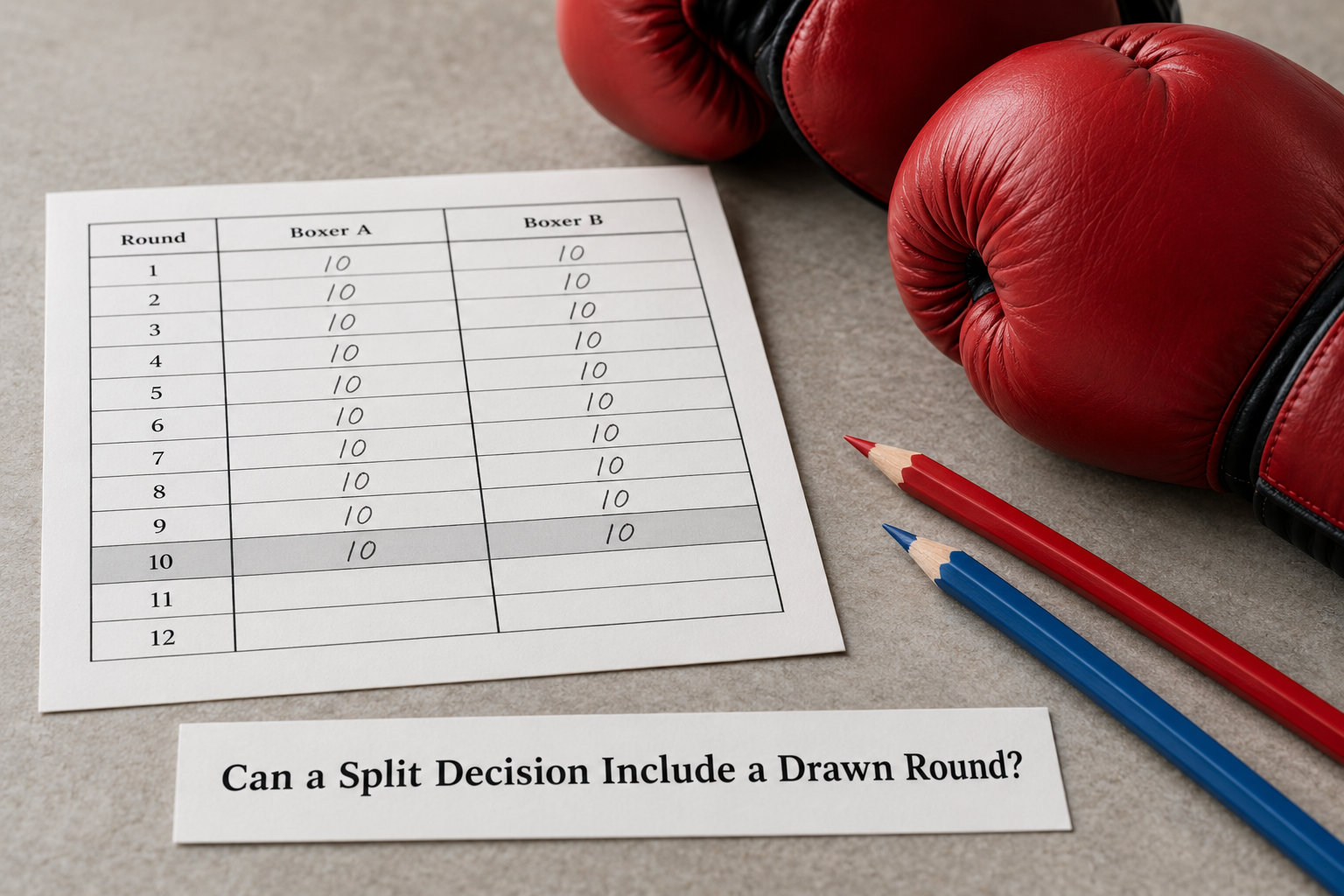
Yes. A drawn round and a drawn fight are two completely different things, and mixing them up is the most common source of confusion in the whole topic.
A drawn round is scored 10-10, meaning the judge saw it as genuinely even. A drawn fight is what happens when the totals on a card end up level, such as 114-114 after twelve rounds. A card can contain a 10-10 round and still produce a clear winner, because the remaining eleven rounds decide the total.
Drawn rounds matter for split decisions because of how thin the margin can become. If a judge gives three even rounds and splits the other nine, that card may finish tied, and a tie on one card is not a vote for either fighter. It leaves the other two judges to decide the bout on their own.
So a drawn round can quietly end a boxer’s chances of a split decision rather than creating one. If one judge scores nine rounds for the opponent and leaves the card level, the two other judges may both agree, and the result is a unanimous decision despite that judge clearly disliking what they saw.
What Is the Difference Between Split, Majority, and Unanimous Decisions?
All of them come from the same three scorecards. The only thing that changes is how those three cards are distributed between the two fighters and a draw. This is the full list of verdicts you will see on a result graphic:
| Verdict | Abbreviation | Required cards | What it tells you |
|---|---|---|---|
| Unanimous decision | UD | Three cards for one fighter | All three judges saw it the same way |
| Majority decision | MD | Two cards for one fighter, one drawn card | Two judges agreed, the third called it even |
| Split decision | SD | Two cards for one fighter, one for the other | The panel was genuinely divided |
| Majority draw | MD-DRAW | Two drawn cards, one card for either fighter | Neither fighter won enough rounds |
| Split draw | SDD | One card each for both fighters, one drawn card | The panel split and no one had a majority |
One more abbreviation worth recognising: DQ stands for disqualification, which ends the fight immediately and replaces the judges’ cards entirely. TKO and KO are stoppages, not decisions at all, so they never carry a card pattern.
Does a Split Decision Mean the Boxer Did Not Win?
No. The fighter named at the announcer’s mic won the bout, and it is written into their record as a win. A split decision is a different kind of win than a unanimous decision, not a lesser one on the scorecard.
For a bettor, it is settled the same way as any other win. If you backed the fighter who took two cards, the bet pays. The method of victory changes nothing about the payout, which is why a parlay leg does not push on the basis of a split.
What it does change is the story around the fight. Boxers with a long list of split decisions in their record are generally viewed as having an inconsistent style or as being hard to judge, and fans tend to read the cards as commentary on the fighter as much as on the fight. Boxers who win a lot of unanimous decisions are seen as doing something that is harder to argue with.
Official statistics from the fight are the natural place to look when the cards do not match what you watched. Punch totals, landed shots, knockdowns and connect percentages are recorded separately by the official scorer and are worth reading alongside the cards. They do not change the verdict, and they are not a route to overturning it, but they do give you something concrete to argue with.
Contested decisions are common enough that sanctioning bodies usually set a rematch clause in a title fight before the first bout, precisely so a split cannot stall a division.
Why Do Boxing Judges Sometimes Disagree?
Because the criteria are ranked, weighted and partly subjective, and three people are watching from three different seats. Judges are instructed to weigh four things in this order: clean punching, effective aggression, ring generalship, and defense. Two judges watching the same twelve rounds will place different weights on those four things, especially in a fight where the styles are opposites.
Seat position matters more than fans expect. A judge seated on one side of the ring sees punches travel across their line of sight, while a judge on the opposite side sees them coming straight at them. A fighter who throws a jab from outside the visible range of one judge may look far busier than he did to the judge directly across from him.
Volume versus accuracy is the other big divider. Fighters who throw a lot and land little tend to lose decisions, while counter-punchers win narrow ones. That is a direct application of clean punching ranking above everything else, and it is why two cards can describe the same 12-round fight so differently.
Real results show how wide the spread can get. The 2017 rematch between Canelo Alvarez and Gennady Golovkin ended on a split decision, with two judges scoring it 115-113 for Alvarez and one scoring it 116-112 for Golovkin. It is a useful example to keep in mind, because the wide card is what people remember and the majority is what decided the bout.
Frequently Asked Questions
What is the minimum winning margin in a split decision?
One round. Because only the card count matters, a fighter can win a split decision having taken nine of twelve rounds, as long as two judges score it for him and the third scores it for his opponent. The margin on the dissenting card is irrelevant to the result, so a 119-109 vote against you still counts as exactly one vote.
Can one boxing judge award more rounds than another?
Yes, and it is common. A judge who scores nine rounds for one fighter while another scores eight is simply seeing a different fight, usually because of their seat position or how they weigh defense against clean punching. The cards do not need to match round for round for a fighter to win, since only the majority of the three cards is ever counted.
What is the difference between a split decision and a majority decision?
The third card. In a majority decision, two judges score the bout for one fighter and the third judge scores it a draw, so no judge sided with the opponent. In a split decision, the third judge scores the bout for the opponent. A majority decision therefore signals partial disagreement, while a split signals a genuine divide across the panel.
Can a boxing split decision be overturned by replay footage?
No. Replays are used for official scorecards, medical reviews and disputed knockdowns, but once a decision is announced the scorecards stand. Broadcast footage does not replace the judges’ cards, so an argument about what happened on television cannot change the official result. The remedy is a rematch, not an appeal on the footage.
Can an undefeated boxer lose by split decision?
Yes. An unbeaten record is only broken by a loss, and a split decision counts as one, since the fighter with two cards is the official winner. Their record then shows a loss, and for a champion it is a surrendered title. Plenty of unbeaten fighters have taken a split decision loss and gone on to win the rematch, so one such result says more about judging disagreement than about ability.
Conclusion
When you see SD on a result, read the individual cards before you react to it. Two cards for one fighter and one for the other is a split decision, and that fighter is the official winner no matter how lopsided the third card looks. Check the margin on the dissenting card to judge how divided the panel really was, and the record to see whether the result is a first for that fighter or one of many.