
Boxers get sanctioned by commissions in two separate stages that beginners constantly mix up. A state athletic commission issues the licence that lets a fighter compete professionally at all, and a championship body such as the WBA, WBC, IBF or WBO separately approves a specific bout and awards a belt. Neither one does the other job.
Here is the plain version: a commission is a government regulator, a sanctioning body is a private title-granting organisation, and a promoter is the business that stages the card and files the paperwork. Once you can name which of those three you are dealing with, the rest of the process makes far more sense.
Everything below reflects commission rules as they stood when this article was last reviewed in October 2026. Commissions change their forms, fees and medical intervals more often than most people expect, so confirm the current requirements with the commission that will actually regulate your first bout.
Table of Contents
- What Does It Mean for a Boxer to Be Sanctioned?
- How Boxers Get Sanctioned by Commissions: The Full Process
- Which Boxing Commission Should a Fighter Apply To?
- What Paperwork Does a Boxer Need?
- What Medical Tests and Exams Are Required?
- How Do Promoters Get a Bout Approved?
- What Fees and Insurance Can a New Boxer Expect?
- What Are Common Reasons a Sanction Application Is Denied?
- How Does Sanctioning Differ for Titles and Tournaments?
- Frequently Asked Questions
- Conclusion: Start With the Correct Commission and Get the Paperwork Right
What Does It Mean for a Boxer to Be Sanctioned?
Sanctioned simply means approved by an authority with the power to approve. In boxing that authority takes two forms, and both use the same word.
Commission-sanctioned means a state or national athletic commission has licensed the boxer and approved the contest. Licence-based sanctioning is what makes a professional bout legal in that jurisdiction. Without it, no promoter can put on a professional boxing event there, and no boxer can legally be paid to fight in it.
Title-sanctioned means a championship organisation has agreed to put its belt at stake. That approval covers the division, the weight limits, the participants records, the officials and the paperwork around the purse. A bout can be perfectly legal and commission-sanctioned while carrying no title at all, which is what most professional boxing is.
Four parties show up in every conversation about how boxers get sanctioned by commissions, and confusing them is the single most common source of bad advice online:
| Party | What it is | What it produces |
|---|---|---|
| State athletic commission | A government body created by state law to regulate professional combat sports | Boxer and promoter licences, bout approvals, medical suspensions, discipline |
| Sanctioning body | A private membership organisation that governs championship titles | Ratings, title sanctions, belts, mandatory challengers |
| Promoter | The company or person staging the event and paying the fighters | Bout applications, contracts, purses, insurance, officials |
| Broadcaster or streamer | The outlet buying the broadcast rights | Money that funds the purse, plus its own broadcast rules |
The federal layer sits behind all of this. The Professional Boxing Safety Act of 1996 established that a boxing commission is an entity authorised under state law to regulate professional boxing matches, and it is why the licensing requirement exists as a matter of federal policy rather than promoter preference.
How Boxers Get Sanctioned by Commissions: The Full Process
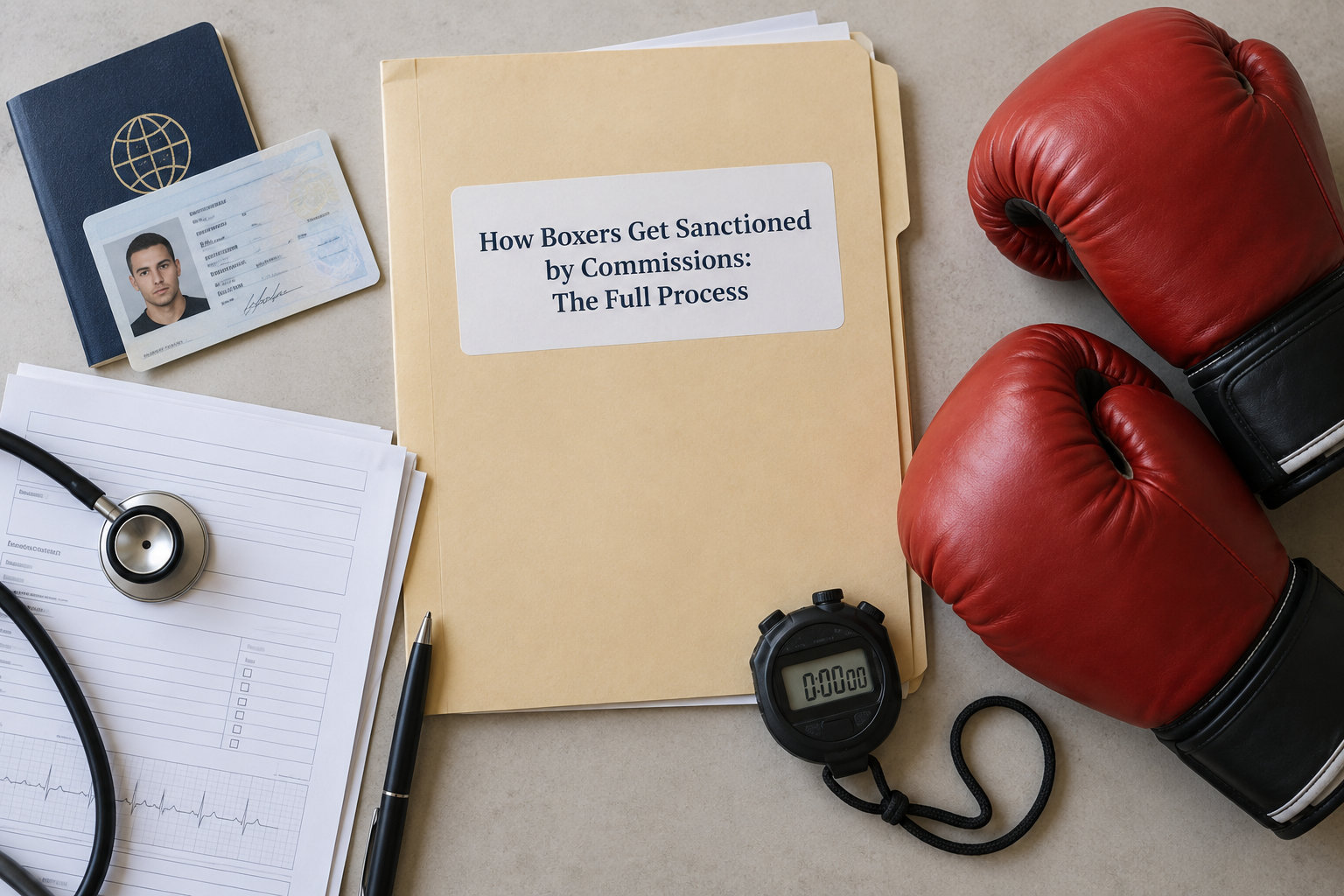
The route from amateur gloves to a commission licence runs through eight steps. Order matters here, because commissions will not process an application that is missing a document from step three when you file it at step eight.
- Choose the commission with authority over your first event. Most fighters license in the state where they plan to debut, because the commission that will sanction the bout is the one whose licence you need.
- Get the application packet from that commission directly. Do not rely on a third-party service or a promoter handing you a form for a different state.
- Complete the application in full. Name, address, date of birth, intended weight class, prior amateur record and professional intentions all appear on the standard form.
- Pay the application and licence fee. Fees are set in state law or state administrative code and change, so check the current schedule rather than assuming a number.
- Submit proof of a recent physical examination. Most commissions want a physical dated within a set window, often twelve months, performed by a licensed physician.
- Complete a background check and any required disclosure forms. Good moral character is a standard phrase in the rules of most commissions.
- Pass the medical requirements and receive the licence. Once approved, your name, licence number and record become available to the record keeper.
- Renew on the commission schedule. Licences expire, and several commissions require an interval neurological exam before renewal rather than a fresh physical.
Here is who does what at each stage, which is the part most newcomers find confusing when a promoter, a manager and a commission all seem to be asking for the same documents.
| Sequence | Who acts | What the boxer supplies |
|---|---|---|
| 1. Jurisdiction decided | Promoter and manager | Target state, target division, target date |
| 2. Application filed | Boxer, often via manager | Completed application and personal details |
| 3. Fee paid | Manager or promoter, sometimes deducted later | Payment against the commission schedule |
| 4. Background and character check | Commission | Disclosures, prior licensing history |
| 5. Medical clearance | Licensed physician | Physical form, and any imaging or test results |
| 6. Licence issued | Commission | Confirmation of licence number and division |
| 7. Bout approved | Promoter files with the commission | Signed bout agreement and bout history |
| 8. Licence renewed | Boxer | Renewal application plus current medicals |
Most commissions set a service expectation in weeks rather than days, and none of them promise a turnaround. If a promoter is offering you a date before your licence exists, that is a conversation worth having early.
Which Boxing Commission Should a Fighter Apply To?
The useful answer is not the easiest or the cheapest state. It is the commission that regulates the event you want to be in.
Jurisdiction usually follows the location of the contest. A bout held in Nevada falls under the Nevada State Athletic Commission, and every fighter on that card must hold a licence that commission recognises. Fighters who live elsewhere can still obtain licences in states with active professional boxing, and many do, because a licence in a boxing-active state opens more cards.
Some commissions regulate by promoter history as well as geography. A promoter with a track record in a particular state may file there even for an event elsewhere, depending on that state’s rules and the promoter agreements in force.
| Commission | Jurisdiction | Notes worth knowing |
|---|---|---|
| Nevada State Athletic Commission | Nevada | Large fight week, licence fees for fighters and officials set in Nevada statute |
| New York State Athletic Commission | New York | Historic boxing venue, publishes statutes, rules and forms |
| California State Athletic Commission | California | Regulates boxing, MMA and kickboxing under state code |
| Texas Department of Licensing and Regulation | Texas | Boxes under a state licensing division rather than a standalone commission |
| Florida State Athletic Commission | Florida | Licensing rules sit in Florida Statute chapter 548 and the administrative code |
| British Boxing Board of Control | England and Wales | National body rather than a state regulator, with its own licensing tier system |
The Association of Boxing Commissions coordinates the state commissions and publishes shared materials such as medical forms and uniform requesting procedures. It is a useful reference, but it is not a regulator and it cannot license anyone.
Outside the United States there is no state model to copy. England and Wales sit under the British Boxing Board of Control, and other countries run national federations or provincial commissions with their own tiers, so an American licence carries no weight abroad.
What Paperwork Does a Boxer Need?
Every commission form asks for similar things, and almost all denial letters come down to one of these items being blank, stale or missing a signature.
- Identity details. Full legal name, date of birth, current residential address, and often a photo identification copy.
- Physical and mailing address history. Some commissions want a residential history covering the past several years rather than a single address.
- Medical records. A physical examination form from a licensed physician, plus any test results the commission requires for your division or age group.
- Amateur record. A boxer’s amateur record, often verified through the record keeping systems the commission accepts.
- Bout history. Every prior professional appearance, with dates, opponents, weights and results.
- Disclosures. Criminal history disclosures, prior suspensions, and answers to good moral character questions.
- Contracts and agreements. Where a professional contract already exists, the commission may want a copy or an abstract of it.
- Banking or payment details. Needed once purses begin, and handled under commission oversight rather than paid directly by the promoter.
Exact requirements vary by jurisdiction and by the level of the event. Applications for an undercard debut can look very different from what a television-led main event requires, so ask your promoter’s office for the commission’s own checklist rather than working from a generic template.
What Medical Tests and Exams Are Required?

Medical screening exists because repeated head trauma is cumulative, and the commission needs a documented judgement that you are fit on the day you fight.
Expect a physical examination, an ophthalmologic or vision assessment, and increasingly a neurological evaluation. Many commissions also require an electrocardiogram, and some require brain imaging such as MRI or CT when a physician orders it. Blood tests appear in certain states and for particular concerns.
The Association of Boxing Commissions publishes medical information release forms and related documents that state commissions draw on, which is why the same form titles keep appearing across state websites. Where ABC materials are not used, the commission’s own form governs.
Two rules matter most in practice. First, only the physician’s signature counts: a commission will not accept clearance by a trainer, a manager or a commission staffer. Second, medical clearance is not permanent. After a knockout or a significant head impact, a commission can impose a medical suspension of a statutory minimum length, often sixty days, and lifting it requires neurological clearance rather than waiting out the calendar.
The Muhammad Ali Boxing Reform Act added a layer on top of that, requiring promoters to give fighters full disclosure of medical information relevant to their participation. Ask for that disclosure in writing before you sign anything.
How Do Promoters Get a Bout Approved?
The promoter does the filing, and the boxer usually signs what the promoter submits. Knowing that division of labour makes late-stage surprises much rarer.
- Bout application filed. The promoter submits the bout request to the commission with names, weights, divisions, venue and date.
- Bout agreements verified. Signed contracts with both fighters, confirming purses, weights and date.
- Records and licences checked. The commission confirms both boxers are licensed and eligible, with no unresolved medical suspensions.
- Officials assigned. Referee and judges are approved, along with a ringside physician for the event.
- Venue and safety requirements met. Ring dimensions, gloves, weight scales, a medical area and an ambulance plan are all reviewed.
- Insurance and fees confirmed. The promoter supplies proof of event insurance and pays the bout fee and official fees.
- Bout approved and calendared. The commission issues the sanction for the contest and it appears on the commission schedule.
On fight night the commission is still present. The ringside physician can stop a contest on medical grounds, and the commission supervises the weigh-in, pays officials from the commission account, and enforces the Unified Rules adopted by the governing body.
What Fees and Insurance Can a New Boxer Expect?
Costs vary widely by state, by level of event and by year, so treat the categories below as a checklist rather than a budget. Every commission publishes its own current fee schedule.
- Licence and application fees. Set by state law or administrative code, and usually the smallest line item a new fighter pays.
- Renewal fees. Annual or biennial, sometimes bundled with an interval neurological exam cost.
- Bout fees. Paid by the promoter, not the fighter, and set per contest by the commission.
- Medical costs. Physicals, neurological exams, bloodwork and imaging, which the fighter usually absorbs directly.
- Event insurance. The promoter’s responsibility, but it affects the promoter budget and therefore the purse offered.
- Official fees. Paid by the promoter out of commission funds.
Sanctioning-body fees work completely differently from licence fees. There is no application fee. The standard model described by fighters and their representatives is roughly three percent of the purse, commonly charged to both champion and challenger, and often not fully disclosed before the bout.
Reported figures from publicly available filings put the WBA, WBC, WBO and IBF combined at roughly 19 million dollars in income from 2024 tax returns, shared in February 2026. A widely reported case involved the WBC reducing a sanction fee to 0.6 percent from the standard rate, with the champion stating he had paid 300,000 dollars in fees to the body. The dispute that followed became the clearest public example of why sanctioning fees are now a common topic on fighter forums.
If a fee figure matters to your contract, ask for the sanctioning body’s fee schedule in writing before signing, and treat the answer as part of the deal rather than a detail to be settled later.
What Are Common Reasons a Sanction Application Is Denied?
Denials are rarely personal. They are almost always administrative, and most of them can be fixed by filing again.
Incomplete or unsigned paperwork
A missing signature, a blank field or a form from the wrong commission is the most common reason an application fails on first pass. Fix: have your manager proof every page against the commission checklist before filing.
An unresolved medical suspension
A fighter still serving a medical suspension cannot be licensed or approved to fight in most states. Fix: obtain the commission’s written release or the physician’s neurological clearance, then reapply.
Incomplete bout history
An unexplained gap in your professional record triggers questions from the record keeper. Fix: supply every prior appearance, including short-notice fights and fights outside your home state.
Medical forms that have expired
A physical dated outside the permitted window is treated as no physical at all. Fix: book the examination early enough to have results in hand before filing.
Contract disputes
Where a bout agreement is contested, the commission may hold or deny the bout approval. Fix: settle the contract question with the promoter first; the commission will not arbitrate your purse dispute for you.
Inadequate venue arrangements
Missing medical facilities, an unsuitable ring or no ambulance plan block the bout, not the boxer. Fix: the promoter files a corrected venue plan.
Late fees or unpaid amounts
Outstanding balances with the commission can stop both licence and bout approval. Fix: confirm your account is current before signing.
Identity, residency or character questions
Identification problems or a failed background check are the most serious category, because they carry conduct implications rather than paperwork ones. Fix: respond in full and in writing.
Where a decision goes against you, the route is usually administrative. A commission decision is typically appealable to an administrative law judge through the state’s administrative procedure act, and a hearing follows. A party that loses there may seek judicial review in the state courts. That is the standard path in states such as Florida, and a similar structure exists elsewhere even where the statute names differ.
How Does Sanctioning Differ for Titles and Tournaments?
Commission approval and championship approval are separate decisions made by separate bodies, and a title does not create legal permission to hold the contest.
A commission permits the contest. A sanctioning body decides whether its championship will be at stake. A promoter may file for both at once, and most title cards do exactly that, but neither organisation can substitute for the other.
| Body | Founded | What its sanction actually means |
|---|---|---|
| WBA | 1922 | Approves world title bouts and maintains rankings across seventeen weight divisions |
| WBC | 1966 | Approves world title bouts and enforces mandatory challengers in designated divisions |
| IBF | 1943 | Approves world title bouts and ranks boxers on its own schedule |
| WBO | 1988 | Approves world title bouts and is widely associated with organising fights between ranked challengers |
Unified fights are the clearest case. Two champions from different bodies can agree to fight, and the commissions approve the contest normally, while each organisation decides separately whether to have its belt on the line and how to rank the winner. Nobody needs anyone’s permission for the fight itself.
Tournaments and brackets add requirements rather than remove them. Weight limits, scheduled rounds, semi-final dates and insurance all have to be set in advance, and the commission still licenses every fighter and approves every contest inside the bracket.
Frequently Asked Questions
How much does a professional boxing licence cost?
Licence costs vary widely by state and by event level, so there is no single US figure. Each commission sets its own application and renewal fees in state law or administrative code, and the schedule changes. Your promoter can tell you what the commission covering your debut event charges, and the commission website publishes the current schedule. Medical costs from your physical and any required tests are separate from the licence fee.
How long does it take to get a boxing licence?
Most commissions work in weeks rather than days, and none guarantee a turnaround. The variables are whether your physical is already done, whether a background check returns problems, and how long the medical review takes. Fighters who file with a complete packet and current medical paperwork move fastest. If a promoter has offered you a date, confirm your licence timing with them before signing the bout agreement.
What medical tests do professional boxers need?
Expect a physical examination, vision or ophthalmologic assessment and neurological screening, with many commissions also requiring an electrocardiogram and some requiring brain imaging. A licensed physician must sign the clearance. After a knockout, commissions can impose a medical suspension with a statutory minimum, commonly sixty days, and lifting it requires neurological clearance rather than simply waiting. State rules set the exact list and intervals.
Do boxers pay sanctioning fees on their purses?
Championship sanctioning fees are separate from commission licence fees. The standard model, described by fighters and their representatives, is roughly three percent of the purse charged to both champion and challenger. There is no licence application fee for a sanctioning body. Fees are not always disclosed before a bout is announced, which is why asking for the fee schedule in writing before signing a contract matters.
Is unlicensed professional boxing legal?
No. Under the federal framework established by the Professional Boxing Safety Act of 1996, professional boxing matches must be regulated by an authorised state commission, and no boxer may compete professionally without the licence that commission requires. Fighting on an unapproved card exposes the promoter, the venue and the fighter, and it leaves nobody to enforce medical standards or pay obligations. Amateur boxing under a governing body such as USA Boxing is a separate legal structure.
Can you appeal a boxing licence denial or suspension?
Yes, in most states. A commission decision is generally appealable to an administrative law judge under the state’s administrative procedure act, which is a formal hearing with a record you can present evidence to. Losing there can lead to judicial review in state court. Deadlines are short and set in statute, so file promptly. Medical suspensions usually have their own route, typically physician clearance submitted for the commission’s review.
Conclusion: Start With the Correct Commission and Get the Paperwork Right
If you take one action from this guide, make it this one: identify the commission that will have authority over the event you want, and ask that commission directly for its fighter application packet and current checklist.
Confirm the requirements with your promoter, submit a complete file with current medical paperwork, and do it early enough to leave room for a background check, medical review and a second filing if something is missing. That single week of margin is what separates a smooth debut from a delayed one.