Last updated: October 2026
How boxing hall of fame voting works is simpler than most fans expect and stranger than most other sports. Roughly 200 electors — members of the Boxing Writers Association of America plus an international panel of boxing historians — cast a closed ballot, and each elector may vote for up to five candidates. The top three vote-getters are enshrined every year no matter what share of the vote they won.
There is no 75 percent bar to clear, and the vote totals are never published. Once you know that, the arguments about who was snubbed make a lot more sense.
Table of Contents
- What Is the International Boxing Hall of Fame?
- How Boxing Hall of Fame Voting Works: The Process at a Glance
- Who Can Be Nominated?
- Who Votes for Boxing Hall of Fame Candidates?
- How Are Nominees Selected?
- What Happens During the Voting Stage?
- Why Do Some Candidates Receive More Votes?
- What Happens After the Vote?
- Common Questions About Hall of Fame Eligibility and Voting
- Frequently Asked Questions
- Can the public vote for boxing Hall of Fame inductees?
- How are boxing Hall of Fame nominees chosen?
- How many votes are needed for induction?
- What is the difference between a nominee and an inductee?
- Can someone be nominated for the boxing Hall of Fame more than once?
- When are the voting results announced?
- Conclusion: What to Follow During the Next Voting Cycle
What Is the International Boxing Hall of Fame?
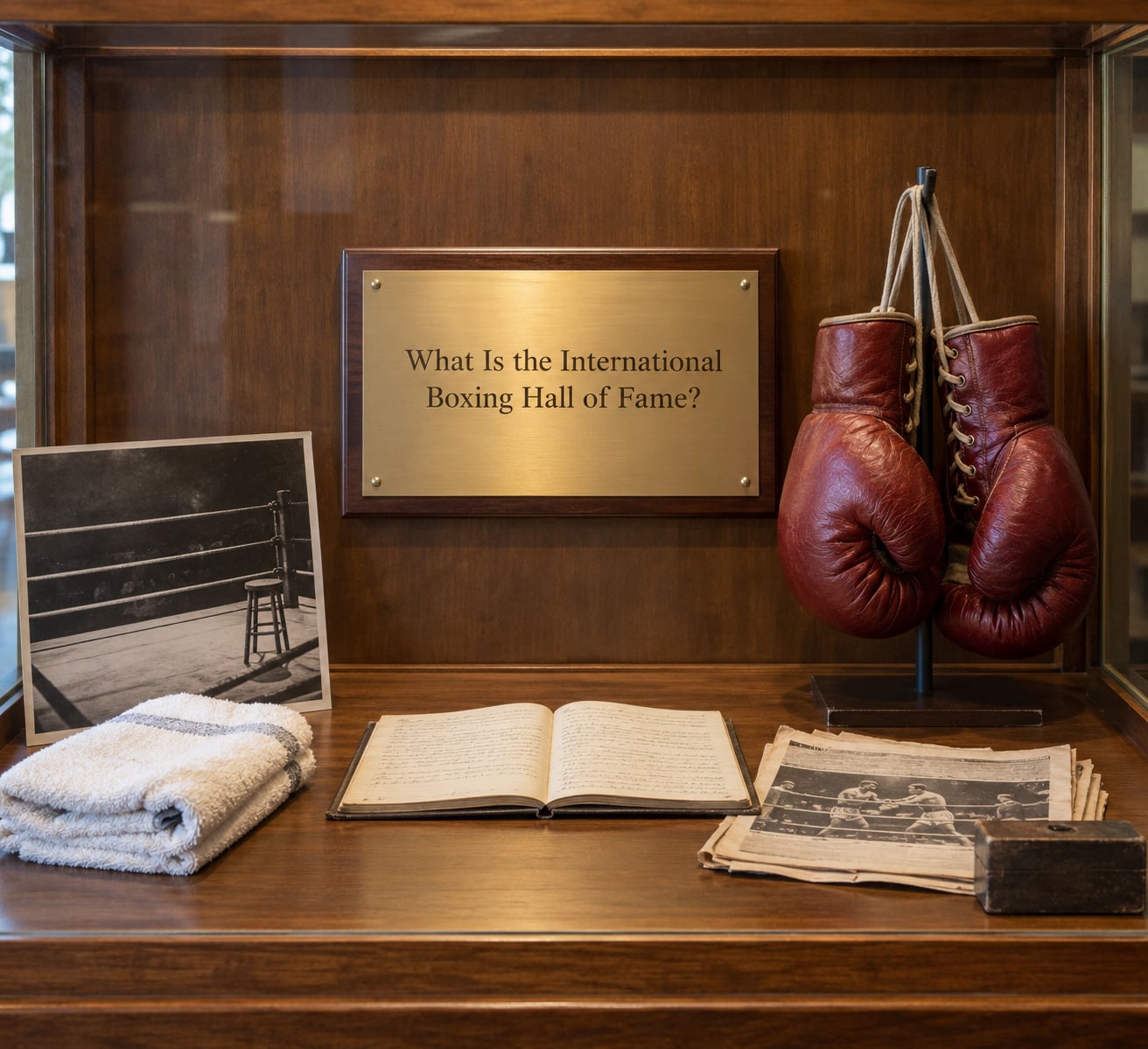
The International Boxing Hall of Fame, usually shortened to the IBHOF, is the body that formally enshrines the people who shaped boxing. It is based in Canastota, New York, and its induction ceremony is the sport’s biggest annual gathering outside of a major fight card.
Induction is a historical honour, not a ranking. A boxer on the IBHOF ballot is being measured against everyone already enshrined, not against the current rankings or against whoever holds a title belt right now.
Why the IBHOF is not The Ring’s hall
There was an earlier Boxing Hall of Fame run by The Ring magazine from 1954 to 1987. It has a separate inductee list, and people enshrined there were not re-voted by the current institution. The IBHOF, which grew out of that organisation’s later work, kept the name and the museum in Canastota but runs its own election process.
That distinction trips up a lot of readers who see older names on one list and wonder why they are missing from the modern one.
How Boxing Hall of Fame Voting Works: The Process at a Glance
The whole cycle runs about eight months from the first ballot to the ceremony. Here is the order things happen in.
- Nominations open. Anyone can submit a name to the IBHOF. Nominees are put forward by members of the press, promoters, historians, or fans.
- Screening committees filter the list. Board-appointed committees review the nominations and decide who is serious enough for a ballot.
- Ballots are distributed. Electors receive ballots on October 1 for the classes holding an election that year.
- Electors vote. Each elector marks up to a set number of candidates, which varies by category.
- Tallies are counted in private. Results go to the Board, and vote totals are not released afterward.
- Results are announced in early December. The elected class is named publicly.
- The enshrinement ceremony follows in June. That weekend is called Hall of Fame Weekend, and it is held in Canastota.
Each stage has its own filter, which is why a popular campaign online rarely speeds a fighter up.
Who Can Be Nominated?
The Hall of Fame does not just take fighters. It splits eligibility into categories, because a great trainer and a great knockout artist are not competing for the same thing.
Modern
Boxers whose most recent bout falls inside a defined modern window. This is the crowded category, the one fans argue about, and the only place the automatic election threshold applies. Modern is split into men’s and women’s ballots.
Old-Timer, split into Early Era and Late Era
Retired boxers whose careers fall in the earlier part of the Hall’s history. The category was divided into Early Era and Late Era to break up a ballot that had grown too congested to be meaningful. Late Era old-timeers get their own election year in the current cycle.
Pioneers
Boxers from the very early era of the sport, before the modern championship structure existed. This category moves infrequently because the pool of eligible names is small.
Non-Participants
People who built boxing from outside the ring: matchmakers, promoters, trainers, managers, cutmen, ring announcers. It is a separate ballot with its own vote limits and its own number of elected names each cycle.
Observers
Journalists, historians, broadcasters, authors and chroniclers of the sport. Also a standalone ballot, with two elected each year rather than three.
Women’s Modern and Women’s Trailblazer
Women’s categories were added to the Hall in 2020. Women’s Modern mirrors the men’s Modern ballot but has a smaller list of candidates, and Women’s Trailblazer covers the pioneers of women’s boxing.
Because the categories are separate ballots, an Observer candidate does not compete for a spot against a fighter. Each category elects its own number of names on its own schedule.
Who Votes for Boxing Hall of Fame Candidates?
The electorate is the part fans ask about most, and the answer is the part they usually get wrong. The vote is closed. You cannot cast a ballot, and neither can a paying customer or a season-ticket holder of any promotion.
Electors come from two groups: members of the Boxing Writers Association of America, who cover the sport for a living, and an international panel of boxing historians. The panel has included writers from Japan, England, Canada, Argentina, Australia, the Netherlands, Germany, Mexico and the United States.
The IBHOF describes its electorate as roughly 200 people, though the exact number moves a little as panels are renewed. Electors commit to a rolling five-year term, which means the electorate turns over gradually rather than all at once.
That design keeps continuity. An elector who joined after a controversial snub is voting alongside someone who was there for the fight that caused it.
It also means the electorate is narrow by design, and r/Boxing threads about each ballot release tend to fill with complaints about that narrowness. The pushback is fair as a criticism, but it has never changed the rules: the ballot is decided by roughly 200 named voters, not by the public.
How Are Nominees Selected?
Getting onto a ballot is harder than getting elected, and the reason is the screening committees.
Nominations are public. A historian, a promoter or a reader can put a name forward, and there is no fee. The nominations are then collected and sorted, and a screening committee appointed by the Board of Directors evaluates them.
The committee looks at a career rather than a highlight reel. A strong record matters. So do the length of the career, the level of opposition, what the fighter did for opponents afterwards, and character inside and outside the ring. For non-participants and observers, the equivalent questions are about influence on the sport and whether the contribution was sustained.
Committees rotate, and the process is deliberately consensus-driven rather than a public shortlist. A fighter can be nominated by several people and still fail to make the cut, which is why campaigning loudly does not reliably move a name up.
What Happens During the Voting Stage?
Ballots go out on October 1. Electors have until a postmark deadline later in the month to return them, and each ballot is specific to one category. A Modern elector’s ballot is not the same document as an Observer elector’s ballot.
How boxing hall of fame voting counts a ballot
Each elector marks a set number of names, and the candidates with the most support win. On the larger ballots that means five selections and three names enshrined, no matter how thin the winning margin. On smaller categories the numbers change, and sometimes fewer than three names are elected.
| Category | Votes per elector | Elected each year | 80 percent clause |
|---|---|---|---|
| Modern (men) | Up to five | Three | Yes |
| Modern (women) | Up to five | Three | Yes |
| Late Era Old-Timer | Up to five | Three | No |
| Early Era Old-Timer | Up to five | Three | No |
| Pioneers | Varies | Varies | No |
| Non-Participants | Up to five | Three | No |
| Observers | Up to five | Two | No |
| Women’s Trailblazer | Varies | Varies | No |
Two mechanics drive almost every argument you will read about the result. The first is fixed slots. The second is the 80 percent rule, which applies only to the Modern men’s and women’s ballots.
What the 80 percent threshold actually does
In the Modern categories, a candidate who receives 80 percent or more of the votes cast is elected automatically, and that does not depend on finishing in the top three. In practice this clause almost never fires, because electors rarely agree that strongly on anyone. Its real purpose is to give an overwhelming consensus a guarantee, not to set the usual bar.
There is no equivalent clause for Old-Timers, Pioneers, Non-Participants or Observers. In those categories the only question is who finished highest.
Why vote totals are never published
The IBHOF keeps the numbers private on purpose. Publishing totals would expose the gap between the winner and the runner-up, and the Board has said it wants every enshrined member treated as equal regardless of how close the vote was.
The trade-off is real. Without totals, a fighter who misses the cut could be a single vote from induction or could be nowhere near it, and nobody outside the counting room will ever know which.
Why Do Some Candidates Receive More Votes?
Electors are ranking names against each other, so support is relative rather than absolute. Here is what moves a candidate up.
Career achievement and length
A long career across several weight divisions and two decades of activity tends to accumulate votes. A short, brilliant career against elite opposition is harder to sell to a panel that weighs longevity.
Influence beyond the record
What a fighter did for other fighters after their career, and how they behaved when they were the one being talked about, both come up in elector diary posts. Writers who publish their own ballots each year frequently mention character as a reason for their selections.
Era and ballot competition
Timing matters more than fans expect. A candidate competing against forty names for three slots faces a different problem from the same candidate on a ballot of eight. Some years are simply stacked.
The size of the electorate
With roughly 200 electors, one person’s ballot is a half-percent of the total. A single organiser who can get a hundred writers to notice a name has moved something real.
What electors leave out
Electors can only vote for the number of names their category allows. A voter with five strong opinions on the Modern ballot still has to rank them, and the man or woman they genuinely rate fifth is effectively a no vote.
What Happens After the Vote?
Results are announced publicly in early December. The press release names the elected class, and that announcement is the last time most boxing fans hear from the Hall until the following June.
The Class of 2027 ballot was distributed on October 1, 2026, with five categories up for election: men’s Modern, Late Era Old-Timer, Non-Participant, Observer, and Women’s Modern. Results for that ballot are set to be announced in early December 2026, and the induction weekend is scheduled for June 10-13 the following year at Canastota and the Turning Stone Resort Casino.
On the weekend itself, each new member is formally enshrined in a ceremony that runs across the days of the gathering. Speeches are short, the plaques are fixed to the wall of the museum, and the names are permanently recorded in the Hall’s index.
Common Questions About Hall of Fame Eligibility and Voting
How long must a boxer retire before the ballot?
Three years. That was a five-year requirement until the Board amended the rules in April 2019, on the argument that waiting half a decade after a fighter’s last fight served nobody once their prime was long gone.
Add the ballot cycle and you get the typical timeline. A boxer who retires today becomes eligible three years later, appears on the next ballot for his category, and if elected is enshrined the June after that. In practice it runs somewhere between three and six years from last fight to ceremony.
What happens when a candidate falls off the ballot?
For most categories, a candidate who is not elected stays on the ballot the following year and competes again. That is why names you would expect to be safely in keep reappearing.
Non-Participants and Observers are treated differently. The 2019 amendments allow the Board to remove anyone who has appeared on ten consecutive ballots without being elected. After a year off the ballot, a candidate can be reconsidered from scratch, which is the practical route back in.
James Toney’s stretch of repeated ballot residency drew years of argument on r/Boxing before his induction in 2022, and it is the standard example of how long the process can stretch.
Is there a percentage threshold like baseball?
No, and this is the biggest misconception carried over from other sports.
| Rule | Boxing (IBHOF) | Baseball (Hall of Fame) | Basketball (Hall of Fame) |
|---|---|---|---|
| Election method | Top vote-getters in fixed slots | Percentage of ballot | Percentage of ballot |
| Threshold | None; 80 percent auto-election in Modern only | 75 percent | 75 percent |
| Names elected | Three per large category, two for Observers | Varies | Varies by season |
| Vote totals published | No | Yes | Yes |
| Public participation | None | Veterans Committee only | None |
The Board has explained the reasoning: boxing records are subjective, opinion varies widely between eras, and a fixed number of slots is fairer than a percentage that punishes a candidate for competing in a crowded field.
Can fans influence the vote at all?
Not directly. There is no public vote and no fan ballot weight, and pressure campaigns cannot add a single elector to the panel. Public attention can only work indirectly, by making sure a name is in front of the screening committee when nominations are being sorted.
Who runs the process day to day?
A Board of Directors sets the rules and approves the final class, and the office in Canastota handles nominations, screening committees and ballot administration. Edward Brophy serves as Executive Director, and he is the person who releases the ballot announcement in October and the results in December.
Frequently Asked Questions
Can the public vote for boxing Hall of Fame inductees?
No. The IBHOF ballot is closed, and only its roughly 200 appointed electors may vote. There is no online ballot, no fan vote and no way to buy participation. Fan campaigns cannot add a voter to the panel, though public attention can help a name reach the screening committee stage.
How are boxing Hall of Fame nominees chosen?
Anyone can submit a nomination, and the IBHOF collects them into categories. Board-appointed screening committees then review each candidate’s record, longevity, influence and character. Names that survive screening go onto the annual ballot, where electors vote and the top vote-getters in each category are enshrined.
How many votes are needed for induction?
There is no percentage target. On the larger ballots, electors vote for up to five candidates and the top three are enshrined regardless of how much of the vote they captured. In Modern categories a candidate with 80 percent or more of votes cast is elected automatically. The Hall does not publish vote totals.
What is the difference between a nominee and an inductee?
A nominee is a candidate whose name has been screened and placed on a ballot for that year’s election. An inductee has been elected by the electors and formally enshrined at the following June ceremony. Appearing on the ballot year after year does not move anyone closer by itself; it only keeps the name in contention.
Can someone be nominated for the boxing Hall of Fame more than once?
Yes, and most modern-era candidates do. A boxer who is not elected stays on the ballot the following year and competes again. The one exception is Non-Participants and Observers, who can be removed after ten consecutive ballots; after a year off the ballot, the candidate can be reconsidered from scratch.
When are the voting results announced?
Ballots are distributed on October 1 and results are announced publicly in early December, so the gap between voting and the announcement is roughly two months. The enshrinement ceremony follows the next June at Canastota. For the Class of 2027, induction weekend is scheduled for June 10-13.
Conclusion: What to Follow During the Next Voting Cycle
Boxing hall of fame voting comes down to five dates and one idea: fixed slots, not a percentage. Track the ballot release on October 1 2026, read the categories that are actually up for election, note the postmark deadline, watch the results announcement in early December, then mark the calendar for the June induction weekend.
Start with the official ballot announcement on ibhof.com. It names the categories, the returning candidates and the newcomers, and everything else people argue about for the next two months flows from that one page.