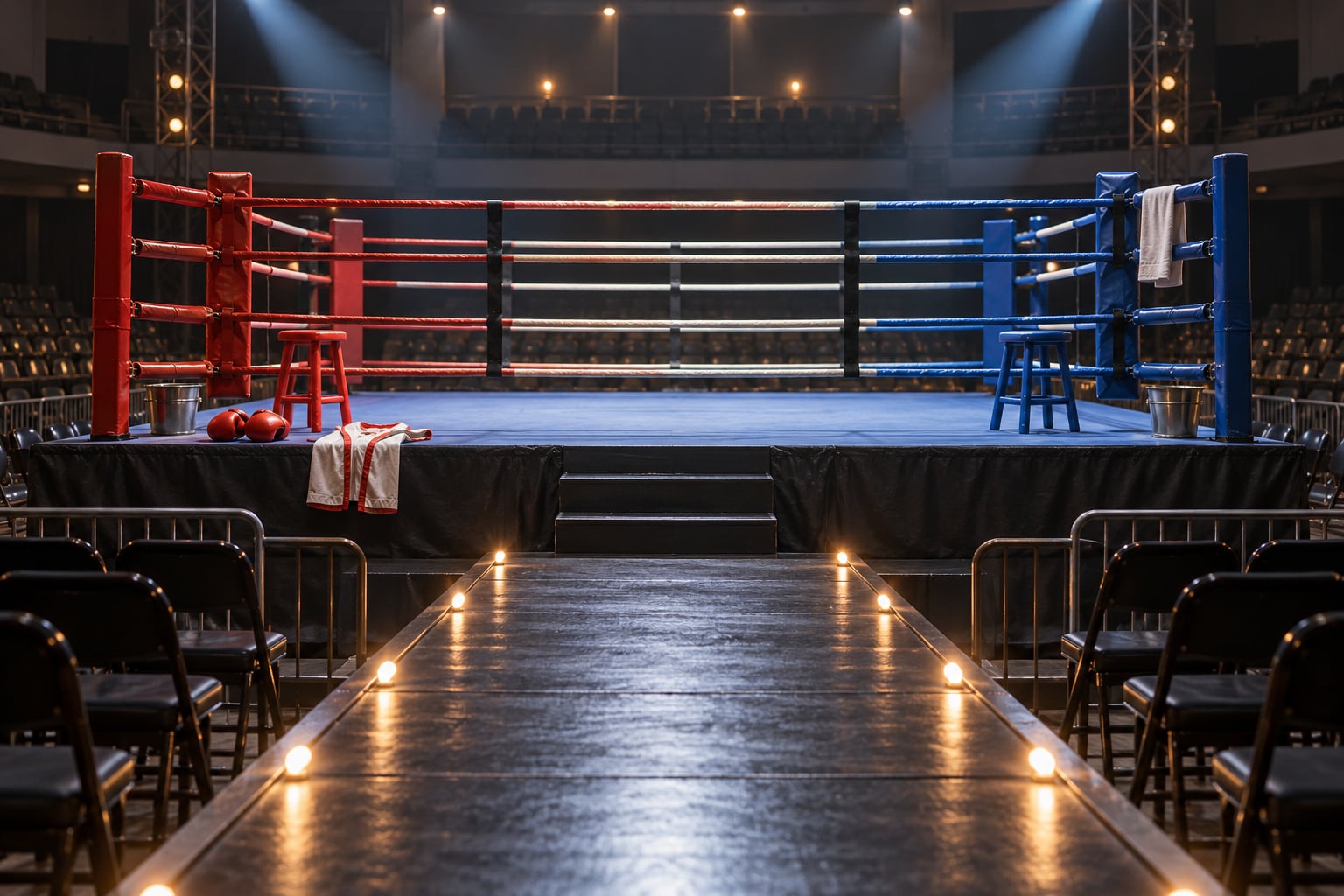
A professional boxing debut is your first sanctioned bout under a state athletic commission licence, and what a pro debut looks like runs from a strip-scale weigh-in in the afternoon to a raised hand under the lights that night. It is almost always a scheduled four-round fight on a club or regional card, fought in eight-ounce gloves with no headgear, and the result goes into your official record for good. Here is the whole night in the order it happens.
Table of Contents
What a Pro Debut Looks Like

Four things separate a professional debut from anything you did as an amateur: a commission licence, a weigh-in, a ring announcement and a scorecard. There is no headgear, no protective cup requirement in most jurisdictions beyond the standard groin protector, and nobody is removing points for contact to the head.
In order, the night looks like this:
- Arrival at the venue, where a commission official checks your licence and your opponent is usually somewhere in the building you have not met yet.
- Physical, if the commission wants one, plus a look at your wraps, gloves and mouthpiece.
- Weigh-in on an official scale, sometimes the day before, more often a few hours before the first fight.
- Hand wrapping in the corner, with a cutman or cornerman doing the work and a gloved inspector checking the result.
- Warm-up: shadowboxing, bag work, then rounds on the pads with the corner watching for anything that looks off.
- The robe goes on and the entrance music starts.
- Walkout to the ring, corner stool, bucket and ice bag.
- Introductions from the ring announcer, then the referee’s instructions and the mouthguard check.
- Three-minute rounds, with a one-minute rest and the cutman working on your face between each one.
- Final bell, then the referee signals, the announcer gives the decision or stoppage, and your record changes by one line.
The Hours Before the Fight
The afternoon is logistics, not drama. You arrive early, sometimes hours before your bout, because commission paperwork moves slowly and nobody wants to be the fighter holding up a card. Your licence, your opponent’s licence and both your bout sheets get checked against each other before anyone thinks about gloves.
The physical takes ten minutes. A doctor looks at your eyes, asks about headaches and dizziness, checks your blood pressure, and can pull you on the spot if anything is off. Being honest about a previous concussion buys you a suspension now instead of a licence problem later.
Wrapping takes longer than most debutants expect. Fifteen minutes of hand wrapping, then the inspector pulls at the layers to check they are snug enough to hold but loose enough to allow a closed fist. Gloves go on, lace, and the fit gets checked once more.
Then it is warm-up. Amateur fighters are used to shadowboxing for a full round or more. Professional warm-ups are short bursts of high output, a handful of hard rounds on the pads, and then back to the corner where the coaches are watching your feet rather than your hands. Fighters who look flat on the pads during warm-up usually get pulled from the card.
The Weigh-In and Final Faceoff
The weigh-in is a formality in the sense that the number is already decided. You cut weight over the final ten days of camp, and the scale at the weigh-in just confirms it. What the official number does is fix your weight class, which sets your opponent’s limit and removes any argument later about whether you were over.
Weigh-ins usually happen a few hours before the first fight on the card, though a promoter can schedule them the day before. Fighters who are making a large cut often start a fluid restriction 36 hours out and eat almost nothing solid in the final day, which is exactly why experienced cornermen will not let a debutant attempt a big cut on short notice.
Sauna suits, hot baths and laxatives are not cutting methods, they are dehydration. A boxer who steps on the scale under the limit and then rehydrates is carrying a fake weight, and commissions test for it by taking a fighter back to the scale after the bout.
The faceoff is theatre with a purpose. You will stand inches from a man you have never sparred, and if you have no connection yet, the staring contest gives you one. Broadcasters use it, promoters use it, and a few veteran fighters simply look at their opponent and start measuring. Treat it as free information, not a predictor. A harmless-looking debutant with a full amateur career behind him is a common sight.
The Walkout and Crowd Reaction
The ring announcer is the voice in the middle of the whole night, and their job runs from the first announcement of the card through the decision. For your bout they will read your name, your hometown, your amateur record and your weight, then do the same for your opponent, then send you back to your corner and start the fight.
The walkout itself lasts about ninety seconds. Robe on, entrance music chosen by you or your promoter, a walk down a lit aisle to a ring that looks far smaller than it did on television. Then the robe comes off, you hand it to someone in your corner, and you put your hand on the ropes for a moment because the surface is closer than you expected.
Reactions vary more than fight fans expect. A prospect with a name gets boos meant to flatter him. A local amateur favourite walking out to applause is a real thing on club cards. And a debutant with no record at all can walk into dead silence, because nobody in the building has an opinion about him yet.
What a Pro Debut Looks Like at the Start of Round One
The referee’s instructions are quick: protect yourself at all times, no low blows, no headgear to adjust, keep your mouthpiece in, and if you get badly hurt tell the referee. Then the referee sends you to your corner, checks the gloves, and the bell goes.
The most common first-round mistake is rushing. Amateur rounds are two minutes with a one-minute break, and many fighters spend their amateur careers in short explosive bursts. Three-minute professional rounds reward a boxer who moves, uses the ring and makes his opponent miss. Fighters who charge out of the corner at the bell usually spend the first ninety seconds burning everything they brought.
Nerves hit the legs first. That is the honest part of a debut, and it passes once a minute of real ring time is behind the fighter.
How the Fight Is Judged
Three judges score every bout using the 10-point must system. Each judge gives the fighter they saw as the round winner 10 points and the other 9, and a judge must award the higher score even if the round was close. Every fighter must be given the same score on every card, so rounds can differ from judge to judge, but totals cannot.
Judges are told to credit clean, hard punching, defence, ring control and effective aggression. They are told to penalise holding, clinching when a fighter is clearly not trying to break away, hitting after the bell, back-fists, low blows and refusing to engage. Activity on its own is worth very little, which surprises new fans who came from a sport where constant movement filled the tape.
A single spectacular moment does not decide anything. One knockdown is not a round. A fighter who drops his opponent and then gets caught walking back to his corner can still be behind on two cards.
Rounds a debutant can expect: four, with the possibility the bout ends in any of them. Four rounds of three minutes with one minute of rest between each is a total of twelve minutes of ring time, and it is more ring time than most amateurs handle in a full tournament.
What Happens After the Final Bell
The immediate sequence is short and predictable. The referee sends both fighters to neutral corners, checks the debutant over with a quick look at the eyes and a few questions, and waves it on if there is nothing wrong. Then comes the wait, which for a decision is usually only a minute but feels much longer.
If the fight was stopped, the announcer gives the result immediately and the hand goes up. If it goes the distance, three scores come back from the judges’ table and the announcer reads them out, round by round in many cases, before naming the winner. A draw on a debut card is uncommon but it happens, and it is more common when both fighters are cautious early.
Your professional record updates from 0-0-1 to 1-0-0 or 0-1-0, with the date, opponent, result, method and round time attached. That entry is permanent, which is why a debut against a name selected by a promoter is something every manager in the room treats seriously.
Then the medical suspension. A commission typically issues a suspension of a set period after a bout, commonly somewhere between 30 and 90 days, and the specific length depends on the ruling and the jurisdiction. During that period you cannot spar or compete in most states. Some commissions also require a neurological exam before clearance for anything after a knockout.
How to Watch a Pro Debut as a New Fan
Learn the two fighters before the bell. Search for the amateur bouts on a streaming service and watch two minutes of each, looking at how they move on the back foot rather than how hard they punch.
Watch the feet, not the hands. Distance control, foot position and whether a fighter gives up the centre of the ring tell you far more about how they will perform than anything that happens when the punches land.
Give round one a pass for evaluation. Almost every debutant looks tight for the first ninety seconds. Watch what changes after the break, when the corner has had a minute to give instructions and the fighter has found the pace.
Keep perspective on the outcome. A debutant who wins a decision after moving backwards for four rounds has learned something valuable, and a debutant who loses on points after standing his ground has still shown a promotionable style. Watchers who only react to the result miss most of what the fight actually told you.
If a bout ends early, the replays matter more than the finish. Look at how the punch landed, where the chin was, and whether the defending fighter had already changed his level before it came.
Frequently Asked Questions
How many rounds is a pro boxing debut?
Almost always four, and it is usually capped at four by commission rule rather than by the promoter. Each round runs three minutes with one minute of rest, so a debutant who goes the distance fights twelve minutes of ring time. After a strong enough showing, a boxer can be booked for six rounds on a later card.
How many days before a fight do boxers weigh in?
Usually the same day, a few hours before the first bout on the card. Some promoters schedule weigh-ins the day before, especially on cards with early start times. Either way, the weight cut itself happens over the final ten days or so of camp, and the official scale on fight night only confirms what was already decided.
How much does a professional boxer typically earn when they debut?
The figures vary enormously by region and by card, so any number you find is worth taking with a pinch of salt. The important structural point is that the boxer’s purse is contracted through a manager, and under a standard management agreement the manager takes a percentage before the boxer sees any of it. Club-card debuts pay very little and main-event debuts pay far more.
Do professional boxers wear headgear?
No. Headgear is an amateur requirement in most federations and is never worn in professional boxing, in any weight class. What a pro does wear is a cup, a mouthpiece, hand wraps, gloves approved for the weight class, trunks, boots and a robe for the walkout. Gloves for lighter divisions are smaller, which is part of why catchpunching is a concern in the lighter weights.
Is 25 too late to become a pro boxer?
It is late by amateur standards and perfectly workable in practice. What a commission cares about is a credible amateur record and a medical history, not a birth date. Plenty of fighters have debuted in their twenties and thirties because they put in years of amateur boxing first, and the age limit people assume exists does not exist.
Is a loss on debut the end of a boxer’s career?
No, and most debut losses are nothing more than useful information. Boxers lose debuts by standing in front of an opponent who was chosen precisely because he was safe, by being outpointed in a fight they could not win on paper, or by making a genuine error in the first exchange. Promoters who liked what they saw usually book the fighter again inside two to three months.
Conclusion: Focus on the First Bell
If you remember one thing about what a pro debut looks like, make it the first ninety seconds after the bell. Everything before it is preparation you can watch from the outside, and everything after it is a result that does not describe the fighter as well as the round does.
Look at how the boxer prepared, how they move under pressure and what they do once the corner has given them a minute to settle. A debut does not need to be flawless to be worth watching, and the fighters who looked lost on night one are the ones worth following for the next three years.