
Boxing eras compare most clearly when you measure five things: how a fighter was trained, how many serious champions existed at once, whether the best actually met, how the public could watch, and what rules were in force. Ranked on those grounds the 1920s through the 1970s sit alongside the 1980s Four Kings run and the modern 2010s, and no single decade wins everything. Here is how the eras hold up against each other in 2026.
Plenty of arguments about the greatest decade of boxing come down to memory rather than evidence. A Reddit poll on the greatest decade of boxing drew the heaviest support for the 1970s and 1980s, and commenters in r/Boxing routinely nominate Ali, Frazier and the Four Kings without ever defining what makes an era good. That is why this comparison scores every period the same way instead of listing names and walking away.
Table of Contents
- How Boxing Eras Compare Across Decades at a Glance
- How Dominant Tactics Changed Across Eras
- Which Era Produced the Deepest Concentration of Stars?
- How Title Fights and Majorweight Competition Differ by Era
- How Broadcasting Changed the Way We Viewed Boxing
- How Safety, Training, and Fighter Conditions Improved
- How Global Competition and Major Fights Evolved
- How Business Expectations Shaped Each Era
- Which Should You Choose?
- Frequently Asked Questions
- Conclusion
How Boxing Eras Compare Across Decades at a Glance
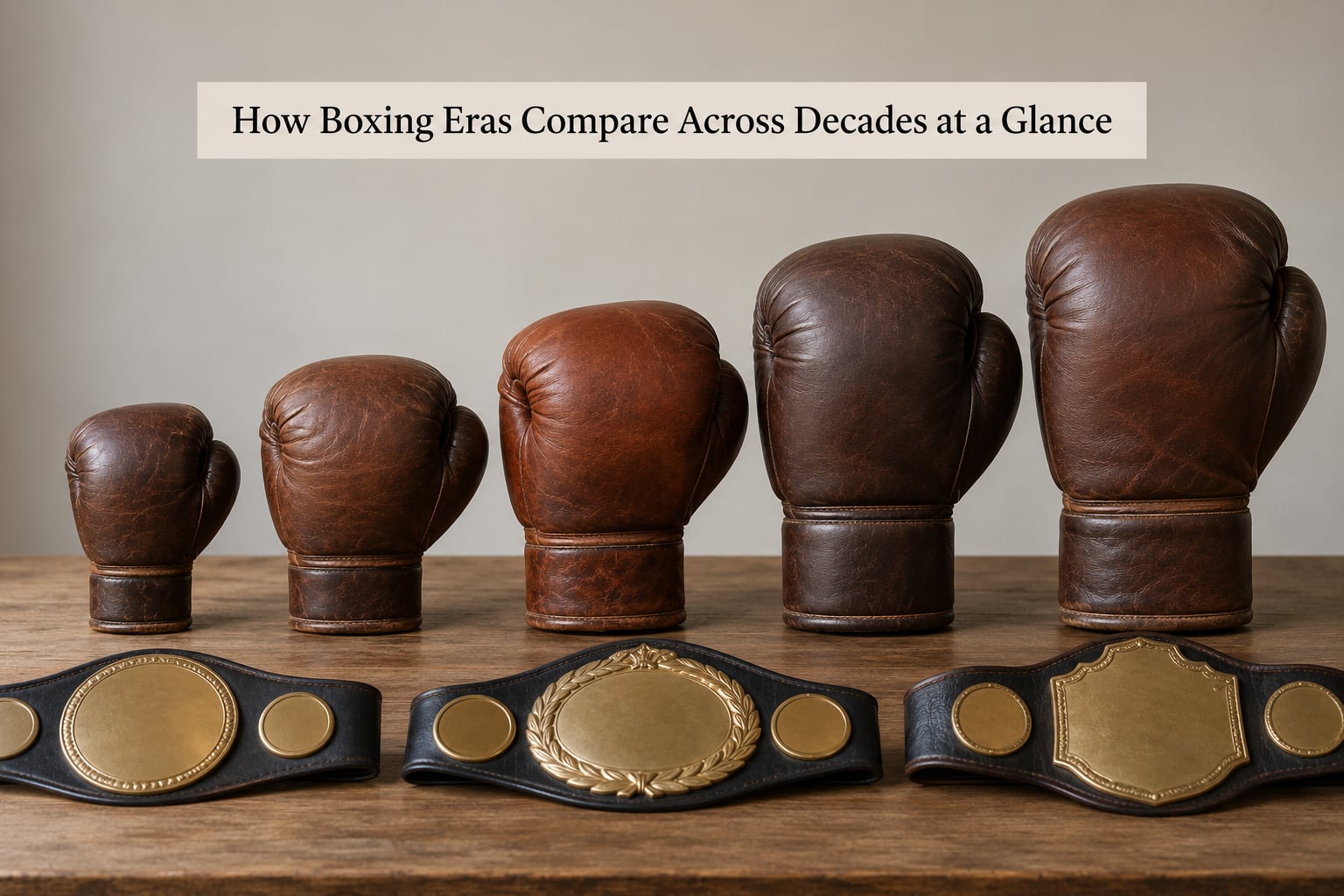
The table below sets five broad era blocks against seven criteria that actually changed across boxing history. Read it as a map rather than a verdict: each row favours different periods, and the columns are not interchangeable.
| Criterion | Pre-1970 | 1970s-1980s | 1990s-2000s | 2010s | 2020s |
|---|---|---|---|---|---|
| Dominant tactics | Pressure and infighting, rough ring work, small gloves | Movement, feints, speed, then the Four Kings pressure era | Southpaw counters, shoulder roll, speed versus size debates | Range control, jab economics, pressure with elite footwork | Movement plus power, with four-belt unification at the top |
| Star power | Few champions, each with enormous reach | Densest concentration: Ali, Frazier, Holmes, Tyson, Hamed’s arrival | Tyson at peak, Holyfield, Whitaker, Pacquiao, Mayweather | Mayweather, Canelo, GGG, Wilder, Khabib, Crawford | Usyk, Inoue, Bivol, Fury, Davis |
| Title opportunities | Mostly one recognized champion per division | Two or three bodies, frequent mandatory defenses | Split begins: five bodies by the 1990s | Four-belt era, many champions holding two and three titles | Formal unification attempts, but multiple champions persist |
| Broadcasting | Newspapers, radio, then sparse network TV | Network TV on CBS and ABC; closed-circuit PPV later | HBO and Showtime, closed PPV, highlight reels | Streaming plus cable, highlight packages dominate reach | Streaming-first audiences, social clips, fewer marquee cards |
| Global reach | US and British strongholds, growing Japanese presence | British, Mexican, Filipino, Soviet and Cuban systems all feeding the pros | Eastern European and Latin American waves; more world events abroad | Japanese, Kazakh, British, Cuban and Mexican champions everywhere | Truly global circuit with regional promotions feeding majors |
| Safety standards | Basic medical help, no glove or cut standards | Gloves standardized to ten ounces for titles, doctor ringside | Better ringside medicine, but weight cutting and dehydration concerns grow | Commission oversight of cuts, rehydration rules, concussion protocols | Strongest medical frameworks, still uneven across regions |
| Defining characteristic | Small gloves and long fights, glorifying endurance | Best-versus-best ambition at its highest | Legends aging into contention while division names multiply | Best talent in decades, worst matchmaking clarity | Unification as the goal, talent spread thin by activity levels |
How Dominant Tactics Changed Across Eras
How boxing eras shifted dominant tactics, and what caused it
Every major tactical shift traces back to a rule or a piece of equipment. Change the glove weight and you change what a fighter can safely throw at close range. Change the number of rounds and you change who is favoured over the distance of a title fight.
The earliest championship era ran on pressure. Gloves were small, the ring was smaller, and standing still in front of a heavy puncher was a bad idea. The bare-knuckle pioneers gave way to gloved championship boxing, and much of the technique through the first half of the twentieth century rewards the fighter willing to work in a phone booth.
Joe Louis and Rocky Marciano offered two different answers in the heavyweight division, and Sugar Ray Robinson added the other pole: a fighter who controlled distance, jabbed and pivoted away from trouble. Marciano in particular built a style on a heavy right hand and a willingness to walk forward into the pocket.
The 1960s and 1970s are where modern ring generalship matured, because Muhammad Ali refused to be a pressure fighter. The circling-out style demanded footwork, ring cutting and ring vision from everyone who faced it. Larry Holmes brought that same logic to the heavyweight division, staying just outside the range where a bigger puncher could reach him and punishing anyone who walked forward.
Smaller gloves came back into championship use in the 1980s with eight-ounce gloves, which rewarded speed and head movement over volume punching. When titles moved to ten-ounce gloves in the 1990s and remained there, cut-heavy styles lost some of their advantage and defensive counterpunching gained ground.
The 2000s split the sport into two credible answers again: the boxer who controlled range with the jab and the boxer who walked forward behind the jab. The 2010s refined that argument rather than resolving it. Canelo Alvarez and Gennady Golovkin fought a trilogy that most observers read as the most technically contested argument in modern boxing, with the answer still disputed years later.
Officiating changed too, and not always for the better. Early officials were inconsistent enough that local judges shaped outcomes in ways nobody audited. Over time sanctioning bodies adopted written scoring rules, and by the 1990s and 2000s most major fights used three judges with electronic scoring, which removed the crooked scoring era and replaced it with a different kind of dispute: judges whose interpretations of the same round simply differ.
The 2020s have not produced a single new tactical school so far. What they have produced is movement at heavyweight, where Oleksandr Usyk used footwork and shoulder positioning to win a division that had spent forty years assuming it could not be out-boxed.
One change matters more than most for comparing old fights to new ones. Round counts fell from fifteen to twelve for world title fights, a shift most state commissions adopted around the early 1980s. Commenters in r/Boxing make a fair point about it: rounds thirteen through fifteen were known as the championship rounds, and shortening the fight disproportionately punishes aggressive pressure fighters who need the later rounds, while doing little to a defensive counter-puncher who was already winning.
Which Era Produced the Deepest Concentration of Stars?
By density of recognised champions, the 1970s and 1980s stand out, and the 2010s are close behind. Measured by concentration rather than quality, the 1920s and 1930s had fewer champions and much wider gaps between them.
The 1920s and 1930s produced extraordinary individuals who mostly dominated for years. Gene Tunney, Harry Greb, Jack Dempsey, Jack Johnson and Joe Louis each held the sport in ways few eras repeat, but there was often one clear answer per division and a long wait for the next one. Concentration of talent was low even though quality at the very top was enormous.
The 1970s changed that. Muhammad Ali, Joe Frazier, George Foreman, Ken Norton, Earnie Shavers, Carlos Monzon, Roberto Duran and Salvador Sanchez were all active and dangerous at overlapping times, across several weight classes at once. Add the arrival of Larry Holmes and the era has more credible simultaneous contenders than any decade before it.
The 1980s narrowed to a famous spine at heavyweight, the Four Kings: Mike Tyson, Larry Holmes, Riddick Bowe and Evander Holyfield. Alongside them sat Sugar Ray Leonard, Marvin Hagler, Thomas Hearns and Wilfred Benitez, four boxers whose rivalry with each other defined a decade. Concentration was extraordinary at the top and thinner beneath it.
The 2010s spread talent more evenly across more divisions than any period in history. Floyd Mayweather Jr, Manny Pacquiao’s late-career peak, Canelo Alvarez, Gennady Golovkin, Terence Crawford, Deontay Wilder, Tyson Fury, Anthony Joshua, Vasiliy Lomachenko and Khabib Nurmagomedov each anchored a division, and most of them overlapped with at least two others.
One warning before anyone reduces this to a list. Fans have a habit of nominating the 1970s and leaving it there, but that decade had a famously thin supporting cast, particularly among Black American heavyweights, and treating it as pure peak dismisses the era’s own flaws. Reddit users debating favourite fighters from each decade will happily name a champion from a decade that had three serious titleholders, and call it the deepest.
How Title Fights and Majorweight Competition Differ by Era
The clearest structural difference is how many bodies a champion had to answer to. Until roughly the 1980s, a title usually meant one recognized champion per division with a short list of mandatory challengers. By the 1990s five sanctioning organisations were crowning champions regularly, and by the 2010s a single fighter could hold three or four belts without ever facing the champion ranked below him.
That fragmentation changed what a championship meant. In the mid-century era, holding the heavyweight title carried an expectation of long reigns and a defined path back to the champion. Joe Louis defended the heavyweight title dozens of times in a row, and the challenger list was public and short.
Rival promotions made the 1970s and 1980s the era of the biggest fights. Separate cable and network operations competed for the same fighters, which at least made best-versus-best matchups financially attractive. The downside was obvious too: champions could be protected from one rival promotion, and mandatory obligations were used as a shield.
Closed-circuit pay-per-view in the 1990s raised the price of watching, which narrowed access, but it also made promoters more willing to assemble dream cards. Whatever the motives, the era produced several fights that had not been possible ten years earlier, including two Tyson-Holyfield bouts and the 1974 Ali-Foreman rematch in Zaire that restored the sport’s credibility on television.
The four-belt era solved the money problem and created an identity problem. Champions hoover up belts rather than risk them, and readers pick the single most repeated complaint in boxing forums: a division with four champions and no clear best has no meaning. Unification is now treated as the goal, and repeated attempts at it have become the modern era’s defining storyline.
How Broadcasting Changed the Way We Viewed Boxing
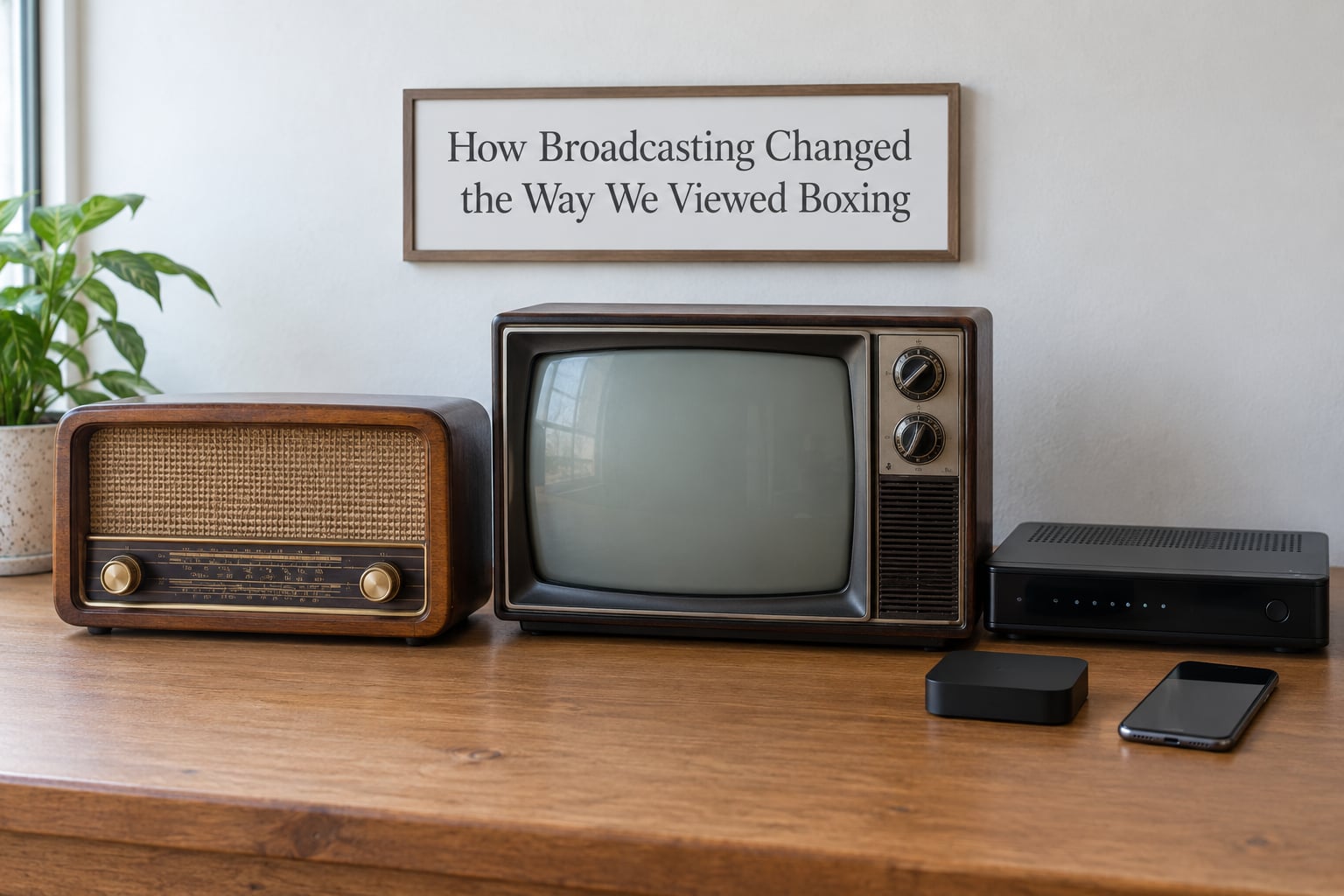
Broadcasting decided which era’s fights we can actually see, and therefore which era we remember. For most of the early twentieth century, boxing reached people through newspapers and radio, so a heavyweight title fight might be described in a paragraph rather than watched live. A punch-by-punch radio call shaped how listeners imagined the fight, and imagination filled the gaps.
Network television in the 1950s and 1960s turned major fights into shared national events, and the Friday Night Fights format built a weekly habit for viewers. Fight of the Century in 1971 was carried on closed-circuit television and shown in theatres, which is the first time the sport’s biggest moment was deliberately rationed for profit.
The 1980s and 1990s brought the dedicated sports channel, with HBO and Showtime making pay-per-view the standard way to see the biggest fights. Drawbacks were real: a Foreman-Tyson broadcast in 1996 was abandoned after a satellite failure, and the memory of that night is still a bruise on the format. Access narrowed as the price of watching rose.
Highlight packages then changed what a fight meant culturally. Tyson, Foreman and Roy Jones Jr became household figures largely through edited footage, not live viewing. The punches we remember are the ones that got replayed, so an era’s public image is partly an artefact of its editors.
Streaming and social clips define the current era. Access is wider and cheaper, but the marquee fights are fewer, and many casual viewers now encounter boxing as a stream of two-minute knockouts rather than as scheduled events. An era that produced one unforgettable night a year can be outshouted by an era that produces clips every week.
How Safety, Training, and Fighter Conditions Improved
Conditions have improved substantially and unevenly. Early championship boxing had no glove standard, minimal gloves that tore, and often no doctor at ringside. A serious cut could end a career with no medical follow-up at all, and weight cutting was unregulated because almost nobody regulated it.
Ten-ounce gloves for championship fights and eight-ounce gloves for lower weights standardised protection, and a ringside doctor became normal rather than exceptional. Mouthguards and headgear entered regular use, and cut stops and doctor stoppages moved from controversy toward routine.
Training science is the quiet transformation. Old-era fighters learned in small gyms with improvised sparring, and many fought with untaped hands because tape was treated as a sign of weakness. Modern camps track punch output, nutrition, sleep and recovery, and conditioning staff work alongside trainers in ways that barely existed before the 1990s.
Weight cutting is the part of the progress story that has not gone well. Rehydrating after a cut is now standard, and state commissions in the United States impose limits and rehydration requirements, which is a genuine change from the era when fighters routinely shed ten percent of their body weight in a week. Fighters and promoters both still push past the new limits.
Frequency also cut against depth of quality in one specific way: a boxer fighting twenty-five times a year often took a bout on short notice against an opponent he was not ready for. The old-timer record of fifty wins is a mix of genuine greatness and six weeks of preparation against opposition that had accepted the fight because it was already booked.
Longer careers have followed from better care, but so has caution. Fighters in modern eras sit out more, take fewer fights, and are protected from hard punches in ways that earlier generations were not. Some of that is medicine working. Some of it is risk being priced into business decisions, and the two are hard to separate.
How Global Competition and Major Fights Evolved
Boxing was never purely American, but the balance has shifted twice. The early twentieth century drew talent from Britain, Ireland and France, and the first era of championship boxing was built on British and American fighters who had trained in an entirely different style.
The British, Mexican, Filipino, Cuban and Soviet systems each supplied champions in the 1970s and 1980s, and the Olympic programme created a formal pipeline that ran from amateur championships to professional debuts. Teofilo Stevenson and the Cuban system, and the Soviet system’s depth of well-rounded technicians, produced professionals who were unusually hard for career pros to break down.
Japan’s rise in the 1970s and 1980s, led by a heavyweight champion who fought at range with footwork in a division that had always been the exception, showed that styles travel between countries and not just between generations.
Mexican boxing has produced a long line of champions and mandatory challengers across weight classes, and Filipino fighters have featured in marquee fights in every decade since the 1970s.
The 1990s and 2000s brought heavier Eastern European and Latin American representation, along with the first significant influx of high-level fighters from Uzbekistan, Kazakhstan and the former Soviet republics. A r/Boxing discussion about trends in the sport makes the case that the late 1980s and 1990s heavyweight scene in the United States was unusually competitive and unusually entertaining, which is hard to argue with on a match-quality basis alone.
Event geography now matters more. Earlier eras clustered major fights in Las Vegas and New York with occasional trips to Europe and Japan. Major fights now rotate through Riyadh, London, Tokyo and other regional centres, driven by broadcast partnerships and sponsorship rather than by which promotion can assemble the best card.
How Business Expectations Shaped Each Era
How boxing earns money shapes how boxing looks in the ring, and this is the single biggest reason eras are hard to compare. Gate revenue, television rights and sponsorship decided matchmaking long before any matchmaker sat down at a table.
For most of the twentieth century, boxers fought far more often. Careers of twenty and thirty professional fights were normal, and titleholders defended regularly because a defeat meant losing income immediately. The downside of that model is that it used fighters up, and it explains why old-timer careers tend to look spectacular early and end badly.
Television rights in the 1980s and 1990s replaced the gate as the main revenue line. Promoters learned that a big matchup, even at very high cost, reliably outsold a stacked card. That capital funded bigger fights, and it also funded promoters who had more reason to protect their own investments than to insist their champion faced the best available opponent.
The four-belt era is the logical result. Collecting belts raises a champion’s status and value without requiring a unification fight, and it keeps two promoters’ assets alive at once. Fans get more champions and fewer decisive fights, which is why the most common modern-era complaint is about matchmaking rather than talent.
Fighter compensation now runs through the opposite problem. A modern boxer might earn more in one night than a mid-century champion earned in a career, while also boxing one or two times a year instead of twenty. Higher pay and far lower activity are the trade, and both sides of it make the modern era harder to rank against the past.
Which Should You Choose?
Pick by what you actually want from a fight, because every era wins something and loses something else. For technique, ring craft and the clearest reading of how boxing works, the 1970s are hard to beat. For power and sustained action, the 1980s Four Kings run is the reference point. For the highest concentration of elite talent across many divisions at once, the 2010s are the strongest candidate. For historical weight and context, the 1920s and 1930s explain where the sport came from. For accessibility, the streaming era wins by a distance. For an accurate picture of boxing’s present and its next decade, only the 2010s and 2020s can tell you.
My own preference is the 1970s, for reasons I can defend rather than just remember. Ali and Frazier gave the sport the clearest tactical argument it has ever had, Holmes brought a genuinely new fighter to heavyweight, and Shavers, Norton and Monzon made the supporting cast deep enough that the era did not depend on one name.
If you want a fair comparison rather than a favourite era, score periods on four things instead of one: champion quality, depth of challengers, how often the best actually met, and how much of the sport you can watch. Do that for each period and the ranking changes less often than people expect, because eras score well on different rows.
Frequently Asked Questions
What is the best era in boxing history?
Most historians point to the 1970s, with the 1980s Four Kings era and the 2010s close behind. The 1970s win on champion quality, depth of challengers and how often the best fighters actually met. The 2010s match them for talent across more weight classes but lose points on matchmaking clarity, since multiple belt holders made title fights harder to read.
Was professional boxing harder to succeed in during the 1970s and 1980s?
In some ways yes. Champions faced mandatory challengers, defended more often, and were expected to hold a title for years, so a loss usually ended a reign and cut income immediately. Fighters also absorbed more punishment with fewer medical protections and far less protective equipment, so career longevity was shorter and the cost of failure was harsher.
Why did boxing have more world champions in certain decades?
Because sanctioning bodies multiplied. For decades one organisation crowned most champions per weight class, so the division had one clear answer. From the 1990s more bodies began crowning champions and weight classes proliferated from roughly eight to seventeen divisions. Fighters also moved between weight classes faster, so a division could hold two legitimate champions without either being inferior.
Were boxers technically better in previous eras?
It depends what you count as technique. Fighters in the Golden Age had more fight experience, a longer amateur pedigree in some cases, and more rounds to prove conditioning. Modern boxers train with better science, nutrition and sports medicine. Records and knockout totals cannot be compared directly because gloves, round counts and ring size all changed.
Can modern boxing rules tell us which era was more dangerous?
Only loosely. Gloves got heavier for title fights, rounds dropped from fifteen to twelve, and ringside doctors became standard, all of which reduce certain risks. But weight cutting, dehydration and repeated head impacts remain serious problems. Rule differences explain a good deal of why old stoppages were more frequent without proving that older fighters were safer.
Conclusion
No era wins every category, and that is the honest answer to how boxing eras compare across decades in 2026. The 1970s offer the deepest concentration of elite champions, the 1980s supply the hardest single rivalry cluster, the 2010s hold the most talent across the most divisions, and the pre-1970 periods explain where all of it came from.
Start by naming the quality you value most, technique, action, stardom, accessibility or historical weight, then pick the era that scores highest there. Once you score several criteria instead of one, the argument gets much shorter and much better.