Amateur boxing scoring and professional boxing scoring both run on the 10-point must system, so a round is always scored 10-9 or wider. The real difference sits in what judges reward: amateur panels count clean, busy punching and effective aggression over three rounds with five judges, while professional ringside judges weigh impact, ring control and damage over as many as twelve rounds with three judges.
That gap explains a lot of what frustrates new fans. A boxer who wins an amateur final by throwing 120 punches can lose the same fight eight months later as a professional. Nothing went wrong with the punches. The judging criteria changed underneath him.
Here is how each system actually works, round by round, with the numbers a spectator needs to follow along at ringside.
Table of Contents
- How Amateur Boxing Scoring Differs from Pro at a Glance
- What Counts as a Point?
- How Rounds and Time Limits Change the Fight
- Why Judges Value Control, Activity and Ring Position
- How Clean Hits Are Judged
- How Points Are Awarded Under Each Scoring System
- How Fouls, Holds and Clinches Affect the Score
- How Draws Are Decided
- How Equipment and Competition Format Affect the Bout
- Which Should You Choose?
- Frequently Asked Questions
- Does amateur boxing use 10-point scoring?
- How many points do amateur boxers need to win a bout?
- Why do professional judges give fighters a 10-9 round?
- Are clean hits more important in amateur or professional boxing?
- How are draws handled in amateur and professional boxing?
- How does scoring differ when an amateur fighter is penalized?
- Conclusion: Learn to Read Both Scorecards
How Amateur Boxing Scoring Differs from Pro at a Glance
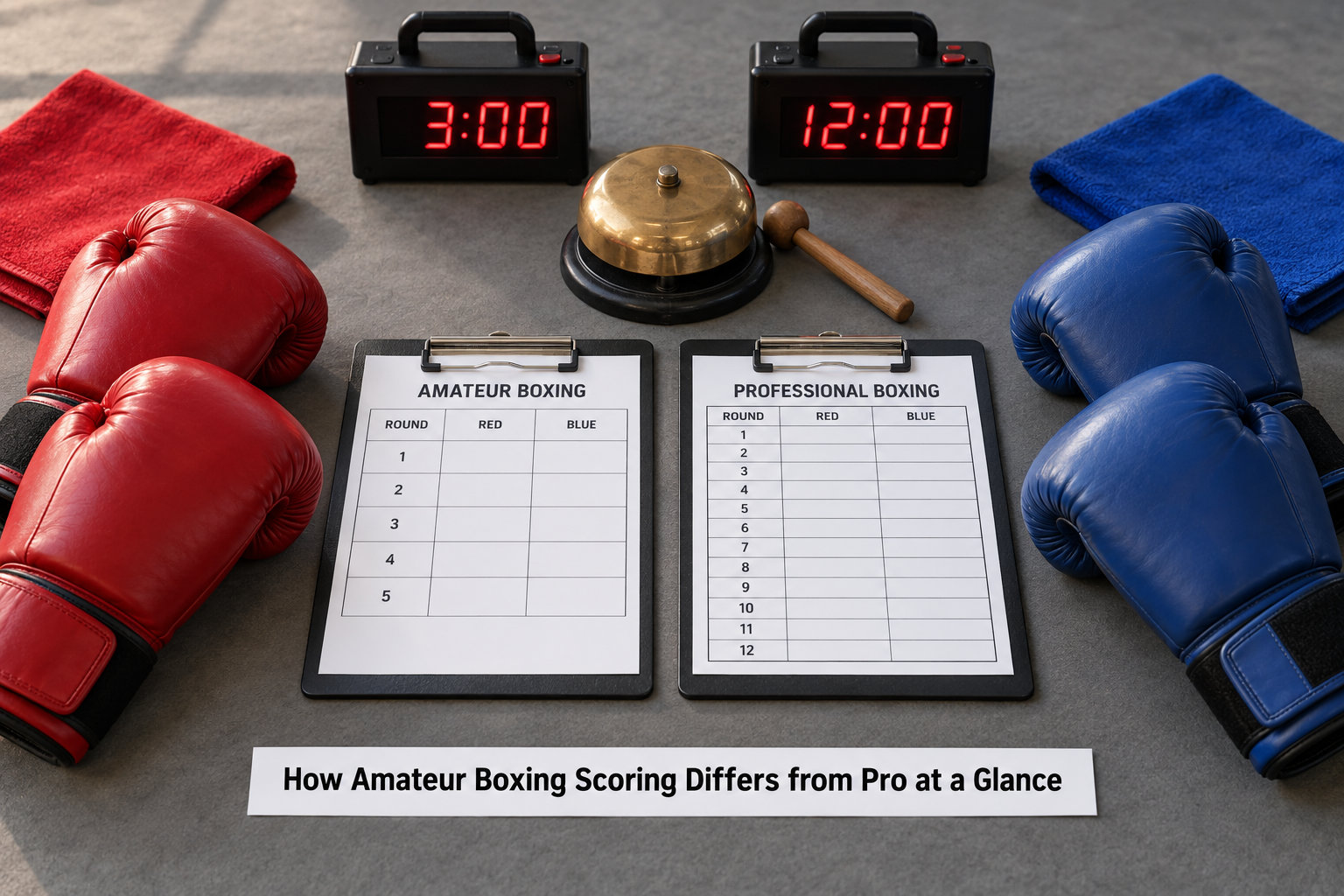
| Criterion | Amateur boxing | Professional boxing |
|---|---|---|
| Scoring system | 10-point must | 10-point must |
| Judges | Five ringside judges at major competitions, three at smaller local shows | Three judges ringside |
| Rounds | Three rounds for men, usually three shorter rounds for women | Four to twelve rounds, twelve for most title fights |
| Round length | Three minutes for men, two minutes for women under most governing bodies | Three minutes per round |
| Main judging priority | Clean hits, volume, effective aggression, ring control, defence | Punch impact, ring generalship, cutting off the ring, hurt inflicted, defence |
| Target area | Scoring zone above the waist and the sides of the head; hits behind the ear or on the back of the head score nothing | Same general target area, with judges weighting the effect of each clean shot more heavily |
| Knockdown rounds | 10-8 for one knockdown, 10-7 for two or more, at the judges’ discretion | 10-8 for one knockdown, 10-7 for two or more, plus the 80/20 rule in several jurisdictions |
| Draws | Rarely allowed in tournaments, which generally need a declared winner | Allowed; a majority decision is a legitimate result |
| Protective equipment | Larger gloves, and headgear required at many non-Olympic shows | Smaller gloves, no headgear |
Two columns on that table look identical, and that surprises people. The 10-point must scale is not the difference. The judge count, the round length, the equipment and the criteria behind the numbers are where the split sits.
What Counts as a Point?
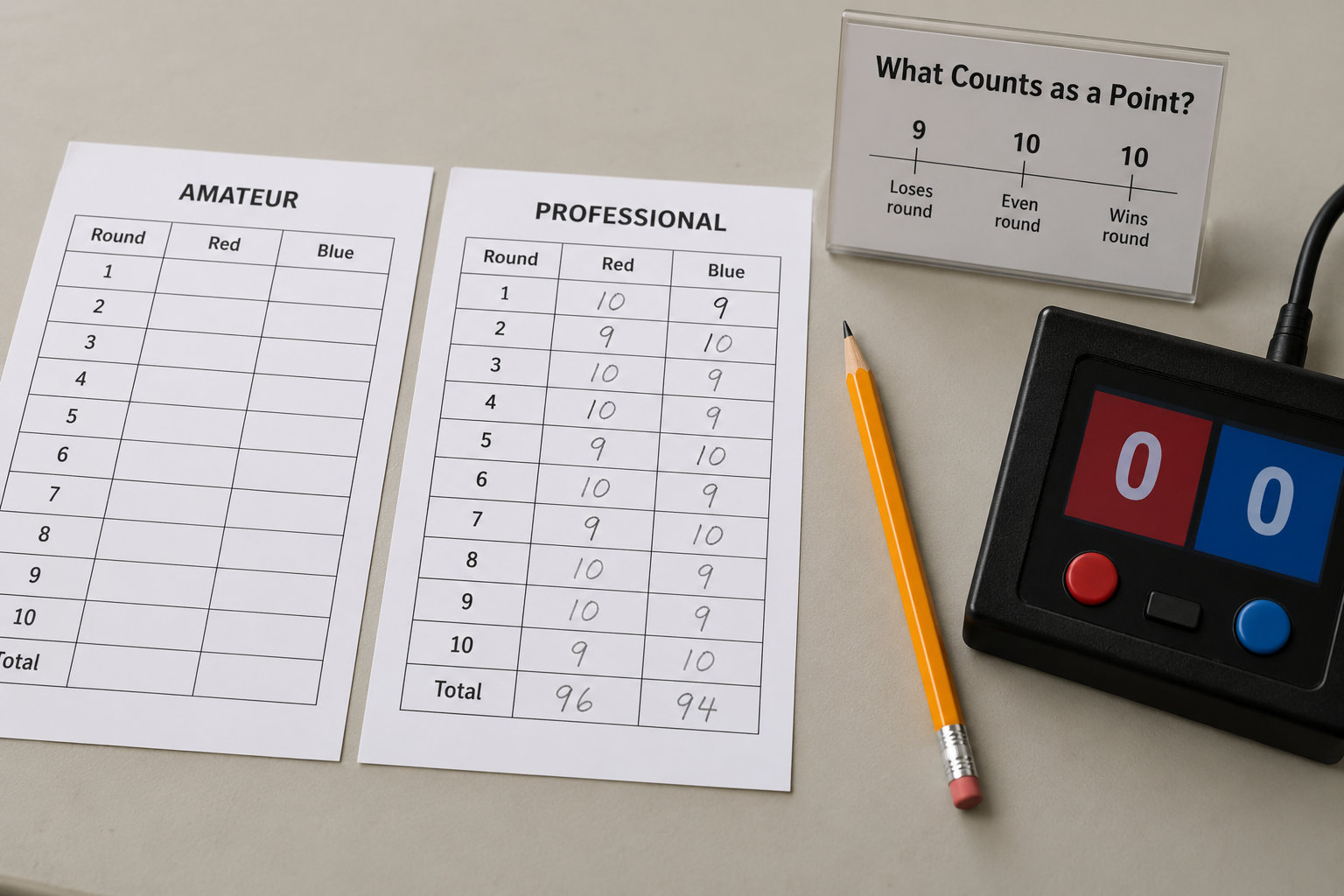
A point is awarded for a clean punch landed inside the scoring zone. Clean means it lands with the part of the glove covered by the knuckle and thumb, not the padding, and that it does not slide off the head, glance off the shoulder or land behind the ear.
In the amateur code, a punch counts even when it barely moves the head, as long as the technique and placement are right. Two light jabs to the temple and a hard looping shot that misses the jaw entirely produce two points and no points. Volume is not a tiebreaker in amateur scoring; it is closer to being one of the main criteria.
In the professional code, the same two jabs may count for nothing if the judge feels the opponent controlled the exchange, while a single hook that snaps the head back is worth a full round on its own.
Consider one 30-second sequence in an amateur bout. A boxer in red misses a wide right hand, lands a jab to the side of the head, steps back out of range, and blocks a counter. That single jab is one point. Now imagine the same 30 seconds in a title fight, where red lands the jab and then a body shot that visibly hurts blue. The judges may give that exchange the round.
How Rounds and Time Limits Change the Fight
Round structure changes scoring before a single punch is thrown. A three-round amateur bout gives each fighter three opportunities to win rounds, so winning one clearly and losing one narrowly is a common result. A twelve-round professional bout spreads the same pressure across 36 minutes of ring time, so no single strong stretch decides much.
Women’s amateur formats usually run three rounds of two minutes rather than three of three, so fighters score in the same number of rounds but have a third less time in each. Formats change by governing body, age group and competition level, so the exact structure at a local club show can differ from a national championship or the Olympic programme.
How Amateur Boxing Scoring Differs from Pro in One Round
Watch an amateur round and then a professional round with the same attention and the difference becomes obvious in the first thirty seconds. The amateur fighter circles, jabs, steps in, ties up briefly, breaks away and resumes jabbing. Most of the round is spent at long-to-medium range, landing in ones and twos.
A professional round at the same moment tends to look different. One fighter walks the other to the ropes, lands a body shot, gets out of range, and resets. The action is shorter and heavier, and the quiet seconds between exchanges matter as much as the exchanges themselves.
Now score it. The amateur judge wrote 10-9 for the busier fighter after a clean round with no knockdowns. The professional judge wrote 10-9 for the fighter who controlled the ring and hurt his opponent twice, even though the busy fighter outlanded him on volume.
Both scorecards are correct under their own criteria. That is the entire distinction.
Why Judges Value Control, Activity and Ring Position
Ring control means where a fighter forces his opponent to stand. A boxer who keeps cutting off the ring, walking a rival to the ropes and dictating the distance is doing something judges score, because control makes every exchange harder for the opponent to win.
Effective aggression means going forward with a purpose, not swinging wild. Moving in behind a jab, throwing a short combination and backing out of range scores well even when the punches are not heavy. Flailing with no plan scores nothing, however busy the fighter looks.
Defence matters on both sides of the ledger. Blocking, slipping and making an opponent miss are credited, which is why retreating and covering up rarely wins rounds for anyone.
Holding and clinching work against the boxer doing them. Referees break clinches to restore clean punching, and time spent tied up is time a fighter is not scoring.
Judges are also human, and they sit at fixed angles around the ring. A judge positioned near a corner can be blocked out by a fighter’s back for long stretches, which is part of why fans argue about which side of the ring you were watching from.
How Clean Hits Are Judged
Both codes require clean punching, and both define clean the same way technically. The difference is what sits on top of the technique requirement.
Amateur judges are told to reward the number and quality of scoring punches, head movement, ring control and defence. Precision and repetition carry the round. A fighter who lands forty well-placed shots has done something a pro judge might not even mention in his notes, because the shot that ends a round is the one that lands hardest.
Professional judges are told to weigh effective striking, defence and who is making the other fighter miss. Impact carries the round. Damage, swelling, a fighter backing off after being caught clean, all of it feeds into the score.
Headgear adds a wrinkle. In shows where headgear is required, judges report seeing fewer punches register cleanly on the scoring zone because shots tend to land on the wider surface of the headgear. It is a small effect that most judges say they account for without thinking about it.
How Points Are Awarded Under Each Scoring System
Both codes run on the same mechanic. Every round, the judge must give ten points to the round winner and nine or fewer to the loser. There is no 9-9 round. That one comes up constantly in forums and it is simply not a thing.
The round scores a judge can write:
- 10-9 the standard round, no knockdown
- 10-8 awarded only when there is a knockdown, or under the 80/20 rule in some jurisdictions
- 10-7 awarded only when there are two or more knockdowns in the round
- 10-6 used in some professional jurisdictions for a dominant round without a knockdown
The 80/20 rule matters in professional boxing specifically. If a fighter is clearly dominated and lands no punch at all in a round, judges in states that apply the rule may score it 10-8 even without a knockdown. Amateur bouts do not use an 80/20 rule in the same way, because amateur judges are directed to reward the punches that do land.
Here is how a typical three-round amateur card and a twelve-round professional card actually add up:
| Bout | Round scores | Total | Result |
|---|---|---|---|
| Three-round amateur, close | 10-9, 10-9, 10-8 | 30-27 | Unanimous decision |
| Three-round amateur, even | 10-9, 10-9, 10-9 | 29-28 | Unanimous decision |
| Three-round amateur, knocked down | 10-8, 10-9, 10-9 | 30-27 | Unanimous decision |
| Twelve-round professional, close | 10-9 x 11, 10-8 in round nine | 117-111 | Unanimous decision |
| Twelve-round professional, even | 10-9 x 12 | 120-114 | Unanimous decision |
| Six-round professional, clear | 10-8, 10-9 x 5 | 59-54 | Unanimous decision |
Totals like 30-27 or 117-111 are only as close as they look. Each round is worth one point on the scorecard, and a decision is decided on totals, not on total punches.
How Fouls, Holds and Clinches Affect the Score
Both codes punish fouls the same way, through a ladder: a warning from the referee, then a point deduction, then disqualification. The difference is how often fighters climb that ladder in practice.
Amateur bouts punish low blows strictly, and the treatment of clinching is deliberately aggressive because prolonged tying up kills the action that amateur judges are told to reward. Referees break and separate quickly.
Professional bouts have a wider range of fouls, including the rabbit punch, low blows, holding the gloves behind the head, and pushing or landing on an opponent already falling. Some commissions dock a point for a single low blow; others require a warning first.
A single point deduction decides close bouts. If a fighter is ahead 115-113 on one card and receives a point deduction, the totals can flip and three judges can split three ways. That is the mechanical reason amateur fighters rarely complain openly in front of the crowd.
How Draws Are Decided
Professional boxing allows a draw. If all three judges score the same totals, or two of the three agree, the result is a majority or unanimous draw, and it stands as an official outcome.
Amateur tournaments rarely allow draws, because a bracket needs a winner in the next round. Where totals are level, the rules give judges or officials a tie-break: compare the fighter who won more rounds, then the fighter who scored more points overall, then the scorecards from individual judges.
Split decisions come from a different source. When the three judges disagree, the bout is scored on a majority basis. In amateur boxing with five judges, you also get the awkward scenarios that only exist in amateur formats, such as three judges scoring it one way and two scoring it the other.
Disqualification can also overturn a score. If a fighter is disqualified after the bell on accumulated fouls, the win goes to the opponent regardless of what the judges wrote.
How Equipment and Competition Format Affect the Bout
Glove size changes punch value and therefore changes scoring. Amateur competition uses larger gloves across most weight classes, which is one reason clean amateur punches are judged for placement rather than effect. Move up a weight division and the gloves shrink, and the same punch registers differently to a judge.
Headgear is required at many amateur shows and absent in the pros. Judges at those shows work around the extra surface area on the scoring zone of the head, which can mean fewer punches counted in close amateur rounds.
Format shapes risk. An amateur fighter trains for three rounds with a ref’s stoppage in mind and a points total as the goal. A professional must pace for twelve, absorb damage that would end an amateur fight, and chase a knockout because a decision may not be there. Many amateurs arrive in the pros with a style built for accumulating points rather than ending exchanges.
Boxers on the BoxRec forum describe that transition as having to re-learn the sport, because they were taught to go for single clean shots and volume rather than sustained pressure and ring position.
Which Should You Choose?
Choose amateur boxing if you are learning technique, if you want a scoring system where clean footwork and clean punching are visibly rewarded, or if you want a structured ladder from local shows to national teams. Five judges at major competitions smooth out the sharpest single-judge swings, which is easier on a beginner than a three-judge split.
Choose professional boxing if your goal is the longest established competitive format, with a defined champion at each weight, deeper rounds, and a scoring system that pays fighters for impact and control. Be honest about the trade: a professional round is judged by a smaller panel, the total is decided by three cards, and a point deduction can cost you the fight.
For a spectator, watch one amateur bout and one pro bout back to back and track only two things: who forced the fight onto their terms, and who landed the shot that visibly hurt the other man. Everything else follows from those.
Frequently Asked Questions
Does amateur boxing use 10-point scoring?
Yes. Amateur bouts at governing body competitions use the same 10-point must system as the pros. Each round, judges award ten points to the round winner and nine or fewer to the loser. The difference sits in the criteria judges are told to apply, not in the point scale itself. Amateur judges are directed to reward clean punching, volume, effective aggression and ring control.
How many points do amateur boxers need to win a bout?
There is no target number, because rounds are what count. In a three-round amateur bout you need to win more rounds than your opponent: two rounds to one gives totals like 29-28 or 30-27. A fighter can lose a round badly and still win the bout by taking the other two clearly, which is why amateur fighters chase rounds rather than knockouts.
Why do professional judges give fighters a 10-9 round?
A 10-9 is the standard round score, and it covers far more than an even exchange. Judges compare the fighters on clean punching, effective aggression, defence and ring control, so a round stays 10-9 whenever nothing hard enough happens to widen it. One knockdown normally turns it into a 10-8.
Are clean hits more important in amateur or professional boxing?
Both codes require clean punches that land inside the scoring zone with the knuckle and thumb. In amateur boxing, precision and repetition are the core of the score because judges are told to count quality landing punches. In the pros, clean hits are weighted by what they do to the opponent, so a shot that snaps a head back and forces a fight to change direction counts far more than a neat but harmless jab.
How are draws handled in amateur and professional boxing?
Professional boxing allows draws: if the three judges produce identical totals, or two of them agree, the result is an official draw. Amateur tournaments usually cannot end level, so rules give judges a tie-break that compares rounds won, then total points scored, then individual scorecards. Disqualification after the bell can also overturn the scored result.
How does scoring differ when an amateur fighter is penalized?
Penalties work the same way in both codes, through warnings, then point deductions, then disqualification. A single deducted point can flip a close amateur card from 29-28 to 28-29, and in the pros it can turn a unanimous decision into a split one. Amateur bouts punish low blows and prolonged clinching strictly, because clean punching time is what the scoring system rewards.
Conclusion: Learn to Read Both Scorecards
The core difference is not the arithmetic. Both codes award ten points to the round winner and nine or fewer to the loser, and neither has a 9-9 round. The difference is what judges are told to reward inside that round: clean volume and effective aggression in the amateurs, impact and ring control in the professionals.
Start with two habits. In an amateur bout, follow the punch count and the ring position, because a busy clean fighter is usually winning the fight in front of the judges. In a professional bout, watch for the shot that changes a fighter’s face or their feet, because that is usually the round. Everything else on the card follows from those two things.