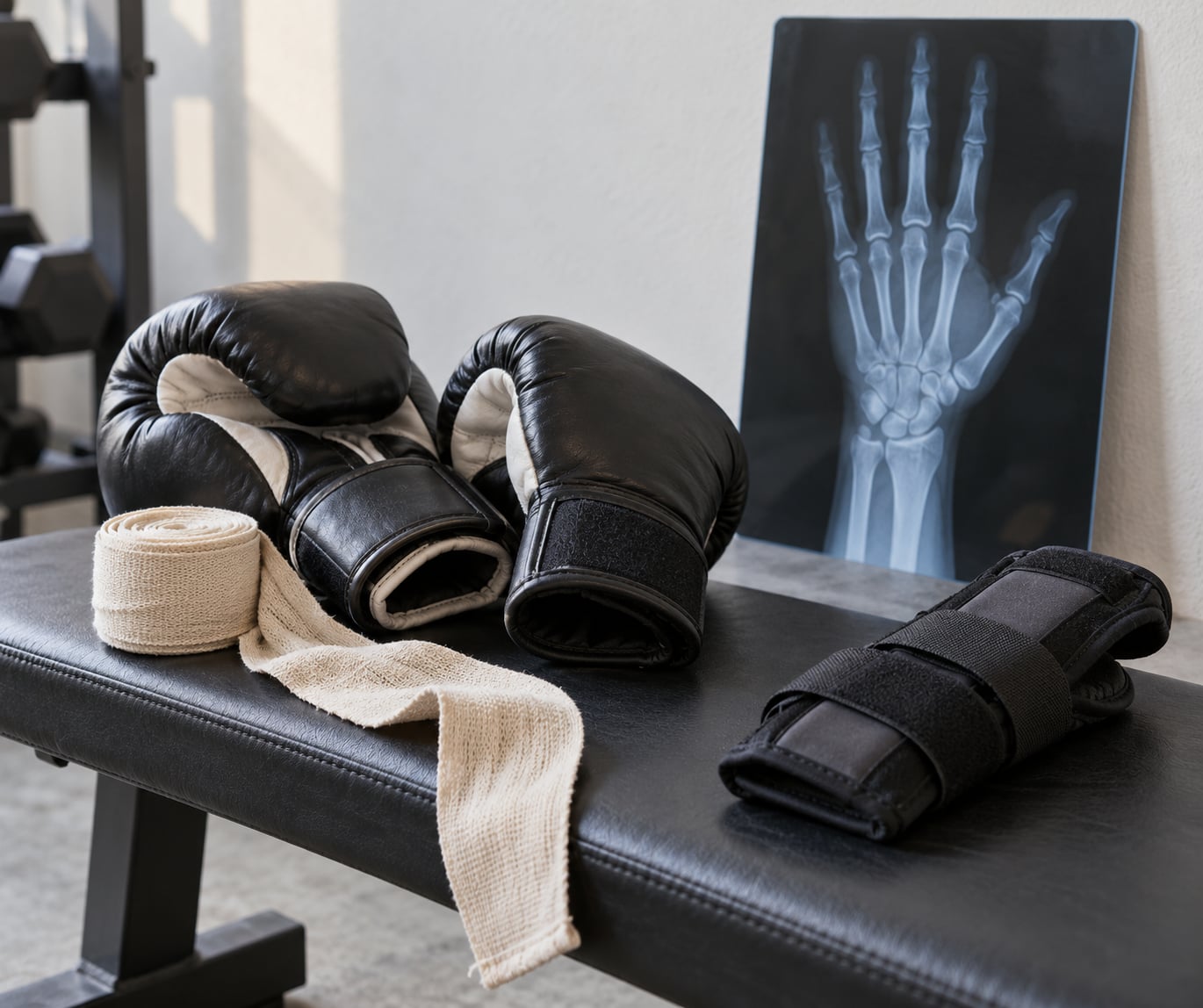
A boxer’s fracture is a break in the neck of the fifth metacarpal, the bone behind your little finger, and it is the hand injury most associated with the sport. Boxers deal with broken hands by stopping training immediately, protecting the hand from further impact, getting a medical assessment and imaging, then following the treatment their clinician prescribes before any return to bag work or sparring.
Nobody should try to self-diagnose or tough this one out. I have watched fighters in gyms treat hand pain as a badge of honor for years, and a fracture that gets ignored can heal in a shape that never fully comes right. Everything below is general information, not a diagnosis or a treatment plan for your hand.
Table of Contents
- What Is a Broken Hand in Boxing?
- Boxer’s fracture or boxer’s knuckle?
- How Do Boxers Break Their Hands?
- Why the ring hand takes the damage
- How Do Boxers Deal With Broken Hands?
- What fighters who ignored it did
- What Is the Recovery Timeline After a Boxing Injury?
- The four milestones that are not the same thing
- How Boxing Training Changes During Recovery
- Technique review time
- Why Do Boxers Fear Coming Back From a Broken Hand?
- The knuckle that never looks quite right
- Identity, competition plans, and who to talk to
- What Risks Can Come From Training Too Early?
- Signs that mean stop, not push
- How Can Boxers Reduce the Risk of Broken Hands?
- Wraps that actually help
- Nutrition and bone healing
- When Should a Boxer Seek Urgent Medical Care?
- Frequently Asked Questions
- Conclusion
What Is a Broken Hand in Boxing?
Boxers break hands in the same ways other combat athletes do: repeated impact through a closed fist, awkward landings, and direct blows to the hand. The fifth metacarpal neck is the classic site, but the fourth metacarpal, the wrist bones and the small finger bones are all vulnerable in a fight.
The fifth metacarpal sits at the outside edge of the hand, under the little finger. Punch with a straight, aligned fist and the force travels into the larger, better-supported bones. Punch crooked, at an angle, or into a hard surface, and that same force concentrates on the neck of the fifth metacarpal, which snaps where the bone is thinnest.
Boxer’s fracture or boxer’s knuckle?
The two get confused constantly, and they are not the same injury. One is a broken bone. The other is a soft-tissue problem that can clear up without a cast.
| Feature | Boxer’s fracture | Boxer’s knuckle | Sprain or dislocation |
|---|---|---|---|
| What is injured | The neck of the fifth metacarpal bone | Extensor tendon and soft tissue over the knuckle | Ligaments or the joint itself |
| Pain pattern | Deep ache in the palm, worse when you make a fist or press on the knuckle | Localized soreness over the top of the knuckle | Sharp pain that shifts with movement |
| Visible sign | Possible bump or shortening of the knuckle, fingers pointing at an angle | Swelling, sometimes a tender lump on the knuckle | Visible deformity if the joint is out of place |
| Typical assessment | Physical exam plus X-ray | Clinical exam, often no imaging needed | Exam, with imaging if unstable |
| Typical management | Splint or cast, and sometimes surgery | Rest, ice, protection, time | Immobilization, sometimes reduction |
| Return to punching | Weeks to months, clinician-cleared in stages | Usually short once pain-free | Depends on stability |
You can often still move a fractured hand, which is exactly why fighters keep training on one. Movement is not proof that the bone is intact. Only imaging tells you that.
How Do Boxers Break Their Hands?
Impact is the constant, but the mechanism matters. Some breaks come from one hard contact. Most come from thousands of smaller ones that never had a chance to settle.
Repetitive bag work creates micro-strain over weeks. Sparring and competition add sudden, unpredictable loads at full intention. Direct hits to the hand during a scramble, a fall onto a hard floor, or punching a wall or heavy bag without alignment can each do it in a single impact. Bare-knuckle boxing removes the padding that used to absorb some of that load.
| Mechanism | What it feels like at the time | Usual assessment |
|---|---|---|
| Repeated bag or pad work | Gradual dull ache that builds over sessions | Exam, X-ray to confirm a hairline or displaced fracture |
| Sparring or a fight | Sudden sharp pain, often followed by swelling within the hour | Same-day exam and imaging |
| Punching a wall or hard object | Immediate crack or pop, immediate pain | Exam, X-ray, sometimes more imaging if the joint is involved |
| Fall onto an outstretched hand | Wrist or hand pain, sometimes bruising along the wrist | Exam, X-ray of the wrist and hand |
| Direct blow to the hand in a scramble | Pain that flares with gripping, possible numbness | Exam, X-ray; nerve or tendon assessment if symptoms persist |
Why the ring hand takes the damage
Some fighters notice it first in the lead hand. It makes sense once you look at the structure: the little-finger side of the hand has less bony and muscular support behind it, so less of the impact is carried before the bone bends.
Boxers who land a lot of straight punches to the body and hooks with a bent wrist push more sideways force into that same neck. Straight alignment is not a style preference in this sport. It is a structural one.
How Do Boxers Deal With Broken Hands?
Honestly dealt with, the process is straightforward and boring, which is part of why fighters fight it. Six steps cover nearly every case.
- Stop training. No bags, no pads, no sparring, no gripping work through pain. The bone does not care how tough you are.
- Protect the hand from further impact. Avoid blows, heavy grabbing, and anything that twists the wrist.
- Get assessed. A clinician examines the hand and orders X-rays. That exam and imaging determine what kind of fracture you actually have.
- Follow the prescribed treatment. That is immobilization in a splint or cast for many fractures, and surgery with pins or a plate for others.
- Rehabilitate. Range of motion, then grip and strength, under the guidance of the treating clinician or a hand therapist.
- Return in stages, only when cleared. Bag work, then pads, then light sparring, then hard sparring, each step approved rather than assumed.
What fighters who ignored it did
Some boxers treated the hand as a thing to work around. You could see it in the way a fighter started finishing with the left, or in a corner that had already decided the round was lost and might as well be spent.
Records and family histories describe fighters continuing through hand problems that later needed surgery, and repeated fractures on the same hand that changed how they threw a punch for the rest of a career. The boxer who ends up with the worst outcome is usually the one who trained through it, not the one who rested.
What Is the Recovery Timeline After a Boxing Injury?
There is no single timeline, and anyone who gives you one is guessing. Most uncomplicated boxer’s fractures are managed with immobilization for roughly six to eight weeks, and a boxer returning to hard training usually sits somewhere in the eight to twelve week range. Displaced fractures treated surgically run longer from the injury to full punching, even though earlier movement is often allowed.
The variables that actually move the needle: which bone broke, where along the neck it broke, how displaced the fragments are, whether the fracture is open or closed, whether it was treated with surgery or a cast, your age and general health, and whether you protected the bone properly while it healed.
Progress also arrives in order, not on a schedule. Common ranges, always subject to your clinician’s sign-off:
| Stage | Typical timing | What is happening |
|---|---|---|
| Assessment and immobilization | Days 1 to 14 | Bone protection, swelling settling, pain control, follow-up imaging if needed |
| Protected healing | Weeks 2 to 6 | Bone knitting, careful gentle movement under advice, grip rebuilding |
| Strength and range work | Weeks 4 to 8 | Range of motion work, grip and wrist loading, controlled bag contact if cleared |
| Return to pads and light contact | Weeks 6 to 10 | Progressive impact, technique rebuild, light sparring |
| Full training and hard sparring | Weeks 10 to 12 and beyond | Full power punching and contact, only once the hand tolerates it |
| Long-term follow-up | Months later | Strength and stiffness monitoring, occasional imaging if symptoms return |
The four milestones that are not the same thing
Back to normal movement, back to bag work, back to sparring, and back to full power with contact are four separate doors. Fighters routinely push through the first three and slam into the fourth too soon.
Movement coming back first is not clearance to punch. A hand can bend fully and still have a bone that has not finished knitting. Only the person treating it decides when impact work starts.
How Boxing Training Changes During Recovery
Everything involving the injured hand stops. Everything that keeps you a boxer does not have to.
What stops: bag work, pad work, sparring, mitt striking, gripping heavy implements, wrist loading, and any drill that asks you to make a fist under resistance.
What continues: footwork on a heavy bag, shadow movement, roadwork, cycling, and general conditioning that keeps the engine honest without loading the hand. Strength work for the legs, back and core carries over directly to ring work. Nutrition and recovery habits continue as normal.
Technique review time
A hand injury is often the moment a coach finally sees the flaws that caused it. Bent wrists, dropped elbows on hooks, and reaching instead of rotating are all visible on video and much cheaper to fix than a fracture.
That review is worth doing deliberately, not in week three of recovery when the hand is sore. Coaches often stage it: shadow the technique with no contact first, then add pads once the bone is further along.
Only the treating clinician can approve exercises and progression. That is not caution for its own sake. Loading a healing bone too early is one of the more reliable ways to end up back at the start.
Why Do Boxers Fear Coming Back From a Broken Hand?
Because the hand is where the punch lives. A fighter can condition through a bad shoulder in a way they never could through a bad hand.
The most common thing I hear from returning fighters is hesitation at the moment of impact. The punch goes out timid, the hand tenses, and the technique falls apart under pressure. Amateurs often describe a longer worry: whether the hand will ever feel solid, or whether it now breaks more easily than before.
The knuckle that never looks quite right
Many healed boxer’s fractures leave a visible bump where the knuckle used to sit flat. Fighters mention this more than any other lasting change, and for most it costs no function at all. A small number of fighters report grip strength that never fully returned to where it was.
Stiffness months after the bone has healed is also common and is exactly what hand therapy addresses. Knowing that these outcomes are ordinary helps, because a fighter who expects perfection often reads normal healing as failure.
Identity, competition plans, and who to talk to
A hand injury threatens more than a limb. It can cancel a fight, change a weight class plan, or stall a career in progress. That is a lot to carry while also trying to heal.
Coaches are usually the first support available and often the most useful, because they have seen the injury before. Fighters who struggled after a fracture often found talking to other fighters who had the same experience more useful than anything else, because the fear of throwing a hard punch again is specific and hard to explain to people who have never had it. Where the worry is persistent or affects daily life, a sports psychologist or a doctor is a reasonable next step, and nothing to be embarrassed about.
What Risks Can Come From Training Too Early?
Most fracture complications trace back to one of two things: a bone that has not finished knitting, or a fracture that was never fully aligned in the first place.
Delayed union and nonunion mean the bone has not bridged. You feel it as persistent pain in the palm, sometimes dull and aching, weeks after you were told things looked fine. Nonunion needs medical review, not more training.
Re-fracture is the obvious risk. A bone that is not fully healed can break again with far less force, and a second break on the same hand often heals less predictably.
Malunion means the bone healed in the wrong position. When it happens in the fifth metacarpal neck, the finger can angle sideways and the knuckle sits lower or higher than it should. Fingers may also point in a different direction than they used to, because the metacarpal has rotated.
Stiffness is the most common lasting complaint. Too much immobilization or too much caution afterwards leaves limited range of motion that takes months of therapy work.
Compensation is the quiet one. A fighter who returns and finds the hand unreliable starts throwing differently, often pulling the punch or twisting at the wrist to protect it. That changes mechanics and pushes stress into the wrist, elbow and shoulder.
Signs that mean stop, not push
Stop training and get checked if you notice increasing pain after a session that used to be fine, pain at rest or at night, swelling that returns, new numbness or tingling, a hand that feels colder or paler than usual, or a knuckle that looks more angled than it did a week earlier.
Any of those means something changed. More load is not the answer.
How Can Boxers Reduce the Risk of Broken Hands?
Prevention is unglamorous and it works. Ten things consistently come up.
- Wrap your hands. Wraps are the single most-cited protection in every gym forum and interview. They spread impact across the whole hand rather than concentrating it on the metacarpal neck.
- Use the right wrap length and tension. A wider wrap spreads force better, and loose or lumpy wrapping over the knuckle creates exactly the pressure point you were trying to remove.
- Pad the knuckles. Fighters returning from a fracture often add extra knuckle padding or pair a gel wrap with a traditional wrap, which turns protection back up for the first months.
- Fix alignment first. Straight wrist, knuckles lined up with the forearm, elbow in. Most hand fractures trace back to a punch thrown crooked.
- Build rounds gradually. Conditioning a hard punch is a process, and the hand pays for a sudden increase in bag volume faster than the legs do.
- Train your wrists and grip. Wrist conditioning and forearm work build the support structures that absorb punch load.
- Train to your age and stage. Younger boxers still developing wrist strength need fewer high-intensity punching sessions than adults do.
- Recover properly between sessions. Bone and connective tissue repair during rest, and fatigue changes punching mechanics in ways that raise risk.
- Eat enough to heal. Adequate protein, calcium and vitamin D, and enough total calories, support bone repair. Anyone with a fracture should confirm supplement needs with a doctor or registered dietitian rather than guessing.
- Report pain early. The earlier a small problem is looked at, the cheaper it usually is. Fighters routinely wait weeks with pain that was worth checking days earlier.
Wraps that actually help
Two rules do most of the work: the wrap sits over the knuckle line where the impact lands, and it stays snug without cutting off circulation. Beyond that, coaches tend to agree on longer wraps for more coverage and on avoiding rolled or twisted fabric over the joint.
Advice on wrapping has not changed much as of 2026, and the gym consensus is blunt: never skip wraps, not even for a light bag session.
Nutrition and bone healing
Bone is living tissue and it repairs with adequate protein, calcium, vitamin D and overall energy intake. Athletes who cut weight aggressively while healing tend to have slower recovery. If you want specifics, ask a doctor or registered dietitian rather than following a generic list online.
When Should a Boxer Seek Urgent Medical Care?
Same-day urgent care, or an emergency department, if any of the following are present.
- Visible deformity, or a finger or knuckle that is clearly angled or shortened
- Severe pain that is not controlled and is getting worse rather than better
- Swelling or bruising that is expanding over the first day
- Numbness, tingling, or a hand that feels cold or pale
- An open wound over a suspected break, or a wound near one
- Signs of infection later on: increasing redness, warmth, pus, or fever
- Pain with passive straightening of the fingers, or an inability to move them at all
These are reasons to stop and get looked at, not things to assess by yourself in the corner of a gym.
A suspected fracture ends boxing until a clinician has assessed it. Protect the hand from further impact, arrange a medical evaluation, and follow clinician-led recovery before resuming training.
Frequently Asked Questions
Can a boxer keep training with a suspected broken hand?
No. If a hand fracture is suspected, boxing stops until a clinician has assessed it. Hitting a bag or pad sends repeated force through a bone that may not have knitted, which can re-fracture it or heal it in a worse position. Conditioning that does not load the hand, such as footwork, roadwork and leg strength work, can often continue once a clinician agrees it is appropriate.
How long does a broken hand take to heal for boxing?
An uncomplicated boxer’s fracture treated with a splint or cast typically runs about six to eight weeks before enough healing for careful reassessment. Boxers commonly return to light bag work in that range and to hard sparring somewhere around ten to twelve weeks. Displaced fractures treated with pins or a plate take longer overall. Your clinician sets the pace based on your own imaging and healing.
Can a boxer spar after a hand fracture?
Sometimes, but only after your clinician clears you and only in stages. Most fighters move from controlled bag work to pads, then to light sparring, before anything resembling full contact or full power. Fighters who report a smooth return usually describe it as gradual rather than sudden. Sparring too early is the step most likely to turn a healing fracture into a re-fracture or a malunion.
What symptoms mean a boxer should stop training immediately?
Stop and get checked if you feel a crack or sudden sharp pain mid-punch, if pain builds during a session and does not settle afterwards, or if swelling and bruising appear within the hour. Also stop for numbness or tingling, a hand that feels cold or pale, a visible bump or angle at the knuckle, or pain that wakes you at night. These signs need a clinician, not a corner-towel assessment.
How can boxers prevent broken hands from happening again?
The measures with the best track record are wrapping hands properly before every session, keeping the knuckle line covered, adding extra knuckle padding after an injury, and correcting punch alignment so the wrist and knuckles stay in line with the forearm. Building bag volume gradually, conditioning wrists and forearms, training appropriate to your age, eating enough to support bone repair, and reporting hand pain early all reduce risk further.
Conclusion
A suspected broken hand ends boxing until it has been assessed. How boxers deal with broken hands is the same in every case: protect the hand from further impact, get a proper medical evaluation with imaging, follow the treatment your clinician prescribes, and rebuild strength and range in stages.
The temptation is always to test it on the bag a week early. That one session is what turns a clean six-week recovery into months of hand therapy, and it is why the fighters who come back best are usually the ones who did nothing for longer than they wanted to.