Styles make fights in boxing because a style is a fighter’s answer to three questions: what distance do I want, how fast do I want the fight to run, and where in the ring do I want to be standing. When two fighters answer those questions in opposite ways, each one’s strengths turn into the other’s problems. That is the whole mechanism, and once you can see it, records stop telling you what will happen.
I have watched enough of this sport to know that the phrase gets used as a way of excusing a result after the fact, which is not what it means. The useful version is predictive. Before the first bell, a sharp fan should be able to say roughly where the fight will be held, who will be uncomfortable, and what has to happen for each fighter to win. This guide is built to get you there.
Table of Contents
- What Does Style Mean in Boxing?
- Why Styles Make Fights in Boxing: The Core Matchup
- What Is the Difference Between a Boxer-Puncher and a Pure Brawler?
- How Do Range and Ring Control Shape Boxing Strategies?
- Why Can a Style Be Effective Until a Fighter Adjusts?
- How Do Styles Influence Punch Volume, Accuracy, and Risk?
- How Do Judges Interpret Different Styles?
- How Can You Read a Style Matchup Before a Fight?
- Frequently Asked Questions
- Conclusion
What Does Style Mean in Boxing?
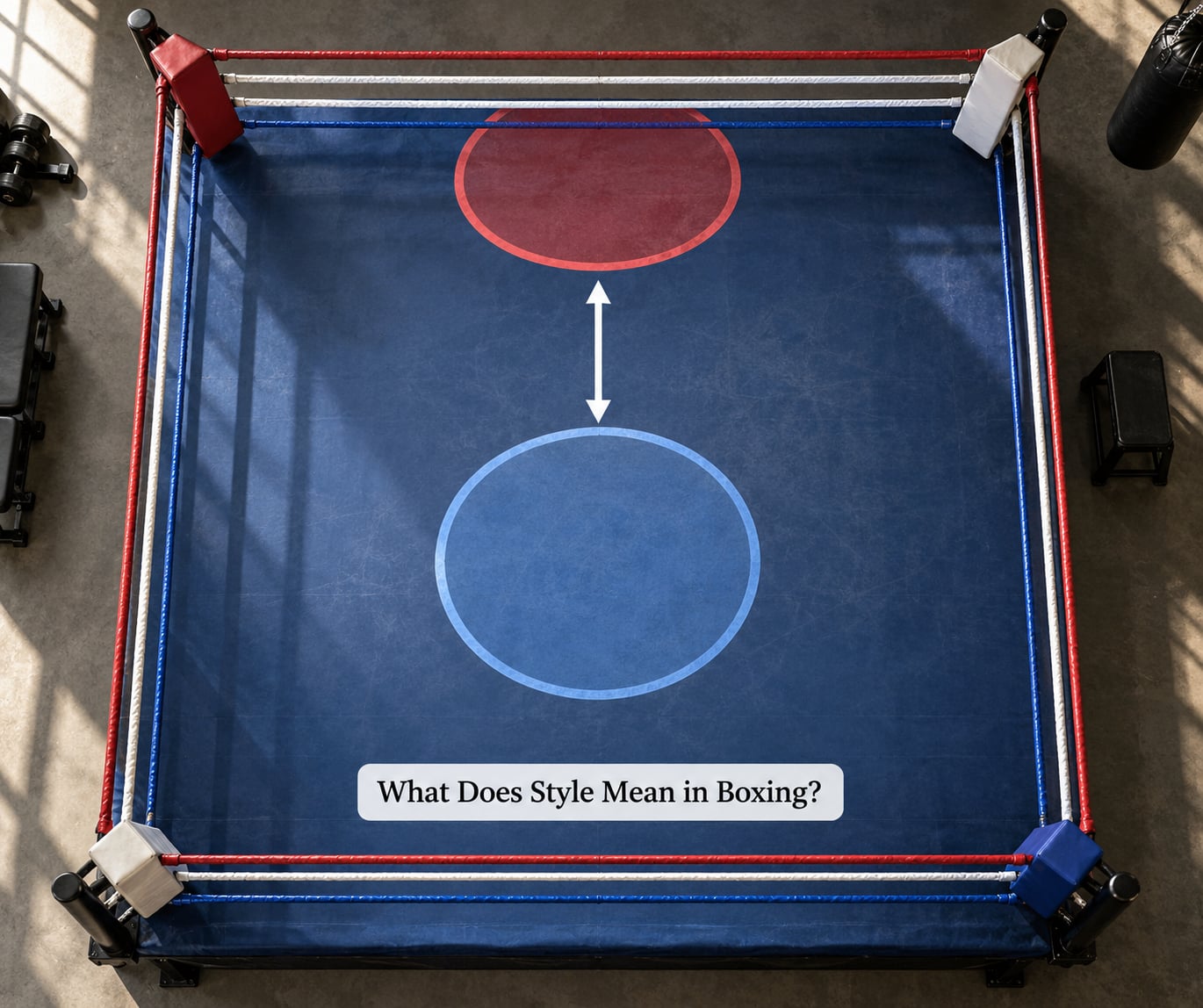
Short answer: a boxing style is how a fighter solves range, pace and offence. It shows up in the distance he prefers, the punches he throws first, the position he defends by default, and where he tries to move you.
That definition matters more than it sounds, because style labels describe how a fighter wins, not how good he is. A gatekeeper can beat a ranked contender on a good night. A former champion can carry a style that has stopped working and still beat a prospect, because the prospect’s style gave him nothing to solve.
Four components make up a recognisable style:
- Distance — where the fighter is most comfortable: on the ropes at infighting range, in the pocket at close quarters, at mid range on the outside, or long range where the jab does the work.
- Method of attack — the jab first, the hook first, the overhand, the uppercut, or no preferred punch at all because everything comes off the counter.
- Defensive habits — slipping, parrying, bobbing and weaving, shelling up behind both gloves, clinching, or simply backing up and relying on the chin.
- Ring position — whether he wants you in front of him, behind him, or on his back foot, and whether he is comfortable following you or only comfortable pressing.
Change any one of those and you have a different fighter. A boxer-puncher who abandons combination work and just walks forward throwing hooks is not a swarmer yet, but he is starting to need the same gas tank one.
Why Styles Make Fights in Boxing: The Core Matchup
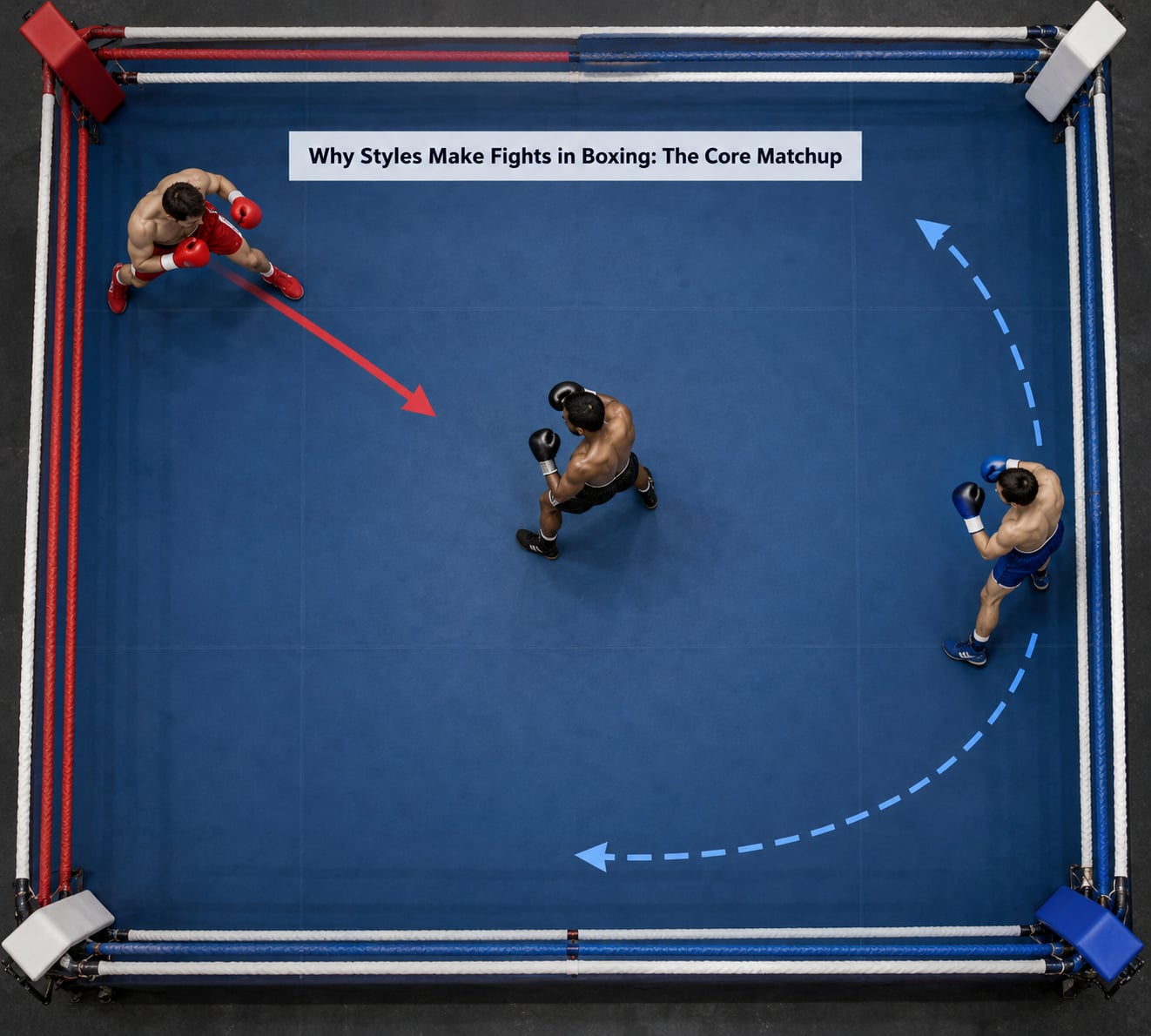
The direct answer: styles create fights because every style needs specific conditions to work, and the fighter who imposes those conditions decides the pace, the opportunities and the emotional pressure of the bout. One fighter’s best punch only exists at a distance the other fighter refuses to allow.
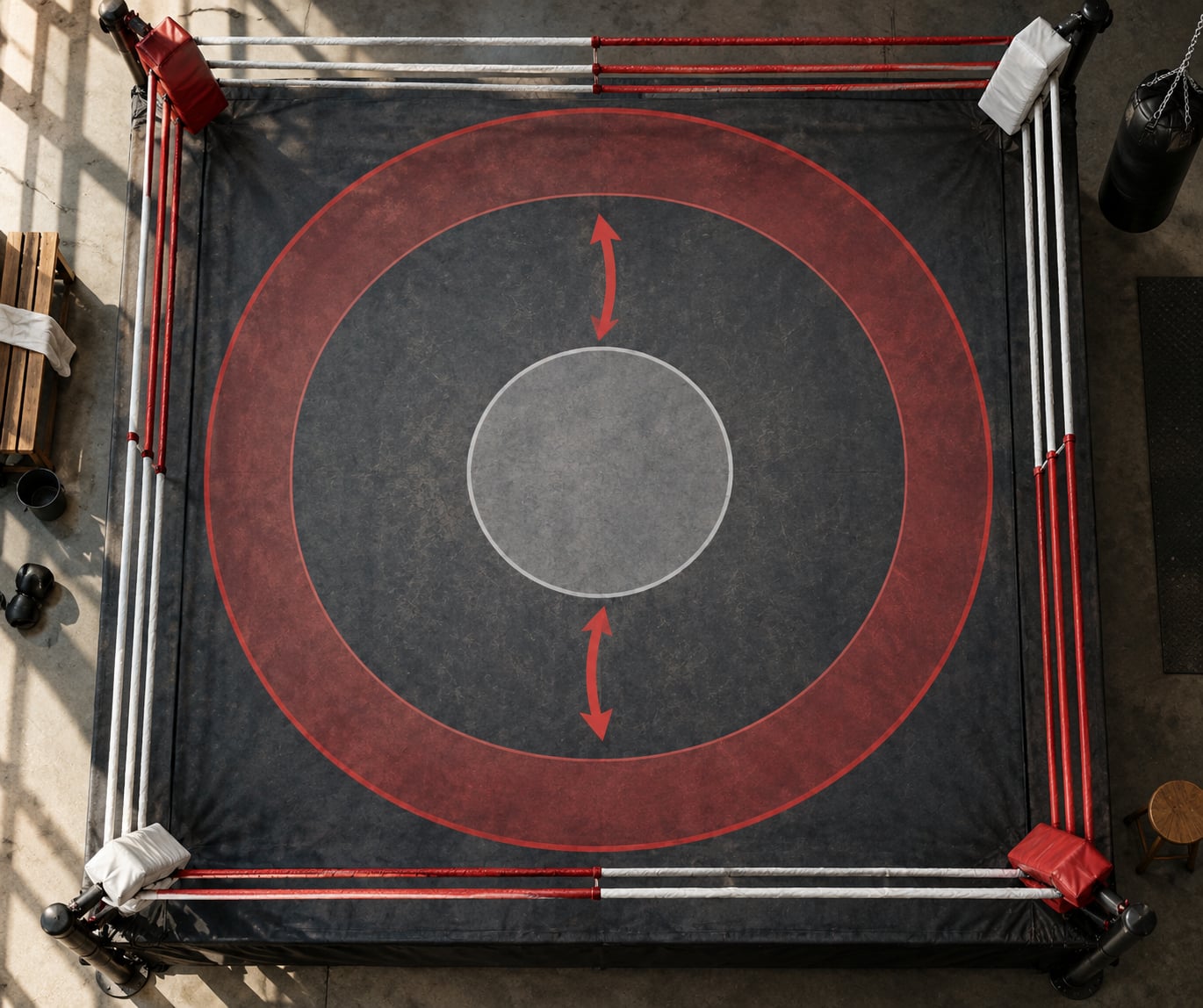
Consider the most common pairing in the sport. A swarmer needs the fight to be short, close and demanding. An out boxer needs the fight to be long, wide and patient. Neither man can get what he wants unless he first takes it, so the fight becomes a constant argument about one variable — distance.
Every style matchup reduces to the same three things:
- Where the fight is held. Whoever dictates the distance is choosing the terms. The cornered fighter is a swarmer’s best friend; the out boxer pinned against the ropes is in serious trouble.
- Who is forced to move. Pressure forces an opponent out of his habits. Movement is not free — every step back costs energy, and every step forward costs ring position.
- Who is forced to commit. A counter-puncher needs an opponent who punches first. A fighter who simply refuses to throw is denying the counter-puncher his entire income.
That third point is why neutral fights are so rare. Almost every fighter has at least one opponent whose style hands him the fight, and a good matchmaker is someone who knows both sides of it.
How Do Pressure, Counterpunching, and Footwork Interact?
Short answer: forward pressure meets evasive defence, counterpunching punishes predictable entries, and footwork changes the timing and the available angles. These three styles form a loop, and each one feeds the next.
Pressure is the forcing function. A pressure fighter walks a man to the ropes, eats some shots on the way in, and takes away the option of starting anything. What he offers in return is a target that keeps arriving, which is exactly what a counter-puncher wants.
Counterpunching is built on anticipation. The whole style rests on a read: you throw, I answer. Against a swarmer the read is easy, because the swarmer has to move forward and his punches arrive on a schedule. Against a fighter who circles, bounces, flicks the jab from outside and refuses to commit to anything, that read never comes.
Footwork is the variable that decides which of those two situations you are in. A fighter who changes levels, pivots on a planted foot and alters his rhythm does not need to be faster than anyone — he just needs to arrive at a different distance than the punch was aimed at. Good footwork turns a chase into a trap.
The loop closes like this: pressure creates predictability, predictability feeds the counter, and footwork is what breaks the whole sequence for one of them.
What Is the Difference Between a Boxer-Puncher and a Pure Brawler?
Short answer: a boxer-puncher wins by making combinations land at range and at close range with real accuracy. A pure brawler wants the fight to become simple, close and brutal, and does not care what order the punches come in.
The boxer-puncher is the hardest style to prepare for, and that is why it comes up so often in matchmaking arguments. He has two games. At mid range he is a jabber and a combiner, using head movement and small steps to land one and two and three. In the pocket he is a body puncher with a hook he can land on the way out. Both games are live at the same time.
A brawler has one game and enormous power in it. Joe Frazier is the clean example: short steps, steady output, a left hook that hurt anyone who stood in front of him, and a willingness to take punishment to reach the pocket. George Foreman is the other version of the same idea, with a right hand that could end a fight from one clean connection.
The difference shows up in what happens to each fighter when the plan fails. When a boxer-puncher’s combinations get blocked, he can shorten the shot or switch levels. When a brawler’s single power punch misses, he still has to close the distance again, and he has to do it while eating counters to the head.
A brawler’s favourite path is a fight that stays close and stays long. Both of those conditions are things the boxer-puncher controls better, which is why the boxer-puncher is usually the slight favourite on paper and why upsets by brawlers are so satisfying.
How Does Southpaw and Orthodox Style Affect a Fight?
Short answer: stance changes which foot leads, which angles are open, and how your natural power punch meets theirs. Neither stance is automatically better, but a southpaw facing an orthodox fighter is a different tactical problem from an orthodox facing an orthodox.
Two orthodox fighters share the same rhythm. Both want the lead foot back, both want to exit on their own terms, and a lot of fights between them come down to who wins the first exchange. Stance takes that shared rhythm away.
Against an orthodox opponent, a southpaw’s rear straight punch arrives on a different line and from a different angle, and a southpaw lead hook can be awkward to parry because it travels across the opponent’s centre. Orthodox fighters also tend to be a touch more comfortable walking a southpaw forward, which means a southpaw sometimes has to work while giving up ring position.
That last point is the well-known cost of the stance. An orthodox fighter can more easily occupy the outside and dictate. The southpaw’s counter is a body attack that makes advancing costly, and being comfortable in that exchange, which is exactly why a handful of southpaws have produced some of the longest-running pressure styles in the sport.
How Do Range and Ring Control Shape Boxing Strategies?
Short answer: ring control is how a fighter decides where the fight happens. Cutting off the ring limits an opponent’s options to backing up, and taking away the backwards direction is what makes most styles work.
Every style has a required range. The swarmer needs the ropes. The out boxer needs space to set his feet and jab. The counter-puncher needs you to come to him. The boxer-puncher is the only one who genuinely does not care, which is why he is the most flexible style in the sport and the most awkward to game plan against.
Cutting off the ring is the most underrated piece of strategy in boxing. A fighter who circles with his back to the open side of the ring is not just moving — he is walking his opponent toward the ropes, where there is nowhere to go. It costs the opponent his choice of footwork and forces him into a range he did not pick.
Ring generalship is the skill of dictating that without getting hit doing it. A pressure fighter who walks forward carelessly just gets counterpunched on his way in. The ones who succeed do it at an angle, cut off the exit, and keep their own feet behind their hips.
Height and reach quietly extend this. A taller out boxer can hold a distance that a shorter pressure fighter has to cross twice as fast, which forces the pressure fighter to spend more gas to reach the same place. Reach is a range advantage, and range is the currency every style trades in.
Why Can a Style Be Effective Until a Fighter Adjusts?
Short answer: styles work until someone changes something the opponent has already prepared for. Switching stance, changing levels, refusing the preferred range or using feints are all ways of making a plan arrive at the wrong moment.
Here are the adjustments that decide most fights, in the order they usually happen:
- Refusing the preferred range. The simplest and most effective one. An out boxer who plants his feet and refuses to advance denies the swarmer the entire fight, at the cost of giving up the counter-puncher.
- Changing levels. Coming in high and leaving low, or the reverse, so the counters that were working miss by a foot.
- Feints and rhythm changes. A fighter who steps in and stops, then steps in and attacks, breaks the timing that a counter-puncher was reading.
- Going to the body. The body reduces a head-moving defence to a head-moving defence that is not breathing properly, and it flattens the legs of anyone who built their plan on endurance.
- Clinch work. The most unglamorous adjustment and often the decisive one. Holding, breaking and tying up resets the distance and drains the fighter who needs his legs most.
- Switching stance. Rare and dramatic. It changes which punch is naturally in front, which usually comes late in a fight as an act of desperation or confidence.
Why can a fighter refuse to adjust even when the plan is failing? Sometimes it is stubbornness, sometimes the plan really is close to working, and sometimes the adjustment demands a skill the fighter does not have. Keith Thurman had built his whole approach around out-working a pressure fighter and largely refused to go back to the ropes for most of his fight with Manny Pacquiao. Changing his entire identity in the corner is harder than it looks.
The telling detail is usually in the third round. A fighter who adjusts gets sharper, not flustered. A fighter who does not starts showing the same punch every time he walks in, and that is the round where you can tell which one you are watching.
How Do Styles Influence Punch Volume, Accuracy, and Risk?
Short answer: styles shape the numbers. A pressure fighter throws more and lands a lower share, a counter-puncher throws far less and lands more of it, and every style carries a risk that shows up in the record eventually.
Volume punchers land a lot because they never really stop throwing. Their landing percentage is low, which is why they need overwhelming volume to be effective, and why they usually need a knockdown to score a convincing round rather than a clean 10-9.
Counter-punchers invert the maths. They throw a small number of punches, most of them with real intent and from a position of strength, so their landing rate is high. Those punches rarely hurt as much as they should, which is the price of never starting anything.
Brawlers throw a moderate number with heavy hands, so their per-punch damage is the argument. Their risk is the chin: the same forward path that brings the power hand into range also brings every counter into range, and over a long fight that arithmetic is unforgiving.
Out boxers have the safest-looking style and the least margin for a bad night. Their punch output is lower and their damage lower still, which means if the plan stalls the scorecards have nothing to show for it. This is why an out boxer who gets hurt often keeps winning rounds long after the fight stops being competitive.
How Do Judges Interpret Different Styles?
Short answer: judges reward clean punching, effective aggression, defence, ring control and damage. They do not reward a style by itself, which is why a brawler can dominate territory and lose a decision.
Under the ten point must system, nearly every round is scored 10-9, so a fighter does not win by landing one hard shot. They win by landing more of the right shots, by denying the opponent a response, or by making a round so clearly better that a judge has to give it ten.
To give a round ten, judges are looking for which fighter landed more cleanly, which fighter controlled the fight, and which fighter did something that made the other’s work not land. Clean punching counts. Damage counts. Consistency inside the round counts. Sloppy forward movement with nothing on it does not, which is the single biggest source of frustration for the pressure fighters who win the crowd and lose the cards.
That is why styles are sometimes described as the ones that need a knockdown. An out boxer or a counter-puncher can win twelve rounds of mediocrity and take the decision. A pressure fighter can win nine rounds by walking forward into counters and still get nothing for it, because the rounds all look similar.
None of this makes style irrelevant to scoring. It makes scoring one of several systems that style feeds into, alongside the punch stats and the shot the fight itself gives you.
How Can You Read a Style Matchup Before a Fight?
Short answer: identify each fighter’s preferred range, guess their plan, name the biggest risk, decide which adjustment is available, and identify the single moment that decides it. Five steps, and the first two rounds give you almost everything.
- Watch where he stands after an exchange. If he settles on the ropes, he wants the pocket. If he wants the centre, he wants space. Where he is comfortable tells you his range without a word of commentary.
- Watch what he does when hurt. Most fighters revert to their style when they get hit, because the style is what they know. Retreat means counter-puncher or defensive instincts; advancing means pressure.
- Watch the first punch of every exchange. The lead hand tells you the range, and the second punch tells you the intent. A jab and a slip means out boxer. Nothing and a hook means counter-puncher. Nothing and a step in means swarmer.
- Watch what he gives away. Look for the man who always takes the first three inches, or the man who never takes them. Patterns that repeat are patterns you can plan against, which is why the second half of a fight often looks nothing like the first.
- Name the deciding moment in advance. Every fight has one: the round the fight starts turning, the adjustment nobody expected, or the punch that was not supposed to land. If you can say what you are looking for, you will see it when it happens.
Two habits help more than anything else. Keep an eye on ring position, because it decides more rounds than punch stats do. And notice the exact moment one fighter stops forcing his own matchup and starts answering the other’s — that is the round the fight was really won in.
The forum consensus on this topic is worth repeating because it is right: a favourable style matchup only closes so much of a skill gap. Style decides how a fight is fought and which mistakes get punished. It does not decide that the better boxer loses, and the record of upsets that reversed on a single adjustment is long.
Frequently Asked Questions
What does the saying u0022styles make fightsu0022 mean in boxing?
It means a matchup is shaped as much by the style each fighter brings as by raw talent. Every style is a way of solving range, pace and offence, and when two fighters solve those problems in opposite ways, each one’s strengths become the other’s problems. Practically, it means you can read a fight before it starts just by knowing what each man needs to win.
What are the different types of boxing styles?
The core labels are out boxer, swarmer or pressure fighter, brawler or slugger, boxer-puncher, and counter-puncher, with defensive specialists, volume punchers and maulers as common variants. Most fighters are hybrids, so the labels describe a preferred range and method rather than a fixed type. Useful shorthand: out boxer wins at range, swarmer wins inside, counter-puncher wins on the response, brawler wins on power.
What is the hardest boxing style to fight?
The boxer-puncher is usually named hardest, because he forces you to prepare for two fights at once: combinations at mid range and real damage in the pocket, with the power to end it either way. Behind him come the pressure fighter, whose output is relentless, and the switch-hitting southpaw, who makes angles inconsistent. The honest answer is that it depends on your own attributes rather than on the label.
What style did Mike Tyson use?
Tyson fought as a swarmer and pressure fighter built on the peek-a-boo guard: both gloves high in front of the face, constant head movement, constant forward movement, and heavy work to the body. He threw very few punches and did not care much about accuracy because he was rarely the bigger man throwing them. The style let him close distance instantly and made escaping him nearly impossible at the time.
What is the strongest fighting style in boxing?
There is no strongest style in the abstract, because every style has a hard counter and its strength depends entirely on the matchup. A brawler is overwhelming until someone stops him coming forward. An out boxer is untouchable until the range collapses. A counter-puncher wins fights he should lose until his opponent refuses to commit. Strength is always conditional.
Does style or skill win a boxing fight?
Skill wins most fights and style decides how close they are. A favourable stylistic matchup can only close so much of a talent gap, which is why every major upset includes at least one moment where a technically better fighter did something his style made predictable. Skill is the ceiling, style decides whether you reach it.
Conclusion
Styles make fights because every style needs conditions, and the fighter who forces his conditions controls the distance, the pace and the risk. What you want to watch, in order, is the distance each man settles at, the rhythm he fights on, how he reacts when something lands, and where he stands relative to the ropes. Then look for the round where one of them stops insisting on his own matchup. That round is the fight, and everything after it is just the outcome.