
A promoter builds a boxing prospect by pairing talent identification with a planned sequence of fights. The promoter finds a fighter, signs him to a promotional agreement, then has a matchmaker feed him winnable opposition, steady coaching investment and media exposure until the fighter earns a shot at meaningful competition. That is the whole idea: to build a boxer rather than to simply collect a piece of promotional inventory.
How prospects are built by promoters, well or badly, is easy to see from the outside. You can count the number of wins that came from opponents with losing records, measure the gap between bouts, and check whether the step-up fight ever arrived. Fans on r/Boxing tend to draw the same line I do: matchmaking that develops a fighter still loses to him at a fair level of resistance, while matchmaking that protects him keeps the wins coming and the risk at zero.
Table of Contents
- What Does a Promoter Do When Building a Boxing Prospect?
- How Do Promoters Find and Evaluate Prospects?
- What Is the Prospect Development Pathway?
- How Do Promoter Expectations Differ From a Coach’s?
- How Do Contracts and Purses Shape a Young Boxer’s Career?
- Why Might a Promoter Drop a Prospect?
- How Can a Prospect Control the Next Stage of Development?
- Frequently Asked Questions
- Conclusion: What to Focus on First
What Does a Promoter Do When Building a Boxing Prospect?

The promoter’s job is to buy a future asset cheaply and develop it on a controlled schedule. A promoter signs a promising nineteen-year-old, places him on undercards behind more proven names, and gives him a run of bouts that are winnable but not meaningless. Each fight adds a credential: rounds survived, a knockdown, a stoppage, a performance a broadcast remembers.
Developing a prospect and collecting a name for a stable are different jobs that often sit in the same building. A promotion signs a hundred fighters and truly builds maybe two. The rest are roster depth, card filler and options that expire quietly. Knowing which kind of fighter you are watching tells you more than any press release.
The work breaks into five areas a promoter controls: which fighters get signed, who they fight, how often they work, where they appear, and how much of the story around them reaches an audience. Everything else — coaching, nutrition, cuts — sits with the gym, and a good promoter keeps that relationship productive rather than trying to replace it.
How Do Promoters Find and Evaluate Prospects?
Promotions scout through gyms, tournaments, amateur records, managers, other promoters’ undercards and unsolicited fight footage sent in by families. Once a name surfaces, the evaluation is brutally short. A matchmaker watches two or three rounds and decides whether the fighter is worth a contract, and the promoter decides whether that fighter fits the roster.
The signals a matchmaker actually weighs
- Amateur pedigree — national titles, tournament records, and how the fighter performed against strong opposition rather than soft opposition.
- Age and timeline — how many useful years are left, and whether the fighter can carry a schedule now.
- Natural attributes — reach, height, punching speed, ring intelligence, and how the body holds up at a given division.
- Style — whether the fighter does something a promoter can put on a card and sell.
- Character — how the fighter responds to a hard round, a knockdown, or a rough crowd.
- Professional viability — coaching, discipline, and whether the fighter has people around him who will answer a phone at three in the morning.
- Marketability — geography, ethnicity, language, and a story an announcer can tell in thirty seconds.
Raw talent alone rarely produces an offer. Two prospects with identical amateur records get very different answers because one has a trainer with a track record and the other is being managed by an uncle. Promoters buy the whole package, and the gym sits inside the package.
International sourcing matters too. American promotions have long looked to Cuba, Russia, Uzbekistan, Mexico and the British gyms for prospects, and the criteria barely change: competition level, discipline, and whether the fighter wants the move.
What Is the Prospect Development Pathway?
The pathway is not one plan but a ladder, and each rung tests a different quality. Promoters call a step-up fight the moment a fighter meets genuine resistance, and the argument over timing is older than the sport.
| Stage | Promoter’s goal | Typical opposition | Typical timeframe | Main risk |
|---|---|---|---|---|
| Debut | Get him into a professional ring and past the first scare | Beginner or semi-experienced | Months after signing | First-round shock |
| Developmental run | Build rounds, resume rhythm, add experience | Limited-record opposition on undercards | Two to four fights | Record looks soft |
| Padded but ranked | Collect a ranking and television work | Prospects on other promotions | One to two years | Padded opponents cost credibility |
| Elimination bout | Test him against a ranked, unbeaten rival | Mandatory or top-ten contender | Around years three to four | A loss can stall the run |
| Title opportunity | Convert ranking into a championship purse | Champion | Years four to eight | Politics and mandatory order |
Each stage asks a separate question. Can he handle a professional round? Can he work a full schedule without falling apart? Can he win outside his home market? Can he beat a rival who is also undefeated?
Weight decisions are part of this. Moving a fighter up a division to build a size edge is a development tool when he is strong and mature, and a bad idea when he is still filling out. Cutting weight to hold a division keeps him in the queue for opportunities that already exist.
Activity is the quiet engine. A fighter who works eight or ten bouts between debut and title fight develops a public identity; one who sits out eighteen months has to start over, and the ring rust shows on the scorecards.
How Do Promoter Expectations Differ From a Coach’s?
A coach asks whether the fighter is technically better than he was ten weeks ago. A promoter asks whether the fighter sells tickets, holds a date, and can be pointed at for a bigger opportunity. Both jobs matter, and they collide more often than the trade likes to admit.
The promoter’s checklist runs toward attendance, television value, opponent quality, reliability, marketability and return potential. The coach’s checklist runs toward technique, workload, recovery, injury prevention and long-term adaptation to a professional schedule.
That is why a promoter can be thrilled with a 12-0 fighter who cannot yet box a full twelve rounds, and why a trainer can be furious about a fight the fighter was never ready for. Practitioners in the trade press have said for years that matchmaking and developing fighters are the most underrated parts of the job, harder than selling tickets.
Ask any promoter how prospects are built by promoters and the honest answer covers both columns. The gym improves the fighter; the promotion decides how often the improvement gets shown, and to whom.
How Do Contracts and Purses Shape a Young Boxer’s Career?
Contracts decide how much of the plan a fighter actually gets to follow. A multi-fight promotional agreement usually bundles a signing advance, purses for a set number of bouts, and options for additional fights at terms the promoter sets. Read the option clause closely; it is where most of the leverage lives.
Frequency clauses matter just as much. A contract promising four fights a year gives a young fighter a schedule to build against, and a promise of eight gives the promoter a claim on the fighter’s best years. Broadcasting commitments and rematch clauses can dictate which opponents are available, because a fighter tied to one network cannot take a bout against another network’s asset.
Geographic restrictions and site agreements narrow options further by tying a fighter to a promoter in specific territories. Disclosure rules introduced under federal boxing legislation require promoters to disclose certain financial relationships to commissions and fighters, and fans often argue those loopholes still favour promoters.
This is general background, not legal advice. Any fighter weighing a promotional contract should have a manager or lawyer read the option periods, purse escalators and termination language line by line before signing.
Why Might a Promoter Drop a Prospect?
Setbacks are normal. Losing a close fight, getting hurt, missing a date for a visa, missing a weight by a pound — a good promotion absorbs these and books the fighter again within a few months.
What ends a relationship is different. A prospect who loses repeatedly to the same level of opposition has answered the question the promoter was paying to ask. Repeated inactivity, a weight problem the gym cannot solve, or a fighter who will not take the required step-up usually closes the file.
There are business reasons too. If the division the fighter occupies is saturated with four prospects and one titleholder, someone gets moved up or released. If the audience a fighter attracts plateaus well below what the promoter projected, the return potential drops and the option expires without being exercised.
Contractual disputes end things quickly as well. Fighting outside an agreement, signing with a rival promotion, or refusing a mandatory challenger can put a fighter on a suspension list and out of sight for a year.
How Can a Prospect Control the Next Stage of Development?
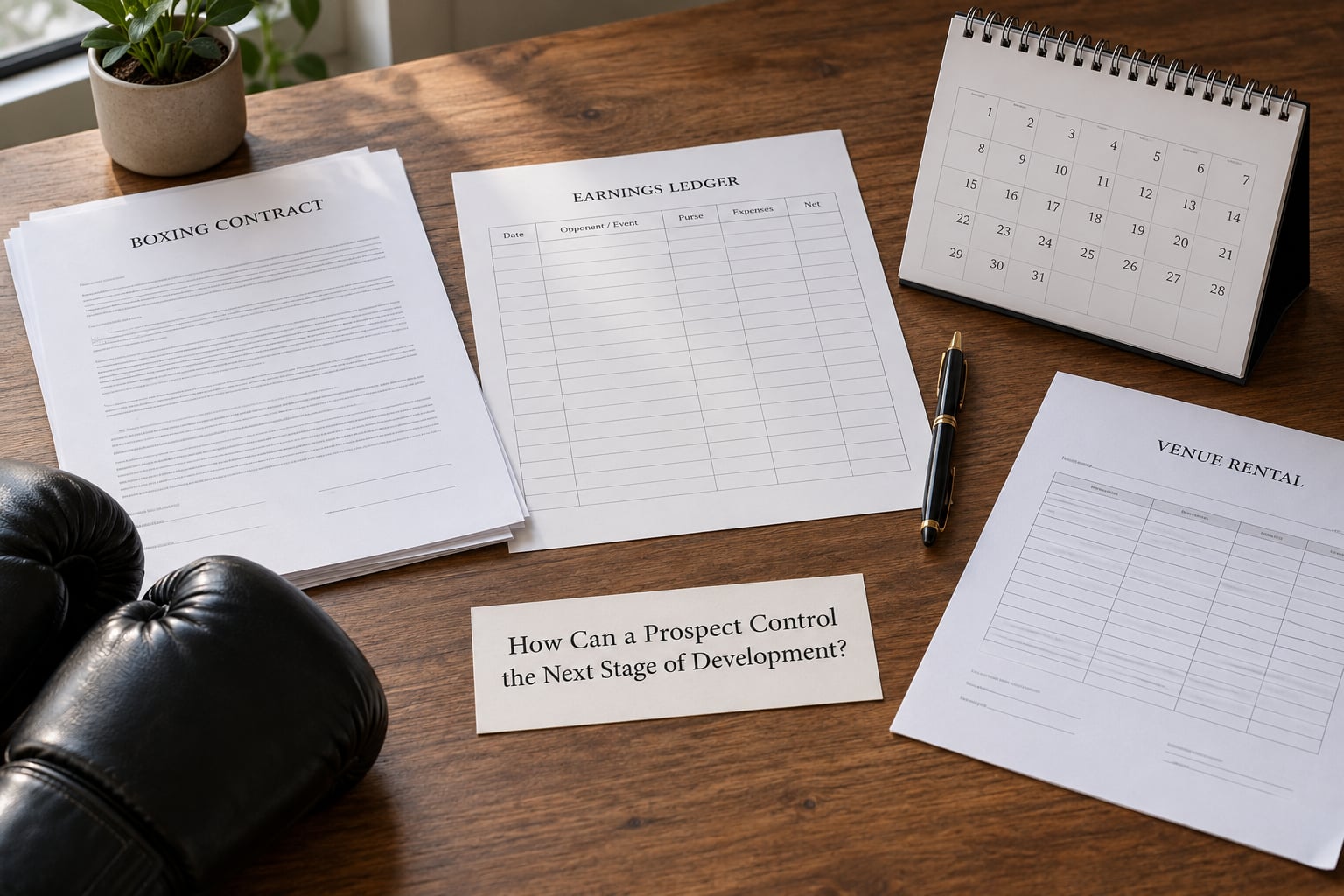
Most of the levers a fighter controls sit outside the ring, and the ones that matter are unglamorous. A clear plan agreed with a manager and a coach, a willingness to take the right fight rather than the safe one, and an honest read of what your own record is worth.
- Set written goals with a manager and coach before signing anything, including the date you want to be tested.
- Ask the promoter to justify the opposition. If nobody will say why an opponent was picked, ask what the plan is for the one after.
- Stay available. Fighters who accept short-notice bouts get matched faster, and dates are the currency of development.
- Read terms with a professional before signing, especially options, frequency clauses and rematch provisions.
- Protect your health. Weight cuts, sparring volume and travel schedules decide how long a career lasts.
- Build an audience slowly through work and availability rather than manufactured hype.
- Track progress beyond the win-loss column: knockdowns landed, rounds survived, quality of opposition, days between fights.
A record padded with soft opposition is not a career. It is a rumour with a date attached.
Frequently Asked Questions
What is the purpose of a boxing promoter?
A promoter’s purpose is to put on profitable events and turn fighters they sign into champions who can carry bigger cards and bigger pay-per-views. For a young boxer, that means finding talent, signing it, then controlling the schedule, opposition and exposure that build a credible professional reputation over several years.
How do boxing promoters find boxers?
Most talent arrives through gyms, amateur tournaments, managers, other promoters’ cards and fight footage sent in unsolicited. Promotions then watch a short clip and check the amateur record, age, style and coaching setup. Sights are also set on international prospects from Cuba, Russia, Uzbekistan, Mexico and the United Kingdom.
Why do promoters give young prospects easy fights first?
A new professional is untested at the level that matters, and a promoter who spends money on a hard debut is gambling with the whole investment. Developmental bouts build rounds, timing and a professional record that a promoter can later show a broadcaster. The obligation runs the other way too: once wins stop testing the fighter, the plan is protecting rather than developing.
What are the responsibilities of a boxing promoter?
A promoter licenses events, contracts and pays fighters, produces and sells the broadcast product, files with state athletic commissions and obeys disclosure rules governing relationships with fighters and officials. Inside a promotion the matchmaker handles booking while the promoter decides the schedule, the budget and which fighters the company is building around.
How long does it take to build a boxing prospect?
Most promotions plan on three to five years before a signed prospect is ready for a title eliminator, and closer to five to eight before a championship opportunity arrives. Fighters who win a regional belt early can move faster, while setbacks, layoffs and long-division waits push timelines out considerably. Nobody can promise a date; the schedule depends on results the fighter does not fully control.
Conclusion: What to Focus on First
The pattern is consistent enough to state plainly. A promoter scouts, signs, sequences, escalates, exposes, then positions. The fighter’s job is to keep answering the right questions in order: can he handle a professional round, a full schedule, a hostile market, a ranked unbeaten rival.
Understanding how prospects are built by promoters comes down to watching one thing. Track the opposition. It tells you whether a fighter is being built or merely protected, and it tells you which side of the argument a promotion is on. For the fighter, the first priority is meaningful competition backed by a stable team. For the promoter, it is credible evidence that a young asset can grow into a championship proposition. Everything else — the narrative, the fan base, the pay-per-view — follows from those two things or means nothing at all.