Two trained ringside operators count them. Each one watches a single fighter from a laptop at ringside, pressing a key every time that fighter throws a punch and a second key when it lands, tallying jabs and power punches separately, round by round, in real time.
That is the whole system behind how punch stats are counted for a televised card. It is called CompuBox, and the numbers it produces are volume measurements, not a scoring system. Once you understand that distinction, the arguments fans have after every close fight stop making any sense at all — which is exactly the point of this guide.
Table of Contents
- How Punch Stats Are Counted in Boxing
- What Does Landed Mean in Boxing Stats?
- How Are Punch Accuracy and Percentages Calculated?
- What Are the Main Punch Statistics in Professional Boxing?
- How Are Punches Recorded During a Fight?
- How Are Power Punches Judged?
- Why Do Different Boxing Sites Report Different Punch Stats?
- How Do Punch Stats Relate to the Official Scorecard?
- How Can You Read Punch Stats Like a Boxing Analyst?
- Frequently Asked Questions
- What to Look at First in a Punch Stat Line
How Punch Stats Are Counted in Boxing
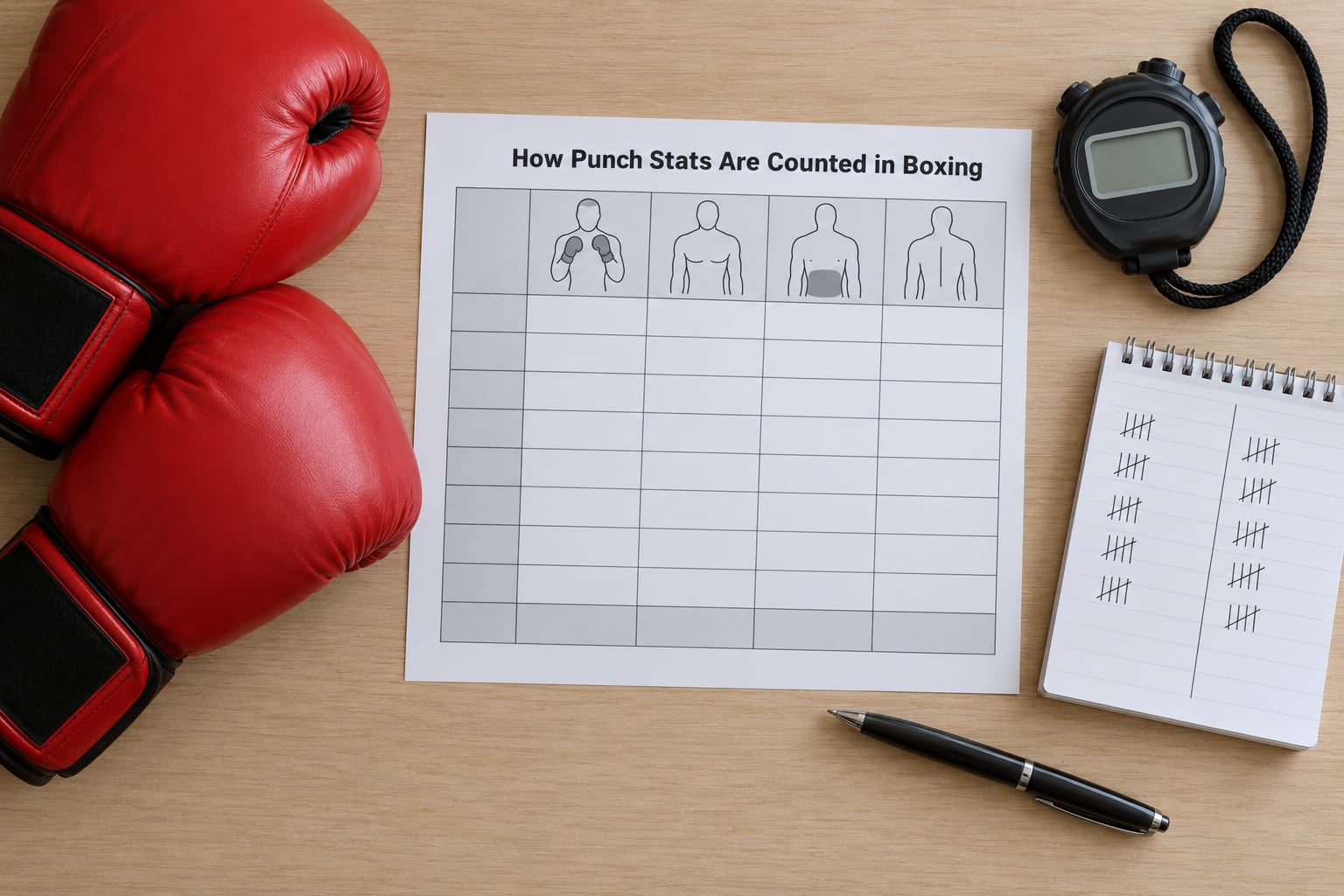
Two people count the punches, not a computer. They sit at ringside, one operator per fighter, each with a laptop and four keys, and they log every punch as it happens. The tally is broken into jab and power punch, thrown and landed, for every round of the fight.
The process in four steps:
- One operator per fighter. Each person watches a single fighter for the whole fight, so nobody is trying to track both at once.
- A key press on the throw. As soon as the punch leaves the glove, one key goes down.
- A second key press on the land. If it makes clean, credible contact, a second key goes down a fraction of a second later.
- A round-by-round total. Between rounds the numbers are read off and checked, then the running totals are published the same night and never revised.
One caveat worth holding onto for the rest of this article: CompuBox is licensed per event, not universal. Regional cards, unlicensed shows and many smaller promotions carry no punch stats at all, so if a fight never shows a graphic, nobody was sitting there counting.
What Does Landed Mean in Boxing Stats?
A landed punch is one the operator judges to have made credible contact with the target area — head, body, or gloves and arms where the shot is genuinely stopped. Grazing contact, a punch that misses entirely, and one thrown into a clinch are all thrown punches that did not land.
The awkward cases are the ones fans argue about for years. A shot that grazes the side of the head might be logged as landed by one operator and thrown by the other. A punch caught on the gloves or deflected by an elbow is a coin flip, and a clean shot into the body from the blind side can be counted even when the television camera never showed it.
Co-founder Bob Canobbio has put a figure on the tolerance. In a 2025 interview with BoxingScene, he described CompuBox’s margin of error as roughly two percent, which sounds tighter than it is. Two percent of a 600-punch fight is twelve punches, spread across two operators working in real time.
None of that tells you how hard the punch was. A graze and a flush hook both get one tally mark, which is why landed totals frequently disagree with a judge’s score.
How Are Punch Accuracy and Percentages Calculated?
Connect percentage is landed punches divided by punches thrown, multiplied by 100. If a fighter throws 200 and lands 60, the connect percentage is 30 percent, and every broadcast graphic that shows 60 landed has 200 thrown somewhere on the same line.
| Figure | How it is calculated | What it tells you |
|---|---|---|
| Connect percentage | Punches landed divided by punches thrown | Efficiency rather than volume |
| Jab connect percentage | Jabs landed divided by jabs thrown | Whether the lead hand is winning the hands fight |
| Power connect percentage | Power punches landed divided by power punches thrown | Whether the big shots find the target |
| Landed per round | Total landed divided by rounds fought | Pace, normalised for fight length |
| Landed per round differential | Fighter A’s landed per round minus Fighter B’s | Volume gap, in the simplest usable form |
The Canelo Alvarez vs Gennady Golovkin bout in 2018 is the cleanest illustration. Alvarez landed 202 of 622 punches, a 32 percent connect rate, while Golovkin landed 234 of 879 for 27 percent. Alvarez threw 257 fewer punches, landed 32 fewer, connected at the better rate, and lost the decision by unanimous decision.
Numbers like that are why an analyst cannot stop at the connect percentage either.
What Are the Main Punch Statistics in Professional Boxing?
Here is the vocabulary that shows up on a televised stat line, with plain definitions for each:
- Total punches thrown and landed — every punch from both categories combined, which is the headline pair most fans quote.
- Jab thrown and jab landed — the lead-hand straight punch, the one mechanical distinction the system actually draws.
- Power punch thrown and power landed — everything that is not a jab: hooks, uppercuts, crosses from the rear hand.
- Connect percentage — landed divided by thrown, usually printed to one decimal place.
- Body shots thrown and landed — tracked separately on most graphics, since body work is now a central part of how fights are read.
- Landed per round — the volume figure normalised for the number of rounds, which is the honest way to compare a six-round bout to a twelve-round one.
Notice what is not on that list: damage, how clean a shot was, whether a punch hurt, defensive work, ring position, or anything about the fighter who was on the receiving end.
How Are Punches Recorded During a Fight?
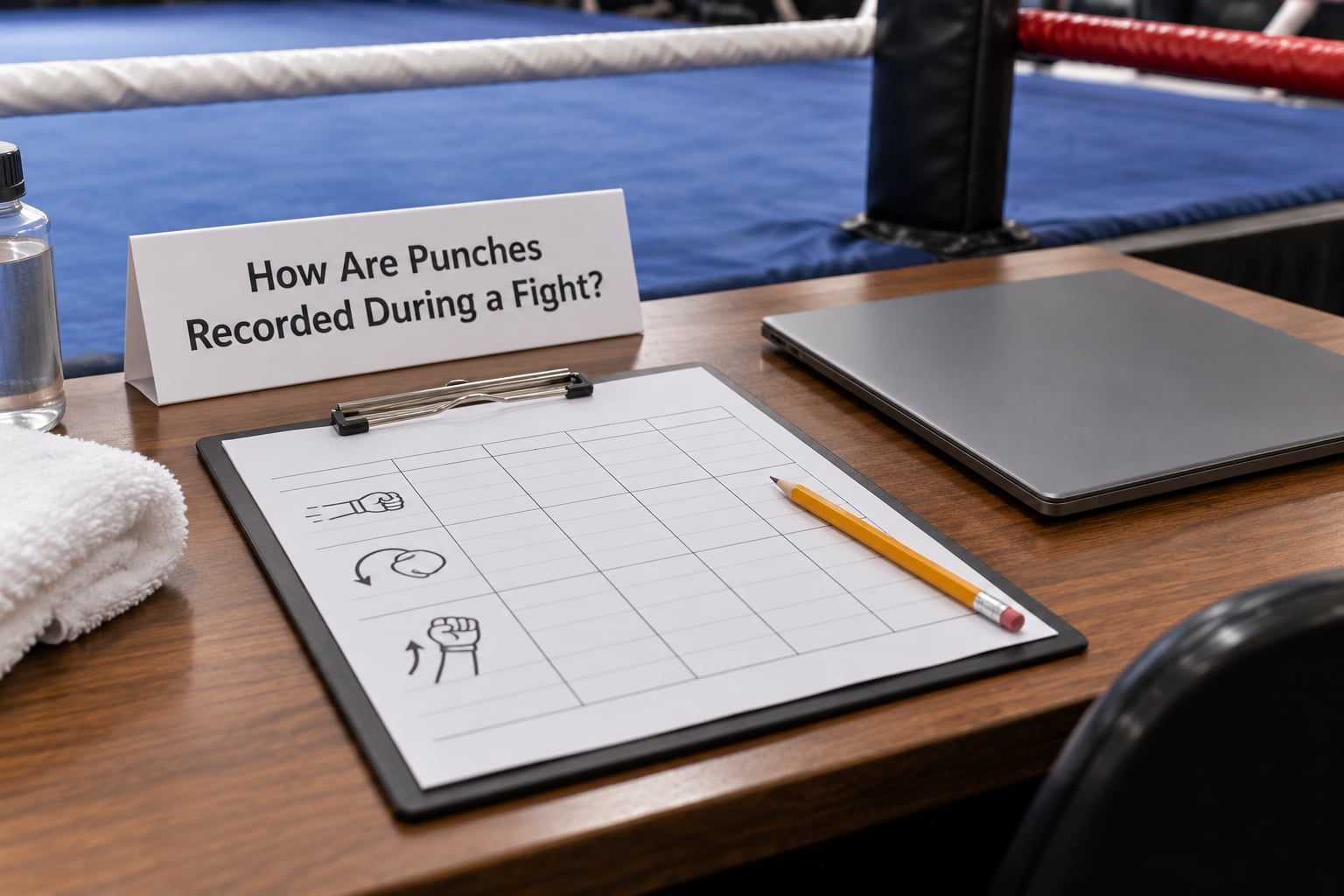
Boxers never record their own punches. Two ringside operators do it, working from a laptop and four keys — one for each of the tracked categories. They sit close enough to see the shoulders and hips rather than the face, because shoulder rotation is the honest tell for whether a punch actually came off.
Everything happens in real time during the round. There is no replay review at ringside, no sensor in the glove, and no machine vision doing the counting. The totals are read off between rounds, checked, and then displayed on the broadcast graphic and published the same night.
That is also the end of the line. The numbers are final once the bout is over; nobody re-talls a fight from footage in slow motion weeks later, and nobody audits them. If a flurry was miscounted at the bell, it stays miscounted forever.
How Are Power Punches Judged?
They are not judged on force. A power punch is simply CompuBox’s label for any punch that is not a jab — a hook, an uppercut, or a straight from the rear hand. No impact is measured, because there is no sensor taking a reading and no camera measuring deformation.
The classification itself is quick and practical. The lead hand is a jab, everything else is a power punch, and the operator decides it while the punch is in flight. Canobbio has been candid that the jab-versus-power-punch split is a naming convention rather than a biomechanical measurement.
So when a graphic shows 234 power punches landed, that means 234 non-jab punches were logged clean. It says nothing about how much damage any of them did, which is exactly why the label misleads casual viewers.
Why Do Different Boxing Sites Report Different Punch Stats?
Four things cause the disagreement, and only one of them is really a mistake.
Event licensing. CompuBox is paid for and staffed on a card-by-card basis. Two outlets can show numbers for the same fight sourced from different providers, and neither has audited the other’s work.
No post-fight audit. Totals are final on the night. Fans on boxing forums routinely re-count from replays and find discrepancies, and the official figures never change.
Subjective calls. Grazes, blocked shots and glancing contact are judged by a human eye in about half a second. Two operators watching the same exchange from slightly different angles will occasionally disagree.
Missing data entirely. No operator means no stat, so absence of punch numbers is not evidence that a fight lacked punches.
Canobbio’s own framing is the fairest summary: the out-lander wins roughly ninety-five percent of the time. That is a strong correlation, and it is still not the same thing as correctness.
How Do Punch Stats Relate to the Official Scorecard?
They are related, and they are not the same thing. Judges score rounds on a 10-point must system, awarding 10 to the round winner and 9 to the loser, with a 10-8 possible when one fighter clearly dominates. They never see the CompuBox figures at any point.
Judges are trained to score four criteria: accurate punching, effective aggression, defence, and ring generalship. Only the first of those maps onto a punch total.
| Judging criterion | Does punch stats measure it? | Does the judge score it? |
|---|---|---|
| Accurate punching | Partly, through connect percentage | Yes, as the first criterion |
| Effective aggression | No — volume is not pressure | Yes |
| Defence | No — dodges and counters appear as a low throw rate | Yes |
| Ring generalship | No | Yes |
CompuBox states the position itself: the statistics in no way, shape or form determine the winner of a fight. That disclaimer is the authoritative word, and it is the sentence to repeat whenever someone treats a punch total as proof a judge was wrong.
Real cases show the gap. In 2017, Jeff Horn beat Manny Pacquiao on all three scorecards, and trade-press reporting of the night put Horn’s landed total at 92 punches. In 2018, Alvarez out-worked Golovkin on volume and connect rate and still lost. In the Haney vs Norman bout, the cards came back 114-113 with punch totals close enough that they could not have separated the fight.
How Can You Read Punch Stats Like a Boxing Analyst?
A useful routine takes about thirty seconds. Start with landed per round rather than the headline total, because it removes the fight-length distortion. Then look at the jab numbers, since a fighter winning the lead hand and losing the power exchange is usually the one boxing out of range.
Next, read the power connect percentage. A boxer landing 25 percent of his power shots versus an opponent at 15 percent is getting the big punches in, which matters far more than the volume difference suggests.
Finally, ask what the winner did that the stat line does not show. Counters, slips, clinches and a fighter who made his opponent miss for twelve rounds are all invisible in a landed total, and each of them is scored.
And treat any number you did not see live with suspicion. The stats are a barometer of activity, not a verdict, and CompuBox’s own disclaimer says so.
Frequently Asked Questions
How do they count punches in boxing?
Two trained ringside operators do it, one assigned to watch each fighter. Each has a laptop and four keys covering jab thrown, jab landed, power punch thrown and power punch landed. They press a key as a punch leaves the glove and a second key when it makes contact, logging every punch in real time, round by round.
How accurate is CompuBox?
Co-founder Bob Canobbio has described the margin of error as roughly two percent, which is about a dozen punches in a 600-punch fight. Grazes, blocked shots and glancing contact are called by a human in a split second, totals are final on the night, and no post-fight re-tally is ever done.
Do punch stats decide who won a boxing fight?
No. Judges score rounds using the 10-point must system and four criteria: accurate punching, effective aggression, defence and ring generalship. Judges never see the punch statistics. CompuBox’s own disclaimer states the figures in no way, shape or form determine the winner of a fight.
What is a power punch in CompuBox?
It is simply any punch that is not a jab — hooks, uppercuts and straight punches from the rear hand. No force or impact is measured, because there is no glove sensor and no machine vision at ringside. The label describes the punch type, not how hard it was thrown.
How do judges count points in boxing?
Judges score each round on the 10-point must system, giving 10 to the winner and 9 to the loser, with a 10-8 when one fighter clearly dominated. They judge accurate punching, effective aggression, defence and ring generalship, then file a scorecard after every round and add it up at the end.
How many punches do boxers land per round on average?
There is no single average worth quoting, because the figure swings enormously with division and style. Volume-heavy pressure fighters land far more than counter-punchers, and a fighter fighting at featherweight produces a different total from one at heavyweight. Landed per round is only useful compared against the opponent in the same fight.
What to Look at First in a Punch Stat Line
Start with landed per round for each fighter, then check the jab and power split, then the connect percentages. That order tells you whether a fighter won on volume, on efficiency, or on neither — which is the only question punch stats were ever built to answer.
Everything else on the graphic is a rounding error away from the truth, and none of it overrides a card.