Southpaws are hard to fight because their stance mirrors yours. Every habit you built against an orthodox opponent, angles, timing, exits, gets turned around, and a straight left hand arrives down the centerline before your own power punch can answer it. Most of that difficulty is unfamiliarity rather than some built-in superiority, which is good news, because unfamiliarity can be trained away.
There is a reason the phrase gets said in every gym with a shrug attached. The mechanics behind it are real, and once you can see the geometry the whole matchup stops feeling mysterious. That is what this guide does: explains what the mirrored stance actually does to your timing, then gives you a concrete plan for the ring or the pads.
Table of Contents
- What Makes Southpaw Boxers So Difficult to Beat?
- How Is a Southpaw Stance Different From Orthodox?
- Why Southpaws Are Hard to Fight: The Four Tactical Problems
- How Can an Orthodox Fighter Beat a Southpaw?
- Can a Southpaw Use the Same Tactics Against an Orthodox Opponent?
- Which Fights Are Easiest Against a Southpaw?
- Frequently Asked Questions
- Conclusion: Start With Timing, Not the Stance Label
What Makes Southpaw Boxers So Difficult to Beat?
Ask why southpaws are hard to fight and most coaches point at the mirror rather than the punch. A southpaw stands with the right foot and right hand forward, leaving the left as the power hand. That is the exact mirror of the orthodox stance, so the punches that should arrive on familiar lines arrive reversed.
Three things follow from the mirror. The southpaw’s rear left travels straight down the centerline, the same line your own rear right uses, which means your power hand and theirs are competing for identical real estate. Angles that felt wide open against another orthodox fighter can look safe against them and close in an instant. And your lead hand, which is used to measuring and framing, suddenly points the wrong way relative to their power side.
Add the third factor and it explains most of the frustration: southpaws are rare. A boxer can go years without facing one, so the awkwardness is not a sign of anything special. It is a sign of zero reps. Fighters who prepare properly, whether by sparring southpaws regularly or by working unfamiliar angles in general, lose most of that edge within a few weeks of focused work.
How Is a Southpaw Stance Different From Orthodox?
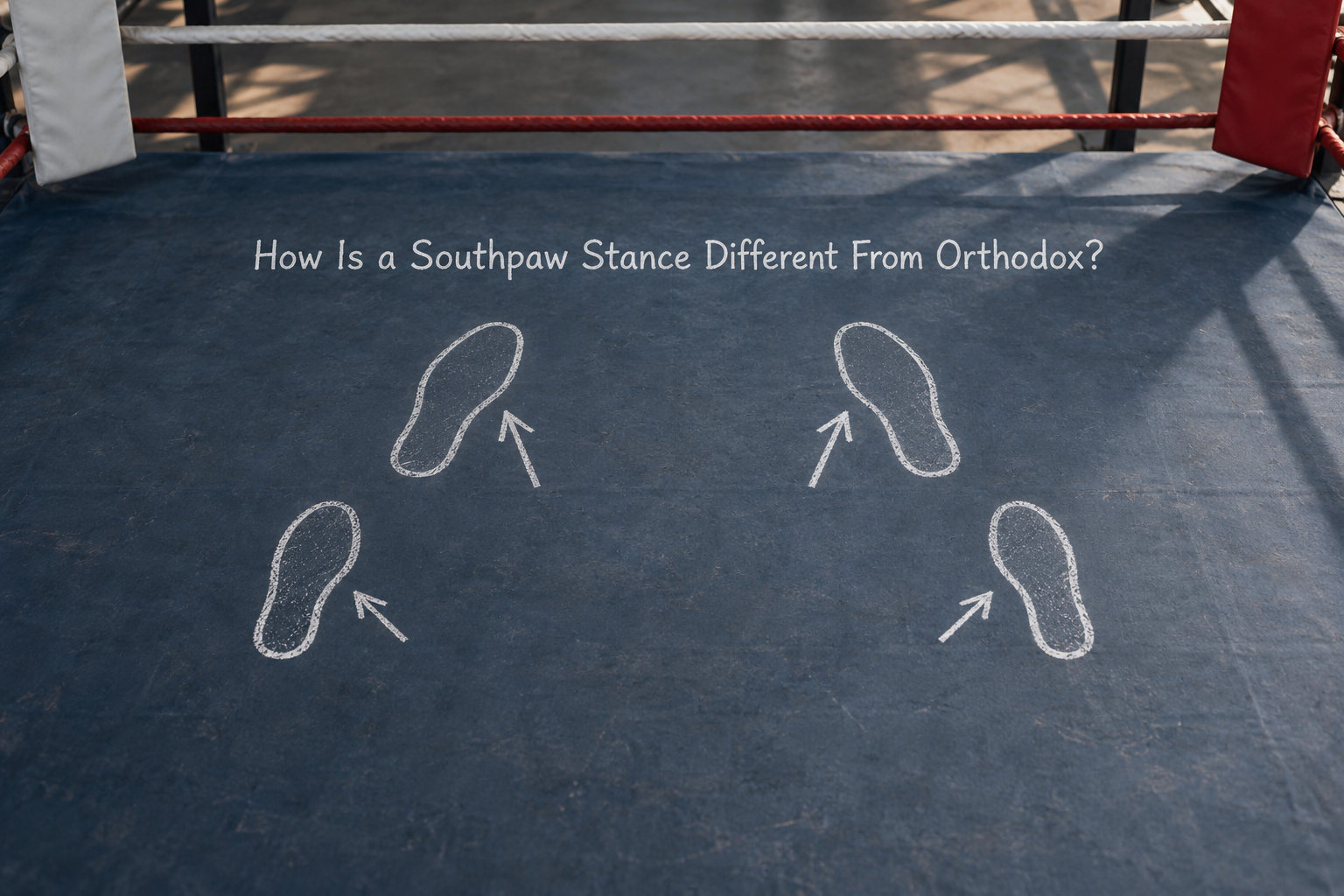
Orthodox is the boxing default: left foot forward, right hand rear, right cross as the power punch, left jab as the range-finder. Southpaw flips that, right foot forward, left hand rear, left hook or straight left as the power shot.
The lead foot does less obvious work than the rear one. It measures distance, sets the angle of attack, and starts every pivot. The rear foot supplies rotation, and rotation is where punch power actually comes from.
| Function | Orthodox stance | Southpaw stance |
|---|---|---|
| Lead foot | Left foot forward, measures range and sets the angle | Right foot forward, measures range and sets the angle |
| Lead hand | Left jab, straight line down the centerline | Right lead hand, often a jab or a wide hook |
| Rear foot | Right foot, supplies hip rotation for the cross | Left foot, supplies hip rotation for the power shot |
| Rear power hand | Right cross travels straight | Left hook and straight left travel straight |
| Natural circle | Often left, moving away from the rear hand | Often right, moving away from the rear hand |
| Most exposed target | Left flank and right cross coming in | Right flank and left hook coming in |
When two fighters mirror each other, they are contesting the same space from opposite directions. Nobody can simply take the angle the other one wants. The result is a foot fight that often decides the round before a clean punch does.
Why Southpaws Are Hard to Fight: The Four Tactical Problems
How Mirrored Footwork Breaks Familiar Timing
Timing is built on repetition. You know roughly how long it takes an orthodox opponent to load a right cross because you have seen it several thousand times. Against a southpaw, the same wind-up reads as slower or faster than it actually is, and your pre-set counter arrives early or late.
That misread compounds. You step in expecting one thing, the punch that shows up is a different punch, and now you are off balance with your hands out of position. Fighters who describe the matchup as feeling strange are usually describing a timing error they cannot yet name.
Why Southpaw Angles Can Look Like Openings
Angle reads are pattern recognition. Against an orthodox opponent, a right hand coming forward usually means a right cross, and a body turn means the power hand is loaded. With a southpaw, the equivalent tells can point to a left hook, an overhand right, or a level change.
The orthodox fighter reacts to a cue that means something else. What looks like an opening on the near side is often the southpaw setting up the rear left, which is exactly where the geometry says it will come from.
How Handedness Deceives Timing and Distance
Body habit shapes distance perception too. A left jab coming at you has one rhythm, and a left hook coming at you has another. When both hands come from the same side of your vision, the lead hand stops signalling what the rear hand is about to do.
Ask why southpaws are hard to fight in any boxing forum and you will hear the same complaint in plain words: the jab lands before the reaction arrives. The diagnosis is usually the same, that this is a familiarity problem rather than a stance problem. It is a good summary, because the cure is reps, not mysticism.
Why Defensive Footwork Leaves a Southpaw Vulnerable
This runs both ways, and it is where the honest part of the answer lives. Backing straight up from a southpaw is a bad habit, because it puts you on your own rear foot with your weight drifting backward and your lead hand unable to do anything about the straight left heading your way.
The orthodox fighter’s usual escape, stepping off to their own left, is unavailable against a southpaw, since that is where the power hand lives. You either cut across to the open side or you get hit. Retreat is a legitimate option; panic is not.
How Can an Orthodox Fighter Beat a Southpaw?
You are not trying to out-mirror them, because mirroring is how you lose the angle fight. The goal is to make your patterns unpredictable in a way their patterns are not.
- Get your lead foot outside theirs. Placing your left foot to the outside of their right foot takes away their ability to pivot freely and makes their exit runs predictable.
- Move to your own left. Circling left takes you away from their straight left and into range where their rear hand is loaded but slow to travel.
- Lean on the right hand. Your right cross does not have to be a knockout punch. Thrown in volume, it forces them to respect it and stops them setting up cleanly.
- Make the lead hand mean something. A jab with a real punch behind it, or a feint-heavy lead, stops their counter-punching from being free.
- Go to the body. They open up while loading the left. Body shots accumulate damage and make the high percentage harder to keep taking.
- Counter the jab as it arrives. Rather than retreating, step in behind their lead hand so the straight left meets your shoulder and your right is already moving.
Fighting a taller, longer southpaw is a different problem, and blaming the stance for it wastes weeks. If you cannot cut the angle because they take it away, work outside their range with feints and beat them on the way out. Circle on the outside of their lead foot, make them reach, and take the return when their weight commits forward. Tall southpaws concede range constantly, because they do not need it.
The gym fix matters as much as the ring plan. Most clubs are stocked with orthodox sparring partners, so southpaw sparring is rare by default. A practical rule is to spend roughly a fifth of your sparring rounds against southpaws, and if no lefties are available, work southpaw-specific pad and bag rounds where the coach leads with a straight left down the middle and you drill the counter paths.
Can a Southpaw Use the Same Tactics Against an Orthodox Opponent?
Yes, in principle. The principles are stance-neutral: control the angle, own the lead foot, make the lead hand honest, work the body, and counter the straight punch on the way in. What changes is direction.
A southpaw applies them moving the opposite way, angles from the other side, targets the orthodox fighter’s open left flank, and leans on the left hook rather than the right cross. Checking hooks and switching pressure mid-fight both work slightly better from that side, which is why southpaws with high ring IQ can feel like a different fighter than they did in round one.
What does not work is assuming the matchup is automatically easy. Familiarity is mutual. An orthodox fighter with hundreds of southpaw rounds behind them will handle a southpaw fine, and switching stances mid-fight only helps if you have done enough of both to make the switch automatic.
Which Fights Are Easiest Against a Southpaw?
There is no style that is reliably easy against southpaws, because stance matchup is one variable among many. Reach and height decide whether you can even work at the range you want. Style decides whether you can survive the pressure while you set it up. Speed, conditioning, ring size, and the fighter’s own ability to adapt under pressure usually outweigh handedness over twelve rounds.
Two matchups tend to favour the orthodox side, though: a taller fighter with a long jab who can keep the southpaw turning away from their power hand, and a pressure fighter who walks the southpaw onto the back foot and makes them set up from a standstill. Two tend to favour the southpaw: an aggressive opponent who chases the jab with his chin exposed, and a patient boxer who never gives them a reason to change rhythm.
Watch a few rounds before you decide anything. The stance tells you what problems you will have, not which ones will actually cost you the fight.
Frequently Asked Questions
What does it mean for a boxer to fight southpaw?
It means your opponent stands with the right foot and right hand forward, keeping the left as the power hand, the mirror of your own stance. Because the two stances face each other, angles reverse, your lead hand stops framing their attacks, and both rear hands want the same line down the middle. Practically, you are running the same fight with the geometry flipped.
Is a southpaw stance more powerful than an orthodox stance?
No. Punch power comes from hip rotation, foot placement, and timing, and none of those change with handedness. A southpaw can rotate the hips exactly as well as an orthodox fighter, and the straight left can be just as heavy. What changes is which side is open and where the angle exits point, not how much force is available.
Should an orthodox boxer try to mirror a southpaw opponent?
Mirroring movement is what usually causes the problems. Copying their rhythm and angles means fighting on their preferred line. What helps is getting your lead foot outside theirs, circling to your own left away from the straight left, and varying your own patterns so they cannot predict them. Contest the lead foot, but never copy the rest of the plan.
Why can a southpaw’s jab feel awkward to deal with?
Because it arrives from a side your body is not set up to read. A southpaw’s straight left travels down the centerline, the same path your own rear hand would take, and it competes with the punch you were already planning to throw. Since their lead hand comes from the same side as their power hand, it gives you far less information than a normal jab does.
Are southpaws automatically harder opponents to face?
No. The difficulty comes from mirrored geometry plus a lack of sparring reps, and the second half disappears with preparation. Fighters who regularly spar southpaws treat it as an ordinary matchup, and the ones who struggle usually have never been given the reps. Stance labels describe a problem; they do not decide the fight.
Conclusion: Start With Timing, Not the Stance Label
The honest answer to why southpaws are hard to fight is mirrored footwork, deceptive timing, and angles that look familiar but run backwards. That is a real mechanical problem, and it is also a trainable one, because most of the dread comes from a lack of reps rather than from any built-in edge.
So watch the lead foot, the rhythm, and the exits rather than the label. Get your foot outside theirs, circle to your own left, keep your right hand busy, and work the body while they set up. Southpaws are not a curse. They are a geometry problem, and geometry has solutions.