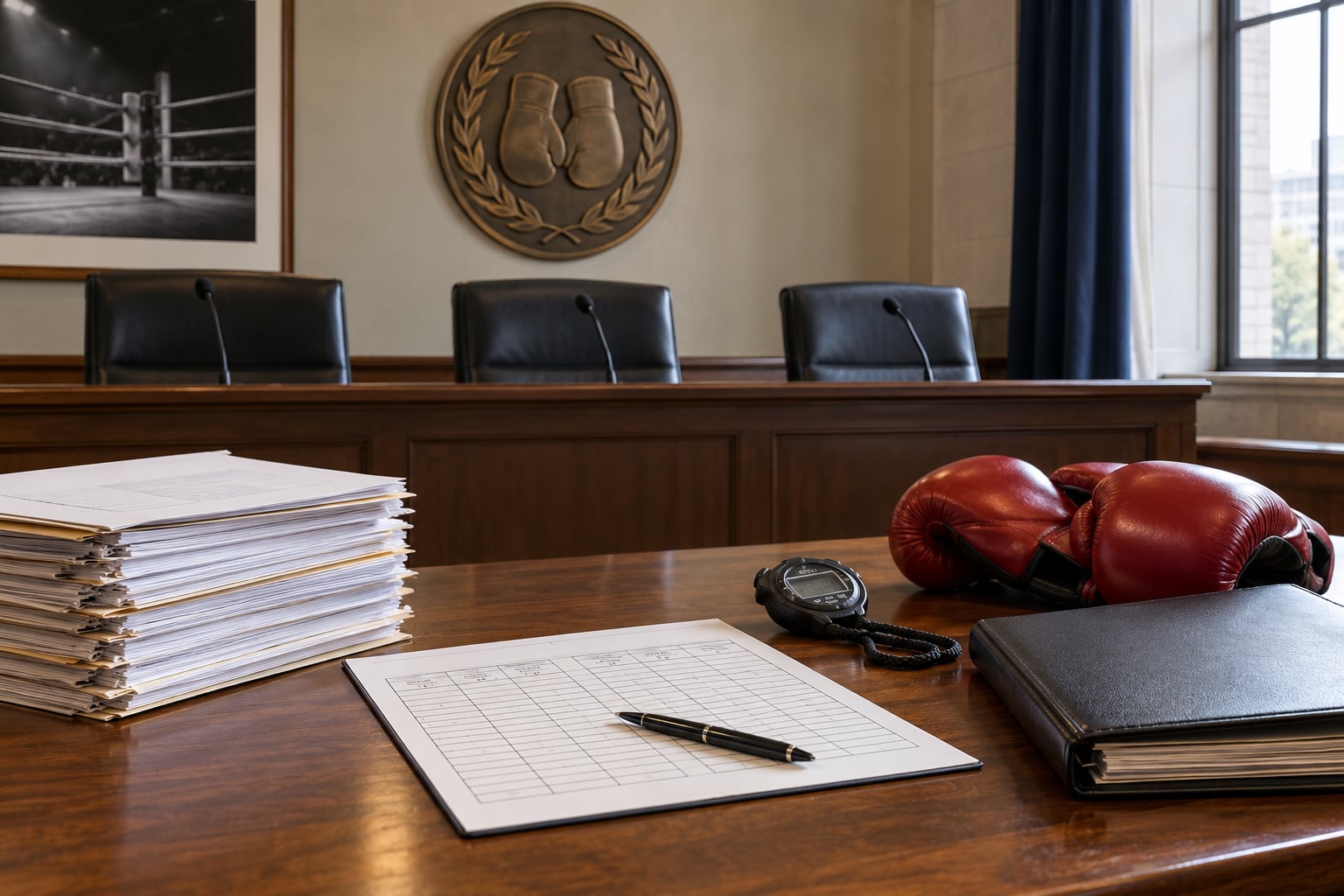
Boxing commissions punish fouls on two separate tracks: during the contest the referee escalates from a warning to a point deduction to a disqualification, and after the contest the commission can fine, suspend, or revoke a license. The person who watches the fight is not the person who ultimately disciplines a boxer.
That split trips up almost everyone who follows boxing, from fans arguing about a low blow to fighters who assume a warning was the end of it. This guide walks through who holds authority at each stage, what the standard fouls look like, what a single deducted point actually costs on a scorecard, and where rules diverge between commissions.
Table of Contents
- What Happens When a Boxer Is Called for a Foul?
- Who Determines and Punishes Boxing Fouls?
- Common Fouls and the Penalties They Can Receive
- Warnings, Fines, and Point Deductions
- When Does a Foul Cause Disqualification?
- What Happens After the Fight?
- How Jurisdiction and Event Rules Change the Outcome
- What Rights Do Boxers Have to Appeal a Penalty?
- Real Examples of Boxing Foul Punishments
- Frequently Asked Questions
- Conclusion
What Happens When a Boxer Is Called for a Foul?
When a referee spots a foul, the first response is almost always a warning. Repeat the offence and points come off your card. Do it badly enough, or hit an opponent in a way that can cause injury, and the bout is stopped and the result can be stripped, turned into a no contest, or awarded to the other fighter.
That is the in-fight ladder. Everything else is slower. A commission can open its own file after the event, review the report and footage, hold a hearing, and hand down a fine or a license suspension that has nothing to do with the scorecards. Referees never impose fines, and commissions rarely step into a live fight.
The severity depends on three things: what the punch did, whether it looked intentional, and how the applicable rulebook treats it. That last variable is why two identical low blows can end one fight with a warning and ruin another with a disqualification.
Who Determines and Punishes Boxing Fouls?
Five bodies can be involved in a single foul, and they each hold a different piece of the decision.
- The referee is the only official who can assess a foul in the contest and issue point deductions. Judges do not deduct points on their own.
- The judges score each round on a 10-point must basis. They do not add a penalty for fouls the referee missed or ignored.
- The promoter sets event instructions, may appoint the officials, and in most jurisdictions has final authority over the running order of the card.
- The state or national commission licenses the boxers, officials, and promoters, and conducts licensing discipline after the event.
- A sanctioning body such as a world title organisation can change a title result or strip a belt for a disqualification, but it cannot fine a licence holder.
Indiana’s administrative code states the separation plainly: only a referee may assess a foul and issue point deductions, and judges may not factor fouls into their scoring. Everything else after the bell belongs to the commission.
The Unified Rules that most professional boxing operates under open with twelve basic rules of conduct. They are short, general statements, which is precisely why the same pair of gloves can produce two different rulings on two different nights.
How Boxing Commissions Punish Fouls in Practice
The pathway usually runs like this. The referee warns, calls a foul, deducts a point, or stops the contest, and reports the call to the official scorekeeper and commission representative at ringside. The commission’s event report goes into the file with the bout results.
From there, one of three things happens. The report stays a formality. Or a commissioner reviews footage and medical records informally and lets the warning stand. Or a formal complaint is filed, and the commission schedules a hearing where the boxer, the referee, and often the other fighter give statements.
Findings land as a warning letter, a fine, a suspension measured in bouts or days, probation, or revocation of the licence. Almost every commission allows one round of internal appeal, and several allow a second review or a court petition after that. The process varies by country, state, commission, and event, so the honest answer to “what will I get for that low blow” is: read the rulebook of the commission that licensed the fight.
Common Fouls and the Penalties They Can Receive
State codes list prohibited fouls in long statutory catalogues. Pennsylvania’s safety code lists twenty-three of them, from hitting below the belt through biting and use of a foreign substance. The table below maps the ones that come up most often to their usual response and to who can go further after the bell.
| Foul | Usual in-ring response | Who can sanction beyond the ring |
|---|---|---|
| Low blow | Warning, point, then stoppage if the fighter cannot continue | Commission can fine or suspend; sanctioning body can vacate a title |
| Headbutt | Immediate warning, points, frequent stoppage | Commission, particularly after a head injury |
| Holding and hitting | Break command, warning, then points | Referee discretion; commission rarely |
| Hitting on the break | Warning or point on the spot | Referee discretion |
| Rabbit punch or kidney punch | Warning, points, stoppage if undetected | Commission if the injury is reported later |
| Eye poke, thumbing, gouging | Warning, points, stoppage | Commission, plus medical suspension |
| Tripping, kicking, kneeling | Warning and points | Commission after repeated offences |
| Attacking a fallen opponent | Stoppage and DQ | Commission, sanctioning body, possible criminal referral |
| Foreign substance or grease | Warning, removal, points, possible DQ | Commission, which can discipline officials too |
| Corner towel thrown in | Towel returned, warning to the corner | Commission can penalise the trainer |
| Mouthpiece repeatedly lost | Waiting count, warning | Referee discretion |
| Pushing a fighter out of the ring or through the ropes | Warning, points, resume-count delay | Referee discretion |
| Refusing to fight or abandoning the contest | DQ or loss | Commission may sanction the licence holder |
None of these outcomes is automatic. Washington’s archived commission rules make the point explicitly: a boxer can be charged with the loss of points for fouling an opponent whether that foul was intentional or unintentional. Alabama’s code goes the other way and gives the referee wide discretion over how to punish an offender. The same act, two rulebooks, two philosophies.
Warnings, Fines, and Point Deductions
The severity ladder is short, and it is worth understanding the rungs in order.
- Warning. The referee tells the boxer to stop. No points, no record, and on most cards nothing reaches the commission beyond the event report.
- Formal foul call. The foul is logged. A second warning usually becomes a point.
- Point deduction. One point comes off the offender’s total for that round.
- Stoppage. The bout ends at that moment, scored on the cards up to that point.
- Disqualification. The result is void. Some jurisdictions also enter it as a no contest rather than a loss.
A deduction sounds small until you put it on the cards. Under the 10-point must, each round is scored 10-9, 10-8, or, for a knockdown without a follow-up, 10-8. If the referee takes a point from a fighter in round four, that fighter’s round drops from a 10-9 to a 9-10. The other fighter is still scored 10-9, and the 10-point must is untouched.
Run that across a twelve-round fight and one point can be worth four or five points on two judges’ sheets, which is often enough to swing a majority decision. Two deductions in the same round can turn it into a 8-10, which reads like a knockdown round. One deduction plus a knockdown becomes a 9-8 or worse. Boxing fans on r/Boxing argue about exactly this arithmetic after nearly every close card, and the complaint about officials with wide discretion comes up in the same threads.
An in-bout warning is not a commission penalty. The referee controls the fight; the commission controls the licence. A fighter can be warned three times in one night and finish the night with a fine waiting for him weeks later, or be fined for a single deliberate headbutt that ended the bout.
One more distinction trips people up. A knockdown, a standing eight-count, and a point deduction are three different things in professional boxing. Taking a knee to avoid a punch is not a knockdown and costs nothing under most rulebooks, though a referee may still order a boxer back to a neutral corner as unsportsmanlike conduct.
When Does a Foul Cause Disqualification?
Disqualification arrives in three shapes, and only one of them happens with the crowd watching.
Immediate. The foul is bad enough that the referee waves the contest off on the spot. Attacks on a fighter already down, deliberate headbutts that end a contest, and low blows severe enough to stop a fight land here. The fighter who is fouled is declared the winner if he is able to continue, and if not, the bout is typically recorded as a no contest.
During the contest. The referee allows a short period to see whether the offender continues, then stops the fight and deducts a point. This is the most common form in professional boxing.
After the contest. The bout finishes, then a commission reviews the footage and alters the result. This happens when something was missed in real time and shows up later on a commission recording or a promoter’s tape.
Persistent failure to continue, abandoning the contest, and refusing to follow the referee’s instructions can all end a fight early. Rules and judicial discretion differ here more than anywhere else, which is why two commissions reviewing the same footage can arrive at two different conclusions.
What Happens After the Fight?
The regulatory consequences run on their own clock, and they can be heavier than anything that happened in the ring.
- Fines. Commissions fine boxers, trainers, promoters, and referees. Fines often attach to deliberate fouls, equipment violations, and corner misconduct rather than to losing a fight.
- Suspension. A licence suspension keeps a fighter out of commission-sanctioned bouts for a set period, sometimes measured in bouts rather than days.
- License revocation. The most serious step, usually reserved for repeated or deliberate fouls, sustained failures to protect fighter safety, or a pattern of conduct.
- Medical suspension. Separate from discipline entirely, and automatic after a knockout. A foul-related head injury can extend it considerably.
- Result changes. A no-contest ruling, an overturn, or the loss of a ranking position.
- Title action. A sanctioning body can vacate a championship when a bout is overturned or the winner is disqualified.
- Criminal referral. A serious in-ring injury caused on purpose can be referred to police. That is rare, and it is a separate process from the commission case.
Keep those last two apart. A fighter whose punch ends a bout and causes lasting harm may face a commission hearing, a title change, and a criminal file at the same time, with different standards of proof and different timelines in each. Medical suspensions follow the injury, not the foul, and can outlast any discipline.
How Jurisdiction and Event Rules Change the Outcome
Boxing looks like one sport and is regulated like forty. Each state commission writes its own contest rules, adopts safety codes, and sets its own discipline process. No one national rulebook binds them all, which is why a fan asking for the universal answer to a foul call is asking a question with no answer.
| Jurisdiction | Notable approach |
|---|---|
| Pennsylvania | A statutory list of twenty-three prohibited fouls, a defined time limit to return to the ring after falling out, and an explicit statement that protective regulations cannot be waived by anyone |
| Indiana | Codes the separation of duties: only a referee may assess a foul and deduct points, and judges may not factor fouls into their scoring |
| Alabama | Grants the referee wide discretion in choosing the punishment for a foul |
| Washington | Allows loss of points for a foul whether intentional or unintentional |
| United Kingdom | The British Board of Control can impose fines and change a contest result after a hearing, not just at ringside |
| International amateur | Electronic scoring runs a different system entirely, where a knockdown and a point deduction are separate events with separate values |
Layered on top of all that are the promoter instructions issued for a specific card, the venue’s own rules, the sanctioning body’s title regulations, and emergency medical protocols that can end a contest without any foul at all. A rulebook being amended this year, or one that was last revised decades ago, is also a live variable. Foul definitions genuinely evolve, and commissions in 2026 are still applying language that was written before some of the current officials were born.
The Association of Boxing Commissions is where most of that churn happens. Member commissions vote on model rule changes at an annual conference and then adopt or reject them at home. At the mid-2010s sessions that process produced new definitions around outstretched fingers, clavicle grabs, and heel strikes to the kidney, alongside formal objections from member commissions that disagreed. Those votes shape model language; they do not bind a single state to change its own code, which is exactly why rules drift apart.
Amateur boxing runs on a separate penalty ladder. Under USA Boxing and international amateur scoring, knockdowns are recorded as drops on a computer, judges cannot deduct points at all, and the referee’s role is to warn, stop the contest, or disqualify. Community argument about that system, particularly from fighters and coaches, makes the same point professional fans raise: the concept of a deducted point means something different in each code.
What Rights Do Boxers Have to Appeal a Penalty?
Every commission process has the same skeleton, because the boxing business runs on due process as much as on glove contracts.
- Notice. The boxer or their representative receives written notice of the complaint, the rule cited, and the date of the hearing.
- An opportunity to respond. The accused may appear, be represented, call witnesses, and question the officials involved.
- Evidence. Bout footage, the official scorekeeper’s report, medical records, and statements from the referee and officials go before the decision-maker.
- Written findings. The commission issues findings of fact and a stated sanction, which is what makes an appeal possible at all.
- Appeal deadlines. Most states set a short window, often measured in days, to request a rehearing.
- Further review. A second appeal to the full commission or executive director, then judicial review in some states.
That applies to discipline cases. Overturning a score or a result taken in the ring is a separate path through the same rules, and it depends heavily on what the commission rules allow. Report disputed calls, briefs, and available footage to the commission in the format it specifies, and keep copies. This is general information about how these processes run, not legal advice, and any fighter with a licence or purse at stake should get a lawyer familiar with the commission in that state.
Real Examples of Boxing Foul Punishments
The range of outcomes is wider than most rule summaries suggest.
Nigel Benn and Ricardo Lopez, 1993. Benn was stopped after a low blow in the second round. The British Board of Control recorded the contest as a no contest rather than a loss for either fighter, because the injury could not be attributed clearly to intentional conduct. This is the standard shape for a low blow: the fight is voided, and the paperwork decides whether anyone pays.
Floyd Patterson and Ingemar Johansson, 1960. Johansson dropped Patterson and was on his way to finish him when Patterson drove his head forward into Johansson’s face. The New York State Athletic Commission fined Patterson heavily and suspended his licence. It is the clearest example of a commission punishing intent after a deliberate headbutt that the referee allowed to continue in real time.
Michael Spinks and Larry Holmes, 1988. Spinks was disqualified in the third round for repeated headbutts and holding after warnings. The New York commission backed the referee’s decision, and the bout was recorded as a loss for Spinks rather than a no contest, because the fouls were judged deliberate and repeated.
Paulie Malignaggi and Miguel Cotto, 2012. A clash in the first round that commentators called a war produced a warning for Malignaggi’s holding and head movement, and the fight continued for twelve rounds. It is the useful counter-example: a commission that leaves a disputed foul to referee discretion.
Anthony Joshua and Andy Ruiz, 2019. Joshua was warned repeatedly and lost points for holding Ruiz, was fined heavily by the British Board of Control, and received a two-fight ban. The fine arrived weeks later, long after the result had been recorded, which is the clearest illustration of the second track in this whole subject.
Jack Dempsey and Jess Willard, 1919. Long before modern commissions, Dempsey was permitted to use his hands at close range and dropped Willard seven times in the opening round. Willard never fully recovered and died a month later. Dempsey’s New York licence was revoked. It predates the modern disciplinary apparatus and is remembered as the founding case for why foul definitions and enforcement eventually had to be written down.
Frequently Asked Questions
Can a boxing commission change a result after a foul?
Yes, in many jurisdictions. A commission can review the bout report, footage, and medical records and then alter a result, convert a win into a no contest, or overturn a disqualification. That power sits with the commission and, for titles, sometimes the sanctioning body. Most states allow a request for review within a set window after the event, and a boxer usually needs to file that request through their representative rather than informally.
What is the most common punishment for a low blow in boxing?
A stoppage, usually with one point deducted first. In professional boxing the referee typically warns, deducts a point on a repeat offence, then halts the contest. If the fouled boxer cannot continue, the result is normally recorded as a no contest. A severe or deliberate low blow can lead to a fine or licence suspension from the commission, and a low blow by a champion can cost a title.
Are accidental fouls punished the same as deliberate ones?
Not always, and the difference depends on the rulebook. Some state codes authorise a point deduction whether the foul was intentional or unintentional. Others, such as Alabama’s, give the referee wide discretion over punishment. Intent matters most after the bell, where commissions weigh whether a boxer showed a pattern of dangerous conduct before deciding on a fine or suspension.
Can a boxing fine or suspension affect a boxer’s future bouts?
Yes. A licence suspension removes a boxer from commission-sanctioned events for a set period, sometimes counted in bouts rather than days, and a promoter outside that commission may not be able to license the fighter either. A medical suspension is separate and usually follows a knockout rather than a foul. Fines are often paid from purse money, which reduces what the fighter actually takes home.
Why do boxing foul rules differ between commissions?
Because each state commission writes and adopts its own contest rules, and there is no single national rulebook that binds them all. The Association of Boxing Commissions proposes model changes through annual member votes, but each commission can adopt, modify, or reject them. Promoter instructions for a specific card and a sanctioning body’s title regulations add another layer, which is why asking for the universal rule on a foul rarely gets a universal answer.
Conclusion
Commissions punish fouls on a severity ladder, and the same incident can land on any rung. The referee’s warning, point, and disqualification run inside the contest. The commission’s fine, suspension, or licence revocation runs weeks later, in a separate process with its own standard of proof. Intent, the injury, the rulebook, and prior conduct decide where a case lands.
If you are trying to work out what a specific penalty meant, go to the rulebook of the commission that licensed the event, not to a general summary. That code sets out what counts as a foul, how the referee must handle it, and what discipline follows. Everything else is somebody’s recollection of a night in a ring.