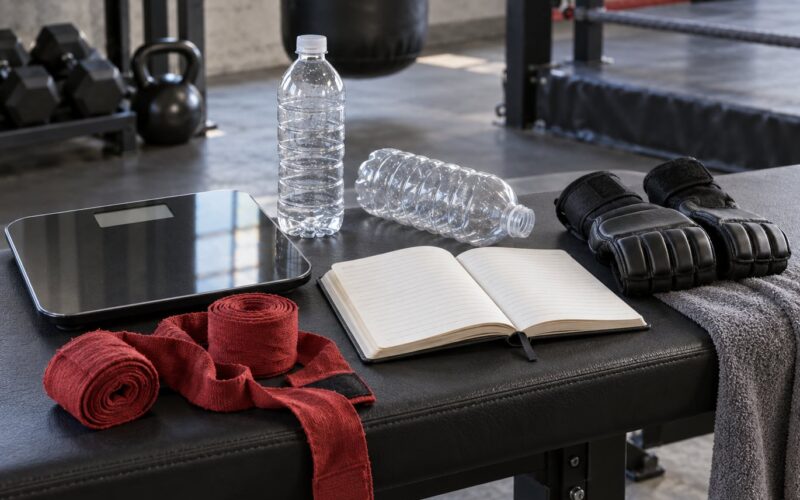
To fight a taller boxer you have to take away the long range they want to fight at: close the distance fast, slip while you move forward, and go to the body before their jab settles. You will not out-punch four extra inches of reach, so you make their best punch expensive and yours cheap.
That takes a few months of honest work, not one sparring session. The seven tactics below are the ones that actually hold up under pressure, and the hard part is not learning them, it is staying relaxed enough to use them when a taller sparring partner is throwing at your head.
Table of Contents
What You Need
You need a qualified coach for at least the first few sessions. Reach problems are awkward to self-teach because the mistakes are subtle, and a coach watching from the corner will see the angle you missed before you feel it.
Equipment matters more than usual, because shorter fighters take punches they were not expecting. Well-fitted gloves that are the correct weight for the session, a mouthguard, and hand and forearm protection are the baseline.
- Gloves sized for the work. Heavy bags and pads take lighter gloves than sparring. Ill-fitting gloves are worse than no gloves when you are leaning into hooks.
- Headgear for amateur rounds. Not because headgear prevents anything, but because it stops small cuts turning into a blood fight that ends your preparation week.
- Shin guards for lower-body work. If you are going to the legs, they need protecting.
- A ring with real neutral space. Training in a cramped corner teaches you to fight panicked.
- Conditioning for the inside. Intervals that let you sprint for ten seconds, work, and sprint again. Steady-state running will not get you through a pocket.
Finally, you need a sparring partner who will actually let you work at close range. If every session with a taller fighter is three rounds of chasing a jab, you are not sparring, you are chasing.
How to Fight a Taller Boxer Step by Step
Here is the order that works, and it is deliberately ordered. Distance first, because everything else fails without it. Body second, because it pays you back while you are still learning to survive inside.
Use your angles to fight a taller boxer
Angles are how you fight a taller boxer without ever being fast enough to beat them on the straight line. A jab travels in a straight line, so a straight line is the one place their reach works exactly as advertised.
Work off the lead foot with a pivot, then move out at an angle rather than forward. Once you are off the line, their distance is wrong, and a punch thrown from the wrong distance is a punch you can see.
Three habits do most of the work here. Pivot after every combination so you are never square twice in a row, cut off the ring so their back foot has nowhere useful to go, and switch sides so you are not a stationary target on one predictable line.
Against a tall southpaw specifically, most fighters want to circle away from the jab, which means moving to their right. Against a tall orthodox, the same logic points to their left. Getting that backwards costs you a round.
Control the range with footwork
Most shorter fighters lose because they never define where the fight happens. You need a working distance you can step into and out of on purpose, not the distance their jab sets for you.
Establish it with the jab. If you can land a jab without extending fully, you are in range. If your shoulder is popping and the punch lands on the way back, you are too far away to commit to anything.
Then vary it. One jab to measure, one jab to break their rhythm, one jab thrown while you step off the line. A jab thrown the same way every time is predictable, and a predictable jab against a longer fighter is a free entry for them.
Step in after you slip, not before. Slip and move forward as one movement, so the punch you are answering with starts from where the slip finished.
Make the taller boxer miss
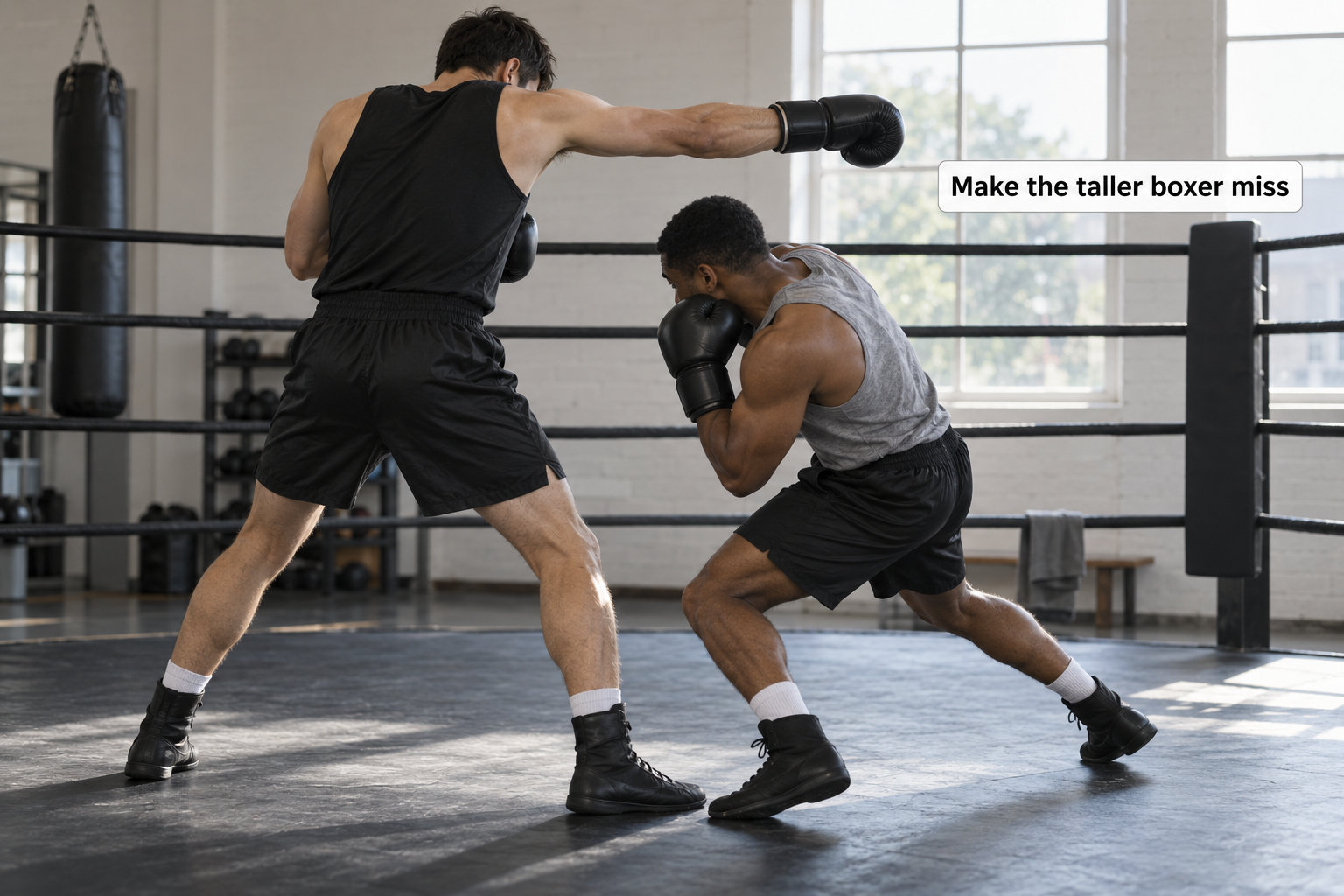
The taller fighter’s plan is simple: throw the jab before you are in range, hit you as you arrive, reset. Break that plan and the round changes shape.
Head movement beats trying to out-punch. A small roll or a slip that takes you off the line works on a taller opponent because their punch was already committed to a target that moved.
Use parries and redirects rather than a static block. A blocked jab is a jab you will answer from a bad position; a parried jab is a jab you answer from a good one.
Defend the body with your elbows rather than your hands. The specific problem shorter fighters hit inside is the uppercut coming over a high guard. Tuck the lead elbow to the centre of your body and keep the chin down behind the lead shoulder, so elbow to forearm to glove closes the line.
Attack the body and legs
The ribs and the liver are where height reverses itself. Their reach is longer, which means their body sits at a height your compact frame reaches comfortably, and their centre of gravity is higher, which means a body shot tips them further than it would tip you.
Work the ribs with the body jab and body hook, and go at the liver with a short left hook to the right side. The liver shot does not score in amateur boxing and it changes a fighter’s entire posture for the rest of the exchange.
The legs are the other half. Calf kicks and low body shots shorten a tall fighter’s base, and a fighter who cannot post his back leg on the mat cannot hold you off at range afterwards.
Two rules keep this safe. Do not lunge straight into a body shot, and do not load up on one hard body punch instead of four clean ones.
Use the jab economically
A jab thrown constantly is a gift to a taller fighter, because it tells them exactly when you are going to be there. Throw it for a reason: to measure, to interrupt, or to open a lane for something else.
Its best use is interruption. A jab to the body as they start a long combination can stop the combination before the power shot lands, which is a cheaper trade than anything you would throw in response.
Patterns worth drilling are short. Jab, slip outside, hook to the body. Jab, step in, short uppercut to the chin. Jab to the body, level change, hook to the body. All three end inside his guard, not at his face.
Build a reliable finish
The most common way shorter fighters lose a good position is by trying to finish it at the end of their own reach. Every time you throw a straight punch past your natural range, you reset to the distance you just escaped.
Finish inside instead. Drop your level and hook to the body, step off the line and come back with a short straight, or pivot out and re-enter. A short punch that lands beats a long one that misses every time.
Form matters here more than power. A hook thrown with your arm and shoulder behind your own hip is a punch you can land at close range. Anything you have to lean into is a punch that puts you off balance and out of the pocket.
Train for the tactical demands
None of this works on fitness you do not have. This is a weekly plan built for someone already training two or three times a week.
- Low shadow boxing, two rounds. Stay flat-footed and keep your chin below your opponent’s imaginary chest. This is the cheapest fix for standing upright and having no inside game.
- Moving-in pad work, three rounds. Your coach throws long punches; you slip and step in on every one. Slipping away is not allowed.
- Body-shot combinations on the bag, three rounds. Jab to the body, hook to the body, then change levels. Add the liver shot once the three-punch sequence is automatic.
- Sparring rounds against a taller partner, four to six rounds. Set one goal per round: one round to only enter, one round to only work the body, one round to survive inside without getting hit.
- Interval conditioning, twice a week. Thirty seconds hard, sixty seconds easy, repeated ten times. This is the exact shape of a pocket exchange.
- Calf and lower-body work, twice a week. Calf raises, box jumps, and fast feet drills on a rope.
Common Mistakes
Chasing is the first one. You push forward behind a high guard every time the jab reaches you, burn your legs, and arrive at the pocket empty.
Standing upright is the second. Tall opponents aim at things they can see, and an upright chin with shoulders level is the easiest thing in the ring to see.
Trading at range is the third. Their jab and straight land before yours ever leave your hand, so an exchange at long range is a straight loss.
The fourth is ignoring the body. Two body shots to the ribs will do more than four head shots that never land, and the fighter who ignored them is usually the one who slowed down first.
The fifth is passive backing up. When you are being out-ranged and you retreat, you give up the ring and let the fight happen at the exact distance the taller fighter chose.
The sixth is copying their pace. If they want a patient, long-range fight and you give them one, you have already agreed to fight their fight.
Common Mistakes and How to Fix Them
Most of these share one root cause: you let the taller fighter pick the distance. What follows is what they do, why it works, and what to practise next session.
- Long jab from outside range. It lands before you can reach, and you reset after. Practise: jab to the body, then step in off your own jab.
- Uppercut over your high guard. Your chin is exposed above your gloves. Practise: lead elbow tucked to centre, chin behind the lead shoulder.
- Three or four hooks inside. Your feet stop working and you cannot set your base. Practise: elbow tight to the ribs, pivot and reset the feet between shots.
- Long straight punch. It out-ranges you if you stand where he wants you. Practise: roll underneath, step off the line, hook to the body.
- Waiting for you to come in. Every forward step you take gives him a free reset. Practise: work on the counter, let him step into your range.
- Fighting at long range all round. It plays to his reach every second of the round. Practise: clinch or reset to the outside, then re-enter.
On reach itself, roughly speaking, a man around 6 foot tall with a 72 inch reach is proportionate and strong, not rare. Under 70 is the short end of the amateur range, 73 to 76 is where most lanky professionals sit, and anything above 76 is exceptional.
The practical reading: every few inches above your own reach changes which shots you can safely contest. If the gap is four inches or less, you can trade at range and win exchanges. Past eight inches, do not try, because the jab will land first almost every time.
One useful correction to the received wisdom. The standard advice that taller fighters should stay inside and shorter fighters should stay outside comes from a single line of folk reasoning that a lot of people repeat without testing it, and it will get you hit.
Good timing beats reach more often than the reach argument suggests. Instead of forcing your way in, set your feet, make him commit, and let him walk into your range.
Both schools are true for different fighters. The inside fighter with a puncher’s power can genuinely do damage in the pocket, so the taller man staying inside can work. The shorter man who cannot survive three hooks inside should not be there at all, which is a technique problem rather than a height problem.
Frequently Asked Questions
Can a 5 foot 7 boxer beat a 6 foot 5 boxer?
Yes, and it happens at every level. A twelve inch height gap is not a matchup-breaker in boxing. What matters is whether the shorter fighter can get inside without eating three hooks, and whether he can work the body once he does. Plenty of stocky pressure fighters have beaten much taller opponents by simply refusing to fight at range.
Can a shorter person beat a taller person in a fight?
In boxing, frequently. Height buys reach, but reach only works at one distance. A shorter fighter who controls the range, attacks the body and legs, and stays composed inside has several routes to win that height cannot take away. Outside of a regulated ring, size is a much bigger factor and this advice does not transfer at all.
Do taller fighters have an advantage in boxing?
At the start of a round, yes, and it is a real one. A taller fighter’s jab lands two to three feet outside your range, so they can hit and reset before you are ever in range, and their height means fewer punches reach their chin. The advantage shrinks the moment the fight moves inside, which is why inside work is the whole answer.
Is 72 inch reach good?
It is solid rather than exceptional. A man around 6 foot tall with a 72 inch reach is proportionate, and it sits in the range where most serious amateurs and plenty of professionals compete. Somewhere around 73 to 76 inches is where lanky professionals usually sit, and 76 plus is exceptional regardless of height.
How do I stay inside against a taller boxer?
Elbows tight, chin down behind the lead shoulder, and feet moving. The punch that beats a high guard is the uppercut, so close that line by tucking your lead elbow to the centre of your body. When you get hit with three or four hooks and lose your base, stop trying to punch and pivot and reset your feet before you throw anything.
Is there a height limit to boxing?
No hard limit, but the practical ceiling is far above most people assume. The useful number is reach rather than height, and a fighter with a long span and a strong inside game can compensate for most of a height gap. Pick the weight class where you are physically strong rather than the one where you are tallest, and you will go further than most fighters expect.
Conclusion
How to fight a taller boxer comes down to four things: take the distance away, make their jab miss, punish the body every time you get close, and be honest about how you finish. Reach is only dangerous while the fight stays where the taller fighter wants it.
Start with one thing at your next session. Shadow box low for two rounds, then do nothing but slip and step in on long punches for three, and let your coach watch the angles rather than your hands.
And if the inside still feels like a place you get punished, get a coach on it specifically. That single gap is where most shorter fighters lose, and it is a fixable one.
Last reviewed for 2026.