Drug testing in boxing works through a fixed eight-step process: a fighter is selected from a pool or targeted by intelligence, gives a urine sample under witness at a collection booth, the sealed sample goes to a WADA-accredited lab, and any hit is confirmed with a second B-sample before a hearing decides the sanction. Nobody chooses the outcome on the night.
The confusing part for most readers is not the lab work. It is jurisdiction. In Britain, UK Anti-Doping does the testing for fighters under the British Boxing Board of Control. In the US, dozens of separate state commissions order their own tests. And a small group of wealthy boxers pay for extra voluntary testing through VADA, which collects samples but has no power to hand out penalties.
So when you read that a boxer failed a test, three separate questions hide inside that sentence. Who tested him? Who decides the punishment? And who paid for it? This guide walks through each one, then runs through eight real cases so you can see how the system actually behaves when it works and when it doesn’t.
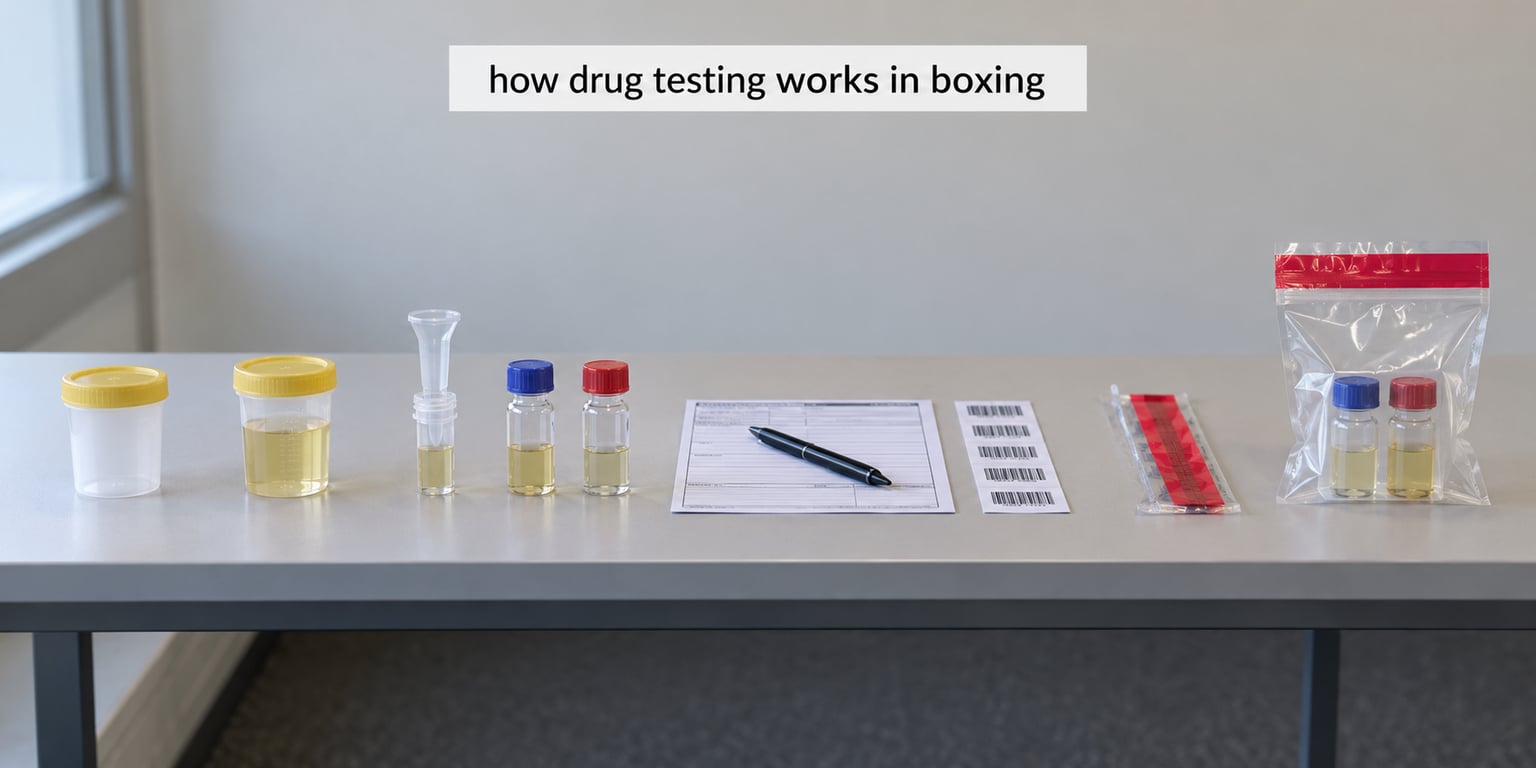
Table of Contents
- How is drug testing conducted in boxing?
- Who runs the test? WADA, UKAD, VADA and the state commissions compared
- In-competition vs out-of-competition testing
- What gets tested: urine, blood and hair
- Who selects the fighter and who pays for the test
- What happens to a positive result
- Real cases: what fighters actually tested positive for
- Strict liability and how fighters get cleared
- The limits of the system, and where the rules are heading
- Frequently Asked Questions
- Conclusion
How is drug testing conducted in boxing?
A boxing drug test is an anti-doping procedure where a governing body or state commission selects a fighter, collects a urine sample under chain of custody, sends it to an accredited laboratory, and confirms any prohibited substance found in it a second time before a hearing. It does not happen in a ring, and it is not decided by a promoter.
The 8 steps of a boxing drug test
- Registration and whereabouts filing. Licensed fighters give the governing body their regular training location and daily schedule. That record is what makes a surprise visit possible at all.
- Selection. The fighter is picked from a registered testing pool, either by lot or by intelligence-led targeting based on the testing body’s risk model.
- Notification. A doping control officer arrives or calls, and the fighter is given short notice, commonly 24 hours, to get to a collection point.
- Sample collection. The fighter provides urine in a private stall with a witness of the same sex present for the whole void. Blood or hair may also be taken depending on the body’s programme.
- Chain of custody. The sample is sealed, labelled, signed for, and couriered to a WADA-accredited laboratory. Every handover is recorded.
- Laboratory screening. The lab screens the A-sample against the WADA Prohibited List using mass spectrometry and, for some substances, the athlete’s stored biomarker samples.
- B-sample confirmation. If something is found, the B-sample is opened and re-analysed, ideally at a different laboratory, in the presence of the fighter and his representative.
- Notification and hearing. The result goes to the anti-doping body, then to the commission or national body, which convenes a tribunal or applies its own rules to impose a suspension, a fine, or a title strip.
Steps one through five are the part fighters find most unpleasant, and the part almost nobody explains. The rest is laboratory procedure that most readers can only take on trust.
Step 3: The fighter is notified and provides a sample
There is no summons. A doping control officer turns up at the gym, the fighter’s home, or a hotel, and hands over a written notice. From that moment the fighter is expected to stay available, which in practice means arranging a collection point within a reasonable distance and within a set window.
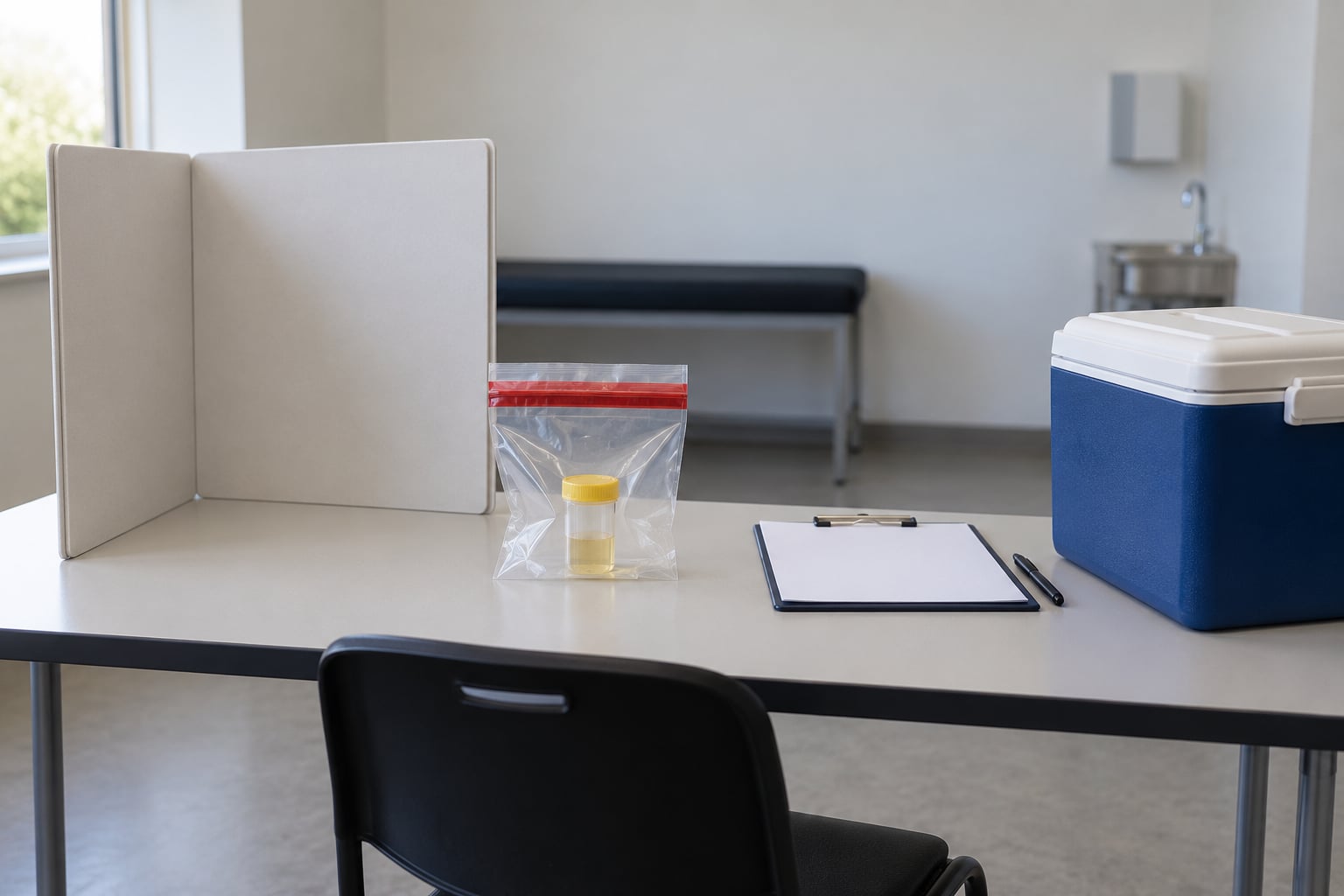
The collection itself is deliberately unglamorous. You are shown to a stall, you are handed a sterile container, and you produce the sample with a witness standing just outside the privacy screen who records that you actually voided rather than pouring in something from a bottle. The sample volume is measured to confirm it is not diluted.
Urine collection is unpopular partly because it is unpredictable. Fighters often cannot produce on demand, so they hydrate in advance, and a heavily dehydrated fighter cutting weight may simply fail to give a usable sample. That is why the rules allow for attempts and a second visit, and why weigh-in-day testing after a cut is one of the more demanding moments of the year.
Samples are split into two sealed containers, the A-sample and the B-sample. The B-sample stays sealed and untouched for the entire investigation. It exists so that one laboratory mistake does not end a career, and so the fighter has a second bite at the same evidence.
The sealed container is then handed to a courier and tracked. The lab receives it in a state that makes swapping or tampering impractical. If a fighter can later show the paperwork was broken at any link, that is a real argument at the hearing.
Who runs the test? WADA, UKAD, VADA and the state commissions compared
Four kinds of organisation appear in boxing testing, and confusing them is the source of most of the online argument about whether the sport is really tested. Only two of them can hand out a suspension.

| Body | What it is | What it does | Who punishes |
|---|---|---|---|
| WADA | World Anti-Doping Agency, the international norm-setter | Publishes the Prohibited List and the International Standard for Laboratories; does not test individual fighters | Nobody directly. It sets the rules others enforce |
| UKAD | UK Anti-Doping, Britain’s national anti-doping organisation | Selects and tests fighters licensed through the British Boxing Board of Control | UKAD, normally a two-year ban |
| VADA | Voluntary Anti-Doping Association | Conducts extra testing that fighters or promoters pay for | Nobody. VADA reports, and a commission or national body decides |
| State commissions | NYSAC, the Nevada commission, and dozens more | Order tests for anyone licensed in their state, at the promoter’s expense | The commission that licenses the fighter |
The Ryan Garcia case shows why the distinction matters. VADA administered his tests because he had signed up voluntarily, but it does not adjudicate punishment. The New York State Athletic Commission imposed the one-year ban. A body can be the lab that found the result and have no authority to act on it.
WADA sits above all of this. It writes the list that UKAD and every commission work from, and it certifies the labs. It has no doping officers knocking on hotel doors in Las Vegas.
In-competition vs out-of-competition testing
In-competition testing means the sample is taken in the window defined around a bout, typically from 24 hours before a scheduled fight to 24 hours after it ends. Out-of-competition covers everything else: training camps, weight cuts, and the weeks between fights.
In-competition is when a fighter is most likely to test positive, because there is no time to cycle off. Out-of-competition testing catches the opposite pattern, the fighter who stays on a long course and gets visited during a quiet week.
UKAD’s published reporting gives a useful sense of the split for fighters under the British Boxing Board of Control: 213 in-competition tests and 133 out-of-competition tests in a reporting period. The in-competition figure being the larger of the two tells you where a commission’s effort naturally concentrates.
What gets tested: urine, blood and hair
Urine is the workhorse because a urine sample is cheap to collect and easy to screen for hundreds of compounds at once. Blood is harder to take, needs trained staff, and is used where the body specifically wants the tighter detection windows that blood provides. Hair is the slowest and most intrusive, and is generally reserved for established cases rather than random screening.
| Sample | What it catches well | Why it is not used for everything |
|---|---|---|
| Urine | Steroids, stimulants, diuretics, narcotics, most masking agents | Detection windows are hours, not weeks. A fighter can be clean at the moment of collection |
| Blood | Stimulants and hormones where a short window is desirable | Requires a phlebotomist, is more invasive, and costs more |
| Hair | Longer-term exposure over weeks and months | Slow, sometimes criticized, generally used after something is already suspected |
The WADA Prohibited List
The substances are not named in boxing rules. Boxing adopts the annual WADA Prohibited List, which groups them into classes: stimulants, narcotics, anabolic agents, peptide and growth factors such as erythropoietin and human growth hormone, hormone and metabolic modulators, and the beta-2 agonists category that contains clenbuterol.
Diuretics and masking agents sit in their own category because they are usually taken to hide something else. A fighter’s own weight cut is also a live issue: if a sample is so dilute the laboratory cannot interpret it, the result can be treated as a refusal-like problem even when nothing was found.
There is also the Therapeutic Use Exemption, which lets a fighter use a listed substance for a genuine medical reason if he applies in advance and gets it approved. It is the only lawful route to a banned substance.
Who selects the fighter and who pays for the test
The fighter does not get to pick, and neither does the promoter. Selection comes from a registered testing pool managed by the national anti-doping organisation, using a combination of random draws and risk-based targeting built from whereabouts information, prior findings, and intelligence about what other laboratories have found elsewhere.
Criticism on fan forums that random testing is not truly random has a partial basis. A pure lottery is easy to game, so most programmes weight selection toward people they consider higher risk. That is a deliberate design choice in the international standard, not a secret.
Money is the other half. The Association of Boxing Commissions regulatory guidelines state that any or all boxers may be required to submit to drug testing, or any other testing as required by the supervising commission, at the promoter’s expense. In practice that means US commission testing is a cost the promoter carries, which has shaped how much of it happens.
Britain’s model is different. UKAD runs its programme as a national anti-doping organisation and funds itself through public money, which is why domestic testing exists without every promoter having to pay for it separately.
Voluntary testing adds a third layer. Anthony Joshua has paid for additional VADA testing for years to sit alongside UKAD’s programme, which is the clearest example of a fighter treating extra scrutiny as a competitive and reputational asset. Most fighters cannot afford that, and cost is the honest reason voluntary coverage is thin.
What happens to a positive result
A positive does not end a career on the day it is reported. The sequence runs from a laboratory finding to a hearing, and most of the delay sits in the middle.
- Initial review of the A-sample. The accredited laboratory reports an adverse analytical finding, typically with a lower-bound concentration for the substance found.
- B-sample analysis. The reserved sample is opened and re-analysed, ideally at a different laboratory. If the B-sample comes back negative, the case can collapse here.
- Notification. The fighter, his team, the national anti-doping organisation and the relevant commission are all formally informed.
- Provisional suspension. In most jurisdictions the fighter is suspended from competition while the case runs, and a title may be vacated provisionally.
- Hearing. The fighter can admit the finding, dispute it, or argue his case was contaminated. A panel decides.
- Sanction. In the UK, a UKAD finding that proceeds normally carries a two-year ban. In the US, the sanction is whatever the licensing commission’s rules provide, which is why the numbers differ so much between cases.
- Purse and results consequences. Depending on the body’s rules, purses from the relevant bout can be forfeited and the result of the fight can be changed to a no contest.
- Title status. Each sanctioning body decides independently whether to strip a championship, which is why two bodies can disagree about the same result.
One more cost lands on the fighter. Independent panels are not free, and the respondent side frequently ends up bearing that bill whatever the outcome.
Real cases: what fighters actually tested positive for
These cases cover the range. Some were deliberate, some were contamination, and in at least one the result was overturned.
| Fighter | Year | Substance | Body involved | Outcome |
|---|---|---|---|---|
| Amir Khan | 2011 | Ostarine and clenbuterol, with a contaminated supplement identified | UKAD | Four-year ban; stripped of the WBA lightweight title |
| Dillian Whyte | 2018 | Meldonium | UKAD | Two-year ban, later reduced to one year on appeal |
| Luis Nery | 2016 | Clenbuterol, attributed to contaminated beef | Mexican commission and the WBC | Banned and stripped by the WBC; The Ring did not strip him |
| Canelo Alvarez | 2023 | Clenbuterol, after the commission found contaminated meat | Nevada State Athletic Commission | Test initially suspended; decision overturned on appeal |
| Conor Benn | 2024 | Clomifene | UKAD, ahead of a title fight | Two-year ban and stripped of the WBO title |
| Ryan Garcia | 2024 | Ostarine, with a second positive sample | VADA tested, NYSAC decided | One-year PED ban from the New York State Athletic Commission |
| Jarrell Miller | 2024 | Two further positive samples before a title bout | Commission-managed programme | Banned ahead of the fight and removed from the contest |
Read across that table and the fragmentation becomes obvious. The UK ban is four years, two years, two years. The US results run from one year to a suspension that was overturned entirely. And the same case can produce one champion status in one organisation and another in another.
Strict liability and how fighters get cleared
Does intent matter? Under strict liability, the standard anti-doping rule, it usually does not. The presence of a prohibited substance in a sample is the offence. Whether the fighter meant to take it, misunderstood a supplement, or was contaminated by a mouthful of bad beef is a factor in the sanction, not in the violation.
That is why almost every cleared case is cleared on contamination grounds rather than on innocence.
The routes out of an adverse finding run roughly in this order:
- Contaminated meat. Clenbuterol is the classic case, because cattle fed certain growth promoters carry residues. Alvarez’s 2023 finding was resolved this way.
- Contaminated supplements. Khan’s case turned on a supplement bought online that the lab found to contain ostarine and clenbuterol. Fighters who take supplements are advised to keep the packaging and the batch number, because it is the only evidence that survives.
- Cross-contamination. The argument that a substance arrived by contact rather than ingestion, which requires a chain-of-custody objection to stand up.
- B-sample disagreement. When the confirmation analysis does not reproduce the finding, the case can fail on the evidence alone.
- A granted Therapeutic Use Exemption. A narrow route, since it has to have been approved in advance.
For anyone reading this as a fighter or a coach, the practical advice is short and unglamorous. Know what is on the Prohibited List, treat any supplement as a risk until a batch-tested product says otherwise, and be cautious with meat in the final weeks before a test.
The limits of the system, and where the rules are heading
The criticism that lands hardest is not about the labs. It is about timing. On boxing forums the most repeated accusation is that a fighter can run a short course during camp, wash out before a scheduled test, and start again afterwards, because random urine testing only gives a detection window of days for most steroids. Nobody has ever produced clean proof of a specific fighter doing this, but the reasoning is sound enough that it is hard to dismiss.
Jurisdiction is the other structural weakness. A fighter licensed in one country can sometimes fall outside the reach of another body’s ruling, and sanctioning bodies disagree about whether a title should change hands. When the rules differ by state and by sanctioning organisation, the same conduct does not produce the same consequence, and that is the strongest argument for reform.
There is also an imbalance between amateur and professional testing. Chris Algieri has pointed to the significant drop-off in testing as fighters move from the amateur ranks to the pros, which matters because it is the amateur ranks where many habits start. The BBC reporting on Anthony Joshua’s comments makes the related point plainly: Joshua said boxing clearly has a doping problem.
The direction of travel is toward more formalisation rather than away from it. Promoters including Eddie Hearn have called for a single global governing body with one standard of testing and one rulebook for punishment, which would remove most of the inconsistency catalogued above. Whether that body arrives before or after another high-profile case is the open question.
Frequently Asked Questions
How is drug testing conducted in boxing?
A commission or anti-doping body selects a fighter from a registered pool or by risk-based targeting, notifies him at short notice, and collects a urine sample under witness in a private stall. The sealed sample is split into an A-sample and a reserved B-sample, couriered to a WADA-accredited lab, screened against the Prohibited List, and any hit is re-tested on the B-sample before a hearing.
Do boxers get drug tested before a fight?
Yes, and that is the in-competition window, running from about 24 hours before a scheduled bout until 24 hours after it ends. That is when fighters are least likely to be clean, because there is no time to cycle off a course. Out-of-competition testing covers camps and the weeks between fights, and is where most of the sport’s testing volume actually sits.
What is VADA testing in boxing?
VADA is the Voluntary Anti-Doping Association, which conducts extra anti-doping testing that fighters, managers or promoters pay for. The important limitation is that VADA does not hand out sanctions. It reports findings, and a national body or state commission decides the penalty, which is exactly how Ryan Garcia’s 2024 positive ended up producing a ban from the New York State Athletic Commission.
What happens if a boxer tests positive before a fight?
The A-sample finding is confirmed on the reserved B-sample, then the fighter is notified and usually provisionally suspended. A hearing follows, where he can dispute the result or argue contamination, and the sanction is imposed. Depending on the jurisdiction that can mean a two-year ban in the UK, a one-year ban in the US, forfeiture of the purse, and a title stripped by the sanctioning bodies that choose to do it.
What did Conor Benn and Canelo Alvarez test positive for?
Benn tested positive for clomifene in 2024 through UKAD, a substance bought from unregulated sellers that is not a legitimate performance aid, and received a two-year ban. Canelo Alvarez tested positive for clenbuterol in 2023 after the Nevada commission found contaminated meat, and his suspension was overturned on appeal.
Who decides which boxer gets tested, and who pays?
The fighter does not choose, and neither does the promoter. An anti-doping organisation selects him from a registered pool using random draws and risk-based targeting built from whereabouts filings. In the US the Association of Boxing Commissions guidelines put the cost of testing at the promoter’s expense, while Britain’s programme is funded publicly through UK Anti-Doping.
Conclusion
How drug testing works in boxing is a process that works reasonably well at the laboratory end and poorly at the enforcement end. Samples are collected carefully, chain of custody is documented, and confirmations are re-run. What varies wildly is how often a fighter is selected, which body tests him, and what he is punished with when he fails.
If you want one thing to take away, make it the distinction between the body that finds a substance and the body that imposes the penalty. That single gap explains most of what looks inconsistent about anti-doping in this sport.