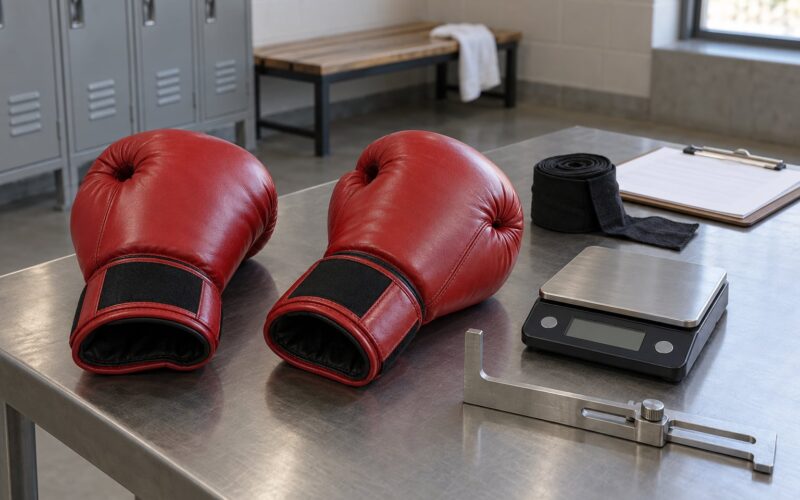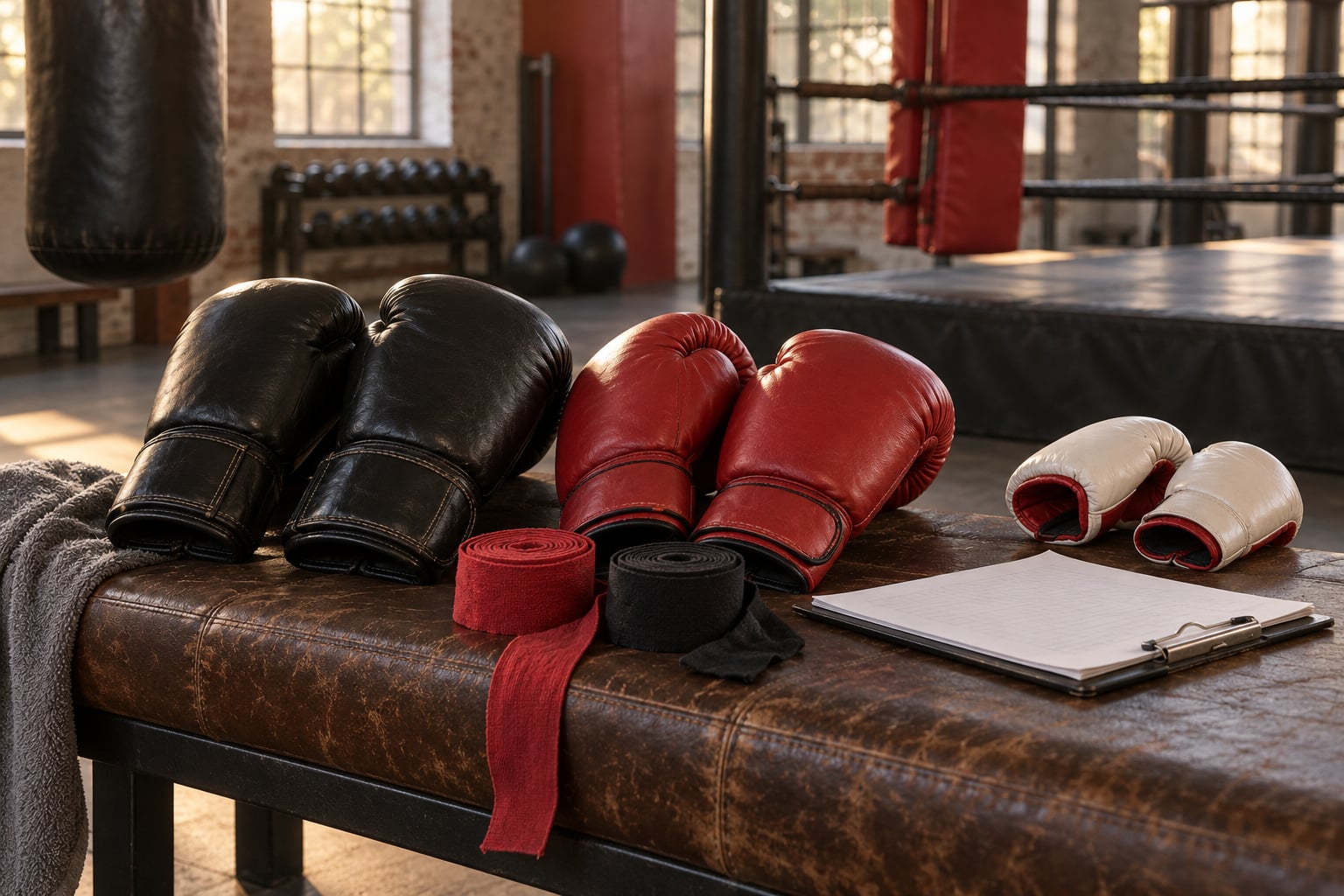
Boxers do not pick their fight-night gloves off a shop shelf the way amateurs do. A title bout glove has to come from a commission-approved vendor or be supplied by the promoter, has to match the mandated weight for the weight class, and is almost always the same make the fighter wore through camp. That leaves preference as the final filter, not the starting point.
Most of the confusing arguments on fight forums come from mixing up two different questions: what a fighter likes and what a fighter is allowed. A champion can be loyal to one brand for fifteen years and still be handed a different pair for a single bout.
Here is the short version before we dig into the details:
- The athletic commission sets safety specs and controls which manufacturers are approved.
- The promoter or sanctioning body often supplies or mandates the gloves for the event itself.
- An equipment contract with a glove maker is the most common way a brand reaches the ring.
- Weight class dictates the ounce rating, which alone can rule out half a catalogue.
- Camp consistency matters, because the glove changes punch feedback and wrist feel.
- Construction details like horsehair padding, attached thumb and lacing get a fighter loyal to one model.
- Title fights add commemorative and colour options the fighter never sees in the gym.
- The champion and challenger often do not wear the same brand, and the challenger rarely gets a say in it.
Table of Contents
- What determines a fighter’s glove choice for a title fight?
- Why glove brands matter so much in professional boxing
- Sponsorship and business relationships
- The fighter’s personal preference and trust
- How glove weight and construction affect performance
- What title-fight rules and commissions can change
- Why fighters might switch brands for a major fight
- How to tell whether a glove is an endorsement or a technical choice
- Why fighters wear specific glove brands in title fights
- Frequently Asked Questions
- Conclusion: Start with the fighter’s actual fight plan
What determines a fighter’s glove choice for a title fight?
A fighter’s fight-night glove is decided by three parties in order: the commission decides what is legal, the promoter decides what is supplied, and the fighter decides what he prefers inside those limits. Contracts and long-held habits fill the gap between them. In practice that means an approved brand, the right ounce rating for the weight class, and the same model the fighter used all camp.
Nothing about that chain is secret, but almost every ranking page on this topic skips it and implies a champion can walk into any gym and order whatever he likes. That is not how a sanctioned title bout works.
Why glove brands matter so much in professional boxing
Glove deals are small compared with a fighter’s total earnings, which is exactly why they are interesting. A logo on both hands, repeated on every poster and broadcast frame for a title fight, is in-ring advertising that costs a manufacturer a fraction of what a ring-canvas banner would run. For a heritage brand, appearing on a champion’s hands is the whole marketing pitch.
For the fighter, the relationship brings income and exposure, and sometimes a hand in what is manufactured. A gym owner or a long-standing manager will often steer a fighter toward a sponsor because the gym is already doing business with that company. That is how many long pairings started.
The champion-to-brand pairings fans remember have stuck for different reasons, and mixing them up causes most of the arguments online:
| Fighter | Era | Gloves he is widely associated with | Why the pairing stuck |
|---|---|---|---|
| Muhammad Ali | 1960s | Cleto Reyes | Ali built the profile of his eponymous gloves as much as the fights themselves |
| Mike Tyson | 1980s and 1990s | Everlast | The association became so strong that the partnership effectively disappeared from public view |
| Oscar De La Hoya | 1990s onward | Cleto Reyes | Long gym habit rather than a single fight-night promotion |
| Manny Pacquiao | 1990s and 2000s | Winning | Team-linked relationship that also carried his colours into fights |
| Miguel Cotto | 2000s | Cleto Reyes | Brand loyalty plus a fighter-run outfit built around that equipment |
| Floyd Mayweather | 2000s onward | Winning | Equipped himself and expected the same gloves on both sides |
| Wladimir and Vitali Klitschko | 2000s | Winning | European camps standardised on one make across generations |
| Naoya Inoue | 2010s and 2020s | Winning | Sponsor relationship carried from the start of his title run |
One note on naming, because it trips people up: TITLE is also a glove brand, capitalised that way, and it has nothing to do with a title fight. An article about championship gloves will keep using both words for two different meanings.
Sponsorship and business relationships
An equipment deal is a contract, and the glove is one line in a wider agreement. A glove company will often bundle gloves with trunks, robe, footwear and a promotional budget, and in exchange it gets the logo across every broadcast still. The fighter gives up the right to appear in a competitor’s gear within a window that can cover training and fight night.
That obligation survives a technical preference. A boxer who finds another make more comfortable mid-camp usually cannot simply switch, because the agreement runs past the bout date. The deal carries financial weight, so a trainer will push the fighter back toward what he already has.
There is also a chain effect from promoter and broadcaster relationships. If a promoter has an equipment partner, that partner can become the default supplier for the event, which quietly narrows what a fighter can wear. The order of contracts matters: promoter deal first, then the fighter’s own equipment agreement inside it.
Sponsor money in this sport is rarely published, so treat any figure you see quoted for a glove deal as unverified. The mechanism is well documented even when the numbers are not.
The fighter’s personal preference and trust
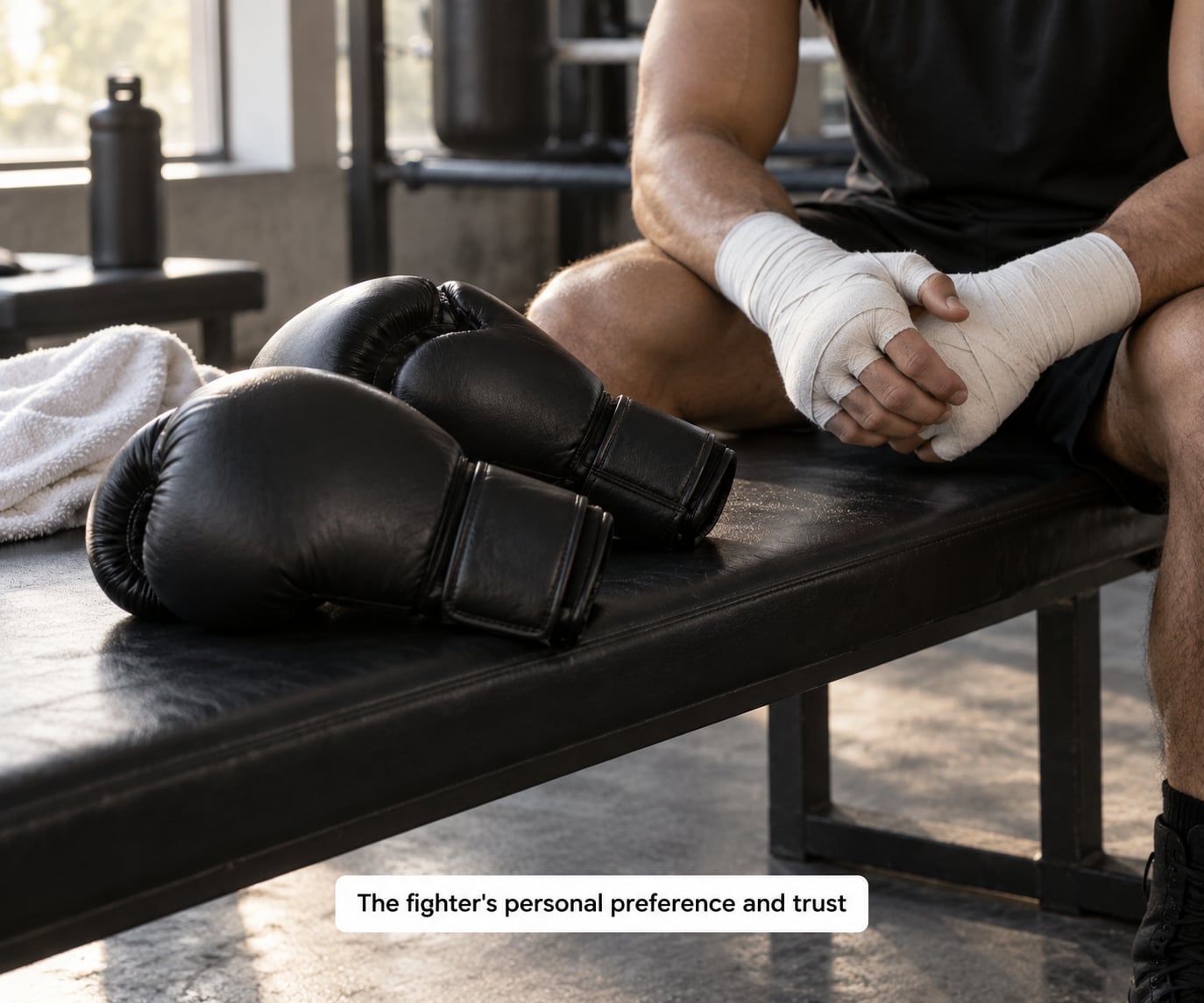
A glove is the last piece of equipment between a fighter’s intention and the other man’s face, so trust matters more than novelty. Once a fighter has spent a camp in a pair, with a few dozen hours of pad work, sparring and bag work, he knows exactly how far the fist travels before it lands and how much the wrist holds on impact. That knowledge is worth more than any spec on paper.
The feedback loop is physical. A glove that sits differently at the knuckle changes how a punch is thrown, and a wrist strap that is looser changes how much a fighter guards his chin. Correcting either in the last three weeks of camp is a bad trade for a title fight.
There is a psychological layer too. A fighter who trusts his equipment fights one fewer problem. Handlers and coaches know this, and it is why a proven model often survives years of contract pressure.
How glove weight and construction affect performance
Ounces are the first hard constraint. The commission fixes the contest weight by division, so the weight class narrows the field before brand even enters the conversation. Fighters spend most of camp in heavier gloves and drop down for the bout, which is why the contest pair can feel unfamiliar even to a veteran.
| Use | Typical weight | What it is for |
|---|---|---|
| Contest, featherweight through welterweight | 8 oz | The regulation glove for the lighter divisions |
| Contest, middleweight and above | 10 oz | The regulation glove for the heavier divisions |
| Sparring | 14 oz to 16 oz | Extra padding for repeated contact over weeks of camp |
| Bag and pad work | varies | Depends on whether contact is involved, not on the fight weight |
Fighters argue about the boundary cases on weight-class threads, particularly near 147 and around the light heavyweight limit, because a fighter who misses division weight is often shifted into a different bracket and therefore a different glove weight. The rule itself is simple; the consequence of the scale is not.
Construction is where brand loyalty actually lives:
- Horsehair padding is firm and gives the puncher immediate feedback, so a fighter who likes to know exactly what his fist hit tends to stay with it.
- Foam or latex padding absorbs more, which some fighters prefer because it feels safer on the knuckles.
- An attached thumb reduces the risk of a finger finding an eye, and fighters who have been cut by one rarely go back.
- Lace-up closures give a firmer wrist than a strap, and some gyms wrap extra lacing for support.
- Cowhide leather and hand stitching mould to a hand over time, which is part of why the same pair gets ordered again.
Two gloves can share the same weight and feel nothing alike. That is the part a spec sheet will not tell you.
What title-fight rules and commissions can change
Commissions handle gloves in one of two ways, depending on the state or country. Some, such as the California State Athletic Commission, maintain an approved list of manufacturers and models that teams submit in advance. Others judge each pair case by case before the bout. Either way the brand must be cleared before fight night, and the process takes weeks.
Outside the United States the approving body changes. Bouts in the United Kingdom and much of the Commonwealth fall under British Boxing Board of Control rules, with their own requirements for weight, padding and marking. A fighter who builds a career on one approved model can still find himself scrambling when the same model is not cleared for a bout in a new jurisdiction.
The sanctioning body, promoter and venue each add a layer. A sanctioning body sets championship rules, the promoter runs the card and often names a supplier, and the venue commission has the final say on safety. A glove can be approved in one state and rejected in another on the same night.
The reference checks are the unglamorous end. Gloves are inspected for weight, padding placement, closure type and clean condition before the opening bell, and a worn or broken pair can be replaced on the spot. That is why a fighter travels with a backup pair he has broken in.
Why fighters might switch brands for a major fight
Switching is not romantic. It is usually forced or pragmatic, and the common triggers are a new sponsor entering the picture, an approved model becoming unavailable in the fighter’s size, a medical requirement, or an equipment problem that appears too late to solve otherwise. A weight adjustment can also push a fighter toward a different make that sits better on the hand.
Title fights add one more: the commemorative pair. Champions are frequently handed gloves in gold, silver or a team colour for a championship bout, which is a marketing decision as much as an equipment one. Pacquiao’s coloured gloves became part of his fight-night identity precisely because they did not look like everyone else’s.
The clearest example of the glove question becoming a storyline is the Mayweather and Maidana rematch. Press and fan discussion focused on Maidana’s gloves, with speculation that Mayweather would object to the Mexican-made pair being used. Fan reaction in archived threads on the subject ran well ahead of the facts, and it is worth saying plainly that a glove dispute was a talking point rather than a settled commission ruling. What it did show is how much authority fans attribute to the champion over his opponent’s equipment.
The underlying issue is real and still unresolved. A fight-night thread from 2008 on one of the major boxing forums asks almost exactly this question about Oscar De La Hoya, Miguel Cotto and Mayweather, and nothing in the thread answers it. The challenger rarely gets to choose once a champion has a preference on record.
How to tell whether a glove is an endorsement or a technical choice
Read the glove twice. First, check whether the brand is already on the fighter’s own event posters or ring canopy walkout kit. A brand appearing there usually means a relationship that predates the fight.
Second, look at the details. A technical choice shows up as the same make and model the fighter has been photographed in all camp, in the correct ounce rating for the division, and in a standard colourway. An endorsement choice tends to show a model that appears for the first time on fight night, in a special colour, or on one fighter and not the other.
Neither reading is conclusive. Contracts, medical needs and promotion-supplied gloves all blur the line, and a fighter will happily take a deal for a pair he has already tested in the gym.
Why fighters wear specific glove brands in title fights
Pulling it together, the recurring reasons appear in roughly this order of how much they limit the fighter:
- Commission approval. The make and model must be cleared by the commission before fight night, which removes brands weeks ahead of the bout.
- Promoter or event supply. An event can mandate a supplier or hand out the gloves, which can override a preference.
- Equipment contracts. Agreements with glove makers and apparel partners usually cover fight night as well as training.
- Weight class. The mandated ounce rating determines which models in a range are even eligible.
- Camp consistency. The pair used all camp is the pair a fighter trusts on the night.
- Construction preference. Padding type, attached thumb, lacing and leather are personal and rarely changed late.
- Opponent-specific planning. A challenger may ask for a glove setup that matches what the champion has used, which is the usual point of contention.
- Special-occasion presentation. Gold, silver and team-coloured pairs are a marketing decision layered over the approved spec.
Do fighters choose their gloves alone?
Not entirely. A coach, manager, trainer or the promoter’s representative can all have input, because equipment choices are usually settled during camp rather than the week of the fight. A fighter with an equipment deal has the least room, while a champion without one may have more say than an outsider expects.
Are title-fight gloves always the same as training gloves?
No, and for most fighters the contest pair is the lightest they wear all year. Camp happens in heavier gloves for protection, usually 14 oz to 16 oz, with a switch to contest weight in the final weeks. The lower weight changes punch feedback, which is why trainers treat the switch as part of the taper.
Can a fighter wear a different brand for every bout?
Technically possible, rarely practical. Changing make and model forces a fighter to test something unfamiliar inside the most important weeks of a year. Contracts, availability and division weight usually push toward one brand over a long stretch instead.
Frequently Asked Questions
Do fighters choose their own gloves for a title fight?
Not freely. The commission approves the make and model, the promoter may supply them, and only then does the fighter’s preference count. Most fighters end up wearing the same make they trained in, because switching late costs them feel. Contracts with glove makers narrow the choice further, and a fighter under an equipment deal usually cannot change for a single bout.
What brand of gloves do professional boxers use?
Cleto Reyes, Everlast and Winning are the three names most readers will recognise, with Grant and Ringside appearing often too. Lonsdale has a strong following in the UK and Commonwealth. The honest answer is that a handful of brands cover most of the professional sport, and the specific model matters as much as the name on the wrist patch.
Did Mike Tyson use Everlast gloves?
Yes, and the pairing dominated his public image through the 1980s and most of the 1990s. Tyson later moved away from that arrangement and set up equipment under his own name. His case is the clearest example of how a glove relationship can end up carrying more weight than the fighter’s desire to change brands.
Why do pro boxers not wear a headguard?
Headguards are essentially absent from professional boxing, unlike amateur competition or kickboxing. Sanctioning rules and commissions permit gloves only, on the grounds that a covered head changes how a punch lands and is judged. Fighters who want added protection usually rely on their glove choice instead, paying attention to wrist support and padding density.
Do fighters get a new pair of gloves for every fight?
Some do, many do not. A fighter with a conditioning problem or a hand injury may be given a freshly made pair for each bout, since a used glove breaks down over months. Fighters without those issues usually keep the same pair through several fights because the shape has already moulded to their hand and that familiarity matters more than being new.
How do commissions approve boxing gloves for a bout?
The commission sets weight and padding specs, then either checks a model against an approved register or reviews the submitted pair directly. Teams usually submit gloves days or weeks ahead so officials can weigh them, inspect the padding and closure type, and reject anything non-compliant. An approval applies to that model for that commission, so a bout in another jurisdiction can force a fresh submission.
Conclusion: Start with the fighter’s actual fight plan
Glove choice in a title fight is a business and safety decision that a technical preference then has to fit inside, not the other way round. Contracts set the outer edge, commission approval trims it, weight class narrows the field again, and camp habit usually picks the winner.
When you watch a champion walk to the ring, read the stated glove weight and the model on the wrist before you judge the choice. If the pairing looks odd, there is usually a reason on a list nobody has published.