Last updated: October 2026
Fighters retire early because the body, the bank balance and the will rarely fail at the same moment. A knee that no longer recovers between camps, a stretch of fights that stops paying enough to cover training, a family that needs a steadier income, or a simple loss of appetite for the lifestyle will each end a career before the sport does. Add repeated head impacts, weight cutting and slow-together decline, and the honest answer is that “early” is measured against expectations that vary enormously from one fighter to the next.
There is no universal retirement age in boxing, and anyone who gives you one is guessing from their own corner. The rest of this piece breaks down the eight factors that come up again and again, separates a fighter’s choice from a medical recommendation, and explains what it looks like when someone walks away while they could still fight.
Table of Contents
- What Does It Mean for a Boxer to Retire Early?
- Why Some Fighters Retire Early: The Main Factors
- How Accumulated Injuries Can End a Career
- When Loss of Motivation Becomes a Retirement Reason
- How Age Affects a Boxer’s Career Decisions
- Why Money Can Push a Fighter Out of the Sport
- Why Fighters Choose Retirement Over Other Priorities
- How Fewer Opportunities Affect a Boxer’s Future
- Why Some Fighters Retire Even When They Could Continue
- How Fighters Recognize When It May Be Time to Stop
- What Happens After a Fighter Retires?
- Does Retiring Early Mean a Fighter Was Not Successful?
- Frequently Asked Questions
- At what age should a boxer consider retiring?
- Can a boxer retire because of mental exhaustion?
- Is retiring after a loss an excuse or a valid decision?
- How much money should a boxer save before retiring?
- Can a boxer return to competition after retiring?
- Is an early retirement less successful than competing into your 40s?
- Conclusion
What Does It Mean for a Boxer to Retire Early?
Early retirement means stopping while you could still pass a medical, still get work and still compete at a level you recognise. It is relative, not absolute.
A professional career typically runs somewhere between a dozen and sixteen years, so a fighter who starts at 22 and hangs the gloves up at 33 has done roughly what the sport expects. Retire at 38 with 60 fights and you have outlasted most of your weight class. Retire at 28 with nine bouts and no injuries, because the purses never justified another camp, and you are the unusual case that makes readers argue.
That disagreement is the point. A boxing calendar treats a 34-year-old as old and a 26-year-old as unfinished, while the same fighter can be physically 40 and chronologically 29. Whether a retirement counts as early depends on fight age, opportunity and ambition, not on a birthday.
Why Some Fighters Retire Early: The Main Factors
Eight factors account for most early retirements, and real cases mix three or four of them at once.
- Accumulated injuries that stop healing between camps, particularly the head, knees, shoulders and lower back.
- Weight cutting damage built up over repeated dehydration cycles rather than a single bad cut.
- Lost skill and confidence after a run of losses or a first opponent who clearly outboxed the fighter.
- Financial pressure when purses stop covering training, medical bills and a household.
- Burnout and mental health, including the depression that follows a loss and the exhaustion of living around a fight.
- Age-related decline, which arrives earlier and harder the more fights a fighter has taken.
- Fewer opportunities once a ranking stalls or a promoter stops calling.
- Competing priorities such as family, education, work or a move to another country.
Worth noting before the detail: none of these is a moral judgment. Calling it a career is a decision, and the useful question is never whether a fighter should have quit, but what they were choosing between.
How Accumulated Injuries Can End a Career
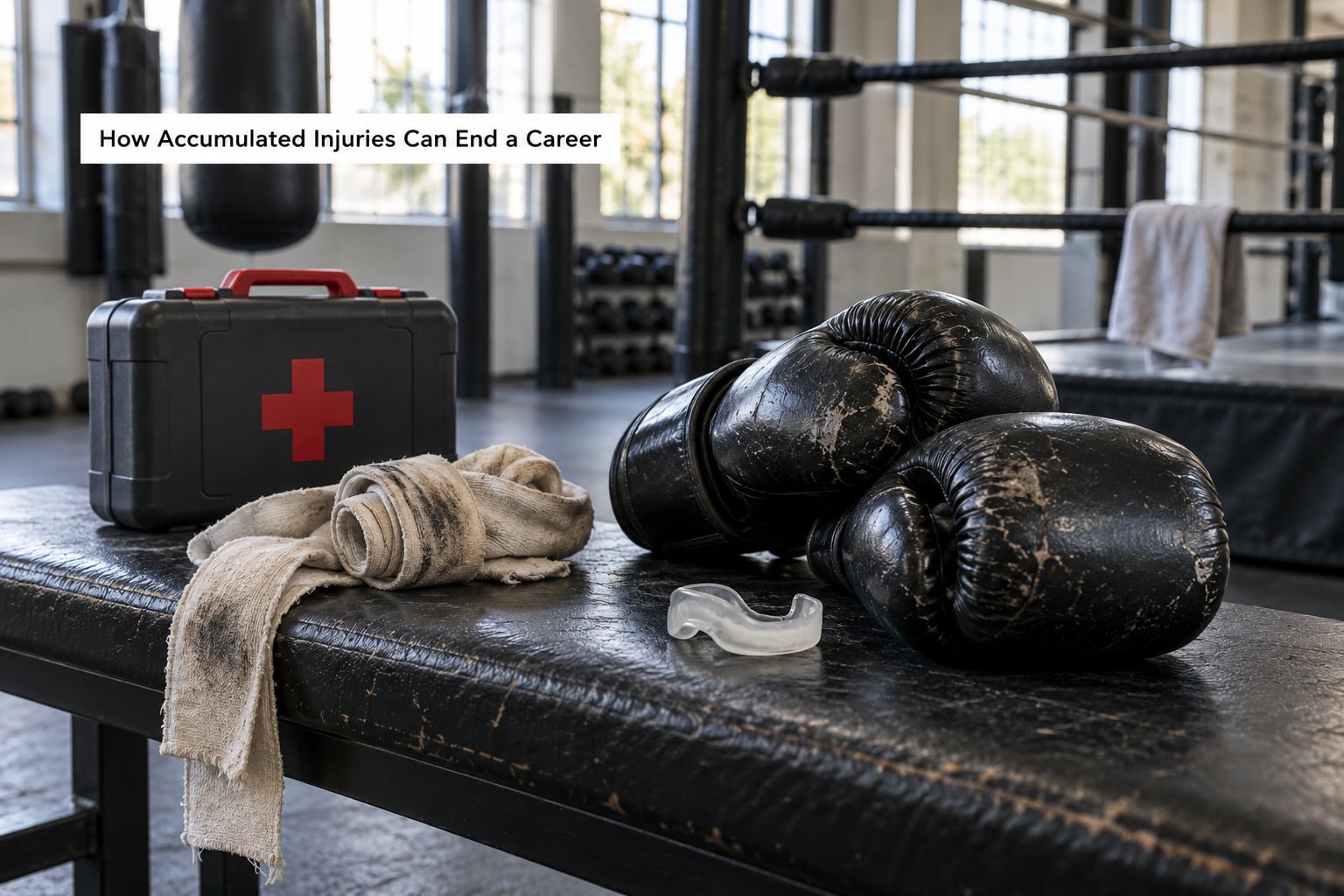
Boxing is one of the few sports where the sport’s central skill is absorbing damage on purpose, and the body keeps a running invoice for it.
Orthopedic wear comes first in most cases. Shoulders that were aggravated years earlier, a knee that never quite came back after a sparring accident, a herniated disc, a fractured orbital bone that healed slightly crooked. Each one is survivable. The problem is the recovery clock: a 26-year-old bounces back from the same session in three days, and a 34-year-old needs three weeks, and a 36-year-old does not heal it properly at all.
Head trauma is the reason families push hardest for an early exit. Repeated head impacts across hundreds of rounds carry a documented risk of long-term neurological problems, and symptoms such as headaches, dizziness, mood changes, sensitivity to light and slowed thinking deserve assessment rather than a decision made in a hotel room the night before a fight. Baseline neurological assessment has become standard practice in many corners for exactly this reason.
There is a distinction fans rarely hear, and it matters. A retirement announcement is a fighter’s or a team’s public statement about a competitive decision. A medical recommendation is a clinician’s advice about safety. Sometimes they match, sometimes they do not, and a fighter can announce a retirement that has nothing to do with a medical opinion.
If you are a fighter, a parent or a partner with concerns about a specific symptom, that conversation belongs with a qualified doctor. Not a promoter, not a trainer, not a forum. This article is general information and cannot assess anyone’s individual risk.
When Loss of Motivation Becomes a Retirement Reason
Sometimes the body is fine and the fighter simply stops wanting it, which is the hardest version of this story to explain to a fan.
Motivation in boxing is fragile because the reward arrives rarely and the costs arrive daily. Six weeks of camp, four weeks of travel, one twelve-minute fight, and then a long empty stretch before the next date. Fighters describe that cycle as grinding, and for a growing number of them the grind stops paying in enjoyment long before it stops paying in money.
Burnout shows up in recognisable patterns: training feels like obligation rather than preparation, the fighter goes through the motions of a camp without enthusiasm, and the idea of another four weeks away from home produces dread instead of anticipation. Add a loss, and the post-fight low that follows a defeat can take weeks to lift. Several fighters have described that period openly, and for some of them it never fully lifts.
There is also the loss of a title to chase. A fighter with a championship reign has a reason to keep taking the punishment that a ranked contender does not. When a belt is gone and the next realistic opponent is not one worth risking health for, the arithmetic of ambition changes. That is not a lack of commitment. It is the sport working the way it is supposed to.
How Age Affects a Boxer’s Career Decisions
Age matters in boxing, but not in the way it does in most sports, because age is only one input into fight age.
What actually declines is speed of recovery, reaction to a single punch, and the elasticity of muscle and connective tissue. Older fighters still have technique, ring IQ and power, which is why they can stay dangerous for years. They simply recover worse between rounds and worse between camps.
That is the basis of the fight-age concept. Analysis of professional fighters has found performance beginning to decline roughly nine and a half years after a fighter’s first professional bout, regardless of birth age. The practical version is simple: a 34-year-old with 70 fights is physically older than a 38-year-old with 12.
Boxing also has championship age rules that complicate the picture further. Depending on the sanctioning body and the division, a title may only be available inside a narrow band, which has been shrinking for some weight classes. A fighter at 30 in one division is ineligible where the same fighter at 32 would have been the natural champion.
Opponent quality is the other half of the equation. As a fighter rises, the pool thins. What is left is a progression of harder opponents every eight months, and there is a point where the risk of a knockout or a bad brain injury stops being worth the purse. Nobody announces that in advance; it just becomes the reason the next fight never gets booked.
Why Money Can Push a Fighter Out of the Sport
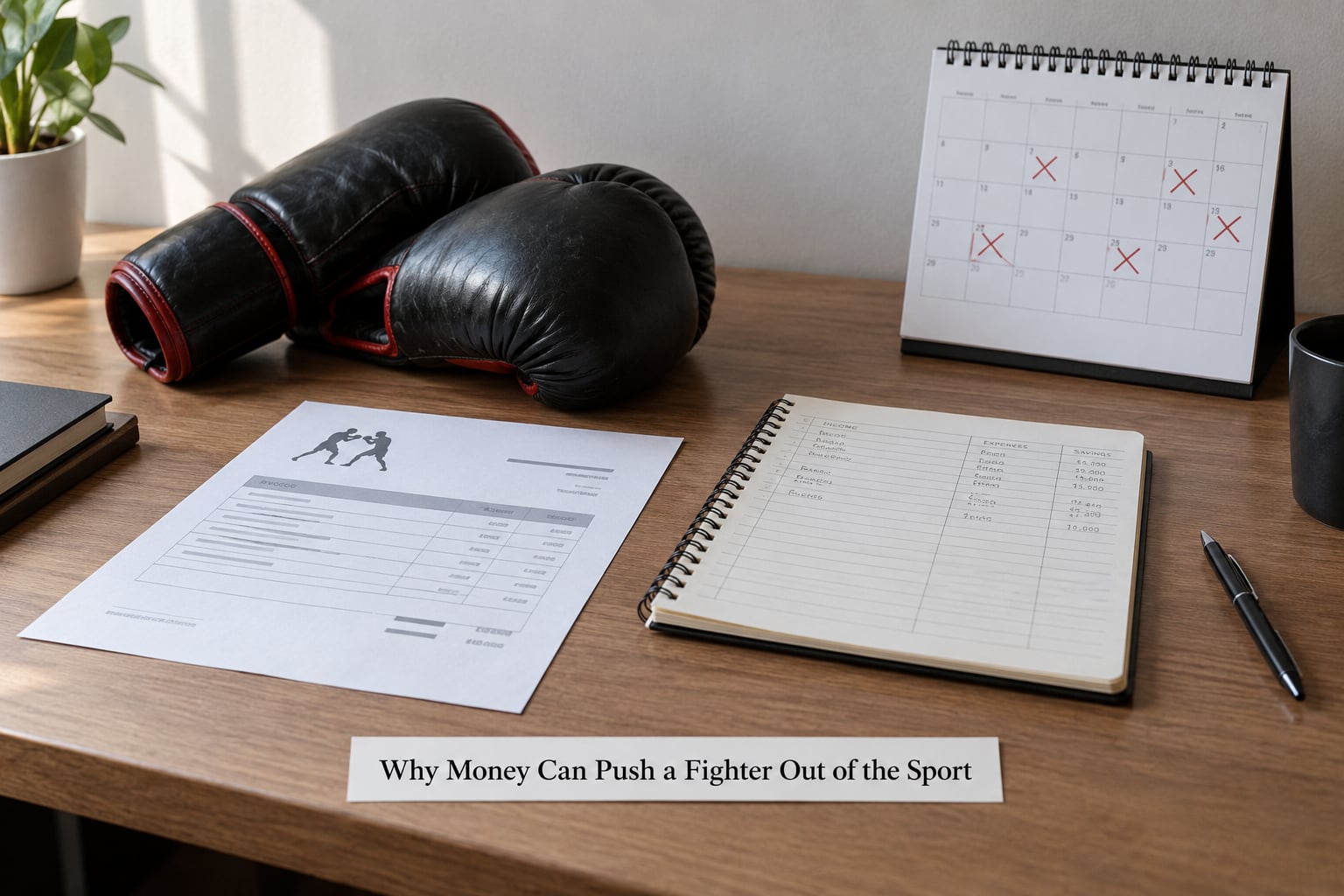
The economics are the part of this conversation fight coverage tends to skip, and they decide more careers than fans expect.
A professional boxer’s income is not a salary. It is a series of one-off payments that can arrive eight or twelve times a year and can vanish for a year at a time. Between them, a fighter pays for training, coaching, training camp fees, travel, manager and promoter cuts, medical appointments, dental work, physiotherapy, nutrition and the ordinary costs of living.
Inconsistent bouts are the problem underneath. A fighter with one nine-figure fight in a career has a very different retirement decision from a fighter with three such fights, because the first has a runway and the second has a habit. Many fighters at the levels where careers actually end have never seen a stable income at all, which is why financial pressure can affect the decision years before anyone calls it retirement.
Health costs are a separate and rarely discussed line. Brain scans, neurological consultations, physiotherapy and surgery are expensive, and often uninsured. Repeated weight cutting adds to it, since the clinical side of making weight is a cost that appears once or twice a year for years.
Most of this is a money question rather than a boxing question. Nothing in this article is financial advice, and anyone weighing a retirement decision against a budget should do it with a qualified professional rather than a forum poll.
Promoters and networks shape the timing too. A fighter whose window has closed usually learns about it by phone, which turns a competitive decision into a commercial one. If you want to understand why a favourite retired without warning, that call is usually the answer.
Why Fighters Choose Retirement Over Other Priorities
Some of the most rational retirements have nothing to do with the ring.
A fighter with a child arriving, or a partner looking for stability, faces a completely different calculation. The difference between two purses sounds small on paper until you weigh it against a mortgage, childcare and the cost of being away from home for eight weeks a year. Plenty of fighters decide the sport is not worth that, and plenty of them are right.
Education and employment work the same way. Fighters take degrees alongside careers, and those who planned one tend to have a much easier exit because they already have a floor. Fighters who planned nothing find retirement means losing the gym, losing the routine and losing the social world all at once.
Mental health deserves its own line. Fighters have spoken openly about depression after losses, anxiety around weigh-ins, and the specific loneliness of a life built entirely around the next fight. When that stops being sustainable, retirement is a health decision, not a character flaw.
Relocation and belonging play their part too. Fighters train where the boxing is, which can mean leaving family behind. Staying in a place with no gym, no sparring partners and no coach can end a career as decisively as any injury.
How Fewer Opportunities Affect a Boxer’s Future
One of the least visible reasons a fighter retires early is simply that nobody called.
Promotion is competitive and thin. A fighter with a winning record can still be unable to find anyone willing to share a card with them, especially at the edges of a division. Fight offers dry up, the ranking stalls, and months become a year of waiting on the phone. A year with no fights is often a year with no competitive reason to stay in the gym.
Loss streaks accelerate the same process. After three or four consecutive defeats, matchmakers pass. The fighter’s profile gets harder to sell, and the record that once opened doors now keeps them outside. Fighters who retire after a run of losses often describe the losses as the trigger, when the real mechanism was what followed them.
Weight problems are the quiet version. Two weight classes above where a fighter naturally sits means fighting heavy against naturally lighter opposition, which compounds fatigue and injury risk. Cutting in the other direction to catch a title opportunity can hollow a fighter out camp after camp. Either way, the division stops fitting, and moving up is not always open to someone who has already been a champion at the lower size.
There is a cultural problem underneath this. When a fighter stops getting fights, it reads publicly as the fighter declining. For a lot of them the phone simply stopped ringing.
Why Some Fighters Retire Even When They Could Continue
Plenty of fighters leave with a win on their record, no injuries and offers still on the table. That retirement is a judgement about value rather than a verdict on ability.
Consider what competition asks on a cumulative basis. Twenty more fights means years more of cuts, sparring and travel, and the reward is more of the same. A fighter who has achieved the goal they started with, and can see clearly what the next decade costs, has every right to decide the exchange stops being worth it. Risk tolerance varies enormously between people, and pretending there is a correct amount of risk for a career is no more useful than pretending there is a correct retirement age.
Legacy enters here too, and modern fighters weigh it differently than their predecessors did. The argument that a champion must defend until beaten is older than the argument against it, and plenty of champions now take a voluntary exit at a level where they know they can still be spoken about well. Retirement can protect a reputation as much as a body.
It also preserves a relationship with the sport. Fighters who retire on their own terms often stay close to the gym, coach on the pads, corner fighters, and get invited back. Fighters who get hurt or dropped repeatedly and leave angry tend to disappear, and they often try to come back a year later. The first group usually has a better second act, and that is a choice rather than luck.
How Fighters Recognize When It May Be Time to Stop
Warning signs show up long before a fighter says anything publicly, and they are usually patterns rather than one bad night.
Why some fighters retire early: the signals to watch for
Persistent pain that does not settle between camps is the clearest one, especially when a fighter starts training around an injury instead of resting it. The next tier is performance: the same opponent beats the same fighter twice, a fighter’s usual attributes disappear a few weeks after making weight, or a win becomes a survival contest.
Then there is the loss of a goal. A fighter with no title shot and no opponent worth chasing will often tell you afterwards that they stopped caring a year before they stopped, and the interviews tend to confirm it.
Financial instability is a signal too, though fighters are often the last to name it. Rising expenses, no financial cushion, and a job that needs taking while still making weight is a situation that resolves itself one way.
Exhaustion is the hardest to measure. Persistent tiredness, no recovery from a good workout, dread before a camp rather than nerves, and irritability around the gym that never used to be there are all worth taking seriously.
Finally, the opportunities dry up and nobody offers. No ranked opponent in the division, no fight inside two quarters, no coach willing to work the road again. For a lot of fighters that absence of an offer is the retirement decision made for them.
Anyone facing these signals should talk through them with a manager, a coach, family and a qualified medical professional before announcing anything. A decision made in a hotel lobby after a bad night is usually a decision made too quickly.
What Happens After a Fighter Retires?
The routes out of the sport are more varied than fight coverage suggests, and the common thread is that nobody plans them early enough.
Coaching is the most obvious line, and most successful gyms are built by fighters who no longer wanted to be hit. Some keep a corner, some run a gym, some travel with a promoter’s stable. Commentary and analysis have become a real career path, though it depends heavily on a fighter being articulate and comfortable on camera, which is not something the sport trains.
Promotion and event work sit close to the ring. So do the unglamorous roles: a matchmaker’s assistant, a commission official, a cutman, a sports therapist. Fighters with a qualification often find that patient work suits them better than the attention a career in the ring gave them.
Plenty go into business, and plenty go into an ordinary job. Both work better when someone has been building them during the last few years of a career rather than after the retirement announcement.
The part that rarely gets covered is identity. Retirement is not like leaving a normal job, and fighters describe losing a role, a routine and most of their social life at the same moment. Some talk openly about depression in the months after. Those who handle it best seem to be the ones who started the next thing before they stopped the first.
On finances after retirement, expect the same pattern: the fighters with savings and a plan are fine, and the fighters without either have a very hard adjustment. There is no standard retirement pension in the major promotions’ equivalent of a league scheme, and a fighter who never had health coverage inherits that problem too.
Does Retiring Early Mean a Fighter Was Not Successful?
No. Career length does not measure success, and early retirement is frequently the most rational thing a fighter does.
It helps to separate three different exits. A voluntary retirement is a fighter deciding the trade no longer pays, whether for health, money, family or plain preference. A medically advised retirement is a clinician recommending the fighter stop competing for safety reasons, which changes the nature of the decision entirely. A career reassignment is the sport moving on, the offers stopping and the fighter following. The three get discussed as if they are the same thing, and fans are often unfairest to the third.
A record that ends on a win, at a level you were still winning at, with money banked and a life you wanted on the other side of it is a good career by any honest measure. A fighter who loses five times and quits with nothing saved has had a harder career, whatever the age.
The unfairest assumption is that retirement signals failure. In most cases it signals that somebody with access to their own choices used them. That is worth remembering next time a favourite announces it is done at 30.
Frequently Asked Questions
At what age should a boxer consider retiring?
There is no fixed age, and anyone who names one is guessing from their own corner. Most professional careers run roughly twelve to sixteen years, so retiring in the early-to-mid 30s is normal rather than early. The better test is condition: persistent pain, recovery that no longer keeps up, and no viable opponent left to chase. Fighters who start young and take many bouts reach that condition in their late 20s, which is why fight age matters more than birth age.
Can a boxer retire because of mental exhaustion?
Yes, and it is one of the least visible reasons there is. Burnout from repeated camps, travel and months of waiting between fights can drain a fighter long before anything physical fails. Fighters also describe depression after losses, anxiety around weigh-ins and a general dread at the prospect of another camp. Any fighter dealing with these feelings should talk to a qualified mental health professional, because retirement is a valid response and not a failure of commitment.
Is retiring after a loss an excuse or a valid decision?
Both happen, and the difference is usually visible in what comes next. A fighter who retires after a loss and then stops competing was often reacting to the fight rather than to a plan. A fighter who retires after a loss but stays close to the gym, coaches and corners is usually executing something they had already been thinking about. Loss streaks also push fighters out for practical reasons, because matchmakers stop calling, so a retirement right after a defeat is often commercial rather than emotional.
How much money should a boxer save before retiring?
There is no widely accepted figure, but the pattern behind good advice is consistent: treat the next two years of ordinary living expenses as the minimum cushion, add foreseeable medical and rehabilitation costs, and keep it separate from anything set aside for a comeback. Fighters who saved during their careers retire calmly. Fighters who did not often have to take a job immediately, which often means another role in the sport to stay busy. Anyone weighing this against real finances should use a qualified financial professional, not a forum.
Can a boxer return to competition after retiring?
They can, and quite a few do. The reasons usually trace back to finances, an offer that was too good to refuse, or a feeling that the previous retirement was premature. Returning is genuinely possible, but the body is usually less forgiving than it was at the first retirement, and the reputation cost is real because fans tend to treat a comeback as proof the first exit was a mistake. Some fighters leave again quickly.
Is an early retirement less successful than competing into your 40s?
No, and it is worth separating two very different cases. A 34-year-old with 70 fights who cannot recover between camps is running out of career whether or not he stops, and continuing costs more than it earns. A 34-year-old with 15 fights who is still winning and still earning has a decision rather than a verdict. The fighters who reach their forties are usually lighter on bouts and fighting with different priorities, which tells you something about pacing rather than about ambition.
Conclusion
Most early retirements are a combination of things rather than one event: a body that stopped recovering as fast, a division that stopped offering fights, money that stopped covering the gap, and a life that became more interesting than the next eight-week camp.
If you are working through it yourself, treat it as four separate questions instead of one. Is the medical picture acceptable, according to a qualified clinician rather than a corner? Are there still meaningful bouts available? Can you pay for the next two years of ordinary life? Do you actually want to keep doing this? Answer those honestly and the age stops mattering much.
And if you are reading about a favourite who just walked away at 30, the honest reaction is not disappointment. It is a question about why.