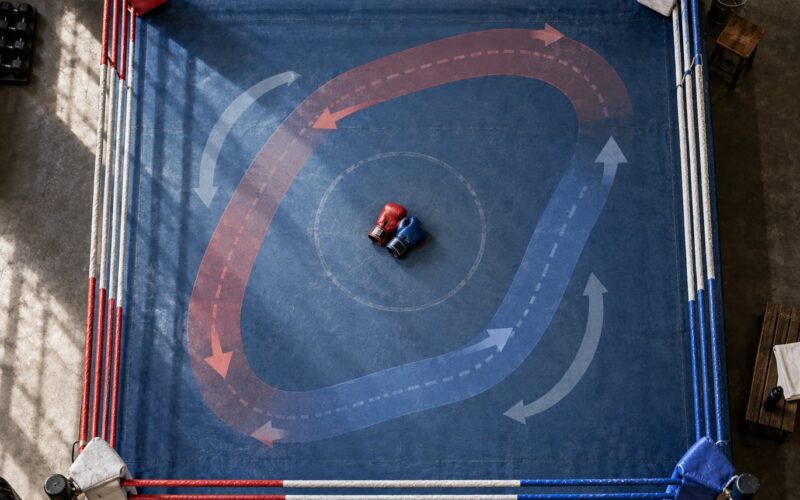
Boxing gyms develop champions through a staged talent pipeline. They recruit beginners and juniors, drill fundamentals until movement and defense are automatic, introduce controlled sparring, enter fighters into the amateur tournament circuit, periodize training through camps, then hand the strongest amateurs to promoters and managers who build the professional career. Talent alone does very little of that work.
That is the honest version of the answer, and it is the version most people never hear. Search results for this question are full of gym marketing copy and forum arguments about natural talent, almost none of which explain the actual system. So here is how the work runs, stage by stage, in the order a serious program runs it.
I have spent enough time around gyms, coaches and fighters to be skeptical of anything that sounds like a secret. There is no secret. There is a long, unglamorous, well-run pipeline, and the gyms that produce champions are usually the ones that respect every stage of it.
Table of Contents
- What Does It Take for a Boxing Gym to Develop Champions?
- How Do Boxing Gyms Find and Nurture Promising Talent?
- Why Individualized Coaching Matters
- How Boxing Gyms Build Skill Through Sparring
- What Physical Training Supports a Boxer’s Progress?
- How Do Recovery and Injury Prevention Protect Development?
- How Does Competition Experience Create Championship Mentality?
- Why Support Staff and Education Matter Behind a Champion?
- How Do Successful Gyms Measure Progress Beyond Wins?
- Frequently Asked Questions
- Conclusion
What Does It Take for a Boxing Gym to Develop Champions?
Champions come out of gyms that combine suitable talent, individualized coaching, high-quality competitive sparring, strength and conditioning, managed recovery, education, and sustained opportunity over several years. Remove any one of those and the pipeline leaks. A gym with great talent identification and no fight entries produces good amateurs who never get seen. A gym with entries and no sparring partners produces a padded record that collapses under pressure.
Think of it as seven layers that have to stack in order:
- Recruitment — finding kids and beginners with the physical traits and the character to keep going.
- Fundamentals — stance, guard, footwork, defense and the jab-cross relationship drilled until they stop being thoughts.
- Controlled sparring — partner work that adds pressure gradually instead of all at once.
- Amateur competition — tournament and Golden Gloves bouts that build a record and a reputation.
- Periodized training — rounds, intensity and conditioning blocks organized around a fight calendar.
- Support infrastructure — strength coaching, nutrition, medical care, film study, and a manager who answers the phone.
- Professional mentorship — matching a proven amateur to a promoter who will put them in fights that matter.
The ordering matters. Programs that skip ahead, handing a fourteen-year-old straight to hard sparring because he is naturally strong, tend to produce a very short list of usable professionals.
How Do Boxing Gyms Find and Nurture Promising Talent?
Scouting is less about finding a prodigy and more about filtering a large pool of children down to the handful who will still be training at twenty-five. Good gyms watch local amateur shows, keep a written watchlist, and send coaches to regional tournaments to evaluate fighters who are not yet on their radar.
When a coach evaluates a young boxer, the assessment usually covers five things. Physical potential (speed, coordination, natural strength, recovery from effort). Technique already in place relative to age. Coachability, which shows up as whether the fighter corrects a mistake in one session or the same one for a year. Character under disappointment. And competitive temperament, meaning how the fighter behaves when a round goes badly.
None of that is a test you can pass in a gym once. It is a pattern coaches watch over months.
Young fighters also get an interview, and parents often underestimate how much weight that carries. A thirteen-year-old who wants to go to the Olympics and a thirteen-year-old who wants to stay busy until summer are treated differently, and honestly, they should be. The gym that knows the difference can give both kids the right program.
Nurturing is largely a matter of giving opportunities early rather than waiting for readiness. Entry-level tournaments, local shows, and non-contact skills clinics let a beginner find out whether they like the pressure, without betting the family on an outcome.
| Stage | Typical age range | Bouts to that point | Main focus | Who evaluates |
|---|---|---|---|---|
| Introduction | 8-11 | 0 | Coordination, confidence, fun, discipline | Head coach |
| Fundamentals | 11-13 | 0-3 | Stance, guard, footwork, jab-cross, defense | Head coach |
| First competitions | 12-15 | 3-10 | Applying technique under pressure | Head coach plus tournament officials |
| Golden Gloves run | 15-19 | 10-30 | Ring craft, ring IQ, building a record | Coaching staff and scouts |
| Pro transition | 18-23 | 30-80 | Professional rounds, cut management, promotion fit | Manager and promoter |
| Title contention | 21 onward | Varies widely | Camp discipline, opponent-specific preparation | Full team with support staff |
These ranges are general, not rules. Late starters exist, and the question of whether twenty is too late comes up constantly in amateur circles. It usually is not too late to begin; it does change the timeline and the available routes.
Why Individualized Coaching Matters
Individualized coaching means the program changes for the fighter, not that the fighter is special. A coach who has watched a boxer for a few weeks should be able to answer four questions: what is technically sound, what is habitually costing them rounds, what physical attributes need building, and how does this person learn fastest.
In practice, that produces very different sessions from the same hour of the evening. A southpaw boxer may spend extra rounds on angle work and lead-hand positioning. A pressure fighter with a weak chin gets conditioning that emphasizes footwork and exiting the pocket rather than hard sprints. A tall boxer who leans back gets lateral movement drills before anything goes near the heavy bag.
Here is what that looks like across a week:
- Rounds — three hard rounds for the advanced fighter, six shorter technical rounds for the beginner returning from a layoff.
- Sparring intensity — controlled technical work for a fighter eight months into learning, live rounds with a returning amateur who needs sharpness.
- Strength work — power and rotational strength for a title contender, general strength and movement control for a young fighter still maturing.
- Tactical preparation — specific counters and patterns for an opponent who leans on a jab, versus building a general style library early in a career.
The coach who runs one identical program for thirty fighters is not training thirty boxers. They are running a class, and a class is not a career plan.
How Boxing Gyms Build Skill Through Sparring
Bag work and pad work teach patterns. Sparring is where a boxer finds out which of those patterns survive contact. Fighters on amateur forums say this constantly and they are right: months of perfect mitt technique can disappear the first time someone steps forward with a jab and makes them reset under pressure.
Gym programs tend to grade sparring into four levels:
- Developmental sparring — light contact, a bigger partner or a beginner, used to introduce the feeling of impact and the need to defend.
- Technical sparring — controlled output, agreed restrictions, focused on a single problem such as slipping counters or fighting on the back foot.
- Situational sparring — set scenarios, starting positions and constraints, so the boxer rehearses a specific exchange rather than a random one.
- Championship-level sparring — full intensity with a genuinely dangerous partner, which only happens once the fighter has earned it.
Coaches control escalation with three levers: partner selection, the rules of the round, and the assignment. Assigning a fighter to a specific task, such as only countering with the rear hand for six rounds, converts sparring from a fight into a drill without anyone getting hit unnecessarily.
Film study closes the loop. Reviewing sparring footage, sometimes with software that tracks output and movement, is how a coach sees the pattern the boxer cannot feel from inside the round. A handful of gyms are testing AI-assisted analysis of sparring footage, and the interest in amateur boxing forums is real, though the tool is still early.
The failure mode is well documented. Pressure to spar before a fighter is ready, intensity escalating without supervision, and a gym that treats exhaustion as the only measure of hard work. All three produce injuries and bad habits that are painful to undo later.
What Physical Training Supports a Boxer’s Progress?
Boxing-specific physical training builds the qualities the sport actually demands: repeat power in short bursts, the ability to hold technique when tired, and enough mobility to move well without loading the joints.
- Strength — squats, hinges, presses and rotational work, built to improve output rather than to look impressive in a gym.
- Speed and power — short, sharp efforts with full rest, since fatigue kills power far faster than light lifting does.
- Boxing-specific endurance — repeated rounds of technical output under fatigue, which is the honest version of a hard twelve-round fight plan.
- Mobility — hips, thoracic spine and shoulders, since a boxer who cannot rotate loses the punch before it lands.
- Speed — footwork drills and reaction work that improve the ability to slip and roll under pressure.
The critical rule is that physical work supports ring performance and never replaces boxing practice. A fighter who spends more time in the weight room than on the bag will get stronger and slower-tired, and will look, to a fight-night audience, like an athlete who does not box.
Trainers periodize all of it around the calendar. A base block in the off-season builds capacity. A pre-competition block sharpens technique and trims. A fight camp reduces volume and raises intensity, then tapers before the bout. Rounds count differently in each phase, and a good coach can explain where in the cycle a fighter sits on any given day.
How Do Recovery and Injury Prevention Protect Development?
A long career depends on staying available to train. Sleep, food, rest days, load management and medical monitoring are what keep a fighter on the floor instead of in a clinic, and the gym that treats them as optional will lose its best prospects quietly.
Concrete practice looks like this:
- Scheduled rest days built into the weekly plan rather than taken when a fighter collapses.
- Nutrition guidance that accounts for a growing adolescent, a weight-class cut, and a fighter training twice a day.
- Track loads week to week, so a jump in sparring or sparring volume shows up as a number rather than a surprise.
- Warm-up and hand wrapping taught as non-negotiable technique, not as optional preparation.
- Qualified medical professionals involved early, with physical therapy and rehabilitation access when something hurts.
Coaches also have to tell normal fatigue apart from warning signs. A boxer who is slow in round two on a hard day is training. A boxer whose power is gone, who is holding a shoulder, who gets winded on a warm-up run, or who is visibly not themselves for more than a couple of days needs to be assessed and, where appropriate, referred to a doctor.
Nobody should train through head symptoms, and no coach is qualified to diagnose a brain injury. If you are a fighter or a parent reading this, that line matters. When something is wrong, the gym’s job is to stop and refer, not to push through.
How Does Competition Experience Create Championship Mentality?
Championship mentality is built in the ring, under a clock, against someone who reacts. Amateur bouts are the cheapest place to learn that. The scoring system rewards clean punches and gives a fighter time to reset, which means a boxer can learn composure without the punishment of a professional card.
What competition actually teaches that training cannot:
- Ring awareness, because a ring is a small space and the corner matters.
- Handling a hostile crowd and an opponent who is simply better on the night.
- Adjusting mid-round, which is the single most useful skill a professional needs.
- Recovering from defeat, and finding out who you are the day after a loss.
- Professional habits with weight cutting, travel, schedule and documentation.
The mistake is over-scheduling. A fighter entered into more bouts than the body can prepare for collects injuries and a padded-looking record instead of experience. A good competition plan matches the fighter’s stage: a beginner in a handful of local shows, an advanced amateur building toward a major tournament, a proven professional choosing opponents rather than accepting any offer.
Wins are how a manager gets a fighter noticed, but losses teach more than wins do. A boxer who loses three times the same way, because the same habit was never corrected, has a coaching problem rather than a character problem, and those are fixable.
Why Support Staff and Education Matter Behind a Champion?
A serious gym is bigger than the head coach, and fighters notice quickly when the roles are unclear. A full setup usually includes a head coach who owns the boxing, assistant coaches who run daily sessions, a strength and conditioning coach, a nutritionist, a physical therapist or physiotherapist, a manager, a promoter relationship, a publicist, and someone handling education for athletes still in school.
Each role removes a different kind of friction. The strength coach means the boxer is not inventing a program from an article. The nutritionist means weight cuts happen once instead of repeatedly. The manager handles contracts, promoters and bout paperwork so the fighter can train. The publicist builds an audience before the fighter needs one.
The failure mode is conflicting advice. Two coaches telling a fighter to hold an orthodox stance against a specific southpaw opponent, or a strength program built for powerlifting that wrecks a boxer’s knees, costs far more than the fee saved. Champions generally come from gyms where the head coach has final say on boxing and the other staff coordinate with that person.
Education matters too, and fighters often resist it at first. A seventeen-year-old with a national title and no idea how to write a media release, manage money, or keep an academic record is vulnerable in a way a coach cannot fix. Gyms that handle that as part of development, not as a favor, produce fighters who last.
How Do Successful Gyms Measure Progress Beyond Wins?
Wins matter, but a good program tracks much more, because a record can hide a fighter who wins by luck against weak opposition and loses badly against a decent one. Coaches watch indicators such as:
- Technical improvement on a defined skill, tested the same way every eight weeks.
- Decision-making, specifically how often the boxer makes a good choice before the punch lands.
- Punch quality and selection, not just output, measured on mitts and film.
- Defensive responsibility, whether the fighter gives away clean shots or simply misses.
- Adaptability, visible when a plan breaks and the boxer has to build a new one.
- Training consistency, showing up and completing the session as written.
- Body composition and recovery markers, tracked without obsession.
- Competitive composure, how the fighter behaves in round one versus round three.
For amateur fighters, the most useful version of this is periodic review with a coach and a written plan, so improvement is visible rather than guessed at. That directly addresses one of the most common complaints in amateur circles: not knowing whether you are actually getting better, or just tired.
Frequently Asked Questions
How long does it take to become good at boxing?
Getting competent in the fundamentals takes most people six to twelve months of consistent training, twice or more per week. Being a genuinely dangerous boxer is a multi-year process built on sparring and competition, not bag work alone. Fighters who start in their twenties often reach the same technical level, just on a compressed timeline with less time for tournament experience.
Is it too late to start boxing in my twenties?
Late is relative, and it depends on the goal. Starting at twenty or twenty-five is realistic for amateur competition, fitness, and a strong hobby career, and plenty of active professionals have late amateur starts. If the goal is a championship, the realistic path runs through the amateur circuit, which takes years of fights, so the honest answer is that the timeline shrinks rather than disappearing.
What age is a boxer’s prime?
Most professional boxers deliver their best work in their mid-twenties through early thirties. That window is shaped less by a fixed number than by accumulated fights, injuries, and recovery. A boxer who starts late may reach a high skill level with fewer fights available, which is why preserving the body through nutrition, load management, and medical care matters as much as any technique session.
How do boxing gyms decide which fighters have champion potential?
Coaches look at physical attributes, technique relative to age, coachability, character, and competitive temperament, then watch those traits over months rather than judging in one session. They also track how a fighter responds to defeat and to correction, because those habits are harder to teach later. A watchlist and tournament scouting usually do the first filtering.
What should parents look for when choosing a competitive boxing gym?
Ask whether non-contact classes are separated from sparring classes, whether coaches demonstrate a movement before raising intensity, and how often a coach will give you a written plan. Watch a session and see whether beginners are being pressured into contact. Also confirm safeguarding practices, coach certifications, and whether the gym enters fighters into amateur competitions at all.
What happens when a fighter changes gyms?
The transition is usually manageable, but a new coach will want to reassess technique, conditioning, and competitive level before adding sparring. Expect a few weeks of rebuilding fundamentals, and expect the new gym to check medical history. The bigger risk is social: leaving a sparring network and a coach who understood your habits can set a fighter back for a season.
Conclusion
Champions come from a system, not a discovery. Recruitment, fundamentals, controlled sparring, amateur competition, periodized training, real support staff, and a professional pathway after that, in that order, over years rather than months. The gyms that get this right are usually unremarkable buildings with a demanding schedule and a coach who writes things down.
So the first thing to do, whether you are a fighter, a parent, or just curious, is assess the boxer honestly. What is technically sound, where are rounds being lost, what competition level are they actually ready for, and who is providing the coaching, the sparring, and the medical support. That assessment tells you more about the right gym than any brochure will.
Updated for 2026.