A swarmer style in boxing means fighting on the offensive at close range: a boxer called a swarmer, pressure fighter or in-fighter advances almost continuously, cuts off the ring, and throws short hooks, uppercuts and body shots in flurries instead of waiting for one clean shot. The goal is to keep the opponent so busy defending that they never reset, tire out, or find space to counter.
That is the whole idea in one paragraph. Everything below is what it looks like in a ring, why boxers choose it, and how you can spot it the next time you watch a fight.
Table of Contents
What Is a Swarmer Style in Boxing?
A swarmer is a boxer who wins by crowding. He closes distance faster than the opponent wants him to, keeps his centre of gravity low and his guard tight, and works at point-blank range where reach advantage disappears.
The vocabulary is muddled, so it helps to fix the terms early. A swarmer is a pressure fighter, a close-in fighter, an in-fighter or an infighter. A brawler is the term most casual fans use for the same thing, and it is not wrong exactly, but brawling usually implies less control of the range and more trading. A peek-a-boo fighter is a specific kind of swarmer who adds constant head movement to the pressure.
The real dividing line is between a swarmer and a fighter who merely walks forward. A swarmer is deliberate about where he stands. He cuts an angle rather than charging straight in, and he goes to the body early because a body shot does not fade as the rounds go on the way a punch to the head does.
How a Swarmer Style Works
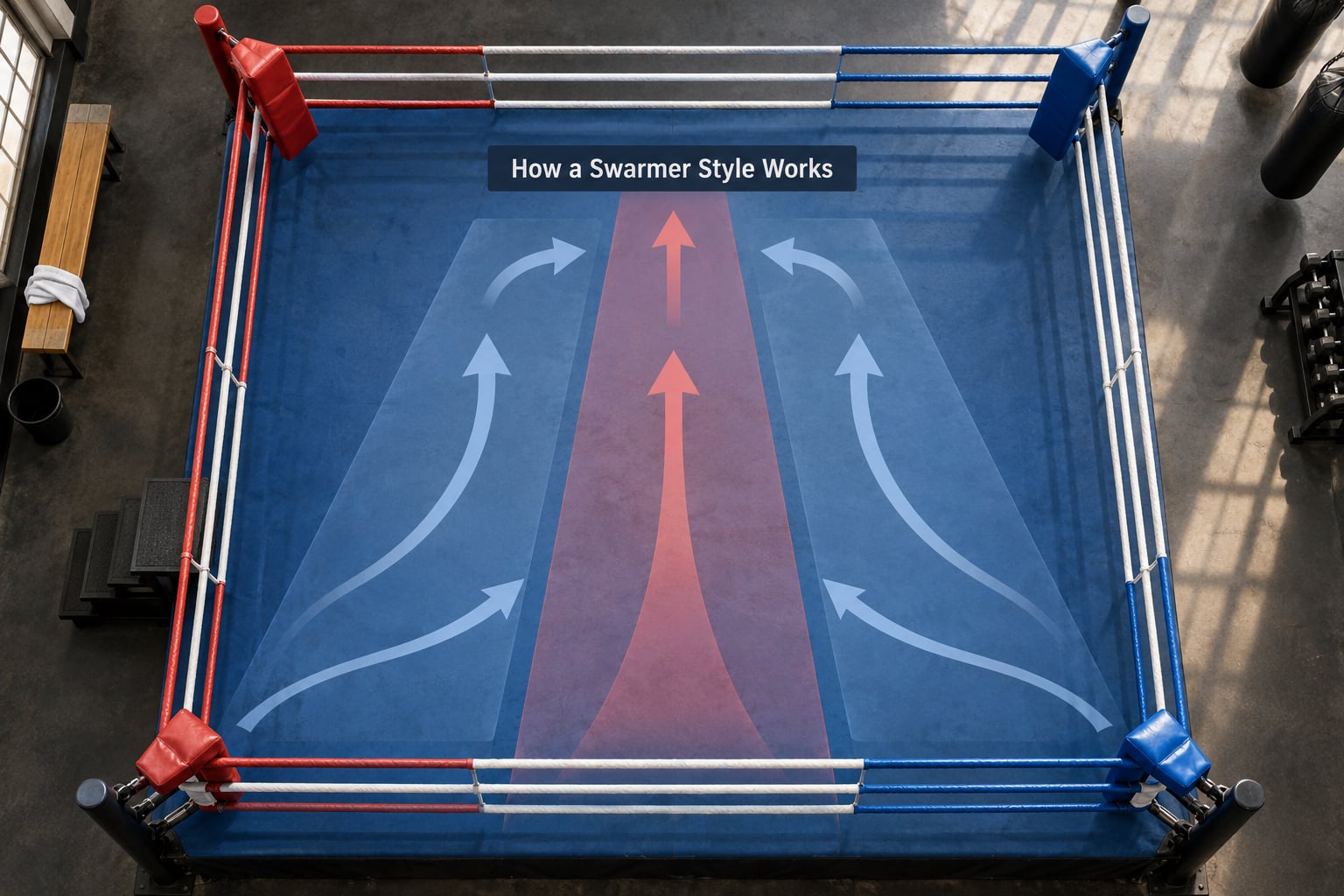
It comes down to five repeated behaviours, and once you can spot them you can call the style from round one.
Closing distance without giving away the centre
The entry is a controlled forward step with the lead foot inside, followed by a level change into the pocket. Swarmers usually step off the line rather than straight forward, because a straight line is a counterpunch invitation.
Cutting off the ring
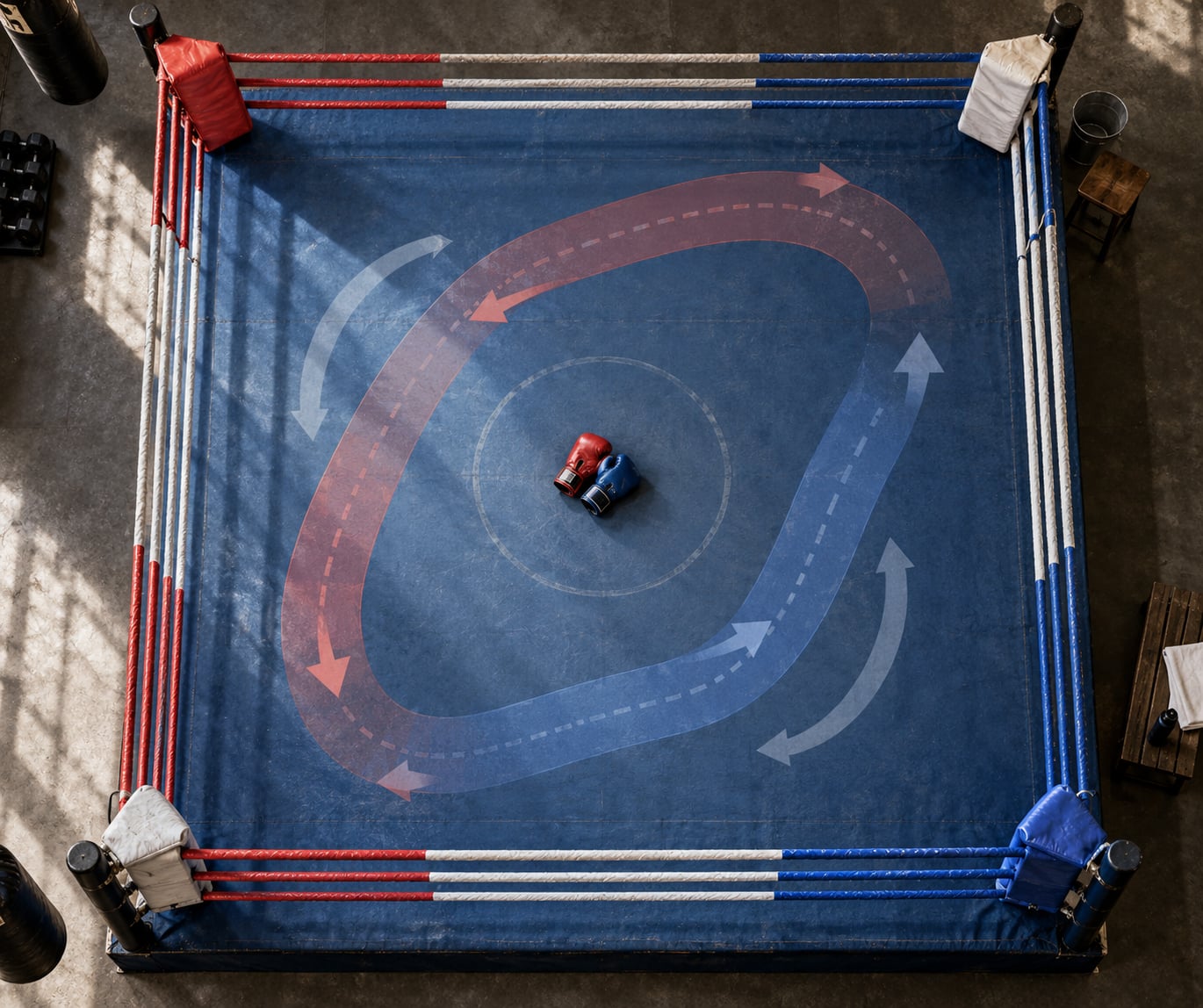
A swarmer will angle left and right across the canvas while advancing, walking an opponent toward the ropes or the corner. Once an opponent is on the ropes, the escape lane disappears and the flurries start landing on a stationary target.
Attacking at two heights
Head and body, constantly, in the same sequence. The level change is what makes the style tiring: the opponent has to bend to block a body shot, which puts the head straight into the hook coming behind it.
Short bursts, not nonstop flailing
Most good swarmers throw three to six punches, disengage a half-step, and go again. The volume looks continuous from the outside, but it is actually paced, and that pacing is what lets a swarmer survive twelve rounds.
Controlling the pace of the fight
Whoever dictates distance dictates the fight. An out-boxer who can keep a swarmer at the end of a jab will win the round by round. A swarmer who gets inside makes the jab disappear.
Why Boxers Use the Swarmer Style
Nobody picks this style for the glamour. They pick it because it solves specific problems.
- It cancels a reach advantage. A fighter a few inches shorter can beat a taller opponent by making the distance useless.
- It punishes a passive opponent. Defensive fighters who give up the centre, lean back and wait for a counter have no answer to sustained work.
- It wins on fatigue, not one punch. Body work and high output accumulate in a way a single knockout shot does not.
- It forces engagement. The opponent has to react, and reacting is exhausting under pressure.
- It suits the scoring in amateur boxing. Points are awarded for clean work, and a swarmer lands a lot of clean work in the eyes of a judge.
Why volume pays off differently in amateur boxing
In the amateur ranks, landing three scoring punches beats landing one spectacular one. Pressure is undervalued at that level and over-rewarded in professional boxing, where a single clean shot ends the argument and every forward step carries risk.
The Main Tactics of a Swarmer
Entering range
The safest entry is at an angle, off the lead foot, with the chin tucked behind the shoulder. Swarming into a jab straight is how pressure fighters get countered. Swarming off a jab, with the head already moving, is how they arrive clean.
Working at different heights
Body work comes first because it is harder to defend with a high guard and does not lose potency as the fight goes on. Uppercuts and overhand rights cover the mid-range, and hooks to the head finish the sequence when the guard has risen to protect the ribs.
Defending while advancing
You cannot defend the way a back-foot fighter does, because the ropes are behind you. Swarmers defend with a high guard, head movement and forward foot pressure instead of lateral retreat. Watch a good one fight: the hands stay up and the feet keep coming, even while they are being hit.
Resetting without backing into the ropes
The clinch is the reset. A fighter who ties up for two seconds buys the breath, breaks the opponent’s rhythm and stops the flurry from becoming a knockdown. It also lets a swarmer refuse to be pushed straight back.
Peek-a-boo as the signature sub-style
Peek-a-boo adds a constant roll, dip and cover-up on both ends of every punch. It is the most smothering version of the style, because it removes the puncher’s target entirely, and it is the version most associated with Mike Tyson and Rocky Marciano.
Strengths and Weaknesses of the Style
Pressure is not a style without costs, and honest coaches talk about both sides.
What the style does well
- Neutralizes height and reach in one move.
- Breaks a fighter who defends passively.
- Compounds over long fights through fatigue and accumulated damage.
- Psychologically wears down an opponent who hates being crowded.
- Leaves the swarmer in control of where the fight happens.
Where it breaks down
- A patient jabber who controls distance wins before the pressure starts.
- A counterpuncher who punishes the entry has a target arriving forward, hands low.
- A slugger with one-shot power only has to be accurate once.
- Defensive errors are catastrophic, because everything lands at point-blank range.
- Pushing forward to win rounds means chasing a fighter who is already beating you on the scorecards.
Which opponents shut the style down
Speed to get off the line, a jab that keeps the swarmer at the end of it, and calm enough defence under fire. Forum consensus usually settles on the same formula: a brawler’s resistance inside beats a swarmer’s pressure, while a boxer’s timing beats the brawler.
How to Tell a Swarmer Apart from Other Styles
Style labels get blurry because fighters mix them. Judge what you see in the ring, not what a commentator called it before the fight. A fighter who attacks behind a jab and pivots off is a boxer-puncher, even if the round looks rough.
| Style | Key focus | Tells in the ring | Weakest point |
|---|---|---|---|
| Swarmer | Close-range pressure | Constant forward movement, tight high guard, body work in bursts | Predictable entries, reaches backward |
| Out-boxer | Distance and jab control | Stays at long range, moves laterally, rarely comes forward | Stranded when the range closes |
| Counterpuncher | Timing and reaction | Still until you miss, then punishes the miss | Passive under sustained pressure |
| Boxer-puncher | Adaptability | Mixes distances, adjusts mid-fight, attacks after combinations | Can be pulled into a brawl |
The clearest single tell is what happens when the opponent steps back. An out-boxer opens up and circles. A counterpuncher waits. A swarmer follows, because stopping would give up the only advantage he has.
Examples of Swarmers in Boxing History
Joe Frazier is the reference point for the style. Against Muhammad Ali he cut off the ring round after round, worked the left hook to the body, and simply refused to be pushed away. Ali won the first fight on points and lost the next two.
Rocky Marciano pressured without moving his feet much, relying on a low centre of gravity, an unorthodox peek-a-boo guard and enormous body work. He fought most of his career against opponents who wanted distance, and he made it a bad idea.
Mike Tyson made the style frightening. With peek-a-boo defence, no lateral footwork and a habit of punching from a stance most boxers find uncomfortable, he made advancing feel automatic and being hit feel optional.
Marvelous Marvin Hagler was a hybrid who could out-box from range and then choose to close it when an opponent got comfortable. His 1980 bout with Thomas Hearns showed the style at its most calculated.
Modern fans argue the style has faded. A long-running r/Boxing thread on whether pressure fighting has died points to fewer champions built around it, while names like Gennady Golovkin and Canelo Alvarez get cited as the current examples. The honest read is that it is less common at the very top than it was, not that it stopped working.
Frequently Asked Questions
How many types of boxing styles are there?
Most boxing systems describe four core styles: the swarmer, the out-boxer, the slugger and the boxer-puncher. Other traditions swap the slugger for the counterpuncher, which gives the same four-part picture with a different emphasis on timing. In practice almost every professional combines at least two of them, so treat the labels as a starting description rather than a category a fighter is locked into.
Who is considered the best swarmer in boxing?
Joe Frazier is usually named first, because he won three fights against Muhammad Ali while out-boxed or outmatched on paper. Mike Tyson gets the most attention for how unbeatable the style looked, and Rocky Marciano for what it achieved against larger opponents. There is no official answer, and the pick usually depends on whether you value consistency, power or punching volume.
What is the hardest boxing style to fight?
Most fighters and coaches point to the swarmer, because sustained pressure removes the rest a fight depends on. A pressure fighter scores, forces constant reactions and shortens the fight to a distance where your reach is worthless. Fighters who hate being crowded describe it as the most uncomfortable style to face, even when they are winning on the cards.
Can a shorter boxer beat a taller boxer by swarming?
Yes, if he closes the distance before the reach matters and if the taller fighter has no answer to pressure inside. Height gives an out-boxer options, not immunity: once a shorter fighter is chest to chest, the jab has nowhere to land. The taller boxer wins back the fight with a jab that holds him off, lateral movement that keeps circling, or one punch that ends the argument early.
What fighting style is best against a swarmer?
A boxer-puncher with jab control and lateral movement is the most reliable answer, because distance is what beats pressure. Keep the jab long, circle toward the open side of the ring, and make him walk into it every round. Counterpunching works too, but only if you are comfortable staying close enough to risk it.
Are swarmers better in amateur or professional boxing?
The style suits amateur boxing more. Amateur judges award points for clean work rather than damage, so a swarmer’s high volume of scoring punches is worth real points. In professional boxing a single shot changes everything, which makes every forward step riskier. Good amateurs usually need more ring craft than good professionals, because volume without control will not win them a ten-round fight.
Conclusion
A swarmer style is close-range pressure fighting built on constant forward movement, ring-cutting and high punch volume, designed to make distance and patience useless. It fails against a fighter who controls the jab and refuses to be hurried into the pocket.
Next time you watch, watch three things: how he closes the distance, where he goes first, and how he manages his energy across the rounds. That will tell you more about what a swarmer really is than any label.