Why the bridgerweight division exists comes down to one gap in the weight ladder. The World Boxing Council created it in 2020 for fighters competing between 200 and 224 pounds, then raised the heavyweight floor to 224 pounds so cruiserweight, bridgerweight and heavyweight meet without a hole in between.
That is the whole idea in one sentence. The rest of the story involves eight traditional weight classes that stopped fitting real bodies decades ago, a six-year-old from Wyoming, and a sanctioning body that has kept building divisions its rivals would rather not have.
Table of Contents
- What Is the Bridgerweight Division in Boxing?
- Why the Bridgerweight Division Exists
- How Did Bridgerweight Become an Official Division?
- How Are World Bridgerweight Championships Organized?
- Why Does Bridgerweight Sit Between 200 and 224 Pounds?
- Which Boxers Have Shaped the Division?
- How Has Bridgerweight Changed Boxing Strategy?
- What Challenges Does the Bridgerweight Division Face?
- Will Bridgerweight Continue to Grow?
- Frequently Asked Questions
- Conclusion
What Is the Bridgerweight Division in Boxing?
Bridgerweight is a professional boxing weight division covering 200 to 224 pounds, which is 90.9 to 101.6 kilograms. The World Boxing Council created it and still sanctions it. It sits directly above cruiserweight, which ends at 200 pounds, and directly below heavyweight, which the WBC now sets at a minimum of 224 pounds.
If you have seen other numbers attached to the name, you are not imagining it. Reports have quoted bands of 190 to 200 pounds, 195 to 210 pounds, 191 to 216 pounds and 86.6 to 101.6 kilograms for the class. Those figures come from different proposals by different bodies, from early reporting, or from both at once. The WBC’s own published division list is the one to trust, and it says up to 224 pounds.
It is also worth clearing up one naming trap. Bridgerweight has nothing to do with light-heavyweight, the traditional class capped at 175 pounds (79.4 kg). The two names look and sound close, and sit only two classes apart, which is where a lot of fan confusion starts.
- Bridgerweight — the WBC class, 200 to 224 lb (90.9 to 101.6 kg), above cruiserweight.
- Light-heavyweight — a traditional class capped at 175 lb (79.4 kg).
- Intermediate division — any class a governing body adds between the traditional eight.
- Alphabet title — a belt from one body that the other three do not count.
| WBC class | Weight limit | Kilograms | Position |
|---|---|---|---|
| Light-heavyweight | Up to 175 lb | 79.4 kg | Third from the top |
| Cruiserweight | Up to 200 lb | 90.9 kg | Second from the top |
| Bridgerweight | 200 to 224 lb | 90.9 to 101.6 kg | WBC intermediate class |
| Heavyweight | Minimum of 224 lb | 101.6 kg and above | Top division |
Why the Bridgerweight Division Exists
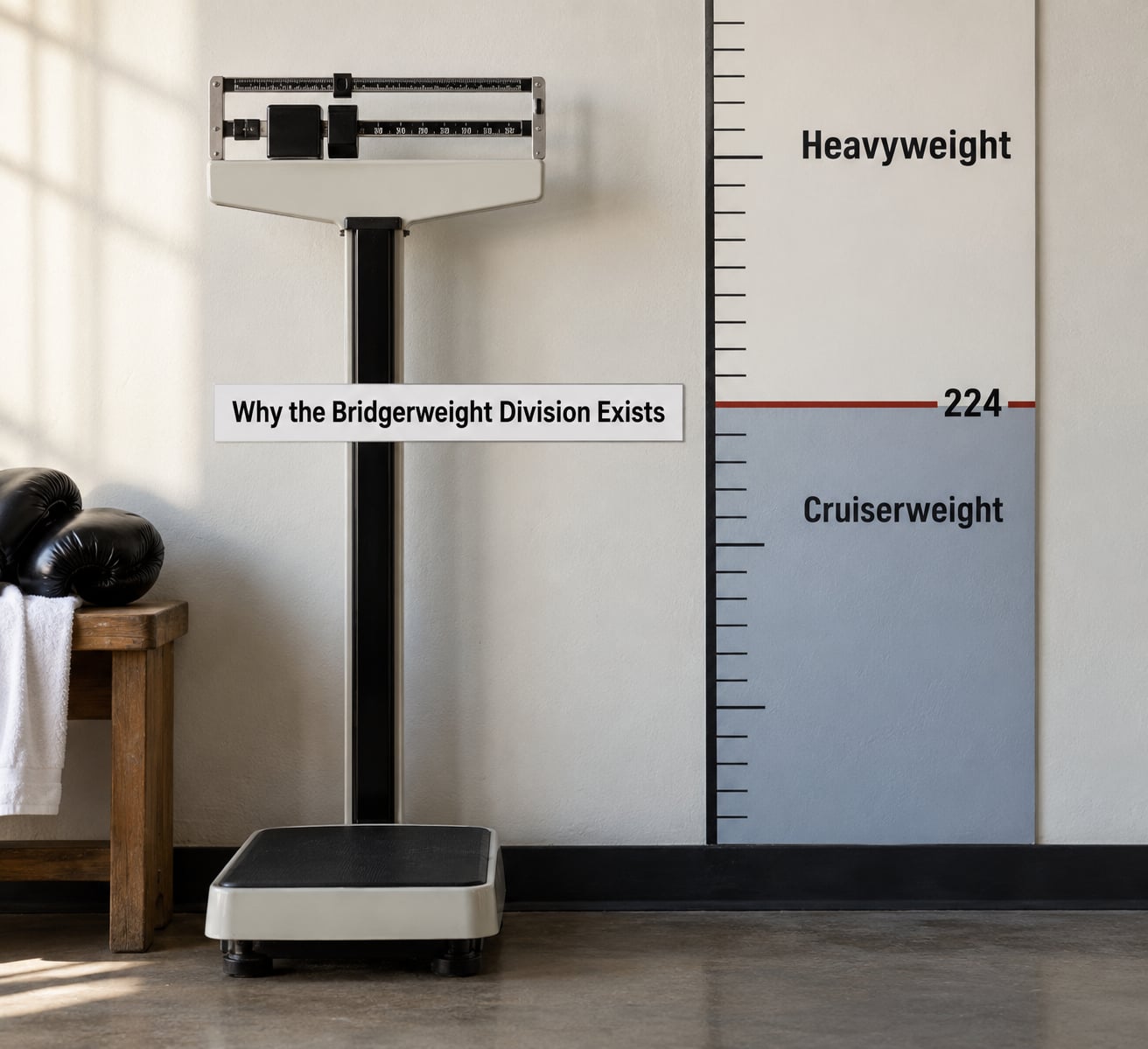
Boxing’s weight ladder used to jump from 200 pounds straight to heavyweight, and fighters who naturally walked around between those numbers had no sensible division to fight in. Cutting 20-plus pounds to make cruiserweight meant severe dehydration. Stepping into heavyweight meant facing men 40 to 60 pounds heavier. The bridgerweight division exists to remove that bad choice.
For years the practical heavyweight floor sat somewhere around 205 to 210 pounds depending on the promotion, which left the band in between genuinely awkward. The WBC fixed that by moving the floor up to 224 pounds and filling the vacated space with a class of its own.
| Division | Floor | Ceiling | The problem it solved |
|---|---|---|---|
| Cruiserweight | 200 lb | 200 lb | Light enough to cut to, but a hard limit for bigger bodies |
| Bridgerweight | 200 lb | 224 lb | Gives natural heavy cruiserweights a competitive home |
| Heavyweight | 224 lb | No upper limit | Now reserved for genuinely big fighters |
Read those three rows as a chain and the logic is plain. Cruiserweight stops at 200. Bridgerweight runs from there to 224. Heavyweight starts at 224. Every pound a boxer can legitimately weigh now has an address.
Why the Bridgerweight Division Exists in Modern Boxing
The proposal did not appear out of nowhere. Boxing has argued about a super-cruiserweight class for years, and the argument has always been matchmaking rather than tradition. When the WBA discussed its own version, the reasoning it published was about avoiding mismatched fights, not about filling a gap on paper.
The principle behind it runs through everything the WBC has done under Don Jose Sulaiman. His long argument was that the eight classic divisions no longer match the athletes entering the sport: bodies have grown, so the traditional jumps are wider than the ones he grew up watching, and the extra cuts are the ones causing damage. An intermediate class reduces both problems at once.
The case for adding divisions generally comes down to health and fairness. Weight cutting to a limit far below your natural weight forces fighters to dehydrate, and the risk sits on the cardiovascular and neurological systems. Fewer extreme cuts means fewer weigh-in problems, and a class that matches similar-sized fighters means fewer mismatches that look dangerous on paper and unfair in the ring.
How Did Bridgerweight Become an Official Division?
The WBC announced the class in 2020 and added it to its published list of divisions. It is an official weight class in the same sense as any other WBC class: it has rankings, it has title fights, and the WBC recognises its champion.
The name is the part people remember. It honours Bridger Walker, a six-year-old from Wyoming who in July 2020 was diagnosed with a brain tumour and fought it publicly while campaigning to raise awareness. The WBC made him a world heavyweight champion for a day, an honorary belt with a child’s name on it, and then attached that name to a new division.
There is a dating wrinkle worth flagging, because it comes up constantly in fan threads. The WBC dates the class to 2020. Plenty of commentary refers to the division as running from 2018 to 2025 and declaring it dead. The 2018 figure does not match the WBC’s own record, so treat anything claiming that start date with a raised eyebrow.
The naming choice also tells you what the WBC wanted from the division. It is not framed as a belt for big men on the way up. It is framed as an intermediate division in the Sulaiman tradition, a place where the sport’s middle sizes can compete without extreme measures.
How Are World Bridgerweight Championships Organized?
Only one body runs it. The WBC creates its own bridgerweight rankings, sanctions title fights in the class and recognises the champion. The WBA, the IBF and the WBO do not recognise bridgerweight at all, which is the entire source of the argument fans have about whether it counts.
The WBA got as far as voting in favour of creating a super-cruiserweight class, then did not put a championship behind it. The IBF and the WBO declined to create anything comparable. A British proposal for a light-heavyweight class inside the British Boxing Board of Control came from a different direction again.
| Class | Body | Range | Status |
|---|---|---|---|
| Bridgerweight | WBC | 200 to 224 lb | Operating, with rankings and a title |
| Super cruiserweight | WBA | Variously reported | Approved in principle, no settled title |
| Light heavyweight | British Boxing Board of Control | Around 195 to 210 lb | Domestic proposal |
So if you see a result sheet, a ranking list or a belt photo, the honest question is which body produced it. Rankings sites and fan trackers disagree about who the champion is because only one of them has a rulebook to consult.
Why Does Bridgerweight Sit Between 200 and 224 Pounds?
The floor is 200 because that is where cruiserweight stops. A fighter inside the class still has to come in at or under 224, so the two divisions share one number instead of leaving a band that belongs to nobody.
The ceiling matters more than the floor. If the top of the class were 215 pounds, then a 224-pound heavyweight would have to lose nine pounds to fit, and heavyweights do not cut like that. Rounding the number up to 224 means the biggest fighter in bridgerweight and the smallest fighter in heavyweight can be the same person on the same afternoon, which is exactly the flexibility a division boundary should provide.
Why the WBC Raised the Heavyweight Floor to 224 Pounds
Because a new class only makes sense if the old one moves. If heavyweight still started at 205, then bridgerweight would run 200 to 224 and heavyweight 205 and up, and the two would overlap for 20 pounds. Overlapping classes are worse than gaps: they create two ways to hold the same title and endless arguments about who counts as a champion.
Setting heavyweight at a minimum of 224 pounds makes the ladder tile cleanly. It also changes what heavyweight means as a division. Instead of including anyone above roughly 205 pounds, it now means big men, and the gap between a strong cruiserweight and a genuine heavyweight has reopened in a way that gives both classes a distinct identity.
That is also why the WBC’s list runs to 18 divisions while most people say boxing has eight. The traditional count stops at heavyweight. The WBC counts every intermediate class it has added on the way up.
Which Boxers Have Shaped the Division?
Oscar Rivas became the first WBC bridgerweight champion in October 2021, beating Ryan Rozicki on the cards. It was a decent fight between two large men and it gave the new class a legitimate first result rather than a placeholder.
Since then the lineage has run through fighters with heavyweight-sized frames and cruiserweight-sized records. Lukasz Rozanski was among the early names to hold or contest the belt, and Kevin Lerena was still being described as the WBC champion in 2025 coverage.
Lawrence Okolie is the interesting case rather than the belt case. A former world champion at cruiserweight who also competed in the lighter-regarded bridgerweight class, he was reported as the WBC’s top ranked contender there, while his trainer Joe Gallagher said his future was at heavyweight and that it was a matter of time.
That pattern shows up repeatedly. Plenty of the best available fighters treat bridgerweight as a place to pass through on the way to heavyweight rather than a place to settle. Treat the names above as context for how the division has been used, not as a ranking of its own.
How Has Bridgerweight Changed Boxing Strategy?
The clearest effect is on taller, longer fighters who were always going to be too big for cruiserweight. Instead of cutting or waiting, they have a division where a southpaw with reach can point at someone without the matchup being a mismatch on paper.
It has also given some cruiserweight champions a place to test themselves against bigger opposition without immediately betting everything on a heavyweight run. A win there says something about punch resistance that a cruiserweight title cannot.
Honestly, the effect on strategy has been small so far. The division did not take hold among enough top names to change how fighters plan a career. What it changed was the option set, which is a narrower thing but not nothing.
What Challenges Does the Bridgerweight Division Face?
The list is long, and most of it comes down to attention. A division nobody promotes, broadcasts or bets on is a division fans reasonably assume is dead.
Talents get thin quickly at 200 to 224 pounds. Boxers in that range who are good enough usually have a heavyweight opportunity waiting, and taking a bridgerweight fight can look like a step back. BoxRec forum regulars have argued for years that bridgerweight, or something like it, was never going to be useful, on the grounds that weight classes exist to produce fair sizing matchups.
Then there is the belt proliferation problem. When several bodies hand out titles at overlapping weights, fans reasonably start discounting all of them. The WBA ranking Jake Paul at cruiserweight was cited in 2025 as an example of where that logic goes.
Bouts have also fallen through. In August 2025, Marc Mysterio called off a fight involving Serhiy Radchenko and publicly declared the division dead, blaming promoter and manager attitudes and a dispute over travel arrangements and money. Whether one cancelled fight justifies that verdict is arguable, but it is a fair signal that the division has never had commercial pull to fall back on.
Will Bridgerweight Continue to Grow?
As of October 2026, the honest answer is that it depends on the WBC wanting it to, because no other body is waiting to take it over. A division with a single owner can survive on that owner’s persistence, or quietly fade.
Four things would tell you it is genuinely growing: credible title fights happening on a regular schedule, ranked contenders who are not just passing through, a broadcaster or streaming platform putting money behind it, and the WBA actually putting a super-cruiserweight championship on rather than leaving it approved in principle.
There is one scenario where it clicks. If a handful of top cruiserweights and a handful of genuine heavyweights both moved in, the talent depth would be there immediately, because the weight match would be close. Several forum posters argue exactly that. Nobody has tested it yet.
Frequently Asked Questions
Is bridgerweight the same division as light-heavyweight?
No. Light-heavyweight is a traditional class capped at 175 pounds (79.4 kg), third from the top of the ladder. Bridgerweight is the WBC class covering 200 to 224 pounds (90.9 to 101.6 kg), the weight band immediately below heavyweight. The names sound alike and sit only two divisions apart, which causes plenty of confusion, but they are 25 pounds apart and run by different people.
Why is 200 to 224 pounds called bridgerweight?
The class is named for Bridger Walker, a six-year-old from Wyoming diagnosed with a brain tumour in July 2020. The WBC gave him an honorary world heavyweight title for a day and then used his name for the new intermediate division it created. The naming framed it as a place for middle-sized fighters, not a stepping stone to heavyweight.
Is bridgerweight a real weight class?
Yes, with one qualification. It is an official WBC division with published rankings, sanctioned title fights and a recognised champion, so the fights and results are real. The WBA, IBF and WBO do not recognise it, which is why trackers disagree about who holds the belt and why some fans treat it as an alphabet title. Official in one body, unrecognised in three.
Who decides the bridgerweight world champion?
Only the World Boxing Council. It runs its own bridgerweight rankings and sanctions title fights at the 200 to 224 pound limit, so a champion in this class is a WBC champion and nobody else. The WBA voted in favour of a super-cruiserweight class but never put a title behind it, and the IBF and WBO have said they have no plans to create one.
How many divisions are there in boxing?
Eight traditional ones, from flyweight at 112 pounds to heavyweight with no upper limit. The WBC publishes a longer list of 18 because it counts every intermediate class it has added, including bridgerweight at 200 to 224 pounds and the classes below it. When someone says boxing has 18 divisions, that is a sanctioning body count, not a change to the traditional eight.
Which boxers suit the bridgerweight division best?
Fighters whose natural weight sits just above the 200 pound cruiserweight ceiling, particularly tall or long heavy cruiserweights who would otherwise cut hard or jump to heavyweight. The class also works as a test for established cruiserweight champions weighing whether they can handle heavier opposition. Fighters already at natural heavyweight size have little reason to stop there.
Conclusion
The bridgerweight division exists to give the 200 to 224 pound band a competitive home, and to make the top of the ladder tile cleanly: cruiserweight to 200, bridgerweight to 224, heavyweight from 224. It was created by the WBC in 2020, named after Bridger Walker, and it is recognised by that body alone.
Start there and the rest follows easily. Read the WBC’s own division list for the real weight figures rather than a news roundup, treat any belt outside the WBC as an alphabet title, and treat the death notices as commentary rather than news until a second body puts a title on.