The short answer to what boxers eat on fight week is this: the foods they already tolerate, in slightly larger portions, with carbohydrate the priority and nothing new. Fight week is not the time to discover a food, a supplement or a fasting protocol. It is the week to eat like you ate in camp, fuel the sessions you still have to get through, and keep every meal boring enough that your gut never thinks about it.
I have watched a lot of amateurs get this wrong, and almost always in the same way. They restrict too early, cut rice out six days out, and then show up on fight night flat, irritable and light. Their coach wonders why they looked dead in round four. The food was the problem.
What follows is the practical version of what boxers eat during fight week, the same principles a sports dietitian would walk a fighter through, with the numbers left in where they help.
Table of Contents
- What Boxers Eat on Fight Week: The Basic Plan
- How Many Calories Do Boxers Need During Fight Week?
- What Foods Help Boxers Train and Recover?
- How Should Boxers Time Meals Before and After Training?
- What Should Boxers Eat on Fight Day?
- How Do Boxers Stay Hydrated During Fight Week?
- Should Boxers Change Their Diet Before a Fight?
- Frequently Asked Questions
- Conclusion
What Boxers Eat on Fight Week: The Basic Plan
Five things matter, and none of them are exotic. Eat enough carbohydrate to power your sessions, because glycogen is what fuels three minutes of repeated explosive effort. Eat protein at every meal to protect muscle while you are training hard. Keep meal times roughly the same as camp so your body has nothing to adjust to. Drink fluid steadily through the day. And do not change anything you have not already tested.
Most fighters are eating some version of this already. The four to seven days before a bout simply raise the stakes on it.
How to adjust carbohydrates through fight week
Carbohydrate goes up as the bout approaches while you are still doing volume, then comes down in the final 24 to 48 hours if you need to shed weight, then goes back up on fight day. If you are not cutting weight at all, you stay high the whole way. If you are several kilos over your class, carbohydrate is the thing you trim first, because every gram of it is stored with roughly three grams of water attached.
Adjust portion sizes, not the meal plan. The plate stays the same shape all week.
How Many Calories Do Boxers Need During Fight Week?
There is no single number, and anyone who gives you one has not met you. A welterweight doing two-a-days and an eighty-kilo heavyweight training mostly technical rounds have different needs, and a fighter five kilos over the limit needs less than one who is already making weight comfortably.
As a rough frame for a competitive adult boxer weighing 70 to 90 kilos, most camps sit somewhere around 2,800 to 4,000 calories a day, and fight week with high volume often pushes higher than that. Female and lighter fighters typically run lower. Numbers pulled from a generic calculator will be wrong for you, so treat these as a sanity check and let training load and weight trend do the deciding.
| Situation | Carbohydrate approach | Protein approach |
|---|---|---|
| Seven days out, sparring twice | High, roughly 6 to 8 g per kilo of body weight | Steady, around 1.8 to 2.2 g per kilo |
| Three days out, weight already on target | Moderate to high, tapering slightly as sessions drop | Unchanged, meals spaced evenly |
| Two to one day out and a few kilos over | Lower, mostly low-fibre sources, small portions | High, to hold muscle while carbs come down |
| Fight day, morning of the bout | Moderate, familiar and low fibre | Lighter, save the big serving for after |
Protein is the one number worth being boringly consistent about. Spacing it across four or five feeds, roughly 0.4 g per kilo per meal, does more for recovery than one enormous dinner.
What Foods Help Boxers Train and Recover?

Carbohydrate sources do the work. Rice, pasta, oats, potatoes, bread, bagels, bananas and sports drinks all deliver glucose into the muscle fast, and the ones you can eat quickly without cooking are worth more than the ones with the fanciest nutrition label. Fructose from fruit adds a little, and so does glycogen-sparing fat like olive oil or peanut butter, but fat slows gastric emptying so it sits badly right before a session.
Protein does the repair. Chicken, turkey, eggs, fish, lean beef, cottage cheese, Greek yoghurt and a protein shake if you already use one. Plant-based fighters can cover the same ground with lentils, chickpeas, tofu, tempeh and pea protein, and they just need to track it more carefully rather than eat more brown rice and hope.
Fruit and vegetables still matter during fight week, mostly for micronutrients and fibre, though the amount drops as the bout nears. Two or three servings a day of cooked or peeled produce is plenty, and raw salads are the wrong choice the night before a twelve-round fight.
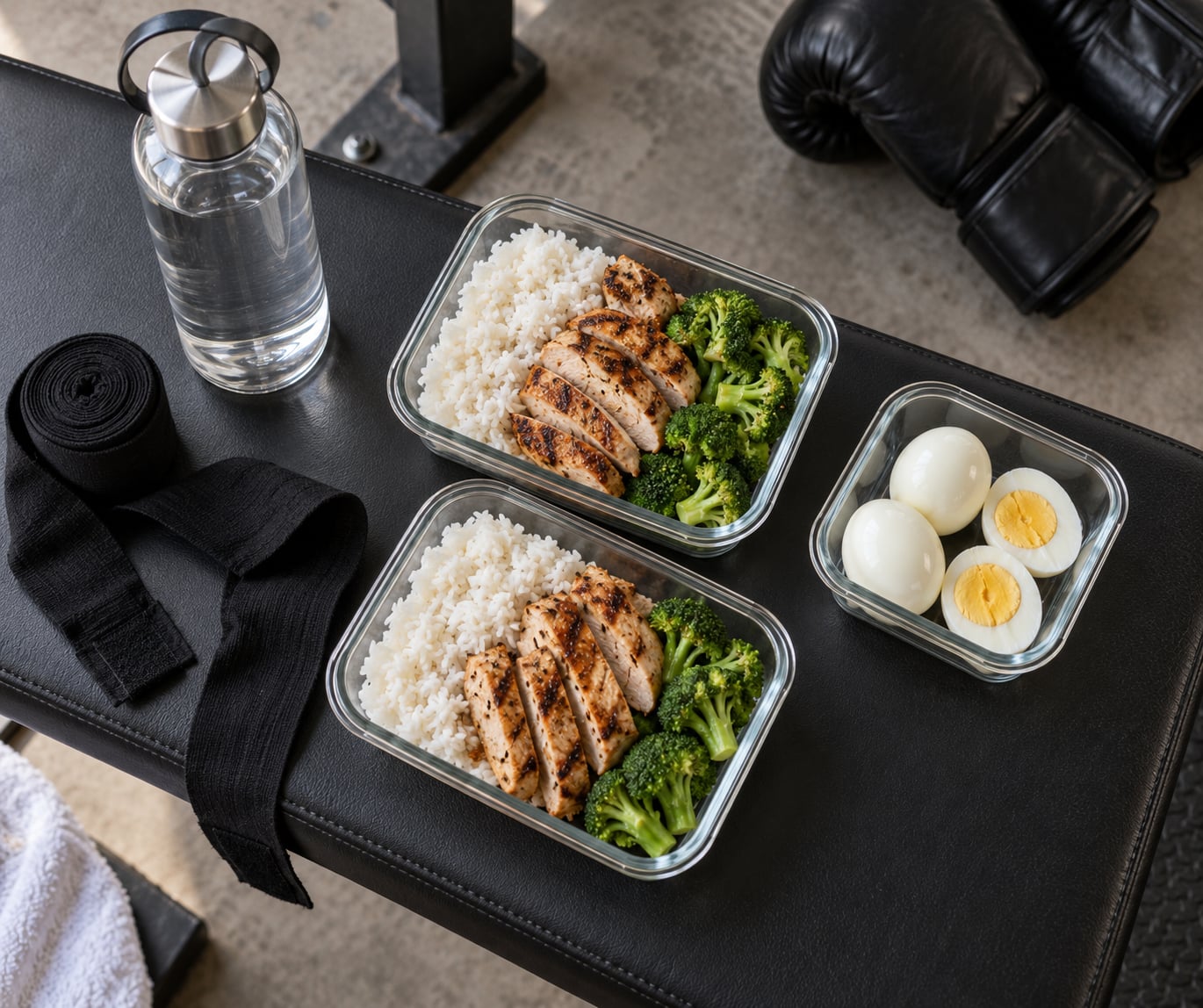
A training-day plate usually looks like this: oats with banana and honey before a morning session, rice and chicken with broccoli for lunch, pasta before afternoon sparring, and salmon or eggs with potatoes in the evening. That is not a prescription, it is a shape, and the shape is what matters.
How Should Boxers Time Meals Before and After Training?
The general rule is to eat two to three hours before a session so the food has cleared your stomach, and to refuel within an hour or two after. A pre-session meal of carbohydrate plus a little protein, eaten two hours out, gives you energy without the heavy feeling. Bag work and pad sessions tolerate more food before them than sparring does.
When the gap is short, shrink it rather than changing the food. Half a bagel with honey forty-five minutes before is fine. A full plate of fried eggs and chips on the same timeline is not.
Afterwards, carbohydrate plus protein within roughly two hours helps refill glycogen and start repair. A recovery shake is convenient when you have nowhere to cook, but it is not magic and a meal does the same job.
What Should Boxers Eat on Fight Day?
A familiar, balanced meal three to four hours before the bell. Nothing new, nothing spicy, nothing greasy, and not much more than you eat on a normal training morning. Most fighters go with oats, rice, eggs, bagels or a banana, in a portion they have eaten before.
Close to the bell, keep food small and low fibre. A banana, some rice or a handful of plain crackers works. Skip the big salad, the raw vegetables and the fibre-rich wholegrain bread, because everything in your gut during round nine is a problem you cannot solve once the bell rings.
Fighters do not fast on fight day, and they do not gorge. The most common mistake is arriving at the venue having eaten almost nothing out of nerves, then feeling hollow in the first two rounds.
How Do Boxers Stay Hydrated During Fight Week?
Steady intake beats catching up. Most fighters need somewhere around three to four litres of fluid a day in camp, more in hot weather or during long sessions, and the useful habit is drinking through the day rather than in the hour after training. Urine colour is a rough guide: pale straw is about right, and if it stays dark through the day you are behind.
Long sessions in a hot gym or in a sweatsuit cost you more fluid than you feel you are losing, which is why sodium and electrolytes come up. Use them, and use them sensibly. Higher-sodium food and drinks help you hold fluid and keep your blood pressure up in the heat, but the amount should follow advice from your coach or a registered dietitian, not a forum thread.
Get medical help if someone is dizzy, confused, not sweating properly, has stopped urinating, or has a headache that will not shift. Severe dehydration during a cut has hospitalised and killed athletes. It is not a rite of passage, and no weight is worth it.
Should Boxers Change Their Diet Before a Fight?
No. This is the single most useful thing you can do on fight week, and it is free. Keep eating the meals you ate in camp. If you have not used a supplement all camp, do not start one now, and if you have not eaten a certain food in the last three months, it has no business appearing this week.
The same goes for restrictive diets. Fasting, keto swaps, juice cleanses and sudden cutoffs to shed a couple of kilos leave a fighter without glycogen and in a worse mood, which matters as much as the physical side. Any change that involves weight, health or performance belongs with a registered dietitian or a doctor before it starts, not in the last week.
Small practical habits carry more weight than big rules. Weigh your food on the same scale each morning, write it down, drink on a schedule, and sleep the same hours you slept in camp. Fighters who track on paper tend to make weight without drama, because there are no surprises on weigh-in day.
Frequently Asked Questions
What should boxers eat the day before a fight?
Mostly what they ate all camp: carbohydrate sources such as rice, pasta, oats, potatoes and fruit, with protein at every meal and normal fluids. Keep it familiar and keep fibre moderate rather than eliminating it, since an unfamiliar gut is the last thing you want on fight night. Nothing spicy, greasy or brand new.
Do boxers need to eat more carbohydrates on fight week?
Usually yes. Carbohydrate is stored as glycogen, and glycogen is what powers repeated explosive rounds, so most fighters eat more of it through fight week and then trim portions in the last day or two only if they are a couple of kilos over the limit. Fighters already at weight keep levels steady instead.
How much protein should a boxer eat during fight week?
Roughly 1.8 to 2.2 grams per kilo of body weight for a competitive adult boxer, spread across four or five feeds of around 0.4 grams per kilo per meal. Protein is what protects lean mass while training volume is high and carbohydrate intake shifts around during a weight cut.
Should boxers take supplements to prepare for a fight?
Only what you have already used safely through camp, and only with advice from a qualified professional. Starting a supplement in fight week introduces a variable you cannot control and that anti-doping rules may restrict. Anything new belongs at the start of a camp, months earlier, not seven days out.
What should a boxer eat on fight day?
A familiar balanced meal three to four hours before the bell, similar to a normal training morning but not larger: oats, rice, eggs, bagels or banana all work. Keep portions moderate, keep fibre low, avoid anything spicy or greasy, and do not arrive at the venue having eaten almost nothing.
Conclusion
The first thing to do is stop changing things. Keep the meals you ate in camp, keep the meal times you used in camp, keep the fluids steady, and make sure carbohydrate and protein are actually enough for the sessions you still have to do. Track your weight and your food in writing so weigh-in day is not a surprise, and bring anything involving weight, health or performance to a registered dietitian or a doctor before it starts rather than in the middle of fight week.