Ring generals win close fights because two of the four criteria judges score with — ring generalship and effective aggression — reward whoever controls where the action happens. A boxer who owns the centre of the ring, manages distance on his own terms and sets the pace lands repeatable, clean punches while his opponent’s best work arrives in exchanges he never chose to have.
The rest of this piece breaks that down into seven lessons, then gets practical: how the ring is actually cut off, which skills matter, how the tactic is lost and recovered, and how to see it on a broadcast.
Table of Contents
- Why Ring Generals Win Close Fights
- What Is a Ring General in Boxing?
- How Do Ring Generals Control the Fight?
- Which Skills Do Ring Generals Need Most?
- How Do Ring Generals Win Close Rounds?
- What Are the Biggest Ring General Mistakes?
- How Can You Recognize Ring Generalship in a Fight?
- Frequently Asked Questions
- Conclusion
Why Ring Generals Win Close Fights
Two fighters can land the same number of punches in a round and one of them deserves the 10-9. The difference is who made the fight happen on whose terms. Judges are told to reward quality punching, effective aggression, defence and ring generalship, and a fighter who dictates distance and tempo gets credit on three of those four without throwing a single harder punch than his opponent.
Territory is the mechanism. Owning the centre means your jab is already in range when you want it, your opponent’s best punch is landing on nothing, and the next thirty seconds are set up by you rather than by whoever swung first. That is why ring generals win close fights: they remove the rounds their opponent needs to have.
The four criteria judges actually score with
The standard criteria used by USA Boxing and the major commissions are clean punching, effective aggression, defence and ring generalship. Most forum scorers will tell you the same list, though not the same order.
- Clean punching — accuracy, power, and landing on the scoring surface of the glove rather than the knuckle part.
- Effective aggression — pressing the action to a purpose, not swinging harder. Purposeful forward pressure counts; standing in front of someone and missing does not.
- Defence — avoiding punches, blocking, rolling, and making opponents miss from a position you control.
- Ring generalship — using the ring, controlling the centre, dictating pace, and choosing where the fight happens.
Notice how close effective aggression and ring generalship are. A boxer can be the aggressor without controlling anything, and can control the ring without ever being the aggressor. The fighters who win close bouts live in the overlap of those two, where advancing and controlling are the same action.
The short answer: seven lessons
- Territory scores. Own the centre and the exchange happens on your terms, not his.
- Misses are points. Making a man miss is scored as defence, and it opens the counter shot behind it.
- Tempo decides tired. A fighter fighting someone else’s pace is cooked by round eight.
- The jab is the whole argument. A consistent jab wins more rounds than occasional power.
- Angle beats speed. Diagonal movement shuts down more exchanges than chasing a runner down the straight line.
- Control steals rounds. Two clear rounds and a draw of the rest is still a decision.
- You have to adjust. Control that never changes when it stops working is not ring generalship.
What judges see that the crowd does not
A working judge sitting ringside has one fixed sightline and no replay, and they are scoring each three-minute unit as it happens. Everyone at home gets the slow-motion replay, which is exactly why a flurried exchange looks like it went your fighter’s way even when the man who threw it was being walked backwards through the fight.
The clinches are the loudest blind spot. Time spent tangled on the ropes is nearly invisible on a broadcast and is scored, and it favours whoever was doing the tying up rather than whoever was trying to break away.
What Is a Ring General in Boxing?
Ring generalship is the strategic control of a boxing fight’s pace, distance and positioning in the ring, used to decide where and how the fight is fought. A ring general is not simply a fighter who moves well. It is a fighter who makes the other man solve problems instead of choosing problems.
Movement is the raw material, not the finished product. What separates a ring general from a busy fighter is that the movement has an intent attached to it.
- Ring position. Where he is between exchanges, and where he has forced the other man to be.
- Distance control. Managing range with the jab and the angle, so his opponent’s best punch is always just out of reach.
- Angle changes. Moving diagonally rather than straight forward, which removes the opponent’s exit line and cuts the ring off.
- Timing. Knowing when a combination will make a man lean, when to step off the line, when to sit down and take the round.
- Awareness. Reading a round adjustment early enough to change the plan before the round settles.
The test is whether the adjustment is available. If a fighter’s only answer to being blocked, slowed or countered is to walk forward and try harder, he is chasing the fight. If his answer is to change distance, change angle or change tempo, he is running it.
Ring general vs pressure fighter vs counter-puncher
| Style | Defining trait | How they win | How they lose |
|---|---|---|---|
| Ring general | Controls distance, angle and tempo | Wins rounds on territory, cuts the ring off, forces follow-ups | Becomes passive, runs out of adjustments, gets dropped behind the lead hand |
| Pressure fighter | Advances relentlessly, crowds the ropes | Body work and sustained offense, pins opponents, empties the legs | Overcommits onto counters, chases angles he cannot reach |
| Counter-puncher | Waits, minimal forward movement | Times the entry, punishes overreach, wins on the back foot | Can be out-worked and out-pointed if the opponent refuses to come |
Ring generalship is not the same as effective aggression
Effective aggression means pressing with purpose. Ring generalship means controlling where the pressing happens. A fighter who walks his opponent to the ropes and pins him there for ninety seconds has done both at once; a fighter who circles behind a jab without ever threatening has done only the second, and will lose rounds to anyone landing regularly.
The high-ranked amateur scorers in the boxing forums put it more bluntly: if one man is simply running, it is not ring generalship. Movement without purpose is just cardio.
How Do Ring Generals Control the Fight?
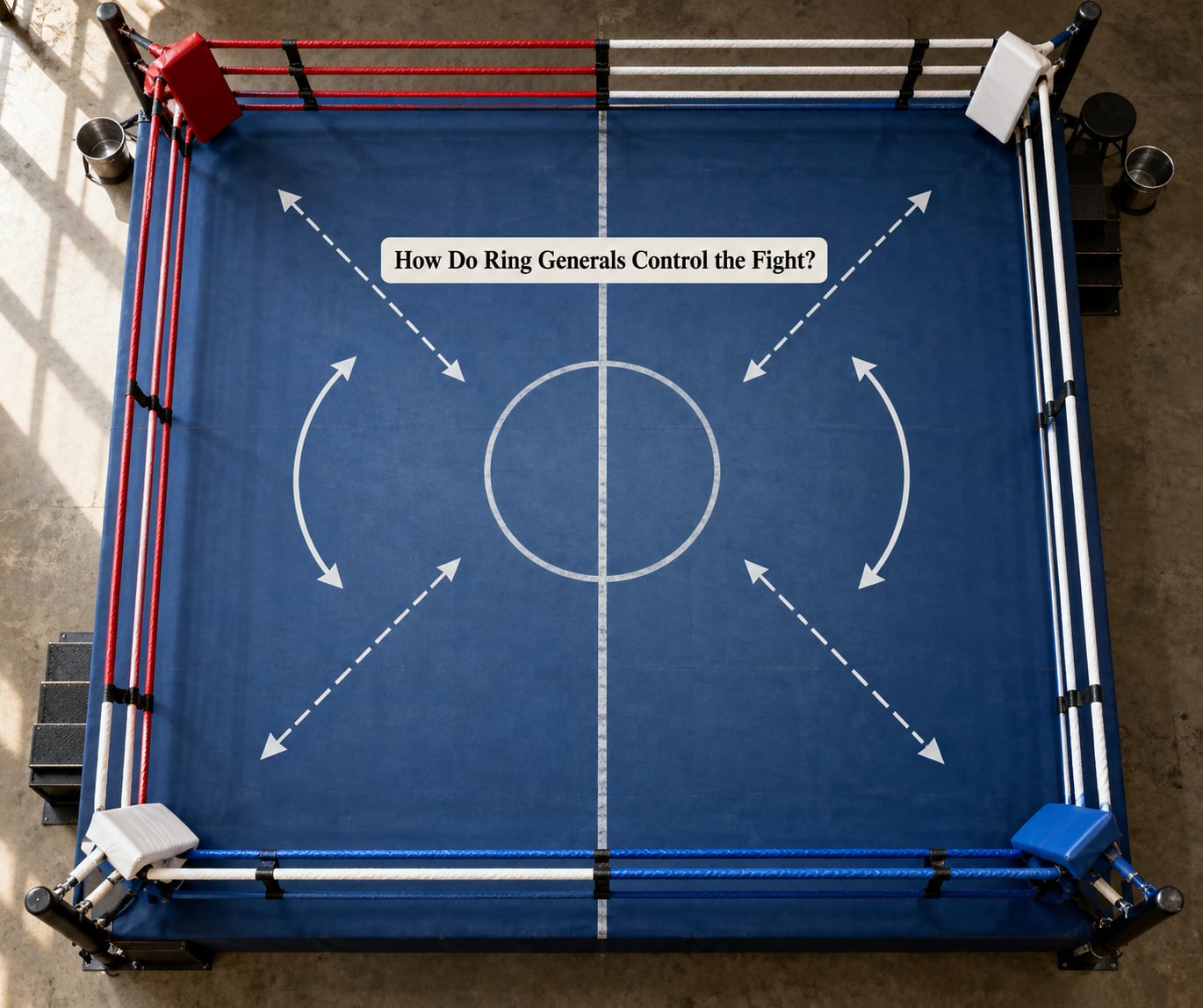
A ring general controls the fight by removing options rather than by attacking faster. The sequence is always roughly the same, whether it is Sugar Ray Robinson in the 1950s or a modern titleholder working the same geometry.
- Establish range with the lead hand. The jab is a measuring instrument first. It tells him how far the opponent’s hands travel and how fast he closes.
- Angle across the centre line. He moves diagonally, so the straight-line exit from the exchange — usually straight back toward his own corner — no longer exists.
- Occupy the exit line. The best place to stand is between the opponent and the ropes. From there, every counter the opponent throws has somewhere worse to go.
- Advance behind pressure he can see. Not a lunge. A controlled step with the jab out, so the forward movement looks effective rather than exposed.
- Force the terms. Once the opponent is on the ropes or in a pocket, the available options are limited, and the ring general picks which one gets used.
- Adjust when it stops working. If the opponent starts timing the entry, he shifts the level, changes the rhythm, or gives ground deliberately to reset the round.
Step two is where most amateurs fail. Walking forward in a straight line is following a runner, not cutting off a ring. Diagonal movement with the body already angled takes away two exits instead of one, and it is the cheapest way to make a fighter look slow.
How a ring general loses the centre and gets it back
Ring control gets lost in predictable ways. An opponent finds a counter that lands, the fighter panics and chases, and suddenly he is doing the walking. Fatigue does the same thing quietly, because the angle gets shallower as the legs go.
The recovery is rarely a big tactical change. It is usually three small things: move off the straight line again, take the round back with clean work rather than volume, and win the last ninety seconds of the round, because judges weight the end of a round heavily and so do the people watching.
Boxers who fight well in close rounds are often the ones who simply out-worked the mistake. A round stolen back at the bell is worth more than a round won comfortably in the middle.
Ring control in two-minute rounds
Ring generalship in the amateurs works the same way but with a different clock. Two-minute rounds reward a different kind of decision than three-minute rounds, because there is no time to settle into a rhythm — the fighter either establishes distance immediately or spends the round reacting.
The usual amateur mistake, and it comes up constantly in gym forums, is trying to win a ten-round fight in three two-minute rounds. You rush, you abandon the footwork that keeps you off the ropes, and you give the round away in the first thirty seconds. One amateur described his version of ring control simply as keeping his back off the ropes, timing his footwork to slip the attack, and attacking first.
Which Skills Do Ring Generals Need Most?
Ring generalship is not a talent you either have or don’t. It is a set of habits, and each one shows up in a close round in a specific way.
- Ring awareness. Knowing where he is without looking, which corner he is heading toward, and where the opponent is relative to him. In a close round this is the difference between cutting the ring off and getting cut off.
- Footwork. Small, efficient movement that lets him change the angle without crossing his feet or drifting backward. Drifting is how a ring general ends up on the ropes without deciding to go there.
- Distance judgment. Reading range correctly, so he steps in on his terms and out before the counter arrives. Getting this wrong costs whole rounds, not just punches.
- Jab or lead-hand control. The lead hand keeps the opponent honest and preserves the space his best punch needs.
- Head movement. Not rolling wildly for show, but moving enough that the opponent’s power shots land on air while he is already stepping off the line.
- Defensive responsibility. Cleaning up after a missed exchange as if he had landed it, which is where most of the free points in a close round come from.
- Patience. Accepting that the round does not have to be won with one shot. Rushy fighters win fewer rounds than they win fights.
- Punch selection. Choosing the punch that scores rather than the punch that feels good, which is usually a different shot.
- Emotional control. Missing the right punch mid-round and still winning it. Composure in round eight is a scoring skill.
How Do Ring Generals Win Close Rounds?
Close rounds are won in small, repeatable ways. Here are the five that show up most often in the scoring.
- They land the higher-percentage punch. A jab that lands four times in a round beats a power shot that lands once. Judges count quality, not highlight reels.
- They own the moment after an opponent misses. The second or two following a miss is the most valuable real estate in the ring, and the ring general is usually already positioned for it.
- They make the opponent follow. Following costs energy and patience. A fighter who is always walking is always giving something up.
- They finish rounds. Judges remember the last thirty seconds. A fighter who closes the round cleanly often takes a round the first eight minutes had been even.
- They win the swing rounds. After a knockdown, after a missed flurry, after a rope wobble, the round is being re-scored in real time, and the fighter who recovers their position first usually takes it.
Case study: Golovkin against Canelo, September 2018
Golovkin’s jab was the most discussed piece of scoring in modern boxing, and Canelo’s second fight with him in 2018 was the clearest example of it. Golovkin won eight of the ten rounds, and the widely held reason — one that scoring fans on boxing forums repeat more than any other — is the consistency of that single punch, thrown from range with nothing wasted on it.
Canelo won the fourth and the fifth. In the other eight rounds he was the busier fighter in short bursts and Golovkin was the one dictating the exchange. The lesson for close fights is straightforward: consistency of a scoring punch, from a position of control, beats volume that arrives in the wrong half of the round.
Case study: Fury against Wilder, December 2018
Fury was dropped twice in the fight and won the split decision. The thing that made the second knockdown survivable was positional: he had been moving on angles and taking the fight away from the pocket, so he was never standing where Wilder expected him.
Both knockdown rounds were scored for Wilder, which means Fury won the decision without ever taking a round on power. He took it on where the fight happened.
Case study: Mayweather against Castillo, 2002
This is the counter-example, and every honest explanation of ring generalship needs it. Castillo pressed forward for long stretches and did enough clean work to earn a split-decision draw against a fighter most viewers considered untouchable at the time.
Control is not a trump card. A fighter who controls the ring and stops landing punches hands the criteria back to his opponent.
What Are the Biggest Ring General Mistakes?
Most bad ring generals do not fail on talent. They fail on habits that look identical to good technique from the other side of the arena.
- Fighting passively. Circling behind the jab with no threat attached is a round-losing habit that looks like ring control on a scorecard nobody is reading carefully.
- Chasing the knockout. The fighter who was ahead on the cards all fight and needs the fight gets a draw, or worse, eats a counter looking for the finish.
- Staying on a straight line. A forward fighter on a straight line is easy to time and easy to angle against.
- Following around the ring. Circling an opponent who is holding the centre is his job, not yours.
- Switching styles for no reason. Changing approach because the last exchange went badly is how a good game plan turns into a bad round.
- Neglecting the body. Head movement and ring position without body work tends to fade by round six, and faded body work is why a controlled fighter can lose the last third of a fight.
- Defending badly after controlling the action. Getting sloppy once a fight is won is the most common way a clear 10-9 turns into a 9-10.
Is ring generalship overrated?
It is the loudest objection in boxing forums, and it deserves a straight answer. The strongest version of it, from a BoxingScene thread: ring generalship is the most overrated thing in boxing, and when it is not backed up by punches being thrown it should not be counted at all.
That objection is basically right, and it is the reason the boxing subreddit thread asking scorers to describe ring generalship produces a correction most readers find useful: if one man is simply running, it is not ring generalship.
Control without punching is not a style, it is an excuse, and the Mayweather-Castillo result is the standing evidence. But the objection overreaches when it assumes ring control is soft. The ring general is the fighter who makes his punches land more often, in the half of the round that gets remembered, without exposing himself to anything. That is not a consolation prize. It is why the tactic works at all.
How Can You Recognize Ring Generalship in a Fight?
You do not need to know the name for the tactic. Five things show up on a broadcast, and you can watch for them from your sofa.
- One man consistently finishes the exchange. Watch who is walking backwards at the end of each flurry, not who threw more.
- Deliberate angle changes. Movement that goes across the ring rather than along it.
- Pressure that produces predictable answers. When the same counter comes back three times, the pressure is being read.
- Economical movement. A fighter who looks like he is barely moving and yet is always in position has solved the geometry.
- Growing comfort. The clearest sign of ring generalship is a fighter who looks better at minute nine than at minute one, while his opponent looks worse.
There is one more tell that regular viewers pick up quickly: the fighter who has won a round without landing anything memorable always seems to look calm about it. He knows where he was, even if you had to rewind to check.
What fans get wrong when scoring at home
The most common scoring error is awarding the exchange rather than the round. Broadcast viewers see the flurry, cheer it, and score it, and miss that the flurry ended with one man two steps closer to the ropes.
The second is ignoring clinches and the third is treating knockdowns as the whole story. A judge is scoring a 10-9 round, not a highlight, and a fighter can win eight rounds of a ten-round fight without landing anything anyone would post.
Frequently Asked Questions
Do ring generals need to be aggressive to win fights?
No, they need to be effective rather than busy. Effective aggression means pressing with a purpose: advancing behind the jab, changing the angle, forcing an exchange on terms you can handle. A ring general who only circles gives the round away, because the criteria reward forward pressure that actually lands something. The fighters winning rounds without many punches are usually advancing with control, not standing still.
Can ring control alone win a boxing fight?
Rarely on its own. Ring control decides rounds, but punches decide fights and knockdowns. A boxer who owns territory for ten rounds and lands nothing worth scoring has handed clean punching and effective aggression back to his opponent. Mayweather’s split-decision draw with Jose Luis Castillo in 2002 is the standing warning, with Castillo pressing forward and doing enough clean work on the cards.
Which style works best against a pressure fighter?
Angles and patience. A pressure fighter wants you against the ropes, so move off the straight line, change levels, and use the jab to reset the distance before he closes it. A counter-puncher style punishes him because he arrives on your terms, but the version most pressure fighters beat is the one that runs backwards in a straight line. That hands over the round every exchange.
How can I judge tactical control on a broadcast?
Watch three things: who is moving backwards at the end of each exchange, which side of the ring each fighter occupies after a flurry, and whether the fighter on the ropes can leave. Then watch the clinches, which broadcast viewers rarely see clearly and which are scored. Judges are scoring ten-to-nine rounds, not knockdowns, and the third minute carries more weight than the first.
How do judges score boxing rounds?
Each round starts at 10 must. Ten-nine goes to the fighter who did more of the four things judges are told to reward: clean punching, effective aggression, defence and ring generalship. A knockdown usually produces a 10-8 or 10-7. Judges get no partial credit for a punch that merely looked good, which is exactly why consistent work beats an exciting minute.
Conclusion
Ring generals win close fights because scoring rewards positional control, and positional control turns every exchange into one the controlling fighter chose. Consistency, not flash, is what the cards add up.
So watch four things in the next close bout you put on: who is walking backwards, who sets the tempo, who changes the plan when it stops working, and who stays disciplined in round nine when nothing is going their way. That last one decides more fights than people give it credit for.