
What the catchweight rule means is simple once you strip away the jargon: a catchweight is a weight limit that the two fighters and their promoters agree to in the bout contract instead of using an official division limit. Neither boxer has to move up or down a division, and they can both be contracted to make the same agreed figure. The interesting part is what happens on the scales after that, and why the number on the poster is not always the number you see on fight night.
Boxing’s weight classes exist to keep matchups roughly fair. Catchweights exist to break that system on purpose, usually for a matchup the public wants to see. Once you know how the limit is set, when the weigh-in happens and what a miss costs, the contract language stops being mysterious.
Table of Contents
- What the Catchweight Rule Means
- How Is a Catchweight Limit Set?
- When Must Boxers Weigh In?
- What Happens If a Fighter Misses Weight?
- How Does Making Catchweight Affect a Fight?
- Catchweight vs Natural Weight, Title Weight and Junior Limits
- Why Do Boxers Fight at Catchweight?
- Famous Catchweight Fights and What They Show
- Frequently Asked Questions
- Is catchweight the same as natural weight?
- Can a boxer compete above an agreed catchweight limit?
- Does a boxer get time to rehydrate after a catchweight weigh-in?
- Why are catchweight fighters not assigned a standard division?
- Is catchweight safer than making a normal title weight?
- Where can I find the catchweight and weigh-in time for a fight?
- Conclusion
What the Catchweight Rule Means
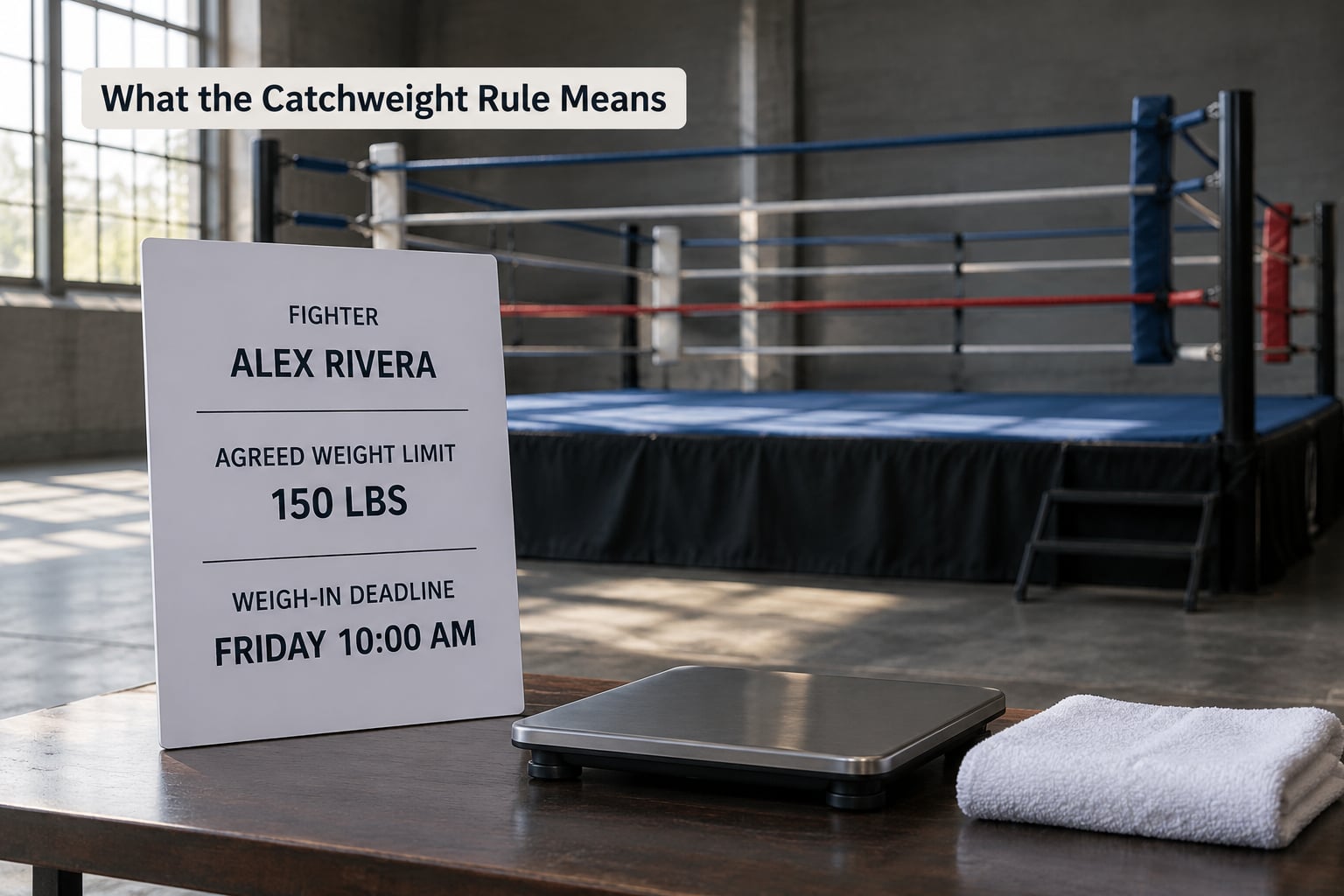
A catchweight is any agreed maximum weight that sits outside the official weight class list. If a bout is contracted at 152 pounds, and 152 pounds is not a division limit, that fight is a catchweight bout even though nothing about it looks unusual on the poster.
The name comes from older English usage around catching even terms, roughly the idea of two opponents meeting at a weight set by agreement rather than by rulebook. It has nothing to do with catching a fighter. If you search the phrase without the word boxing, you will land on food packaging, where catch weight means a product that varies slightly from its labelled weight. That is the same phrase, a completely different meaning, and it is the reason some automated answers to this question come back confused.
Is catchweight a new weight class? No. A weight class is a fixed band defined by a sanctioning body, and a title at that weight belongs to a division with rankings, champions and mandatory challengers. A catchweight is a one-bout contract term with no division attached to it.
| Type of limit | Where the number comes from | Attached to a division? | Typical use |
|---|---|---|---|
| Division limit | A sanctioning body’s fixed list | Yes | Ranked and title fights inside one division |
| Catchweight | Negotiated into the bout contract | No | Cross-division or non-standard matchups |
| Open weight | No agreed maximum at all | No | Fights where neither side will accept a limit |
| Junior limit | A division ceiling set by age or years pro | Yes, temporarily | Young or inexperienced fighters moving up |
One detail catches new fans out: most division limits are a ceiling, not a floor. A heavyweight is capped at 200 pounds plus in most sanctioning bodies, and a fighter may come in well under it. A catchweight works the same way, so the contracted figure is the heaviest the fighter is allowed to be, not the weight they have to hit exactly.
How Is a Catchweight Limit Set?
Nobody assigns a catchweight. It is negotiated, usually months before the bout, by the fighters’ camps, their managers and the promoters, and then written into the bout agreement as a contractual weight limit with a deadline attached. The sanctioning body or state athletic commission then has to approve the event on those terms before the fight is licensed.
Where the number comes from in practice
Promoters almost always start from a round figure that suits the matchup rather than a division, typically the heavier fighter’s comfortable walking weight or somewhere between the two fighters’ frame limits. A middleweight who wants to fight a super middleweight at something above 165 pounds has to agree to a number that no division recognises, and both sides have to sign off.
Rankings and television considerations push the number around too. Broadcasters push for a limit that keeps the matchup intact, sanctioning bodies may ask for a limit that keeps a title meaningful, and managers push for whatever keeps their fighter in the fight without an unlimited negotiation. The contracted fighter usually has the least say in the final figure, which is a large part of why catchweights carry a bad reputation.
How a catchweight is negotiated, step by step
- Establish natural size. Camps discuss where each fighter can realistically compete without an extreme cut, usually based on their history, frame and current division.
- Pick a compromise figure. The number often lands between the two fighters’ division limits, or at a well-known round figure that carries no division meaning of its own.
- Decide who is the smaller fighter. The side expected to cut harder may negotiate rehydration language, a weight-loss timeline, or a penalty clause in return for accepting the limit.
- Agree the weigh-in window. The contract fixes when the official weigh-in happens and how many hours before the fight that is.
- Add penalties. Overweight consequences are written in, and they can include a fine, a purse deduction, a ban on the title or a requirement to pay a substitute’s purse.
- Get the commission to license it. The governing body reviews the terms and sanctions the bout at the agreed limit rather than in a division.
Contracts commonly include a rehydration clause as well. That is a separate provision from the catchweight itself, and it exists because a fighter who steps on the scale at the agreed number and then puts weight back on can arrive at fight night noticeably bigger than the other man. The clause puts a ceiling on how much rehydration is permitted, usually expressed as a second weight checked at a fixed time before the bout.
When Must Boxers Weigh In?
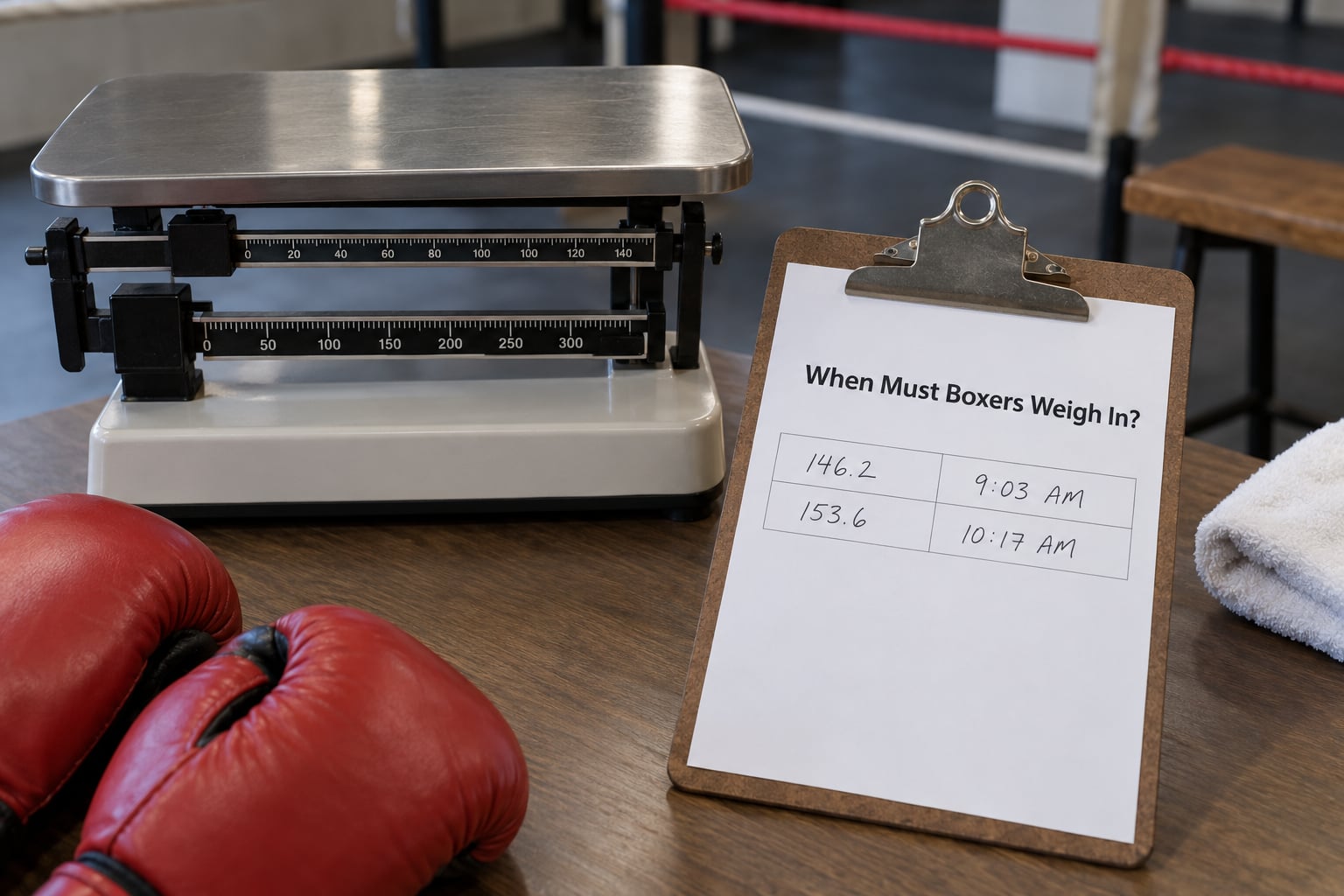
Boxers normally step on the official scales the day before the fight, and the contract sets the exact deadline, often around midday the day before the card. If a fighter cannot make the agreed catchweight by that deadline, the consequences start immediately, because the commission’s licence for that bout is conditioned on the weigh-in.
Some events hold two weigh-ins. A preliminary weigh-in earlier in the week, sometimes at a public appearance or a training gym, exists mostly as a checkpoint so a camp can adjust before the formal one. The official weigh-in is the one with legal weight, and it is the reading that goes on the record sheet.
Some commissions and sanctioning bodies allow a same-day allowance, letting a fighter who is a small amount over the limit make up the difference a few hours later on the day of the fight. The tolerance is measured in fractions of a pound and varies by rulebook, so a fighter who is well over the number has no second chance under any version of it.
Across the major sanctioning bodies, the practical pattern is the same: WBC, WBA, IBF and WBO all sanction bouts at agreed limits, and none of them treats a catchweight as a division. A championship at a non-standard weight can be defended, but the title, the ranking and the record attached to it exist outside the standard divisional order, and that is where most of the argument starts.
What Happens If a Fighter Misses Weight?
Missing a catchweight is more serious than missing a division limit, because the whole bout was built on that number. Outcomes range from a formality to the fight being stopped before it happens, and which one applies comes down to the contract, the commission and how far over the fighter was.
The usual outcomes
- A fine or purse deduction. The overweight fighter pays a set amount out of his purse. This is the most common resolution when the miss is small and the opponent is willing to continue.
- The opponent’s purse is raised. In some contracts a miss triggers a payment to the fighter who did make weight, so he is compensated for the risk he agreed to take.
- Forfeiting a share of the purse. Some agreements let the overweight side forfeit a percentage of his own purse rather than pay a separate fine.
- A replacement fighter is paid. If the bout is called off, the fighter who made weight can be contractually entitled to the agreed payment for an opponent who never showed up at the right size.
- The bout is cancelled. A large miss, or a refusal by the fighter who made weight to go on, ends the fight. The commission can suspend the licence that covered it.
- The result is a no contest. In rarer cases the fight happens, the result is recorded, and the bout is marked a no contest because it was not held under the contracted terms.
Because contracts are private, the details of a specific penalty are rarely public. What is public is the pattern. A well-known example of an overweight at a contracted catchweight saw the fighter face a heavy penalty built into the agreement before the fight went ahead, which is the usual outcome when a manager is confident the number is achievable and the commission will allow the bout to continue.
There have also been cases where a fighter came in well above an agreed limit and still fought, because the other side chose to take the fight anyway and the commission allowed it. Those are the cases fans argue about most, since they turn a contract failure into a size difference nobody agreed to.
How Does Making Catchweight Affect a Fight?
Making a catchweight is physically hard in a specific way, because the agreed figure often sits below what the fighter’s body naturally carries. Rather than cutting to a division ceiling he is used to, a fighter may be cutting several pounds deeper to hit a number chosen for commercial reasons.
Weight cutting works by shedding water, and a deeper cut means a larger share of that water comes back between the weigh-in and the first bell. A fighter who steps on the scale at the agreed catchweight and then rehydrates fully can arrive at fight night several pounds above the number, and if the contract has no rehydration clause, there is nothing stopping it.
The practical effects show up in a few places. Energy is lower early, which shows in the first two rounds as a slower start than the fighter’s normal pattern. Recovery between rounds is slower, and cuts are more common later on. A fighter who misses the weight badly can end up starting the bout already depleted, because camp time was spent on a cut that still failed.
Dehydration is the part that gets the most attention, and rightly so. This is general information rather than advice for any individual: severe fluid restriction carries real medical risk, and anyone considering an aggressive cut should speak to a doctor or a qualified nutritionist rather than copying a routine from a fighter’s social media. Fight contracts and commission rules exist partly because the sport has accepted that extreme cuts carry risk.
Most commissions have tightened weigh-in rules over the years, with rehydration checks, same-day allowances and time limits between weighing and competing. The direction of travel is clear, even though the specifics differ from state to state and from country to country.
Catchweight vs Natural Weight, Title Weight and Junior Limits
The fastest way to understand catchweight is to put it next to the other kinds of limit a boxer might have to make. Natural weight is simply what a fighter carries when he is not cutting. A title weight is a division limit that also has a championship attached to it. A junior limit is a temporary cap tied to age or experience. A catchweight is none of those three.
| Type of limit | Fixed by | Belongs to a division? | Can it change with the fight? |
|---|---|---|---|
| Natural weight | The fighter’s own body and camp | No | No, but it moves week to week |
| Title weight | Sanctioning body | Yes | No, not without a division change |
| Junior limit | Age or years-pro rule | Yes, temporarily | No, it lifts as the fighter gains experience |
| Catchweight | The bout contract | No | Yes, but only before the bout is agreed |
| Open weight | Nobody sets a maximum | No | No, because there is no number to change |
Where the 17 divisions sit
Catchweights are easier to spot once you can see the standard limits they sit between. These are the recognised division limits in pounds and kilograms, from strawweight up.
| Division | Limit (lbs) | Limit (kg) |
|---|---|---|
| Strawweight | 105 | 47.6 |
| Light flyweight | 108 | 49.0 |
| Flyweight | 112 | 50.8 |
| Super flyweight | 115 | 52.2 |
| Bantamweight | 118 | 53.5 |
| Super bantamweight | 122 | 55.3 |
| Featherweight | 126 | 57.2 |
| Super featherweight | 130 | 59.0 |
| Lightweight | 135 | 61.2 |
| Super lightweight | 140 | 63.5 |
| Welterweight | 147 | 66.7 |
| Super welterweight | 154 | 69.9 |
| Middleweight | 160 | 72.6 |
| Super middleweight | 165 | 74.8 |
| Light heavyweight | 175 | 79.4 |
| Cruiserweight | 185 | 83.9 |
| Heavyweight | 200+ | 90.8+ |
Note the gaps between divisions. Super lightweight to welterweight is seven pounds, welterweight to super welterweight is seven, super middleweight to light heavyweight is ten. A catchweight of 152 sits in the middle of the welterweight band, and a contract at 155 sits between super welterweight and middleweight. Both are legal, both are non-standard, and neither belongs to either division.
Why Do Boxers Fight at Catchweight?
Strip away the arguments about fairness and the reasons are mostly about making a matchup exist at all. Fighters agree to catchweights for a small number of reasons, and most of the controversial ones are commercial.
The reasons that come up most
- The matchup is worth more than the division. Two well-known fighters on either side of a division limit often draw a much larger audience than the same two men in their own divisions.
- Career stage and age. An older fighter can hold a title against a younger opponent at a weight that favours him, and a younger fighter gets a meaningful fight without a permanent move.
- Opponent size. A fighter may want the fight but not the size difference, so a limit is used to blunt it. Whether that is fair depends entirely on who rehydrates more.
- Protecting a title’s meaning. A champion can defend at a weight that keeps the belt in a useful position, and the challenger gets a shot without changing division.
- Broadcast and promoter pressure. Schedules and television deals are built around dates, and a catchweight is the fastest way to make an awkward matchup happen on one of them.
- A negotiated compromise instead of a promotion. Some catchweights genuinely split the difference, with both fighters moving a little instead of one moving a lot.
Critics make two separate arguments, and they are worth keeping apart. The first is competitive: one side rehydrates more than the other, so the fight stops being a fair test. The second is structural: a catchweight bout produces no divisional result, so it feeds into nobody’s ranking and does not move a pound-for-pound argument in either direction. Some fans also use the phrase weight bullying for the first problem, and the word gets used a lot in forum threads, generally for a limit where the smaller fighter is asked to give up more than the larger one.
Both criticisms have a fair answer. Catchweight bouts can be decided on pure ability when both men come in at similar size, and the criticism lands hardest when a bigger fighter rehydrates freely against a smaller fighter who came in already depleted. The argument is not really about the rule existing. It is about who the rule serves and who pays for it.
Famous Catchweight Fights and What They Show
A handful of well-documented bouts show the range of what a catchweight can look like, from a limit just above a division ceiling to one that lands in the middle of a division band.
| Fight | Year | Agreed limit | Where the limit sits | What it showed |
|---|---|---|---|---|
| Oscar De La Hoya vs Manny Pacquiao | 2008 | 147 lbs | Welterweight limit | A champion moving up to take a fight at another man’s own number |
| Riddick Bowe vs Evander Holyfield | 1992 | 214 lbs | Above the heavyweight ceiling | Catchweights can also sit above a division, not only below |
| Artur Gatti vs Michael Ward | 2002 | 140 lbs | Super lightweight limit | How a contract limit and the actual sizes can diverge wildly |
| Juan Diaz vs Ricky Hatton | 2010 | 140 lbs | Super lightweight limit | A bout in a smaller division staged for a welterweight opponent |
| Floyd Mayweather Jr vs Manny Pacquiao | 2015 | 144 lbs | Between welterweight and super welterweight | The most public catchweight in modern boxing, and a permanent argument about it |
| Canelo Alvarez vs Liam Williams | 2017 | 152 lbs | Midway through the welterweight band | A fighter staying put while an opponent took the fight on his terms |
| Canelo Alvarez vs Gennady Golovkin | 2018 | 155 lbs | Between super welterweight and middleweight | A compromise limit for a matchup across two divisions |
| Amanda Serrano vs Erika Cruz | 2017 | 122 lbs | Super bantamweight limit | Catchweights are not confined to the men’s divisions |
Read the agreed limit column on its own and the pattern jumps out. Most of these numbers are not division limits, several sit in the gap between two divisions, and at least one sits above the heaviest traditional class. Once you notice that, the phrase on a fight poster stops being strange. A number between two divisions is the clearest signal that nobody is trying to squeeze the bout into a ranking system.
Frequently Asked Questions
Is catchweight the same as natural weight?
No. Natural weight is simply what a fighter carries when he is not cutting, and it moves around week to week with diet, training and lifestyle. A catchweight is a contracted maximum written into the bout agreement, often set well below either fighter’s natural weight so both men can make it. The two can be far apart, and the gap between a fighter’s natural weight and his catchweight is exactly the weight he has to cut.
Can a boxer compete above an agreed catchweight limit?
It is allowed, because most limits are ceilings rather than exact weights, but it is not free. Contract language can deduct money from the purse, order a payment to the opponent, or cancel the bout if the miss is large. Some rules also allow a same-day tolerance of a fraction of a pound. Coming in over by several pounds is a different matter entirely, and is usually treated as a breach of the agreement.
Does a boxer get time to rehydrate after a catchweight weigh-in?
Usually yes, and that gap between the weigh-in and the first bell is exactly why rehydration clauses exist. A fighter who steps on the scale at the agreed number will put fluid back on before the fight, and some contracts add a second weigh-in a few hours before the bell to cap how much. Where no clause applies, the fighter may rehydrate freely, which is one reason catchweight bouts are argued about.
Why are catchweight fighters not assigned a standard division?
Because the limit is private to one bout and was never approved as a division limit by a sanctioning body. No ranking, mandatory challenger or title is attached to it, so a catchweight result does not change a fighter’s divisional record. Fighters still compete in the divisions their career is built around, which is why catchweight fights are treated as tests of ability rather than as divisional results.
Is catchweight safer than making a normal title weight?
Not necessarily safer, and there is no medical case for it. A catchweight can demand a deeper cut than a division ceiling a fighter already handles, and the extra weight is usually water that returns before the bell. Anyone considering an aggressive cut should talk to a doctor or a qualified nutritionist rather than following a routine from a fighter’s social media. Rules vary by commission and country.
Where can I find the catchweight and weigh-in time for a fight?
Start with the promotion’s official bout announcement and the event poster, which usually list the contracted weight and the division or catchweight label. Fight-week coverage often reports the actual weigh-in figures once the scales come out. The sanctioning body’s listing and the state athletic commission’s event record will confirm the approved limit. Rules and terminology differ by country, so check what applies to the specific bout.
Conclusion
What the catchweight rule means in practice is that the two fighters agreed on a number themselves, and that number sits outside the standard divisions. It gets set during contract negotiation, checked at an official weigh-in the day before the fight, and comes with penalties if either man misses it. It also comes with no divisional ranking attached, which is why catchweight results leave pound-for-pound arguments exactly where they were.
Before any catchweight bout, look for three things: the contracted limit, the weigh-in deadline, and whether a rehydration clause was agreed. Those three details tell you more about how the fight will be decided than the weight printed on the poster. Everything else is a debate about whether the matchup should have happened at all.