Trainers plan a fight game plan by studying every fight the opponent has had, turning what repeats on that tape into one primary objective, naming the specific things the boxer must avoid, and writing down in advance what will make them switch plans. The rest is drilling it until it stops being a thought and becomes a reaction.
The order matters more than most fans expect. A trainer will not settle on an approach until the tape has been watched twice, and will not hand the plan over until it has survived live rounds in the gym. What follows is how that actually works, from the first scouting session to the sixty seconds the corner has between rounds.
Table of Contents
- What Does a Fight Game Plan Do?
- How Trainers Research the Opponent
- How Trainers Choose the Primary Fight Plan
- How Trainers Build a Game Plan Around the Boxer
- How Trainers Turn Strategy Into Fight-Game Training
- How Trainers Adjust the Plan During Fight Week
- What Happens in the Corner During the Fight?
- How Trainers Plan for Different Fight Scenarios
- Frequently Asked Questions
- How do trainers create a boxing game plan?
- What should a boxer focus on during a boxing game plan?
- How do trainers adjust a game plan during a fight?
- Should a boxing game plan be changed before fight week?
- How many tactics should a boxer remember in a fight?
- What is the difference between a boxing game plan and a fight strategy?
- Where to Start With Your Own Fight Plan
What Does a Fight Game Plan Do?
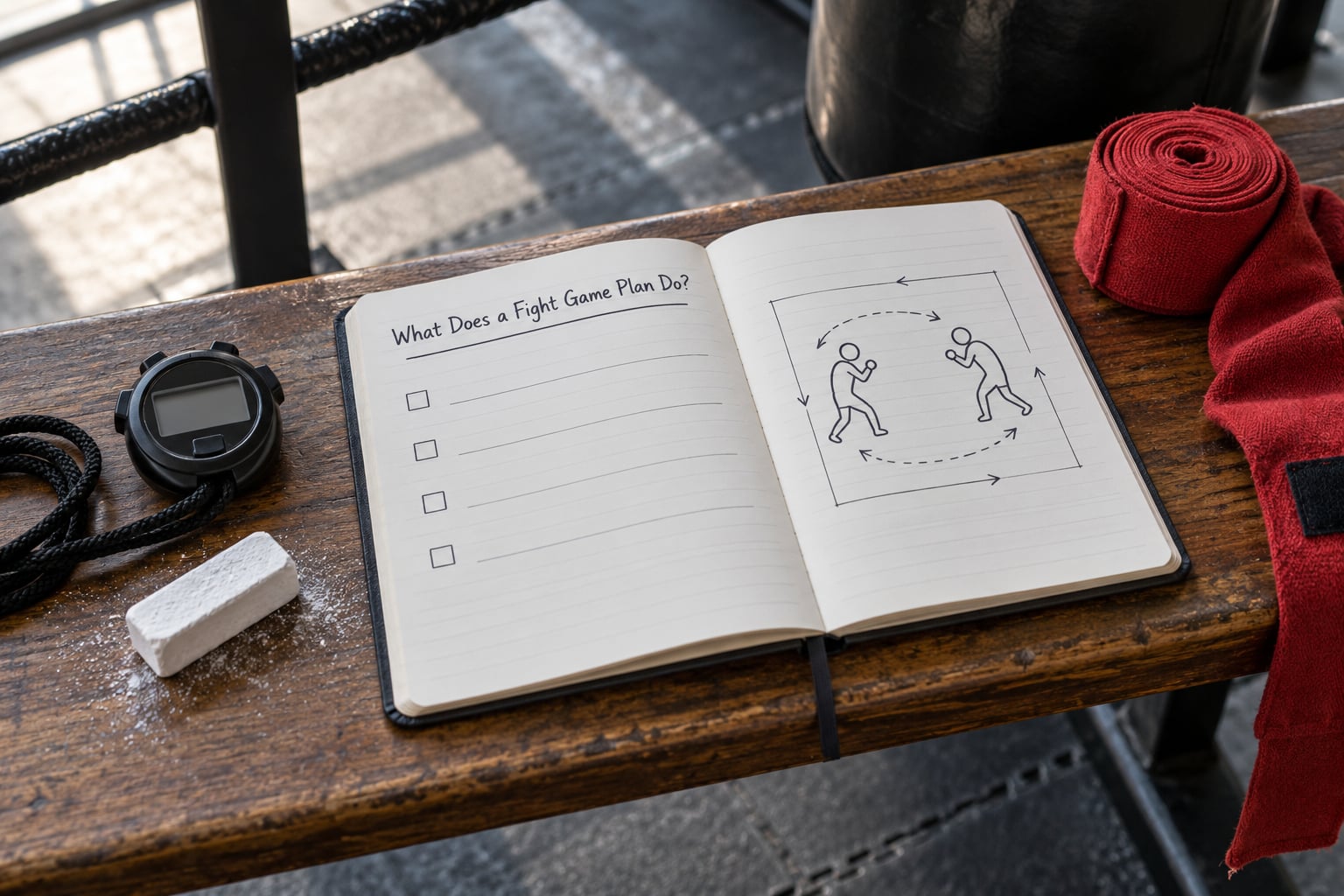
A boxing game plan is a written, ranked set of tactical instructions built from studying an opponent, telling a fighter what to do first, what to do next, and under what conditions the whole thing gets thrown out. It is not a list of things that would be nice to land.
The plan operates at two different levels, and confusing them is the most common mistake in amateur corners. The strategy is the overall identity of the fight, something like staying long on the jab and making the opponent come forward. The fight-game instructions are the small repeatable actions underneath it, like jab, jab, step off the jab, reset, jab.
Good plans also carry a negative. A trainer who writes down what the boxer should do without writing down what he must not walk into has only done half the job. Most bad nights in the ring trace back to a fighter stepping into something the corner had already seen on tape and never named out loud.
How Trainers Research the Opponent
Research starts with tape, and the useful part is not watching fights but watching them twice with different questions. The first pass is wide, looking at the overall shape of the fighter. The second pass is narrow, counting specific things.
On the second pass, trainers are looking for repetition. A go-to punch that lands or nearly lands in three of the last four fights is a tendency. A defensive habit, like a fighter who drops his right hand every time he steps back after throwing a hook, is a tendency. Entry points, like the way someone leaves the chin open coming off the ropes, are tendencies.
These patterns are only usable if they show up in more than one fight. One unusual moment is an accident. The same unusual moment across five fights is a pattern the trainer can plan against, and the scouting report is basically a short list of those patterns with a clip attached to each one.
There is a version of this where there is almost nothing to watch. Short-notice replacement opponents and debutants leave a trainer with amateur clips, a gym reputation, and very little else. The honest response is to plan around the parts that cannot be scripted, which are shape, reach, and intent, and to build a plan that lets the boxer adjust as soon as real data arrives.
How Trainers Choose the Primary Fight Plan
Only one thing can be the main event of a fight. Trainers force a ranking, usually a primary objective with one or two secondary objectives underneath, because a boxer in round six can hold one instruction in his head and roughly two at best. Anything longer than that is a wish list.
The primary objective usually comes from where the matchup already tilts. Against a fighter who walks forward with his chin high, pressure means making him miss and punishing the miss. Against a counterpuncher who is happy to wait, the answer is often to take the round back by making it busy and refusing to stand still in range.
Other common routes include working behind the jab to break a taller opponent’s rhythm, going to the body early to slow a fighter’s legs and then taking the head away, or simply making the fight as boring and repeatable as possible for a boxer who does not want a war. A good trainer picks the route the boxer can execute, not the one that would look best on a highlight reel.
Alongside the objective goes a danger zone. That is the one specific thing the opponent does which this boxer must not walk into, stated as a rule with a distance attached.
How Trainers Build a Game Plan Around the Boxer
The second half of the question is who is executing it. A plan that requires a fighter to do something they cannot do is a bad plan, and the give-away is always the same: it looks brilliant on the whiteboard and falls apart in the third round of sparring.
Reach and height decide a lot of it. A fighter with four inches of height and a longer jab gets told to make opponents miss at range, not to brawl. A shorter boxer without a strong chin has the opposite instruction, which is to get inside, get busy, and make the fight close enough that height stops helping.
Age, conditioning and temperament count too. A plan built around sustained high output needs an engine that can produce it over eight rounds. Some boxers fight better when told what to do and some get worse, because being told what to do pulls them out of the instinct that has been keeping them upright. Trainers learn which kind of fighter they have long before the opponent gets booked.
How Trainers Turn Strategy Into Fight-Game Training
A plan on paper does nothing at all. The training job is to make the plan the boxer’s default rather than something he has to remember while being hit, and that work happens in a specific order through the camp.
Bag and pad work carry the primary objective first, in the exact sequence it will be needed. Then sparring turns it into a situation. Instead of eight rounds of general boxing, a trainer sets up specific rounds with rules attached, such as three rounds where the boxer may only leave the jab or the right hand as the exit, or a round where he has to win the last ninety seconds because a score is called at the end of it.
Defensive drills get trained as deliberately as offence. Whatever the opponent’s go-to is, that punch gets thrown at the boxer hundreds of times in the gym so the answer stops being a decision. Video review then closes the loop, and corrections have to be countable. Clean that exchange, landed three of six exits, got hit on the exit four times out of five.
Camp length usually lands somewhere between eight and twelve weeks, with six or seven showing up for short-round fights where the work is sharpening rather than building. What the forum arguments miss is that length is not the variable that decides the plan. Repetition of the specific situations is.
How Trainers Adjust the Plan During Fight Week
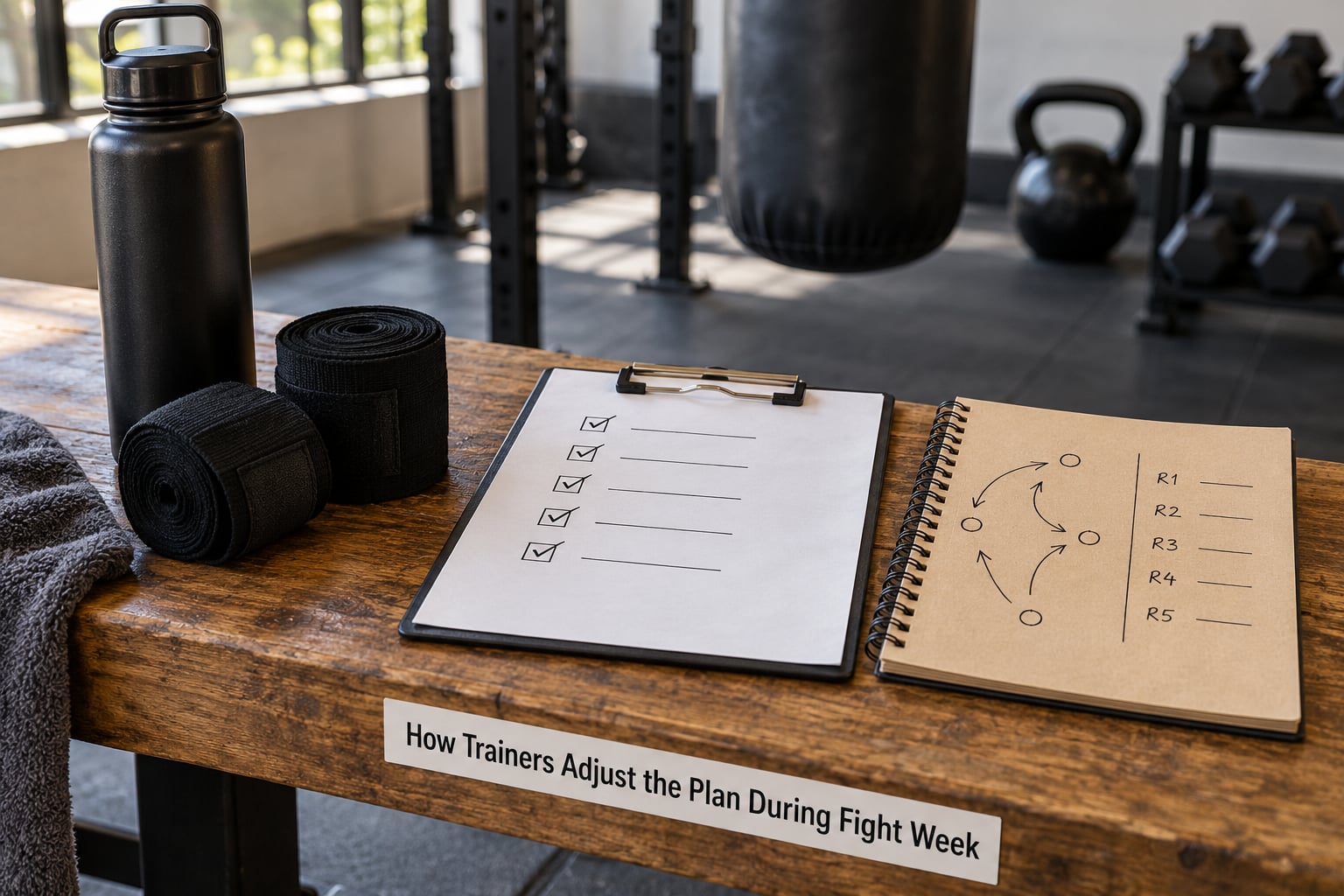
During fight week, trainers keep the primary objective and change everything underneath it. The plan itself is rarely touched, because a strategy rewritten in the final week is a strategy nobody has drilled. Weight, conditioning, sparring volume, rest and the wording of reminders are what move.
Sparring is the first thing to come down. Hard rounds in the last ten days risk the boxer getting hurt at the exact point where the plan needs them healthy, and nobody wants to rehearse an attack that has been damaged in training. Tactical light rounds, positional work, and finishing sequences that rehearse the plan without absorbing punishment usually replace them.
The reminders also get shortened. A twelve-point plan cannot survive a bad round, so the corner reduces it to a trigger phrase the boxer can call himself. Shorter reminders, said more often, are how a plan stays available when the boxer is tired and losing.
What Happens in the Corner During the Fight?
Between rounds the trainer has about sixty seconds, and the order of what gets said is remarkably consistent. Correction comes first, then reinforcement, then the contingency for the round that is coming.
- First, one correction naming the thing that just happened. It is the only part of the round the boxer can still connect to.
- Second, the primary objective again in the boxer’s own words. Reinforcement beats new instruction when there is no time to teach.
- Third, the tell to look for in the next round. That gives the boxer something to search for instead of something to worry about.
- Fourth, the plan switch and its trigger. Pre-agreed decisions get made calmly; mid-fight ones get made late.
The second’s job is water, the stool, the towel and the mouthpiece, and watching for the signs that change the round count. The cutman’s work is part of the same system, because a cut that is bleeding in round two changes what the plan can be in round six no matter how well it was written.
One thing trainers will not do between rounds is introduce a brand new plan. Adjustments get made on the walk back from the stool, in the language already used in the gym, and usually they are smaller than the fighter wants them to be.
How Trainers Plan for Different Fight Scenarios
The contingencies are written before the fight, which is the only time they can be written calmly. The common ones cover most of what goes wrong.
When the boxer is behind
The mistake is turning it into a brawl, because that is usually the fight the opponent wants. Trainers push toward volume, cleaner punches, and winning the final ninety seconds of a round to swing the judges’ perception of a close round.
When the opponent pressures early
The plan says circle, tie up, and make him pay for every step in. Early aggression is expensive, and the boxer who is still sharp in round four usually wins a fight the other man started fast in.
Against a southpaw
Everyone leads with the jab, and the jab is what a southpaw’s forward hand lives on. Trainers work the lead-hand exit hard, double the jab, and look for the straight right that a southpaw’s stance leaves open behind the rear hand.
Against a taller opponent
Reach disadvantage is the question amateur fighters ask most often, and it deserves a real plan rather than tips. The answer is a change of distance, not a harder punch. Cut off the ring instead of chasing him, take the feet, work the body to slow the legs, and refuse to trade at the one range where he wins. Cutting off the ring is a skill, so it gets drilled in every round of the final two weeks.
Against a cautious fighter who shells up
The plan is to accept an ugly first half and keep the same output. Patience is the tactic. The risk is boredom, and a bored boxer drops his hands, so rounds with assigned targets keep the attention somewhere.
When the fight becomes attritional
Some fights just get long and hard with no breakthroughs. Trainers have a standing agreement for that case, built around economy. Fewer shots, better shots, and the reminder that a round won cleanly beats a round won with damage taken.
Frequently Asked Questions
How do trainers create a boxing game plan?
Trainers watch every available fight of the opponent at least twice, once for overall shape and once to catalogue patterns that repeat. Those patterns become one primary objective with one or two secondary ones, plus a named danger zone and pre-agreed conditions for switching plans. The plan is then drilled in situational sparring until it works under pressure.
What should a boxer focus on during a boxing game plan?
One thing. A boxer can hold roughly one instruction in his head mid-fight and two at best, so the primary objective has to be short enough to shout and simple enough to act on when tired. Secondary tactics exist for the corner to draw on, not for the boxer to juggle. If the fighter cannot state the main objective in five words, the plan is too long.
How do trainers adjust a game plan during a fight?
They diagnose before they change anything, checking in order whether the boxer gave the effort, executed the plan correctly, is being out-boxed on skill, or is fighting the wrong plan. Only after that do they switch, and they use the trigger written before the fight rather than inventing a new idea in the corner. The adjustment is usually smaller than the boxer wants it to be.
Should a boxing game plan be changed before fight week?
Rarely, and never in the final ten days. A strategy rewritten late is a strategy nobody has drilled, and a boxer under fatigue will fall back on whatever he has repeated most. Coaches usually keep the objective and change the loading around it instead, cutting hard sparring, shortening reminders, and protecting the situations they want available on fight night.
How many tactics should a boxer remember in a fight?
Fewer than people think. One primary objective, one defensive rule, and one trigger for switching is a full load for a fighter in a hard round. More tactics on the card means less of each one under pressure. The rest lives in the corner’s head and gets introduced only when a specific condition shows up, which is how a long plan fits into sixty seconds.
What is the difference between a boxing game plan and a fight strategy?
Strategy is the broad identity of the fight, such as outboxing a pressure fighter or making the contest short and physical. A fight game plan is the written, ranked set of instructions that carries out that identity, with tells to look for, a danger zone to avoid, and stated conditions for abandoning it. Strategy says what kind of fight this is; the game plan says what the boxer does in round two.
Where to Start With Your Own Fight Plan
The whole process collapses into something you can do before your next sparring session. Write down one primary objective in five words or fewer, name the one thing your opponent does that you must not walk into, and decide in advance what will make you switch. That is a plan, and a short one is better than a long one nobody follows.
Everything a trainer adds later, the tape review, the round-by-round scripting, the contingency list, grows out of those three lines. If a plan cannot be stated in a corner in sixty seconds, it is not finished yet.