Counterpunchers win rounds by making their opponent’s punches miss and then making them pay for it. They land far fewer punches than a pressure fighter, but a much higher share of what they throw actually lands, and they do it by controlling distance, timing and ring position rather than by out-working anyone.
That sounds simple, and it is not. Counterpunching is the hardest style in boxing to fake, because the punch only exists if the defence was real. Below is how the style actually works, which punches to use, how to beat a fighter who never stops walking forward, and how to practise the timing without a partner who keeps telegraphing.
Table of Contents
- What Is a Counterpuncher in Boxing?
- How Counterpunchers Win Rounds
- What Makes a Counterpunch Successful?
- How Do Counterpunchers Control Distance and Ring Position?
- How Do Counterpunchers Time Their Punches?
- Which Punches Are Best for Countering?
- How Do Counterpunchers Win Without Taking Extra Damage?
- How Can You Counter a Pressing Opponent?
- Common Counterpunching Mistakes
- A Simple Counterpunching Drill You Can Practice
- Frequently Asked Questions
- Are counterpunchers better than aggressive boxers?
- How do you counter a jab without getting hit?
- Should a counterpuncher always wait for the opponent to punch first?
- What is the difference between countering and countering on the back foot?
- Can a counterpuncher win a fight by boxing defensively?
- How do counterpunchers counter a pressure fighter?
What Is a Counterpuncher in Boxing?
A counterpuncher is a boxer who wins by reacting to an attack rather than creating one. He makes the opponent commit first, avoids or redirects the incoming punch, and lands a shot into the gap that commitment leaves behind.
That is different from blocking. A blocker absorbs punches and resets; a counterpuncher does something with the information that the punch gave him. It is also different from simply fighting defensively, because a pure defensive fighter is trying to survive the round while a counterpuncher is trying to own it with a low output.
The style works at every weight class because it relies on timing and position rather than size or strength. A taller boxer with long limbs uses it by stepping out and countering from range, a shorter boxer uses it by pivoting away and coming back over the top. The mechanics scale; the principle does not.
How Counterpunchers Win Rounds
The whole style runs on one repeatable loop, and every good counterpuncher is running it constantly even when they look idle.
The counter loop, step by step
- Invite or create the opening. Give ground, sit at the edge of range, or hold still on the outside so the opponent reads it as passivity and steps in.
- Read the attack. Catch the tell: the shoulder dip before a cross, the weight shifting onto the back foot before a jab, the hips turning before a hook.
- Evade or absorb safely. Slip, pull back, roll under, parry or pivot. The defence has to be genuine, because the counter is only useful if the punch genuinely would have landed.
- Counter at the right distance. Not too far out, where your own punch has to travel and miss, and not so close that you are under his chin with no exit.
- Regain control. Step back, reset the feet, re-establish the lead-hand relationship before he can answer.
Step five is where rounds get lost. A counterpuncher who lands a beautiful shot and then stands there admiring it has traded control for a single punch, and a good opponent will take that trade every time.
There is a version of this style built on anticipation instead: the counter arrives as the attack starts rather than after it ends. Anticipation lands bigger, but it is also far easier to get wrong, because a miss against an anticipation is a counter you ate.
What Makes a Counterpunch Successful?
A counter only works when six things line up. Miss one and it turns into an exchange you did not want.
- Timing. Early enough that his hands are still travelling, late enough that you are not reaching. The window is short and it closes fast.
- Distance recognition. Knowing whether he is just inside, just outside or well out of range before you decide anything.
- Angle. Punching from somewhere his body is not lined up to protect. A counter from directly in front is a trade; a counter from forty-five degrees is a gift.
- Balance. Weight over the back foot, not dragged forward by the punch. A counter thrown while falling forward is a counter plus a step into trouble.
- Punch selection. The fastest punch that lands from that angle. Not the hardest one.
- Recovery. A route back to safety planned before the punch leaves your hand.
Notice that power is not on the list. It is a by-product. If you are trying to make a counter hurt more, you have usually already started making it worse.
How Do Counterpunchers Control Distance and Ring Position?
Range is the counterpuncher’s real weapon. Every clean counter in the history of the style happened because the defender decided where the punch would be thrown from.
The lead foot is the steering wheel. From an orthodox stance it points at the opponent’s chest, and the smallest forward movement of that foot shortens the gap without committing the rear foot. Backward movement is done on the same foot, sliding rather than stepping, so the rear foot never crosses and you never end up square.
Pivots do three jobs at once. They take you off the line of an attack, they open an angle for the counter, and they move the opponent’s feet out of position for whatever he throws next. A pivot that only evades wastes the opportunity.
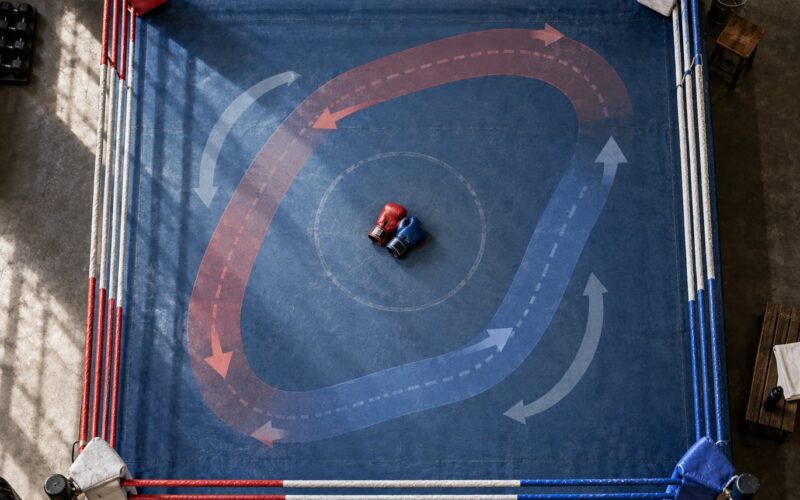
Ring position matters more than most people expect. A counterpuncher on the ropes has nowhere to slide and gets trapped into an exchange, which is a pressure fighter’s favourite outcome. So the style is built around turning the ring: walk an opponent to the ropes, pivot out, take the centre back. Cut off the exit, step away from the corner, and make him cross your lead foot.
Angling also controls what he can see. From an angle, his best punch comes around instead of straight, which slows it down, and your counters come straight off his blind side.
How Do Counterpunchers Time Their Punches?
The difference between anticipating and reacting is the whole difference between a good counterpuncher and a dangerous one.
Anticipating means starting the punch as the attack starts. You read the hip or the shoulder, you are already moving, and your punch arrives while his is still loading. This is why fighters like Bernard Hopkins could use the counter jab to stop a man walking forward: the jab came out on the step in, not after it.
Reacting means starting after the punch peaks and starts to travel home. Safer, because the gap is confirmed, and slightly slower, which is why the counter after an attack is often a fast jab or a short hook rather than the biggest punch available.
Three situations worth drilling:
- Countering a jab. Do not slip it, let it pass, and meet it with your own jab or a straight right. Parrying works too, though a parry that is too strong is an invitation for him to spin off you.
- Slipping a cross. Slip to the outside and the cross leaves him open down the same line, so your own cross goes straight down it. Slip inside and his arm is across your body, which is where the uppercut lives.
- Coming off a wide hook. A wide hook travels further, which means his weight is more committed and his recovery longer. This is the moment for the overhand or the straight right, not the hook.
One honest warning about the counter jab: it asks for timing most fighters do not have. A counter jab thrown a fraction early lands on his glove or on nothing at all, and hands your opponent a free punch at close range.
Which Punches Are Best for Countering?
Not every punch works as a counter. What you throw is decided by the evasion you used and the angle it left you with.
| Punch | Best situation | Usual evasion | Main risk |
|---|---|---|---|
| Counter jab | He walks in behind a long jab | Hold, pull, or parry outside | Being too close when the punch misses |
| Straight right | He comes forward after a missed punch | Outside slip, back step | Slipping too late and getting clipped |
| Left hook | He throws a wide right and stays square | Pivot to the outside | Coming around into his right hand |
| Right cross | He overcommits forward on anything | Slip or roll under | Rolling low into his hooks |
| Uppercut | He bends forward, or slips inside your jab | Inside slip, pull back | Missing low against a southpaw |
| Body shot | He is tall, upright and breathing hard | Slip, pivot, angle change | Crouching into a head punch |
The body shot is the most underused counter punch in the style. It costs him almost nothing in gas, it does not cost you air the way trading head shots does, and judges count clean body work the same as clean head work.
Against a southpaw the whole table flips, because a right-hander’s best outside slip goes the wrong way. Against an orthodox fighter you slip his jab to the left; against a southpaw you slip it to the right. Get that wrong once and you will be counting to eight.
How Do Counterpunchers Win Without Taking Extra Damage?
A counterpuncher who gets hit clean has thrown the punch away. Damage is not an acceptable cost of the style, so the defensive work has to come first.
Head movement beats almost everything a jab or a hook can offer. Small movement, taken before the punch is thrown, means you never get hit by it at all, and it leaves you positioned to answer instead of recovering. Slipping late to survive a punch you already saw is the version that ends up on the highlight reel against you.
The shoulder roll, best known from the Philly shell, is the highest-percentage defence against a cross and the easiest one to over-use. Rolled too often, it becomes predictable and it slows your own counters.
Parrying is the cheapest counter trigger there is because it uses almost no energy and keeps your hands ready to answer. It works best as a two-hand parry that redirects rather than a big push that turns you into a target.
Punch selection is defence too. A counterpuncher who throws twenty light counters a round and never gets hit is winning on volume of successful shots even though the output looks small.
And the rule that ties it together: the second your counter lands, you are already leaving. Reset, or the next punch is the one you eat.
How Can You Counter a Pressing Opponent?
This is the matchup that decides whether a counterpuncher’s night goes well. Beating a good pressure fighter is hard, because he does not need openings, he creates them.
What works is refusing to fight on his terms.
- Do not go backwards. Backing up hands a counterpuncher every second of the fight. Move at an angle or stand still; standing still and countering is better than retreating.
- Make him miss by moving his feet, not your head. An angle change beats a come-forward fighter far more often than a defensive roll does.
- Counter at the edge of range, not inside. At the edge, only straight punches are fast enough to land before he closes. Inside the pocket, his reach and his weight beat yours.
- Pivot away, then come back. Take yourself off the line, reset, and re-enter on your terms rather than staying where he put you.
- Use the check. Sometimes the best counter against a pressure fighter is not a counter punch at all. A jab in the face, a shoulder to the jaw, a step that stops his momentum, all of them break the rhythm the pressure depends on.
If you are getting cornered, trade. A pressure fighter will take a clean punch over a long chase every time, and giving him the punch stops the walk.
Common Counterpunching Mistakes
- Counting too late. If his fist has already gone past your ear, the counter is an exchange. Start the counter while the punch is still travelling.
- Pulling the head straight back. Pulling vertically drops your guard and leaves a target. Pull back with your chin behind your shoulder, not off your feet.
- Reaching instead of stepping. A counter thrown from a static stance has no power and no exit. Move the lead foot, then throw.
- Standing still after landing. The single most common way a counterpuncher loses a round he was winning. Step out the instant the punch lands.
- One counter, every time. Lean on the pull counter and he will start timing it and land his jab straight through. Mix slips, pulls, rolls and pivots.
- Abandoning the jab. Counterpunchers get into a habit of waiting for something big. The jab is the tool that stops him walking forward in the first place.
- Countering from the pocket. Below punching range is the worst place to try a counter. Get out, or commit to the exchange.
A Simple Counterpunching Drill You Can Practice
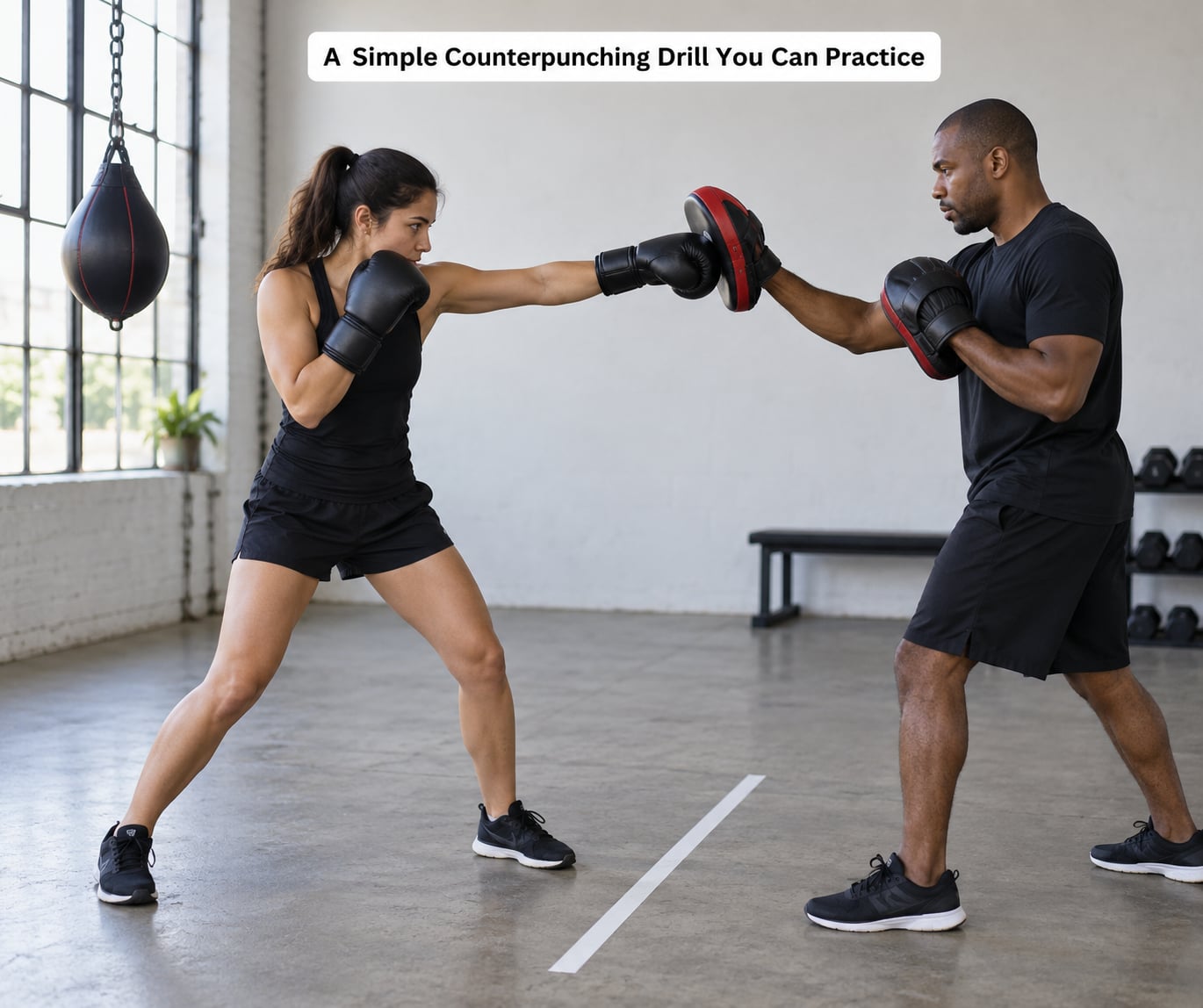
You do not need a partner who telegraphs to build this. You need structure, because the mistake most people make is shadowboxing counters without ever deciding which evasion to use.
Mark a line on the floor with tape. That line is the edge of range: you are inside it, you are at it, or you are outside it. Everything below happens relative to it.
| Stage | What you do | Checkpoint |
|---|---|---|
| 1. Slow and called | Call the evasion out loud before you do it, then counter at half speed into a bag or mitt | The evasion is right every time before speed matters at all |
| 2. Slow with commitment | Someone throws a pre-announced punch; you evade and return a jab or straight right | You land the counter without stepping in |
| 3. Competition speed | Same, but at full speed with a pause-free start | Ten counters in a row, most of them landing clean |
| 4. Distance decisions | Shadowbox the loop: hold, read, evade, counter, reset | You can name the distance before you move |
| 5. Counter-only rounds | Spar with the rule that you may not throw first | You are countering, not waiting, and you are still moving |
Checkpoint at every stage before moving on. The one that matters most is stage five, because a counterpuncher who cannot move while waiting will get trapped the first time a real opponent leans on him.
Frequently Asked Questions
Are counterpunchers better than aggressive boxers?
Neither style is better on its own, and most good boxers borrow both. A pressure fighter wins by making opponents uncomfortable at close range; a counterpuncher wins by punishing the distance they need. The matchup decides it: an accurate counterpuncher against a shifty pressure fighter can be a very hard night, because pressure denies the time the counter requires.
How do you counter a jab without getting hit?
Do not try to beat it with your own jab or your head. Read the tell, and let the jab pass while you meet it with a jab of your own, a parry to the outside, or a straight right over it. The key is deciding before it is thrown. Moving early keeps your balance and your guard; reacting late means you are already chest-to-chest when his next punch arrives.
Should a counterpuncher always wait for the opponent to punch first?
No. Waiting every time makes you predictable, and a patient opponent will happily stand in front of you and refuse to commit. A counterpuncher should mix in a jab, a feint, and the occasional counter that starts before the attack does. The style is about choosing when to be reactive, not being permanently passive.
What is the difference between countering and countering on the back foot?
Counting while moving forward is aggressive and usually beats a retreating opponent. Countering on the back foot means you are giving ground as you answer, which keeps you out of range but produces a weaker punch and can drift you toward the ropes. Most counterpunchers use the forward version from range and the back-foot version only when they are near the ropes and need the space.
Can a counterpuncher win a fight by boxing defensively?
You can win rounds, and often do, but winning a whole fight that way is difficult. Judges weigh clean punching, ring generalship, defense and effective aggression, and pure defense leaves some of those empty. The fix is not more punches thrown, it is making the defensive work visible: punching while you defend, controlling the ring, and landing a visible counter every few seconds so the round reads as work rather than absence.
How do counterpunchers counter a pressure fighter?
They refuse to go backwards, change the angle instead of retreating, and answer at the edge of range where straight punches are still fast enough to land. They mix in checks: a jab, a shoulder, a step that stops his momentum, since pressure runs on rhythm and rhythm can be broken. Nobody does this perfectly, which is why it remains the toughest matchup in the sport.
Start with distance, not the punch. Most people who want to counter want to learn the shots first, and then spend months landing counters from a stance that is already too far back to answer anything. Get the footwork right and the timing will follow far more quickly than the other way round.