Boxers walk the ring before a fight to steady their nerves, take up the space, and show the other man who he is dealing with before the first punch lands. The ritual runs from the ropes to the corner, often to the middle of the ring and back again. Very little of it is compulsory, and almost all of it is personal.
New fans usually notice the walk without knowing what they are looking at. Here is what actually happens, what each part is for, and which parts a fighter genuinely has to do.
Table of Contents
- What Is the Ring Walk in Boxing?
- Why Do Boxers Walk the Ring Before a Fight?
- How the Ring Walk Helps a Boxer Prepare Mentally
- Why Boxers Carry Robes, Belts, and Other Symbols
- How the Ring Walk Builds Crowd Energy
- Does Every Boxer Walk the Ring the Same Way?
- Common Myths About the Ring Walk
- Frequently Asked Questions
- The Meaning Behind the Walk
What Is the Ring Walk in Boxing?
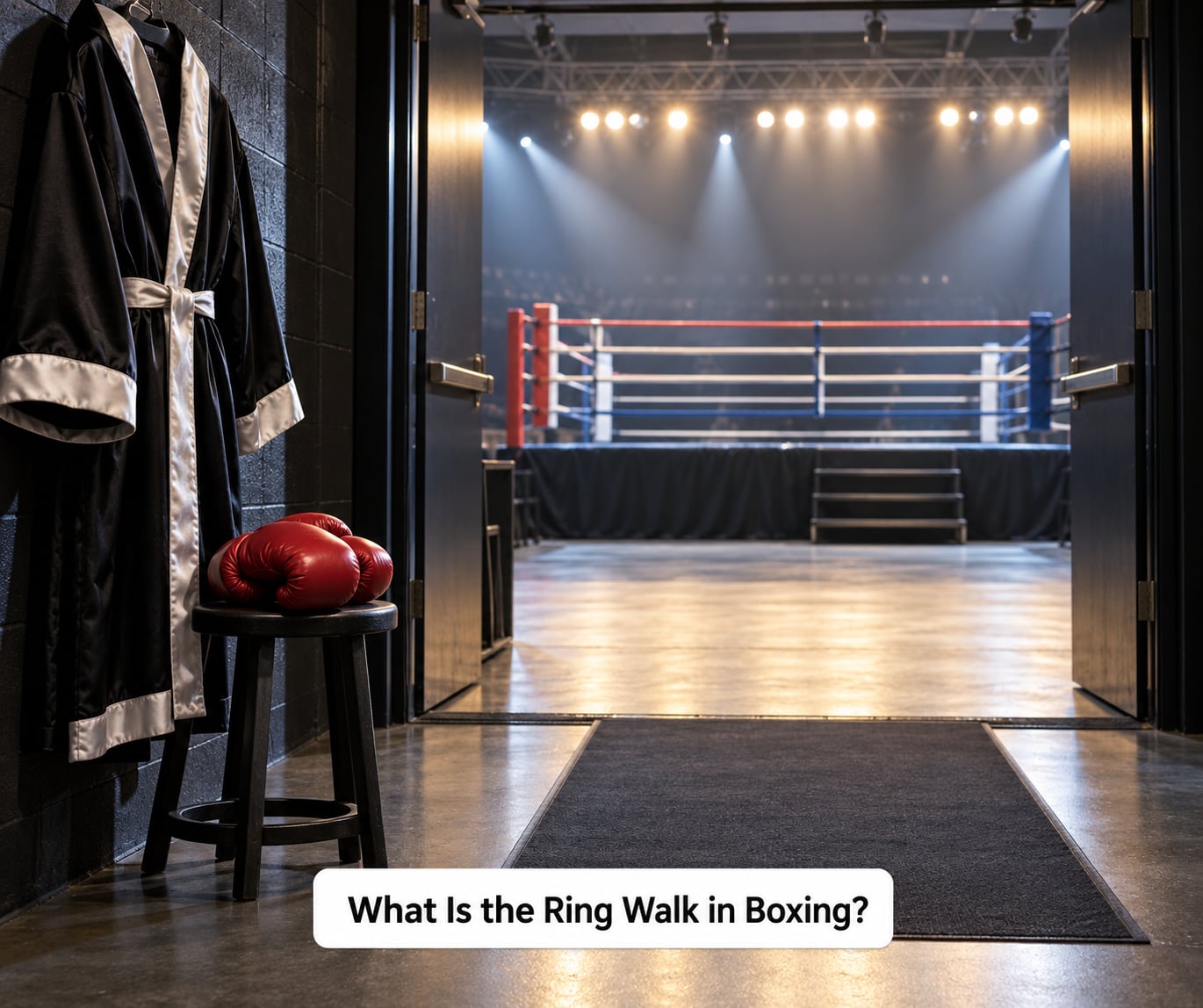
A ring walk, also called a walkout or ring entrance, is the short ceremony between a fighter leaving the dressing room area and the opening bell. It happens once per bout, after the undercard has finished and the referee has checked gloves, wraps and equipment in the fighter’s corner.
Both fighters do it. The order usually follows the bill, so the fighter on the second walk sees the first fighter already standing at his corner. The walk takes about two or three minutes including the warm-up, which is roughly a third of the ten-minute break most promoters allow before the bell.
What happens during a ring walk, step by step
- The approach. The fighter and his team come through the curtain, usually to entrance music, under the arena lights.
- Through the ropes. The fighter ducks under the bottom rope on the side of the ring, helped through by his cornermen, and steps up onto the canvas.
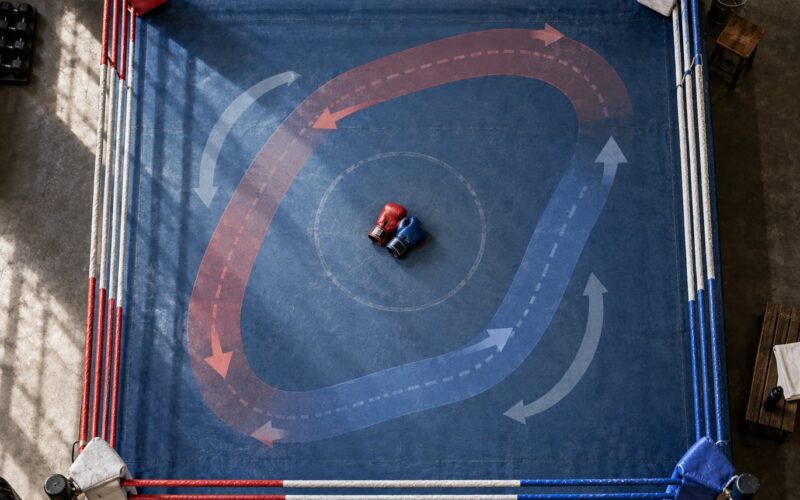
- To the corner. He walks to his corner, usually a short lap first, and his team takes the robe off, drops the hot tub, places the stool and leaves.
- Warm-up. Skip rope, shadowbox, roll the shoulders. This is the only part of the walk that is a genuine physical preparation.
- The apex. Some fighters walk to the centre of the ring, touch the ropes or the canvas, and raise a glove. Nothing in the rules requires this.
- Acknowledgement. Salutes to the crowd, to a corner of the arena, or to a specific person in the crowd.
- Back to the corner. The fighter returns, puts the stool in front of him, and the referee brings both men to the centre for the instructions.
- Instructions and the bell. The referee reads the final instruction, the fighters touch gloves and return to their corners. The bell rings and the ritual is over.
The rope step is the part people miss on television. A fighter has to bend almost double to clear the bottom rope, which looks undignified on a wide camera angle but is the only genuinely awkward part of the whole routine.
Why Do Boxers Walk the Ring Before a Fight?
The reasons run in this order: the walk settles the fighter’s head, it puts pressure on the opponent, it presents the fighter to the crowd, it gives the promotion and the broadcast something to show, and it works as a marker of time.
Reasons at a glance
- Settling nerves. A known sequence calms a nervous system.
- Shifting the mind into competition mode. Sparring and fighting feel different, and the walk marks the switch.
- Taking up space. A fighter who circles the ring makes the arena feel smaller for the man opposite.
- Reading the crowd. Noise settles a fighter. So does silence.
- Showing the audience who you are. The robe, the music and the walkout all carry a message.
- Pressing the opponent. The walk happens in full view of the man across the ring.
- Running the clock down. Ropes, apron and canvas all take real time to cross.
- Handling nerves physically. Movement and a warm-up release the adrenaline dump.
Ritual and focus
The strongest reason is repetition. A fighter who walks the same route, in the same order, with the same music, is running a routine he has run hundreds of times, and routines make a nervous body predictable. George Groves talked about centring himself during his walk, and that idea comes up again and again with fighters.
Psychological pressure on the opponent
The other fighter is standing three feet away, watching, unable to warm up properly while being looked at. A calm fighter is a problem for a nervous one, which is why the walk can feel pointed even when nobody says a word.
Presentation and showmanship
The walk is also the one piece of the night that the fighter personally controls. Everything else is decided by a promoter, a broadcaster or an opponent. The entrance is where a fighter can put a bit of theatre into an evening that is otherwise run by other people.
Warming up for the opening bell
Underneath the theatre, the skip rope and shadowboxing are real work. A boxer who walks straight into his corner and sits down has done himself no favours. Most corners treat the walk as the last five minutes of warm-up with an audience.
How the Ring Walk Helps a Boxer Prepare Mentally
A familiar walk settles concentration because the fighter knows exactly what happens next. There is a difference between nervous energy that scatters and nervous energy that has a job.
It controls pre-fight anxiety
Adrenaline arrives before the first bell whether a fighter wants it or not. Movement during the walk burns some of it off and gives it a direction, and a fighter breathing hard from skipping rope is in a different state from one sitting on a stool holding his breath.
It reinforces confidence
Walking into a bright arena with thousands of people standing up does something to a fighter’s sense of what he can handle. By the time he reaches his corner, the room has been dealt with rather than avoided.
It marks the transition from training to competing
Sparring is cooperative. A title fight is not. Fighters describe the walk as the line where the day stops being preparation and starts being the actual thing, and that shift is worth marking with a fixed routine.
It gives the fighter control of one variable
There is no control over the opponent, the venue or the judges. There is a lot of control over the walk, and taking something back before a night when almost everything is uncertain is worth more than it sounds.
Why Boxers Carry Robes, Belts, and Other Symbols
Nothing on the walk is compulsory, so what a fighter brings with him is a choice about how he wants to be seen. The items themselves mean less than what the fighter and his team put into them.
The robe
A robe keeps the fighter warm, hides the wraps, and gives the cornermen something to remove. It also frames the walk. Ali’s entrances in the 1960s and 1970s turned the robe into part of the character’s public identity rather than a piece of kit.
Championship belts
A belt carried into the ring is a statement about status, not about the fight in front of it. Defending it puts it on the line in front of everyone, which is why champions often walk with it and challengers rarely do.
Headgear, gloves and entrance gear
Coats, gloves carried in the hand, headgear and team colours all appear in the walk and none of them change the fight. They do change the picture, and on a broadcast card that plays for a minute, the picture matters.
Team colours and the second team
The cornermen who walk a fighter in, the kit they wear and the formation they hold are part of the presentation. It signals who has been in the gym all year, and the crowd reads it immediately.
Customs differ promotion by promotion and country by country. What looks compulsory in one arena is a personal habit in another.
How the Ring Walk Builds Crowd Energy
The walk is the moment the room comes up. The announcer sets it up, the music lifts it, and a calm fighter in front of a standing crowd does the rest.
Music and the walkout cue
Entrance music is the loudest lever a promoter has. Fighters have used the same tracks for decades and fans often know them before the fighter appears, which turns the first verse into a shared event rather than a broadcast cue.
The announcer and the order of the bill
The ring announcer introduces each fighter, which is what sets the crowd’s expectation of how long the walk lasts. A crowd that knows what is coming will wait; a crowd that does not starts talking before the bell.
Composure under lights
The thing the audience actually responds to is a fighter who looks calm. Nerves are visible on television and fans notice them instantly. The walk is the moment composure either shows or does not.
When the arena is empty
Entances in empty or near-empty arenas, common during the pandemic years, lost most of their charge and gained something else instead. A walk to a silent room is a strange experience, and fighters said so at the time.
Forum threads on r/Boxing and r/undisputedboxing split cleanly on one point: a controlled, short walkout reads as confidence, while an over-engineered one reads as noise. Regulars are blunt about the ones that go on too long.
Does Every Boxer Walk the Ring the Same Way?
No. The compulsory part is short, and everything after it belongs to the fighter.
What is actually required
A fighter has to be in the ring, in his corner, gloves checked, before the instructions and the bell. Some rulesets direct the fighter to a particular spot and the referee controls the final call to the centre. That is the extent of it.
Solo walks and team escorts
Some fighters walk alone and send the team out ahead of them. Others are walked in by the second team, or led by a coach, parent or sibling. A fighter entering alone is usually making a point about being alone.
Brief entrances
Plenty of fighters walk straight to the corner, do a short warm-up and sit down. It reads as businesslike rather than disrespectful, and several champions have built a career on giving the crowd very little.
Fighters who skip the ceremony
Some come out with the undercard and wait in the corner already wrapped. On televised cards this confuses new viewers, because the fight starts before the moment they think it starts.
Amateur and Olympic boxing
The walk is mostly a professional habit. In amateur and Olympic tournaments, fighters are often already in an assigned corner, warm up on the apron or in a designated area, and move to the centre when called. There is rarely an entrance team, an entrance song or a robe, and a young fan who only knows tournament boxing sees almost none of the ritual described here.
Common Myths About the Ring Walk
Most of the confusion on this topic comes from three myths that show up again and again on forums.
Myth: the walk is just for show
Partly true, and missing the point. The presentation is real, but so are the warm-up, the adrenaline release and the ritual. A fighter can be theatrically silly and still take the preparation seriously.
Myth: a good walkout tells you who will win
It does not, and the record is full of reminders. A memorable entrance has been followed by some very ordinary twelve rounds. What a walk can do is unsettle an opponent; it cannot punch for a fighter.
Myth: every fight has the same walkout
There is no single fixed routine. Every element beyond getting to the corner is chosen by the fighter or the promotion, and a great many fighters deliberately keep the ceremony short.
Myth: fighters walk the ring to scout their opponent
This one persists because the walk looks like an inspection. A lap around the ropes gives a fighter a feel for the surface and the ropes’ tension, but nobody is looking for weaknesses out there. The scouting happens with the hands wrapped and the eyes on.
Frequently Asked Questions
What is a ring walk in boxing?
A ring walk is the short ceremony a boxer performs before the opening bell: coming through the ropes, circling to the corner, warming up, sometimes touching the ropes at the centre of the ring, and returning to the corner for the instructions. It is part ritual, part warm-up and part performance.
Why do boxers go in and out of the ring?
A boxer enters through the ropes because the ring is raised above the floor, and leaves it the same way once the fight is over. The other trips in and out during the round are tactical: leaving the ropes to reset foot position, then backing into them to rest and to escape.
Is the ring walk part of the rules of boxing?
Only in a small part. Rules generally require a fighter to be in his corner with gloves checked before the instructions and the bell, and they control where fighters stand for those instructions. The robe, the music, the walk to the middle of the ring and the salute to the crowd are all personal choice.
Why do boxers wear robes or hoods before a fight?
A robe keeps a fighter warm before the bell, covers the hand wraps, and gives his corner something to remove as part of the routine. Fighters also use it as a prop, which is why robes and hoods became part of the entrance tradition rather than just a piece of kit.
Does the ring walk affect the outcome of a fight?
There is no way to measure it, and memorable entrances have followed plenty of quiet losses. Fighters do describe the walk as a way to settle their own nerves, and calm on the way in can unsettle the man across the ring. Treat it as a tool, not a prediction.
What do boxers do in their corner before a fight?
They finish the warm-up, get the stool set, take instruction from the cornermen and settle in for the instructions. Once the bell goes, they turn to face the fighter at whatever angle the referee indicates, usually with a raised glove to start.
The Meaning Behind the Walk
Why boxers walk the ring before a fight comes down to three things: the fighter needs a routine that works, the opponent needs to know he is being watched, and the room needs something to cheer. The robe and the music are decoration on top of a practical warm-up and a private habit that most fighters repeat for years.
If you watch the next walkout with that in mind, notice where the fighter looks first, how long he stays at the ropes, and what he does before he sits down. Then watch the bell. Everything else was preparation for those twelve minutes.