Why volume punching wins decisions comes down to one structural rule: under the 10-point must system, a judge has to award every round to somebody. A fighter who lands more clean punches and controls more of each round’s three minutes is simply far more likely to be named that round’s winner. Volume matters only when it arrives with accuracy, positioning and clean contact.
The complaint you hear in forums is that judges reward busy fighters over the ones landing the shot that hurt. Sometimes that is exactly what happens. More often, the fighter with the higher punch count created the pressure that produced the fight’s best punches, and nobody can tell where the volume stopped and the quality began.
Table of Contents
- What Does Volume Punching Mean in Boxing?
- How Do Judges Score a Boxing Fight?
- Why Volume Punching Wins Decisions
- Punch Output vs. Punch Accuracy: What Judges See
- How Volume Punching Forces an Opponent to Respond
- The Role of Clean Punches and Visible Damage
- Why High Punch Volume Can Backfire
- How Boxers Can Use Volume Without Taking Unnecessary Risks
- What Stats Measure Volume, and What They Miss
- How to Tell Whether Volume Is Affecting the Scorecards
- Frequently Asked Questions
- Does throwing more punches automatically win a boxing fight?
- What is the difference between punch volume and accuracy in boxing?
- Can a fighter win by throwing lots of jab punches?
- Why do punch statistics differ from the judges’ scorecards?
- Is a flurry better than landing one powerful punch?
- How do judges value body punches compared with head punches?
- Conclusion: Look Beyond the Throw Count
What Does Volume Punching Mean in Boxing?
Volume punching means throwing far more punches than the average fighter over the course of a round and a fight. Those punches come in flurries, three- and four-punch combinations, and sustained forward pressure rather than one isolated shot at a time.
Two numbers get mixed up constantly. Punches thrown is a volume measure. Punches landed is a quality measure. A fighter can throw 100 punches and land 35 of them; another can throw 55 and land 40. The first fighter looks busier, the second fighter may have won more rounds, because judges score what reaches the opponent, not what leaves the glove.
Three subtypes fans actually use
A long-running Sherdog forum thread on volume punching versus pot shots separates the style into outside pressure, inside swarmers and combination punchers. The distinction matters because the risk profile is different for each. Amir Khan and Oleksandr Usyk illustrate outside pressure, Joe Frazier and Antonio Margarito the inside swarm, and Canelo Alvarez and Evander Holyfield the combination middle ground fans insist is its own category.
How Do Judges Score a Boxing Fight?
Boxing is scored round by round, and the totals are added at the end. Each judge keeps a card. A three-judge panel watches from three different positions in the arena, which is one reason two judges can hand out very different cards for the same fight.
The core rule is the 10-point must system. For a typical round, the judge gives the winner 10 points and the loser 9. A judge may not score a round 10-10 unless the action was genuinely even, and that option is used sparingly. Rounds where a knockdown or sustained dominance occurs can be scored 10-8. A twelve-round fight decided 116-112 means the winner took ten rounds and the loser two.
Four official criteria sit underneath those numbers, drawn from the Association of Boxing Commissions guidance that state commissions work from:
- Clean punching — how many punches land with power and accuracy, and how much damage follows.
- Effective aggression — pressing the action versus being forced backwards, and whether the pressure creates openings.
- Ring generalship — who controls distance, cuts off the ring and dictates where the fight happens.
- Defense — avoiding punches, blocking, rolling, slipping and sliding out of range cleanly.
Judges are told which shots landed and which missed, but only in their own heads and only from ringside. The referee does not keep the scorecard.
Why Volume Punching Wins Decisions
Here is the direct answer. Volume punching wins decisions because the 10-point must system converts sustained output into won rounds. Every round needs a winner, a narrow margin is still a win, and a fighter who out-works an opponent across three minutes gets that round far more often than not. Five mechanisms do the work:
- It manufactures the round winner. A judge who watched two rounds of near-equal punching has to pick one. The fighter who threw far more meaningful shots is the safer pick, and safer picks win cards.
- It forces defensive reactions. Pressure makes opponents shell up, grab, clinch and roll. A fighter holding a glove to the temple is not out-boxing anyone, and judges read that posture as losing the round.
- It shortens the counterattacking window. A counterpuncher needs you to miss. The more often you extend yourself, the more chances that window opens.
- It accumulates. One round can be lost and recovered. Twelve rounds of small advantages compound into a wide decision on all three cards.
- It creates visible damage over time. Repeated clean body and head shots compound in a way one hard punch simply does not.
The arithmetic is unglamorous. A split second on a round’s tally is the whole difference between a round won and lost, and output is the most reliable way a fighter creates that margin.
Punch Output vs. Punch Accuracy: What Judges See
This is where the argument breaks down, because fans track a different number than judges do. Punch totals live on BoxRec and CompuBox; the scorecard lives in three officials’ heads.
| Measure | What it tracks | What judges actually weigh |
|---|---|---|
| Punches thrown | Raw output, the volume figure | Almost nothing on its own |
| Punches landed | Connect rate, roughly landing percentage | Weight, damage, location of the shot |
| Clean punches | Shots that land without a block or glove catch | The single most important counting input |
| Power shots | Punches with visible effect on the receiver | Can outweigh volume in a single round |
| Ring control | Who set the distance and forced the action | Ring generalship, a named criterion |
| Defense | Slips, rolls, blocks taken | A full criterion, and the volume puncher’s risk |
Note the asymmetry in row one and row three. The number fans argue about is the one that matters least.
How Volume Punching Forces an Opponent to Respond
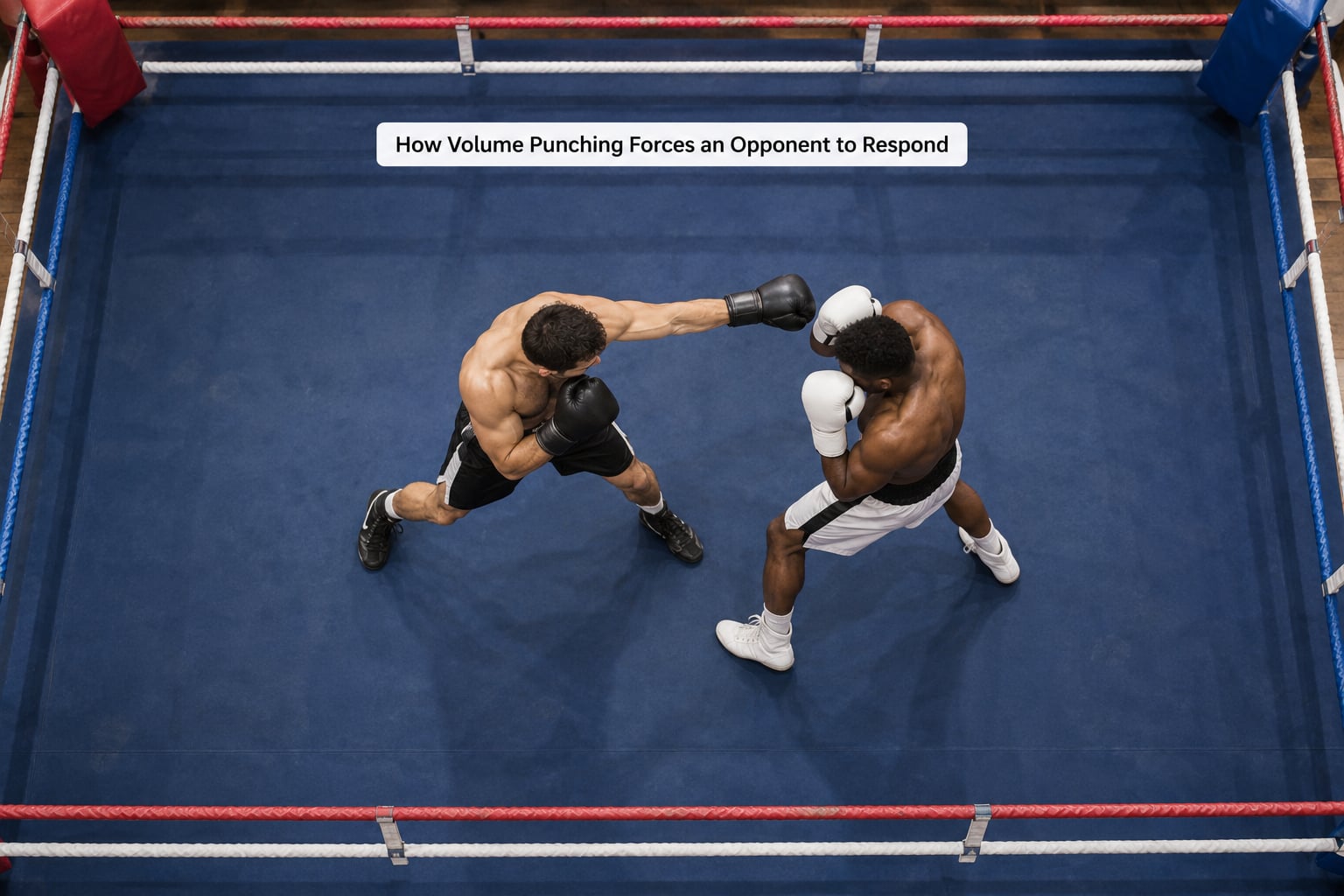
Sustained output is not just an accumulation of punches. It changes what the opponent is physically able to do. A fighter under constant forward pressure cannot circle away easily, cannot set his feet for a counter, and cannot pick his moments.
That is why a volume puncher often wins rounds he is landing fewer damaging shots in. The opponent’s only reliable answer is to give ground and cover up, and covering up scores nothing. The pressure fighter then gets a round he did not earn with power, he earned by removing the opponent’s choices.
Watch what happens to distance over three minutes. A pressure fighter who starts at long range with the jab, follows with the cross and steps inside with the hook has effectively decided the terms of every exchange that follows.
The Role of Clean Punches and Visible Damage
Clean punching is the bridge between volume and points. A punch that lands on the shoulder, the glove or a raised elbow is recorded as a punch, but judges are told to discount it. A punch that snaps a head back is not.
The best volume punchers mix speeds and levels in the same exchange. Lomachenko’s flurries often opened with a jab that looked like a rangefinder and ended with a body hook the opponent never saw coming. That combination of soft and hard is what keeps a high work rate from reading as harmless.
Damage over rounds compounds too. A body punch that visibly affects an opponent’s breathing changes the next round as much as a head shot, and judges watch for a fighter whose movement and posture deteriorate while the volume fighter’s do not.
Why High Punch Volume Can Backfire
Volume punching loses fights in predictable ways, and the honest version of this guide needs to say so.
Missed punches come back. Every extended punch is a commitment with a recovery time. Juan Manuel Marquez’s knockout of Manny Pacquiao in the fourth round of their 2012 fight is the canonical case: the volume was landing, and one counter through the middle of the flurry ended it.
Fatigue is cumulative. Thrashing out 100 punches a round is a cardio problem before round eight. Dmitry Bivol versus Artur Beterbiev in 2024 showed the other end, where the pressure fighter’s output was matched and eventually outlasted.
Flurries can hide a bad shot. Ten soft punches and one hard one is a bad trade if the opponent is a genuine knockout artist. Bernard Hopkins made a career out of letting opponents fill the space in front of him.
Style shifts get misread. A fighter who used to swarm and now throws fewer punches is usually changing tactics or aging, and fans often read it as a decline in ability that never happened.
How Boxers Can Use Volume Without Taking Unnecessary Risks
Volume is a skill, not a personality trait. These are the mechanics that make it survivable.
- Work behind the jab. The lead hand holds the distance and the attention. Punches thrown behind it rarely arrive as clean counters.
- Vary the level. Head, head, body, head breaks the timing a counterpuncher is reading.
- Use the angle of approach. Stepping off the line turns a straight-ahead exchange into one where the reply has to travel further.
- Cut the ring early. A pressure fighter who lets an opponent bounce out to the neutral corner has given away the round.
- Count your exits. Finish combinations with your hands back and your feet moving out of range, not with a fourth punch nobody needs.
- Keep a guard. Defense is a scored criterion and it is the thing a swarmer sacrifices first.
Amateurs chasing a higher punch count usually lose on the exit step. Rushing back to range with the chin up costs more than the extra punch gains.
What Stats Measure Volume, and What They Miss
CompuBox and BoxRec count punches thrown and landed per fighter, and both are useful with the right caveat: they do not weigh power, do not track how a punch landed, and do not know what happened immediately afterward.
The 80/20 rule refers to roughly four of five punches missing. Below that connect rate, volume is mostly noise. A fighter landing 40 percent of a hundred punches is doing something genuinely dangerous; a fighter landing 20 percent of a hundred is mostly setting up his opponent’s counters.
Fans also get caught by a mismatch of styles. A thread on r/Boxing pointed out that Floyd Mayweather, rarely described as a volume puncher, threw significantly more punches than Miguel Cotto in their 2015 fight, because Cotto kept walking forward and Mayweather kept answering. Total output tracked the fighter who was under more pressure, not the one applying it.
So a punch-stat advantage is a question, not a verdict. The way to use it is to ask what the fighter did with the punches: at what distance, from which stance, with what visible effect on the opponent’s face and body.
How to Tell Whether Volume Is Affecting the Scorecards
You cannot read a scorecard live, but several on-screen signals tell you whether output is registering.
- The opponent’s guard is high and their feet stop moving.
- Clean shots are snapping heads back rather than landing on gloves.
- The pressure fighter controls the center of the ring instead of chasing.
- The opponent’s output drops noticeably after the flurry exchanges.
- The referee steps in more often for holding and clenching, which drains the round.
- Late in the fight, the busy fighter still looks fresh while the other one is grinding.
If none of those show up, the volume is decorative.
Frequently Asked Questions
Does throwing more punches automatically win a boxing fight?
No. Volume only wins when it produces clean, accurate shots or takes options away from the opponent. A fighter who throws a hundred punches a round and lands a fifth of them often loses to a cleaner boxer who lands half of what he throws. The must-award-a-round-winner rule rewards whichever fighter actually did more in each round, not whoever was busiest.
What is the difference between punch volume and accuracy in boxing?
Volume is the number of punches thrown. Accuracy is the share of those that land cleanly, usually expressed as a connect rate. They are independent: a swarmer can have high volume and poor accuracy, a counterpuncher low volume and high accuracy. Judges reward landed clean punches, so volume only matters when it feeds accuracy or forces a defensive response.
Can a fighter win by throwing lots of jab punches?
Yes, if the jab controls distance and sets up the punches that hurt. Judges credit effective aggression, and a lead hand that keeps an opponent from setting their feet is doing real work. A fighter throwing dozens of soft jabs while eating counters is not scoring, though, because the shots lack weight and the defense is failing.
Why do punch statistics differ from the judges’ scorecards?
Punch statistics count thrown and landed punches without weighing power, accuracy of placement or defensive work. Judges score four criteria per round: clean punching, effective aggression, ring generalship and defense. A fighter can out-throw his opponent and still lose rounds where he was pushed onto the back foot and landed mostly on gloves.
Is a flurry better than landing one powerful punch?
Neither is automatically better, and they answer different questions. A flurry accumulates damage and removes options over three minutes, which is how fights are won on the cards. One powerful punch can end a fight outright, but judges score rounds rather than moments, so a fighter who wins no rounds with a single shot still loses the decision.
How do judges value body punches compared with head punches?
Body punches count when they land cleanly and visibly affect the opponent, and judges are trained to notice a fighter whose breathing, posture and movement degrade. Head punches get the attention because the damage is easier to see, but a body punch that stops an opponent from throwing at all has done more for the round than a head shot that slid across the temple.
Conclusion: Look Beyond the Throw Count
Volume punching wins decisions because the must-award-a-round-winner rule turns sustained, accurate output into rounds, and rounds become decisions. The punch total is the least interesting part of that equation.
Watch three things when you sit down with a fight: which punches land clean, who controls the distance, and whether the busy fighter can still defend when the other man loads up. Those three answers tell you more about the cards than any punch-stat page.