Punch stats can mislead you because they count punches thrown and recorded as landed, not punches that hurt, changed the round or won it. A fighter can be out-landed across twelve rounds and still win every round that mattered, and the stat sheet will never explain why.
Every broadcast recap ends with the same two lines: total punches landed and connect percentage. Read alone, those numbers invite a conclusion the numbers cannot support. Below is what the counters actually record, where they break, and how to read them without fooling yourself.
Table of Contents
- What Do Boxing Punch Stats Actually Measure?
- Why Punch Stats Can Mislead You
- Seven ways punch stats lose the fight
- 1. Feints and measuring hands get counted as throws
- 2. Blocked, parried and shouldered shots get counted as landed
- 3. Grazes count the same as clean shots
- 4. One person sees each fighter
- 5. Nothing gets corrected after the bell
- 6. Fight totals erase the round-by-round story
- 7. Scoring is not arithmetic
- The case where the totals described the opposite of the fight
- What Do High Punch Totals Reveal?
- Does a High Connect Percentage Make a Boxer Better?
- What Are Power Punches and What Do They Miss?
- Why Does Punch Volume Need Context?
- Should You Trust Punch Statistics?
- How to Evaluate a Fighter’s Punching Numbers
- Frequently Asked Questions
What Do Boxing Punch Stats Actually Measure?
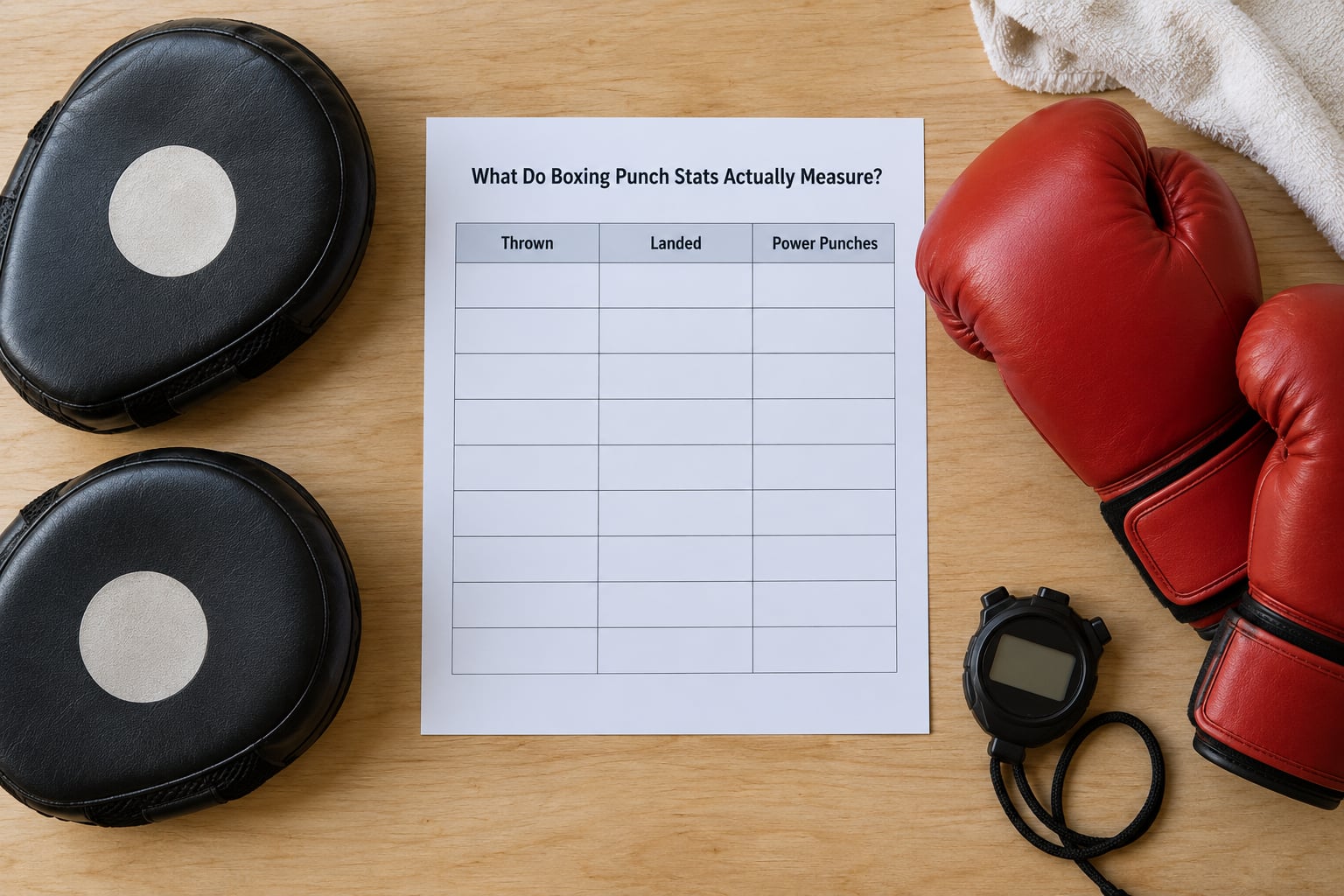
The headline figure is punches landed divided by punches thrown, usually printed as a percentage. Alongside it you get a jab line and a power punch line, and most modern tables split the fight into rounds.
Everything in that table comes from ringside operators, not from a camera. Under the standard Compubox method, two operators sit at ringside, each watching one fighter, and each has four keys: jab connect, jab miss, power punch connect, power punch miss. They press one of them for every punch they judge, in real time, and the software totals it up.
That design is the whole story. The system records volume and location of contact as a human eye can see it live. It does not measure force, damage, whether a punch changed the tactical situation, or how much a fighter gave up to land it.
| What punch stats record | What they cannot record |
|---|---|
| Punches thrown and punches counted as landed | Force, damage and cumulative wear |
| Jab versus power punch classification | Whether a connect was clean, deflected or a graze |
| Connect percentage as a thrown-to-landed ratio | Punch selection and intent |
| Per-round splits | Ring position, cut-offs and defensive work |
| A running total across the contest | Which round a fight was actually decided in |
Keep that table in mind for the rest of this article. Almost every complaint about punch stats traces back to the left column being read as if it were the right one.
Why Punch Stats Can Mislead You
Here is the direct explanation. Punch stats compress selective, situational actions into flat totals. A hand that pokes out to measure range, a shoulder roll that turns a punch into nothing, a jab thrown purely to keep the opponent honest and a clean hook that snaps a fighter’s head back all become one entry, because the operator pressed one of four keys.
Consider a hypothetical exchange. A fighter misses a jab, lands a jab on the shoulder of a fighter leaning away, gets a parried hook counted as a connect, then lands one clean right hand that visibly snaps the opponent onto the ropes. Four events, four entries, and the one that mattered sits beside three that did nothing.
Seven ways punch stats lose the fight
1. Feints and measuring hands get counted as throws
A fighter extends a hand to find where the opponent’s guard is. That is useful boxing and it is not a punch. It still looks like a thrown punch to an operator working at full speed, so output figures quietly inflate.
2. Blocked, parried and shouldered shots get counted as landed
A punch that hits a raised glove, gets parried onto the shoulder pad or gets rolled off a body leaning may or may not register as a connect depending on what the operator saw. A landed total can therefore describe a fighter who was getting hit and doing nothing with it.
3. Grazes count the same as clean shots
There is no gradation in the entry system. A fingertip catching the brow as the head turns away occupies the same slot as a straight right hand landing flush.
4. One person sees each fighter
Each operator watches one fighter, which means a punch thrown while out of the operator’s line of sight can be missed or assigned to the wrong fighter. There is no second camera angle reconciling the two views.
5. Nothing gets corrected after the bell
The count is made live and stands. There is no replay pass where a disputed exchange is rewatched and revised, which is the opposite of how every other disputed call in boxing gets handled.
6. Fight totals erase the round-by-round story
A twelve-round total is an average. A fighter who was hurt in rounds two and three and dominated from four onwards can finish with a respectable aggregate that hides the only two rounds anyone will argue about.
7. Scoring is not arithmetic
Judges score under the 10-point must system with three judges, and there is no 10-10 round available to them. Two near-even rounds must still produce a winner, so even punch totals get resolved along lines that have nothing to do with punches landed.
The case where the totals described the opposite of the fight
The most discussed example is Mayweather against Pacquiao in 2015, and the reason it matters is that the disagreement is documented rather than asserted. After watching the fight, poster Tarkus on the BoxRec forum recounted round one at 41 punches thrown by Mayweather and 20 by Pacquiao. The Compubox figures for that same round were 36 and 20. Another poster put the Mayweather round-one total at 54.
A second poster, Coachmanager, counted landed punches for all twelve rounds and got 72 for Mayweather against 62 for Pacquiao. That is nowhere near the official line, and it is not a claim that either count is correct. It is a demonstration that three competent people watching the same rounds produce three different sets of numbers.
The thread’s lasting point was not that one tally was right. It was that Compubox figures are one more set of error-prone human opinions, and that the recurring answer people reached for after recounting was effective aggression, ring generalship, clean punching and defence. None of those appear in a punch stat line.
What Do High Punch Totals Reveal?
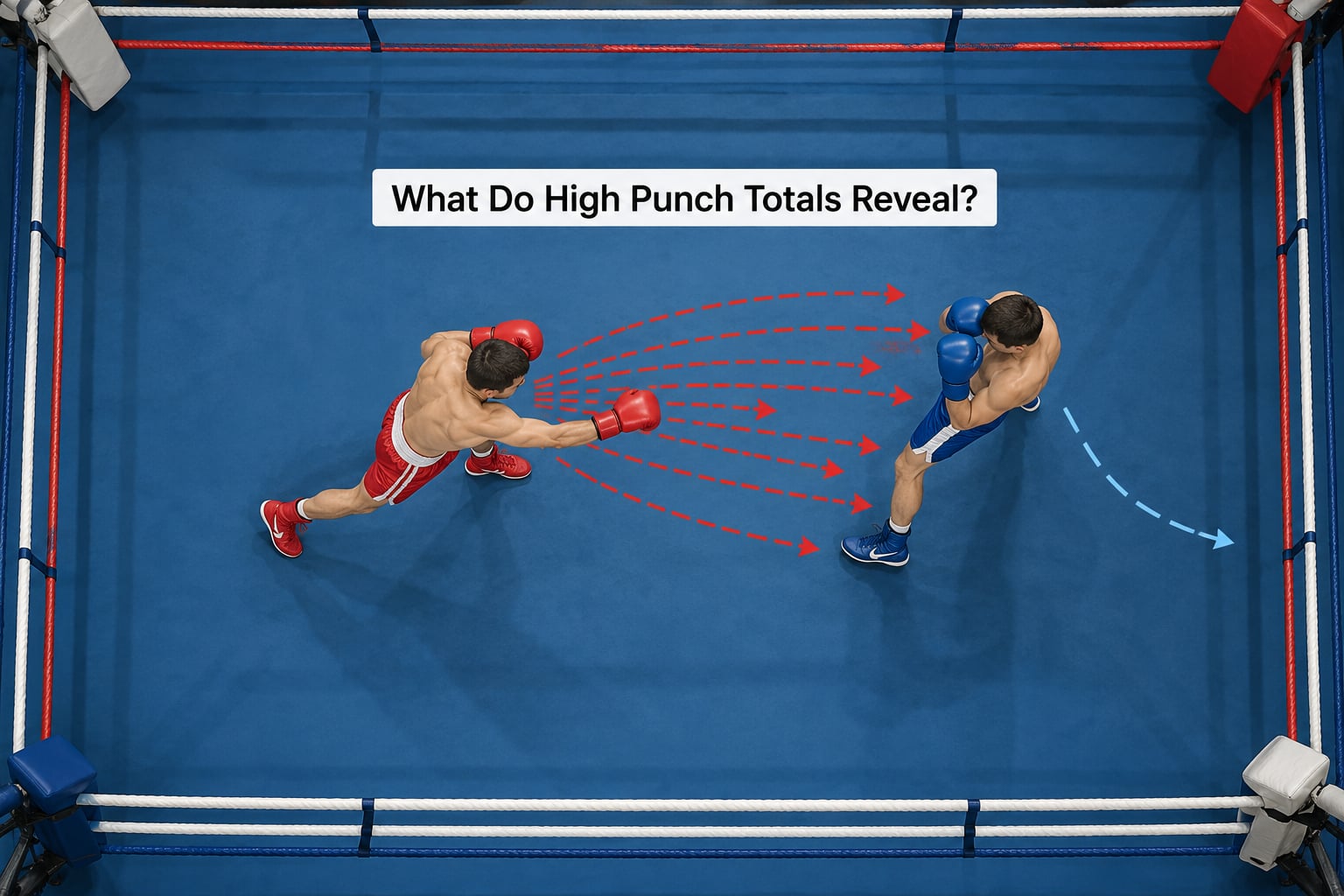
A high punch total tells you something real and narrow: the fighter was busy. They were willing to engage, they spent time in forward positions and they were not playing keep-away. That is worth knowing.
What it does not tell you is whether the work was accurate, whether it landed in places that mattered, or whether the fighter was giving anything away to do it. Volume can be the product of good work or of a fighter throwing harder because the plan has stopped working.
There is also a style bias buried in the number. Output stats favour whoever spends more time in range. A counter-puncher who sits behind a jab and answers with a hook every time a rush comes in can control a fight with a fraction of the volume and end up on the wrong side of the landed total.
Fatigue decay matters too. A high-volume fighter’s numbers typically fall apart in the last two rounds, and the stat line rarely shows whether that decline was tactical or physical.
Does a High Connect Percentage Make a Boxer Better?
Connect percentage is a genuine efficiency measure, but it measures efficiency of the counting system as much as efficiency of the fighter. A high number can come from throwing fewer, safer punches, from fighting at long range where a shoulder roll stops the counting, or from a jab that connects often and does almost nothing.
Opponent style changes the figure completely. A fighter who stalks behind a high guard faces a low connect rate no matter how well he fights, because the guard is doing the work. A percentage taken across different opponents is not a skill measurement.
The range question matters as much as the opponent. Accuracy recorded at long range and accuracy recorded on the ropes are different measurements, and the stat line never tells you which one you are looking at.
What Are Power Punches and What Do They Miss?
A power punch in the counting system is any non-jab punch. That is the entire definition, and it explains most of what the category gets wrong.
A looping right hand that misses everything gets a power punch miss. A short hook into a high elbow guard can register as a power punch connect. Both live in the same column, so the power punch line measures how often the counting convention was applied, not how much damage a fighter did.
Damage also sits outside the system by design. Clean contact on the chin, body shots that steal a round, cumulative wear across a shoulder, an arm that stops working after round four, none of these are tracked. They show up as movement, in the scorecard, or in a corner decision, and they never show up in the numbers.
Whether a punch changed the tactical situation is the most useful thing to know and the least available one. The stat line cannot tell you that the fighter who was winning on the cards had already stopped throwing the punch that was winning it.
Why Does Punch Volume Need Context?
Productive output and wasted output produce identical entries. The difference only becomes visible when you split the fight into rounds and set what each fighter landed against what each fighter conceded.
Round level is the first fix. A round-by-round table shows you where a fight turned. Momentum swings, a round where one fighter landed five and conceded twenty, an opponent who slowed down after getting hit in the body, all of that disappears in a twelve-round sum.
Plus and minus splits are the second. Where they exist, they show the gap between what each fighter landed and what they ate, which is much closer to how a round is judged than raw landed totals.
Range and defensive pressure are the third. A pressure fighter working inside walks into counters, so high output and high risk travel together. A fighter who blocks, rolls and uses distance will show fewer connects and give away less.
Opponent quality is the fourth and the one people skip. A volume figure from a contest against a passive opponent and a volume figure from a contest against a relentless one are not the same measurement, and most stat lines are compared anyway.
Should You Trust Punch Statistics?
Trust them as a log of activity, not as a verdict. A punch stat line is a reasonably honest account of how often a punch was thrown and how often one appeared to land, produced quickly under pressure by a human being. That is a narrow, useful thing.
The numbers hold up well for comparing jab volume across a fighter’s own recent contests, for spotting a decline in output across rounds that might point to fatigue or damage, and for understanding which fighter chose to fight forward more often.
They hold up badly for deciding who fought better, for predicting what happens next against a different style, for judging punch quality, and for anything that depends on a single disputed exchange. For those questions the round-by-round splits, the scorecard and the fight itself are better evidence.
Our view after working through these numbers is simple. Punch stats are an input to an argument, and the argument is where they belong.
How to Evaluate a Fighter’s Punching Numbers
Before watching a fight, read the stat line with this checklist in mind.
- Check who produced the numbers. If the line does not say who counted it or how, treat it as decoration.
- Split jab from power punch. A total dominated by jabs describes a different fight than one dominated by heavy shots.
- Look at the round splits, not the total. The middle rounds decide most fights.
- Read the connect percentage against the opponent’s guard. A low number against a high guard is not a failure.
- Ask what the fighter gave up. Rushing creates counters, and counters do not appear in an output column.
- Look for plus and minus. Where available, the landing-to-concession gap is more meaningful than landed punches alone.
- Watch the fight. Punch stats describe attempts. Only the fight describes what happened.
And if a stat line produces a strong feeling about a fight, that is the moment to be most careful. Statistics get used to justify conclusions that were decided before the numbers arrived.
Frequently Asked Questions
How does CompuBox count punches?
CompuBox uses two ringside operators, each watching one fighter, with four keys per punch: jab connect, jab miss, power punch connect and power punch miss. They press a key in real time as each punch happens, and the software compiles totals, connect percentage and round-by-round splits. There is no slow-motion correction pass afterwards.
Are CompuBox stats accurate?
They are a good-faith human count made live, not a verified record. Operators can misjudge grazes, blocked or shouldered shots, and punches thrown out of their sightline, and nothing is corrected on replay. Fans who recount rounds in slow motion regularly reach different totals from the official figures on the same rounds.
What is the 10-8 round in boxing?
A 10-8 round is a dominant round that one fighter earns convincingly. Ten-point rounds are common, but judges do not award 10-8 rounds often, and they have no 10-10 option at all. That means near-even rounds still produce a winner, decided on ring position, ring generalship and damage rather than on punch totals.
Does landing more punches mean you won the round?
Not on its own. Landing more punches without landing anything clean, without controlling range and without avoiding counters can describe a fighter who lost the round. Judges weigh clean punching, effective aggression, defence and ring control, and none of those appear in a punch total.
Why do punch stats favor counter-punchers?
Output counts favour whoever spends more time forward. A counter-puncher answers rushes from behind a jab, so a smaller share of their punches get thrown and a smaller share of their opponents’ punches come back. They can control a fight with far less volume and still finish behind on landed punches.
Start with context, not the biggest number. The landed total is a log of attempts, so read it alongside the round splits, the jab and power punch lines, what the fighter conceded and what the scorecard did. That is how punch stats can mislead you, and it is also how they become useful.