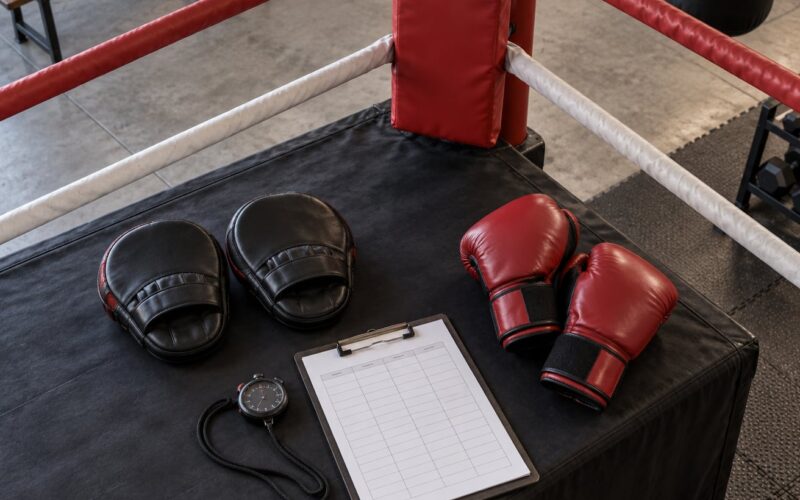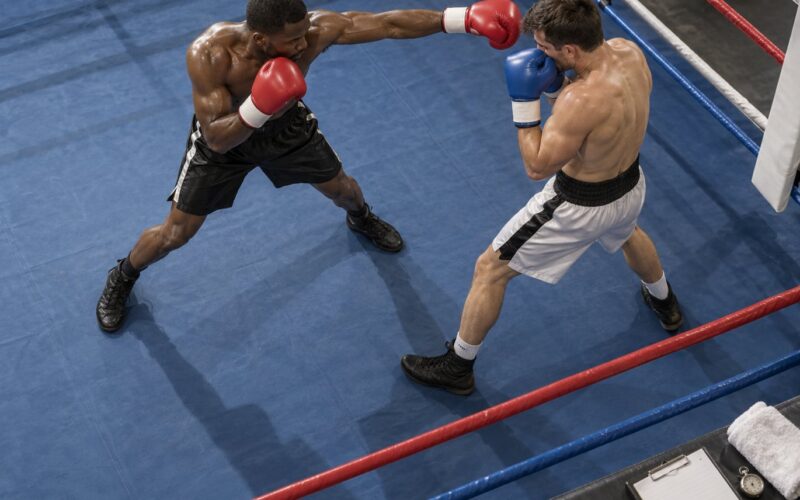
Why staredowns matter to promoters is simpler than the sport’s critics think: a face-off is the cheapest hype a promotion can buy, and it costs nothing but fifteen seconds of ring time and a camera in the right place. Two fighters stand nose to nose, the room goes quiet, and a bout that may have had no personal history at all suddenly has an image with a face on it. That image then does the work of a whole marketing campaign.
The ritual is not decoration. It is a repeatable content format, a matchmaking signal and a legal risk, and understanding why it works explains a lot about how boxing gets promoted in 2026.
Table of Contents
- What Is a Staredown in Boxing?
- How a Staredown Builds Event Interest
- Why Staredowns Matter to Promoters
- How the Staredown Shapes Fighter Psychology
- How Promoters Turn a Staredown Into Promotion
- When a Staredown Creates Problems Instead
- How Promoters Can Measure Whether the Staredown Worked
- Seven Lessons for Promoting a Responsible Staredown
- Frequently Asked Questions
- What is the purpose of a staredown in boxing?
- Are staredowns required for a boxing bout to be official?
- Can a promoter order two fighters to stare each other down?
- Why do boxers stare down before touching gloves?
- When should a promoter stop a staredown for safety?
- Do staredowns actually increase boxing ticket sales?
- Conclusion
What Is a Staredown in Boxing?
A staredown, also called a face-off or a square off, is a staged confrontation in which two fighters stand inches apart and hold eye contact for the cameras. It is not a fight, it is not regulated as one, and nothing in the rules requires it to happen.
It comes in three versions, and promoters use all three. The press conference face-off happens days out, usually in front of a sponsor backdrop, and is where the biggest reactions tend to occur. The weigh-in face-off is the formal one, held after both fighters make weight, where commission officials stand close because the temperature is at its highest. The media day version is looser, filmed for short-form video, where a fighter might be mid-sentence when the other walks past.
Boxers stare at each other for the same reason they tap their forehead before the bell. It is a private ritual, and it gives a fighter something to do with his focus in the seconds before contact.
How a Staredown Builds Event Interest
The reason it outperforms a speech is that it compresses. A two-minute answer to a reporter’s question needs context, and most viewers never hear it. A face-off needs none. Two men, silence, a raised voice or a shove, cut to a black screen.
Stillness is the part promoters underestimate. A fighter leaning in without speaking looks controlled; the same fighter shouting for fifteen seconds looks unhinged. The quiet version travels better because a viewer can project their own dislike onto it.
Then there is reusability. One 15-second clip produces a headline photograph, a vertical video for social, a freeze-frame for a poster, and a GIF that a fight account can post the next morning. Most of that material is filmed once and cut four ways, which is why a small promotion can look like it has a marketing department.
Why Staredowns Matter to Promoters
Why staredowns matter to promoters comes down to one commercial fact: they convert a scheduled bout into a story with an antagonist, and they do it in front of a camera at effectively zero production cost. The Nevada Athletic Commission’s executive director Bob Bennett said it plainly when he blocked the Wilder-Fury weigh-in face-off in 2020, explaining that “the face-off is used to build last-minute interest in the bout” and acknowledging the cost of removing it.
What a promoter actually gets from a staredown:
- Last-minute demand. A buzzed clip in the final 48 hours is one of the few things that still moves a purchase decision made at the supermarket checkout.
- A photograph. Wire services and social accounts need an image, and a face-off is the easiest one on fight night to obtain.
- A headline when the fight itself does not deserve one. When the matchup is technically interesting but emotionally flat, the face-off supplies the headline the promotion needs.
- A running narrative for a quiet fight week. Undercard announcements and matchmaker comments give broadcasters something to fill.
- Sponsor value. A partner logo sitting under a face-off clip gets a fraction of the reach of a scripted introduction.
- A rematch hook. If the confrontation survives to the final bell, the next one writes itself.
None of that is sentiment. It is inventory, generated in real time, that a promoter can carry through the final week.
How the Staredown Shapes Fighter Psychology
For the fighters, the face-off is not primarily a media event. It is a read on the other man, conducted in public and without gloves.
Confidence shows immediately. A fighter who steps back early has decided the other one is not worth the proximity. A fighter who leans in and holds it is telling the room, and himself, something useful.
Intimitation works the other way as well. A promoter who wants an undercard to feel dangerous can pair two fighters who visibly react to each other at the weigh-in and let the crowd do the work of making it matter.
Focus is the quiet part. Fighters report that the seconds before a staredown sharpen attention, the same way a pre-bout ritual does. It resets the mind from the noise of a busy fight week.
Using a Staredown Well, and Where to Draw the Line
A promoter gets the most from this ritual when the tension is real and nobody has to manufacture it. Let two fighters who dislike each other stand still and let the silence do the work. What rarely helps is prompting, goading, or putting a microphone between two men in a small room with cameras rolling.
Aggression should never be encouraged. The person who benefits from an escalation at a press conference is the promotion’s media team, and the people carrying the consequences are the fighters and the venue staff. Promoters who push past that line tend to learn about it in the form of an insurance claim.
Why Staredowns Matter to Promoters in Matchmaking and Press Events
Watch the face-off closely enough and it becomes a matchmaking diagnostic. Two fighters who lean in and enjoy it are telling you the rivalry will sell, and probably that both will be disciplined enough to hold it together through fight week.
Disengagement is information too. A fighter who refuses to engage may be protecting a relationship with his opponent, protecting a sponsor, or simply avoiding a rematch narrative. It can also mean the promotion has a cold fight on its hands and needs the ritual more, not less.
Fury and Whyte shook hands after a staredown that was interrupted by John Fury and a member of Whyte’s camp trading words. That is the pattern a promoter plans for and hopes not to get: a moment where the confrontation belongs to two teams instead of the fighter who is actually being sold.
How Promoters Turn a Staredown Into Promotion
The face-off sits at a fixed point in a fight week, and everything around it can be planned backwards from that moment.
| When | Event | Where the staredown fits |
|---|---|---|
| 10-14 days out | Match announcement | First posed photo if both camps agree; no confrontation expected |
| 7-9 days out | Press conference | Open floor face-off; the reaction clip that runs on fight channels |
| 5-7 days out | Media day | Loose footage for short-form video and background in broadcast packages |
| 1 day out | Weigh-in | The formal face-off, highest stakes, highest heat, commission present |
| Fight night | Walkouts and introductions | Brief eye contact in the ring before the bell; feeds the opener |
| After the bell | Post-fight interview | Callback to the earlier moment; closes the narrative the clip started |
A promoter who treats the weigh-in face-off as the only one wastes the week. The presser clip builds the narrative, the weigh-in clip delivers the payday, and the post-fight interview closes it out.
Broadcast packages treat the same footage differently. A wide shot with the promotion’s logo behind the fighters is an asset; a shaky phone clip from the floor is a liability. Lighting, backdrop and a clear instruction to keep gloves down are all things a competent promoter controls in advance.
When a Staredown Creates Problems Instead
The same ritual that sells tickets has ended fights before they start. In November 2024, Mike Tyson slapped Jake Paul at the Netflix weigh-in face-off after Paul stepped on his foot, and the clip circulated for weeks independently of the fight result. The promotion got reach it had not paid for, and a separate story it had to answer for.
That is the trade in one incident. A face-off can produce a headline that outruns the event.
Regulators treat it as a risk-management question rather than a tradition question. Bennett’s 2020 ruling blocked the Wilder-Fury face-off after the two shoved each other at the news conference, drawing on the Khabib and McGregor precedent. A commission that allows a confrontation it cannot control is a commission that will eventually be asked why it allowed it.
The physical risks are ordinary and unglamorous. Fighters have been cut by headbutts during a face-off. Shoulders get rolled in a clinch that nobody calls a knockdown. Crowds react to raised voices the same way they react to anything loud in a small space.
There is also the version that is simply ugly. Discriminatory gestures, threats aimed at a corner, and gestures that read as personal rather than promotional get covered as controversy, and controversy is not the same asset as hype. A promoter who cannot tell the difference will find out the expensive way.
How Promoters Can Measure Whether the Staredown Worked
Ticket movement and pay-per-view numbers are the honest measures, and they are slow. Everything else is a leading indicator, and it is worth tracking a handful.
How many outlets used the photograph, and how many ran it above their own story? Did the clip get picked up by accounts beyond the sport, which is the difference between a fight clip and a general-interest clip? How long did it stay on a broadcaster’s social feed? Did sponsors quote it in their own posts? And did it generate conversation about the fight rather than about the incident?
That last one is the number promoters get wrong. A clip that outperforms the bout itself is not a success. Fans on r/Boxing have made the point for years, describing the difference between a face-off that makes people want to watch the fight and one that makes them watch the clip instead.
Talk to promoters and the complaint is consistent: boxing press conferences are widely described as slow and formal, and the face-off has become the only part worth watching. That is a fair criticism of fight week. It is also an argument for the ritual rather than against it, because it means the moment is carrying the entire promotion.
Seven Lessons for Promoting a Responsible Staredown
First, know why you are doing it. If the answer is that it will make good content, that is a business reason and a good one. If the answer is that you want to create a rivalry the fighters do not have, stop.
Second, get consent from both fighters and both camps beforehand. A face-off arranged behind one manager’s back is a negotiation you have already lost.
Third, set the rules in advance. Gloves stay down, hands stay visible, voices come down after a fixed count. The instruction should come from the promotion, not improvised by whoever is nearest the microphone.
Fourth, keep people in the frame who can end it. A commission official at the weigh-in, a promoter at the presser, a referee in the ring. Someone needs standing authority to step between two people.
Fifth, keep it about the fight. The line between rivalry and insult is thin, and crossed often enough it becomes the story instead of the setup.
Sixth, shoot it properly. Backdrop, light and framing decide whether a face-off looks like an event or like a phone video.
Seventh, close the loop. The payoff for a face-off is a post-fight interview where one fighter finally says the thing the clip implied. Skip that and the promotion built tension it never released, which is how a good moment turns into an anticlimax.
Frequently Asked Questions
What is the purpose of a staredown in boxing?
A staredown gives a bout a human face before anyone throws a punch. For the fighters it is a focus ritual and a read on the other man. For the promotion it is a photograph, a headline and a social clip generated live, in front of cameras, at no production cost. That is why the Nevada Athletic Commission described the face-off as a tool for building last-minute interest in a bout.
Are staredowns required for a boxing bout to be official?
No. Nothing in boxing rulebooks requires a face-off, and a bout is official once the commission approves it and the bell rings under the referee’s instruction. The Nevada Athletic Commission blocked the Wilder-Fury weigh-in face-off in 2020 and the fight still went ahead as scheduled. The ritual is cultural and commercial, not regulatory.
Can a promoter order two fighters to stare each other down?
A promoter can propose it, but not compel it. Promoters normally clear the face-off with both fighters and camps beforehand, because a face-off agreed to by one side and sprung on the other is the fastest way to have a fighter decline to appear at all. Where the promotion does have authority is over the setting: backdrop, microphone handling, who stands where and when the moment is called.
Why do boxers stare down before touching gloves?
It is a pre-fight ritual that sharpens attention in the last seconds before contact, much like the forehead tap or the shuffle. Fighters also read the other man during it. Stepping back early is a signal; holding the lean is a signal too. The touch of gloves is a separate convention showing respect, and the two often happen back to back.
When should a promoter stop a staredown for safety?
Stop it the moment anyone raises a voice above conversation, moves a hand off their side, or is forced backward into anything. At a weigh-in the commission official has that authority and the promotion should support the call. The 2020 Nevada ruling is the precedent: after the Wilder-Fury shoving incident, the face-off was removed from the weigh-in entirely rather than re-run with warnings.
Do staredowns actually increase boxing ticket sales?
No promoter publishes per-fight attribution data, so nobody can put a number on it. What is well documented is the mechanism. Bob Bennett of the Nevada Athletic Commission said the face-off builds last-minute interest in the bout, and the same clips circulate in the final week of nearly every promotion. Treat it as a leading indicator feeding ticket and pay-per-view demand, not a switch that decides a sale.
Conclusion
A staredown pays off when it expresses something real. A promoter with a genuine rivalry gets a photograph that carries the whole event. A promoter with none is borrowing attention he will have to repay, and a promoter who forces it can end up paying in insurance instead.
If you run a promotion or produce fight-week content, three things come first. Decide what the moment is for before you arrange it, agree it with both camps in advance, and give someone on the night the standing authority to end it. Get the lighting and framing right and the rest follows, because the reason staredowns matter to promoters has never really been the stare.