
A lineal champion is decided by one rule: whoever beats the reigning lineal champion in the ring becomes the next lineal champion. It is not a belt handed out by a commission, and no sanctioning body can award it.
What follows is how the chain actually starts, how it changes hands, and where it breaks.
Table of Contents
- What Is a Lineal Champion in Boxing?
- How Is a Lineal Champion Decided?
- Which Ranking Systems Help Establish the Lineage?
- What Happens When a Champion Moves Weight Division?
- Why Do Some Lineal Claims Remain Disputed?
- Frequently Asked Questions
- Who decides the lineal champion in boxing?
- Is a lineal champion an official boxing title?
- What is the difference between lineal champion and undisputed champion?
- Does winning one world title make a boxer the lineal champion?
- Why can two boxing organizations disagree about the lineal champion?
- How does The Ring magazine affect lineal championship?
- Conclusion
What Is a Lineal Champion in Boxing?
A lineal champion is the fighter who holds the longest unbroken chain of victories in a weight division. Each titleholder inherits the position by beating the previous holder, which is why the idea is usually shortened to the man who beat the man.
It is an intangible world title. There is no physical belt, no governing body, and no set of rules written into a commission’s regulation book. Its authority comes entirely from competitive history.
The idea dates back to 1892, when heavyweight champion John L. Sullivan, known as the Boston Strong Boy, defended his title so often against challengers of every caliber that observers began looking for a clearer standard. Jack Johnson’s win over Sullivan in 1906 turned a debating point into a working tradition, and the phrase the man who beat the man came into regular use.
Boxing needs the concept because its four major sanctioning bodies — the WBA, WBC, IBF and WBO — regularly crown different champions in the same division. Lineal status was the fan-created answer to a division with three belts and three holders.
Here is the difference in plain terms. An alphabet champion holds a belt from one sanctioning body. An undisputed champion holds every major belt in a division at once, which is rare. A lineal champion holds no belt at all; he holds the chain of who beat whom.
How Is a Lineal Champion Decided?
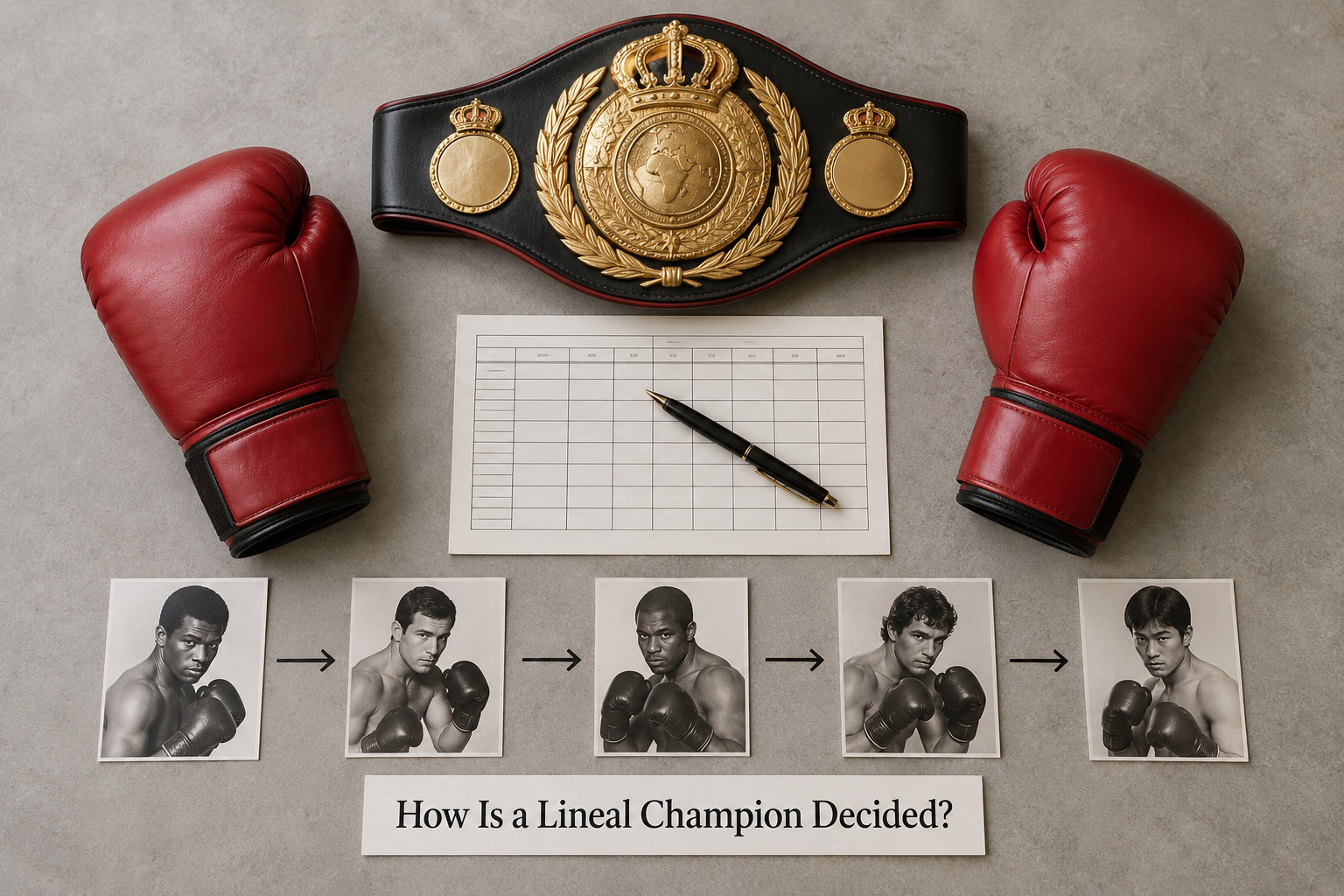
The answer comes down to this: the lineal title passes in the ring and nowhere else. Nobody is appointed, and no vote creates a champion.
The decision runs in four steps, and every lineage keeper follows some version of them.
- A line starts between the top two. When a division has no recognized holder, the two highest-ranked credible contenders fight each other. The winner becomes the first champion of the new lineage.
- The title transfers only through a decisive win. A draw, a no contest, or a win over an opponent the champion was not expected to face usually leaves the chain unchanged.
- Rankings shape the challengers, not the outcome. Divisional rankings decide who is treated as a legitimate contender. They cannot install a champion.
- A broken chain stops the succession. Until a new line is crowned, the division has no lineal champion at all.
That last point is the one most arguments skip. If the holder retires, moves weight, dies, or simply refuses meaningful fights, the line stops. Nobody inherits it by default.
How Lineal Champion Is Decided After Each Major Fight
A result only changes the lineage when it involves the reigning holder or closes an open vacancy. Beat a champion who is not the lineal champion and you have won a belt, nothing more.
The sequence fans follow most often looks like this:
- A ranked contender beats a champion and moves to the top of a division — the case for an open line gets stronger, but nothing changes until the holder actually meets him.
- The lineal champion defeats a lower-ranked opponent — most lineage keepers still count the title as intact, though critics call this a thin defense.
- A challenger beats the lineal champion in the ring — the chain transfers immediately and instantly.
- A champion is stripped of his belts by a sanctioning body for missing a mandated bout — the belts change hands, the lineal chain usually does not.
That fourth case is where the two systems deliberately come apart. Sanctioning bodies strip champions for missing deadlines, refusing opponents, or failing medicals. The lineal chain ignores administrative decisions and looks only at what happened between two fighters.
Which Ranking Systems Help Establish the Lineage?
Several organizations keep lineal lineages, and no one of them is universally accepted as the authority. Their rules differ most on one point: where a new line is allowed to start.
| Organization | How it decides the holder | How it fills a vacancy |
|---|---|---|
| The Ring magazine | Runs the longest continuously published set of world rankings | Often declines to name a successor until a top contender earns a claim in the ring |
| Cyber Boxing Zone | Historical lineage compiled by historian Cliff Rold, most detailed in the archived heavyweight records | Crowns the top two ranked contenders when a line breaks |
| BoxingScene | Publishes rival lineages and argues several can exist at once | Tracks multiple parallel claims rather than forcing one |
| Transnational Boxing Rankings Board | Consensus-based rankings used as a contender reference | No single mandatory rule; feeds the ranking side of the decision |
| Lineal Boxing Champion | Published divisional lineage lists with its own recognition standard | Crowns a successor based on ranked results |
| Sports Illustrated | Editorial recognition of the division’s leading fighter | Ad hoc, decided case by case |
The honest answer for a reader tracing a claim is to check two lists rather than one, and accept early that a single ruling list does not exist.
What Happens When a Champion Moves Weight Division?
A line breaks in four distinct ways, and they are not interchangeable. Fans tend to collapse all four into the phrase it goes vacant, which hides where the argument actually starts.
- Retirement. The chain ends. If the fighter unretires, most lineage keepers treat the original reign as still valid, though not universally.
- Moving up in weight. The old division loses its holder. If the fighter wins a title in the new division, he may inherit that division’s chain instead — and boxing history contains champions credited with lineal status in several divisions at once.
- Death. The chain ends permanently. No successor is named until the division’s top two fight.
- Refusing to defend or being stripped. The most argued case. A sanctioning body may take the belts away, but the lineal chain is generally unaffected because no fight was lost.
For a weight move, be precise about the claim. Holding a chain in one division while another division has no holder does not make you the champion of both. It makes you the only named successor candidate in the division you vacated.
Muhammad Ali’s three reigns as lineal heavyweight champion remain the most-cited example of a single division’s chain being claimed more than once by the same fighter. George Foreman’s 1994 return, and the question of what his win restored, is the canonical modern dispute.
Why Do Some Lineal Claims Remain Disputed?
Disputes come from the same root cause: no rulebook. Six recurring problems account for nearly every argument.
- No agreed starting point. Different bodies crown different first champions for the same division, and the disagreement never gets resolved because nobody has the authority to resolve it.
- Unrecognized titles. A win over a champion nobody in the lineage recognizes does not count for everyone.
- Thin defenses. A champion who fights only soft opposition holds the chain while the premise of the title — that it identifies the best fighter — collapses. Historians have criticized specific long reigns on exactly this ground.
- Long absences. A champion inactive for years is still the holder in most lineages, which makes the chain technically intact and practically meaningless.
- Controversial decisions. Split decisions and unclear results produce claims on both sides, and lineage keepers split.
- Parallel claims. When a specialist outlet publishes a different champion from the mainstream view, fans end up with two answers and no tiebreaker.
The Fury-Wilder situation is the example that comes up most often in forums. A fighter claiming the lineal heavyweight title while being treated as a challenger by other parties is exactly the kind of framing that makes the concept feel self-promotional.
Division-level records show the same pattern. Pacquiao, Mayweather Jr. and Crawford are each credited with four divisions of lineal status, and Ali remains the only three-time lineal heavyweight champion. Crawford’s four divisions came with an unusual feature: he held The Ring’s own belt in all four.
The concept also travels beyond boxing. Kickboxing used it heavily, with Peter Aerts among the most-cited holders. In MMA it has been applied irregularly, most often to heavyweight, where Fedor Emelianenko’s long defended reign is the reference point. In women’s boxing, Claressa Shields is the name most often raised when discussing two-division claims.
Frequently Asked Questions
Who decides the lineal champion in boxing?
Nobody appoints a lineal champion. The title passes only when a fighter beats the reigning holder in the ring, and new lines are started when the top two ranked contenders in a division fight each other. Historians, The Ring, Cyber Boxing Zone and other outlets keep competing lineages, but none of them controls the title.
Is a lineal champion an official boxing title?
No. A lineal championship is an intangible title with no belt and no governing body. It has no legal standing with any state athletic commission, which approves fights and belts but does not recognize lineal status. That is precisely why it was created: to name one leading fighter when sanctioning bodies disagreed.
What is the difference between lineal champion and undisputed champion?
An undisputed champion holds every major belt in a division at the same time, which happens rarely. A lineal champion holds no belt at all. He holds the unbroken chain of who beat whom in that division. A fighter can be undisputed without being lineal, and can be lineal without holding a single sanctioning body belt.
Does winning one world title make a boxer the lineal champion?
Not by itself. A world title win matters if the champion you beat was the recognized lineal holder, or if the division has no recognized holder and your win establishes the strongest credible claim. Winning a belt from a sanctioning body without touching the chain changes your record, not the lineage.
Why can two boxing organizations disagree about the lineal champion?
Because each uses a different rule set, mainly about where a lineage may begin and whether a champion must be crowned in the ring. One body may fill a vacancy with the top two ranked contenders, another may decline to name anyone. With no authority above them, both lists stay published and the disagreement persists.
How does The Ring magazine affect lineal championship?
The Ring’s rankings shape who counts as a top contender, which determines who can realistically fill a vacancy, so its lists influence nearly every lineage decision even when no one follows them literally. The magazine has also stopped naming lineal champions outright, leaving other outlets to publish the chains instead.
Conclusion
So, how lineal champion is decided comes down to a chain and a gap. The chain starts when the top two credible fighters in a division meet, passes in the ring with each decisive win, and breaks the moment the holder retires, moves weight, dies, or declines to fight meaningfully.
Before you accept a claim, check four things: which division the chain covers, when it started, who recognized it, and whether the holder has actually defended. That is the whole method. Anyone who tells you there is a single official list is wrong, and anyone who tells you it means nothing is also wrong.