Points are deducted in boxing by the referee, not the judges, as a penalty for a foul such as a low blow, a head butt, holding or punching after the bell. Judges only score each round. That single split explains most of the confusion behind close scorecards, so it is worth understanding how the deduction is applied and why one point can decide a fight.
Below I break down the 10-point must system, the judging criteria that apply when no foul happens, the fouls that actually cost points, and what happens when a knockdown or an intentional foul changes the arithmetic. The examples use realistic scorecard numbers rather than any one specific fight.
Table of Contents
- Why Points Are Deducted in Boxing?
- How Does the 10-Point Must System Work?
- What Do Judges Look For in Each Round?
- What Are the Most Common Reasons Points Are Deducted?
- What Happens When a Boxer Is Knocked Down?
- How Are Fouls and Rule Breaches Penalized?
- How Are Point Deductions Awarded by the Judges?
- Can Point Deductions Be Changed After the Fight?
- Do Boxing Scoring Rules Vary by Organization or Country?
- Frequently Asked Questions
- Conclusion
Why Points Are Deducted in Boxing?
Points are deducted to punish rule-breaking during a specific round, and the referee is the only official who can order it. Judges write their own round scores and never subtract points themselves.
In professional boxing the same three officials handle a bout from different angles: the referee works inside the ring and enforces the rules, while the three judges sit ringside and score. When the referee decides a boxer has broken the rules badly enough to cost a point, that point is removed from that boxer’s total for the round in which the foul occurred.
The most common reasons points are deducted are:
- Hitting below the belt
- Head butting or deliberate contact with the head or neck
- Persistent holding or smothering the opponent
- Punching after the bell has sounded
- Striking the back of the head with a downward blow
- Using an elbow, or a forearm and glove used together as one strike
- Repeatedly fouling the same boxer after warnings
- Disobeying the referee’s instruction, such as failing to break a clinch or leaning on the ropes during a count
One myth is worth clearing up straight away. A fighter does not lose a point for losing a round, for missing punches, or for being outworked. A round is simply scored 10-9 against them by the judges. Points only leave a boxer’s total when the referee calls a foul severe enough to warrant it.
How Does the 10-Point Must System Work?
In the 10-point must system the winner of a round is awarded 10 points and the loser 9, so every round is worth exactly one point of separation. A deduction does not change how the round is judged; it is subtracted afterwards from the offending boxer’s round score.
Rounds are not counted like points in basketball. Nobody keeps a running tally of landed punches, and nobody adds a separate pool of points. Each judge fills out a card round by round, adds the columns at the end, and the highest total wins.
| Round score | What it means | How it happens |
|---|---|---|
| 10-10 | Even round | Both fighters land similar clean work with neither clearly ahead |
| 10-9 | Clear round | One fighter wins the round on clean punching, control or defense |
| 10-9 (upset round) | Round won by the underdog | Often a fighter under pressure uses defense and counterpunching to steal the round |
| 10-8 | Dominant round | A knockdown is scored, or a round is so one-sided that many judges award it without one |
| 10-8 with a 2-point deduction | Dominated and fouled | A fighter wins the round decisively but also takes one point off it for a foul |
A worked example shows where the deduction lands. Suppose a fighter wins four rounds by 10-9 and a knockdown round by 10-8, giving totals of 118-114. A referee deduction of one point in round two turns that into 117-114, which is a split decision on two cards. A two-point deduction turns it into 116-114, and the fighter who started behind may now be ahead on every card.
A draw happens when the totals land level. A knockout works differently: it ends the bout and is recorded as a stoppage rather than a decision.
What Do Judges Look For in Each Round?
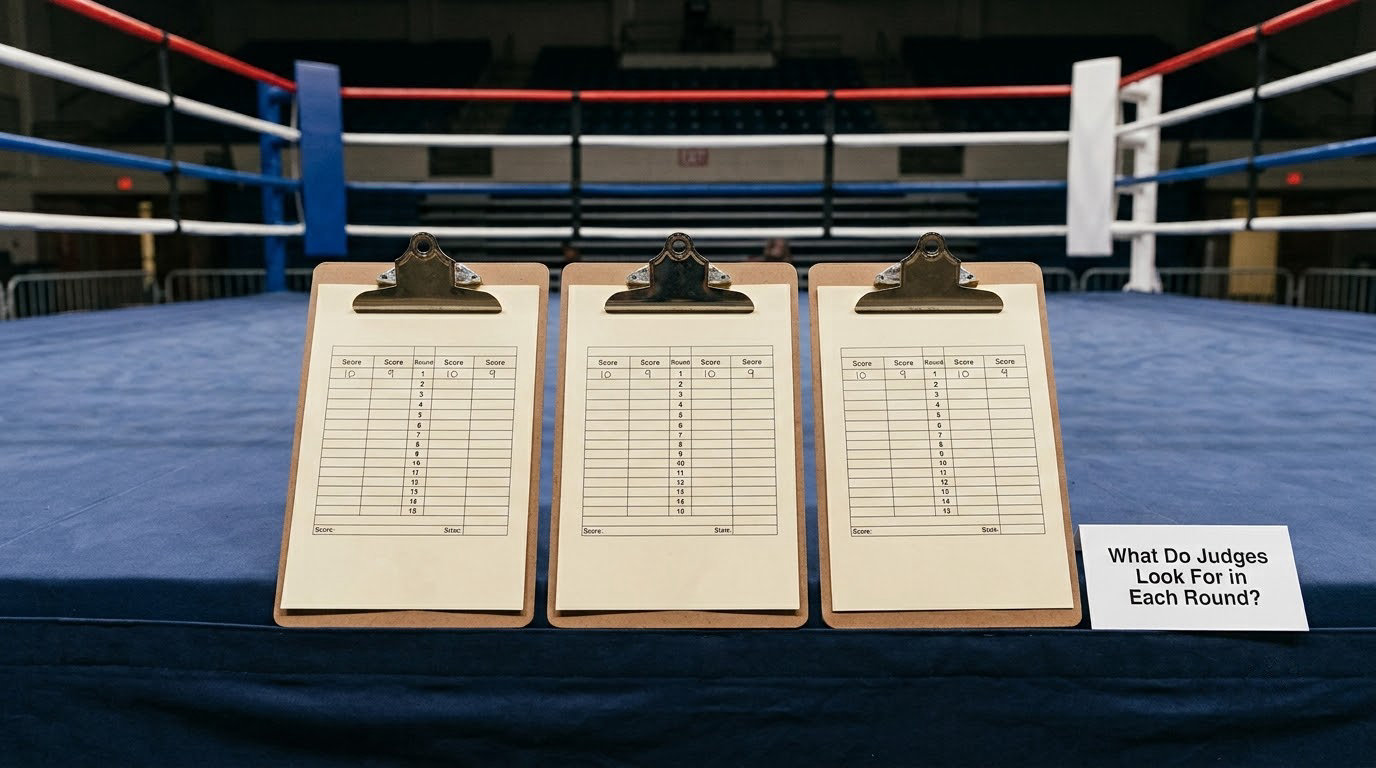
Judges score five things: clean punching, effective aggression, ring generalship, defense, and the overall impression the round gives of who made boxing look like boxing. None of these involve the punch count.
- Clean punching. Judges count quality, not volume. A hook that lands on the temple and snaps the head back outweighs three wild swings that miss everything.
- Effective aggression. Pressing forward matters when it produces damage. Bouncing on the toes for two minutes without throwing does not.
- Ring generalship. Cutting off the ring, controlling the centre and forcing an opponent back all count in the score.
- Defense. Slipping, rolling and blocking cleanly can win a round on its own, particularly when a fighter is under pressure and countering well.
- Overall impression. A round can tip on work rate and the flow of the exchanges rather than a single clean shot.
Judges do not see a punch counter. There is no device feeding them landed totals in most professional bouts, so they score what they can see from their seat. That is why the usual complaint after a split decision is that a judge was blocked from an angle while another had a clean view.
What Are the Most Common Reasons Points Are Deducted?
Excessive holding and repeated fouling are the reasons you will hear about most often, followed by low blows and after-the-bell punches. The cost is usually one point, with two reserved for more serious or repeated offenses.
Missed punching and inaccurate work
Missing is not a foul and it does not cost points. What gets noticed is a fighter throwing wild, landing on the gloves or the fighter’s own head, or throwing so many wild punches that nothing clean comes with them. Judges reflect that in the 9, not in a deduction.
Clinching and holding
Excessive clinching is the foul fans notice most, and it does cost points once the referee decides a boxer is using the clinch to block punches rather than to survive them. A boxer who leans on an opponent and denies them offense while breaking the rule repeatedly can be warned, then lose a point, then lose two.
Ordinary defensive movement is completely legal. Stepping off the line, sliding away, rolling a punch and stepping back inside are all fundamentals. The line is crossed when a fighter grips the opponent’s arms or head, holds rather than punches, and repeats it after the referee has already told them to let go.
Defensive evasion and passivity
Standing on the back foot for a full round without a punch is not a deduction. It simply wins no round with most judges, and the 9 tells the story. The exceptions sit at the edges: refusing to answer after a knockdown, leaning on the ropes during a standing count, or deliberately lying down to avoid a punch, all of which can be treated as rule breaches.
Why points are deducted in boxing: the foul list
| Foul | Typical cost | Usual outcome |
|---|---|---|
| Low blow | 1 to 2 points | Warning first, then a deduction if the pain continues; the bout often stops on medical grounds |
| Head butt or contact to the neck | 1 to 2 points | Often deduct points when the contact is clear and repeated |
| Persistent holding or smothering | 1 point | Warning, break instruction, then a deduction if it continues |
| Punching after the bell | 1 to 2 points | Deducted from the closing round; two points are common in many jurisdictions |
| Elbow or forearm and glove together | 1 to 2 points | Usually deduct points because the strike is not legal under any rulebook |
| Downward blow to the back of the head | 2 points | Treated as one of the more serious fouls in most rulebooks |
| Persistent fouling after warnings | 1 point then 2 points | Escalates quickly; a deliberate pattern can end the bout |
| Disobeying the referee’s instruction | 1 point | Applied when a boxer refuses to break, continues after being told to stop, or fails to stand during a count |
| Out of the ring through careless pushing | 1 point | Judges may deduct if the exit is judged unsportsmanlike rather than accidental |
One real case still circulates in boxing forums: a one-point deduction in the ninth round of a heavyweight title fight, described at the time as harsh, because the fighter who received it had dominated the round and the deduction removed a cushion that later proved decisive. It is a useful reminder that a deduction applies to the round it happens in, not to the fight as a whole.
What Happens When a Boxer Is Knocked Down?
A knockdown usually costs the fighter who went down the round, dropping it to 10-8, because judges use the 10-point must system to reflect a knockdown. If the same boxer is knocked down more than once in the round, the scoring can drop further.
The sequence runs in a fixed order. The fighter who is knocked down must go to a neutral corner, and the referee begins a count of ten. The fight ends if the count reaches ten. If the fighter rises before the count is finished, the referee uses a standing eight count to check that they can continue safely, and the action resumes with the dropped fighter under instruction not to lean on the ropes through the count.
Saved by the bell is the term for a fighter who is still down when the round ends. The round is scored as it stood at the bell, and the knockdown is already reflected there.
Two details trip people up. First, a 10-8 does not require a knockdown; a round can be scored 10-8 purely on dominance. Second, a knee is not a knockdown in boxing. Slipping onto one knee is treated as a slip, and judges are told not to count it, because a rule that rewarded ducking would reward the fighter who simply avoided the punch.
How many points a knockdown costs is not identical everywhere. Some commissions score one knockdown as 10-8 and treat repeat knockdowns in the same round more harshly, while others specify the drop directly. The rulebook printed for the event settles it.
How Are Fouls and Rule Breaches Penalized?
Fouls are penalized on a stepped scale that starts with a warning and ends with a disqualification, and only the middle steps take points off.
- The referee warns the boxer and tells them what was wrong.
- If the foul happens again, the referee deducts one point from that round.
- If the boxer keeps fouling, the referee deducts two points.
- If the conduct is severe enough, the bout can be stopped or the boxer disqualified.
The split between accidental and intentional matters most at step four. A foul committed by accident, such as a clash of heads when both fighters step into the same jab, usually leads to a break and no penalty once the referee is satisfied nobody is at fault. The same clash caused deliberately, or repeated after a clear instruction to stop, can cost two points and end the bout.
An intentional foul can lead to a disqualification, which records a loss for the offender on the result sheet regardless of the scorecards. A no contest is used where the foul makes the outcome impossible to judge fairly, and it is recorded on neither fighter’s record as a win or loss. A technical decision goes the other way: it is awarded to the fighter who was ahead when the stoppage happened, provided the stoppage was caused by something other than the fouls themselves.
How Are Point Deductions Awarded by the Judges?
Point deductions are not awarded by the judges at all; the referee awards them, and the judges apply them to their own cards when they total them up.
Here is how a bout is scored from the opening bell to the announced result. The referee watches every exchange for rule-breaking and records any warning or deduction with the round it belongs to. At the end of each round the referee gives his own score to the judges. Each judge fills in the round independently, based on what they saw in that round only. When the bout ends, the referee collects the three cards, checks them for clerical errors such as a round entered in the wrong column, and hands them to the ring announcer. The announcer reads each card and combines them into the official result.
The result wording tells you how close it was. A unanimous decision means all three judges picked the same fighter. A majority decision means two agreed and the third scored it for the other fighter, with two winning cards counting as the official verdict. A split decision means all three cards differed and the fighter with two wins takes it. A split draw means one judge scored it for each fighter and the third scored it a draw. A plain draw means all three cards ended level.
The declaration also tells you whether points were deducted. A result written as a technical knockout in round three with a time of one minute and five seconds records a stoppage by the referee, while a decision line with two totals such as 116 to 112 shows the scorecards with any deductions already applied.
Can Point Deductions Be Changed After the Fight?
A deduction can be corrected before the cards are read if the referee recognizes an obvious error, but judges cannot reopen a completed decision because a fighter or a corner disagrees with a close round.
That distinction matters. The referee has authority over deductions and stoppages throughout the bout, so a foul called in error can be cleared, adjusted or converted before the cards go to the announcer. Once the cards are in the ring announcer’s hands, the scoring is finished. A protest from a losing corner does not reopen the totals.
Delays do happen for other reasons. A doctor may be asked to examine a fighter before the decision is announced. A rulebook may need to be consulted when there is any question about a foul, a knockdown or a stoppage. Some jurisdictions also allow for review of official records when there is a clear error in how a result was written down.
Video review is the exception rather than the rule. Most professional bouts are decided on the cards as written, and footage review is generally reserved for matters of eligibility, disqualification or record correction rather than for re-scoring a round.
Do Boxing Scoring Rules Vary by Organization or Country?
The 10-point must system is used almost everywhere, but the details are not identical across governing bodies, so the rulebook for the specific event is the final word.
Variation tends to show up in four places: how many points a particular foul costs, how a knockdown is scored, what the referee must do after a low blow, and what a fighter has to do to be counted. A two-point penalty for a punch after the bell in one jurisdiction may be a one-point penalty with an automatic second offense somewhere else.
Amateur boxing is different again. Instead of three judges writing 10-9 rounds by eye, most competitions use an electronic scoring system where each clean punch registers points and the score is displayed at ringside. Fouls are handled differently there too, and many amateur rulebooks deduct two points rather than one, or subtract them per punch rather than per round. Rounds are shorter, the scoring reflects the number of scoring punches rather than a judge’s impression, and the technical scoring can make simultaneous exchanges feel harsher than they would in a professional bout.
A practical way to follow any card is to check three things before the first bell: which commission or sanctioning body is supervising, what the rulebook says about points for fouls and knockdowns, and who the three judges are. Everything else on the scorecard follows from that.
Frequently Asked Questions
Does a boxer lose a point for every punch they miss?
No. Missing is not a foul and it is not a deduction. Judges score a round on quality of punching, defense, control and effective aggression, so a fighter who throws a lot and lands little usually gets a 9 rather than losing points. Points only come off a round when the referee calls a foul such as a low blow, head butt, holding or an after-the-bell punch, and the point is removed for that round only.
Why do judges give a boxer a 9 or an 8?
A 9 is what the losing boxer of a round receives under the 10-point must system, meaning the other fighter won the round on clean punching, control or defense. An 8 means the round was dominant enough that a knockdown is normally scored, though a referee deduction is another reason a fighter can receive 8 or 7. A 10-10 is a rare even round where neither fighter clearly won.
Can a judge deduct a point without a foul?
No. Only the referee can deduct points, and only for a foul or a breach of instruction. Judges score each round on its own and cannot subtract anything on their own initiative. If a judge felt a boxer was avoiding a fight or holding constantly, that shows up as a lost round on the card, not as a point removed by the judge.
What does it mean when a fighter is saved by the bell?
It means the fighter was still down or too badly hurt to continue when the round ended. The round is scored as it stood at the bell, with the knockdown already reflected in the score, and the fighter returns for the next round after the referee and doctor decide it is safe. A saved fighter is usually given a standing eight count on the resumption.
Why can a knockdown not always decide the fight?
Because a knockdown only changes one round. It usually turns a round into a 10-8, which is a two-point swing instead of the normal one, but the remaining rounds are still scored on punching and defense. How many points a knockdown costs also varies by commission and rulebook, so the size of the swing is not the same in every jurisdiction.
Conclusion
Deductions are a referee’s penalty for a rule breach, applied to one round, on top of a system where rounds are simply scored 10-9. Knowing why points are deducted in boxing comes down to that one distinction: the referee deducts, the judges only score. Once you have it, most controversial cards make far more sense.
To read the next close decision, watch effective punching rather than punch volume, note who controls the ring, track how often fighters are warned, and keep the knockdown count beside the round-by-round scores. Those four things explain nearly every scoreline you will see.