Television changed boxing by turning a regional, gym-based sport into a national, then global, star-driven entertainment business. It created the superstar, invented pay-per-view, dictated when and how long fighters work, and eventually left the sport scattered across streaming services and hard to find at all.
Before the cameras arrived, boxing was a patchwork. A New York fighter might never travel west of Philadelphia; a Chicago or Los Angeles following was large, loud and entirely separate. Television was the thing that dissolved those borders, and the effects have outlasted every network that carried the sport.
Table of Contents
- How Television Changed Boxing in the Early Years
- How Broadcast Stars Made Fighters Household Names
- How Pay-Per-View Transformed the Business of Boxing
- How Television Altered Tactics, Judging and Fouls
- How Satellite Television and Streaming Expanded Access
- How Television Reshaped Boxing Culture and Rivalries
- Frequently Asked Questions
- Conclusion: What Changed Most About Boxing on TV
How Television Changed Boxing in the Early Years
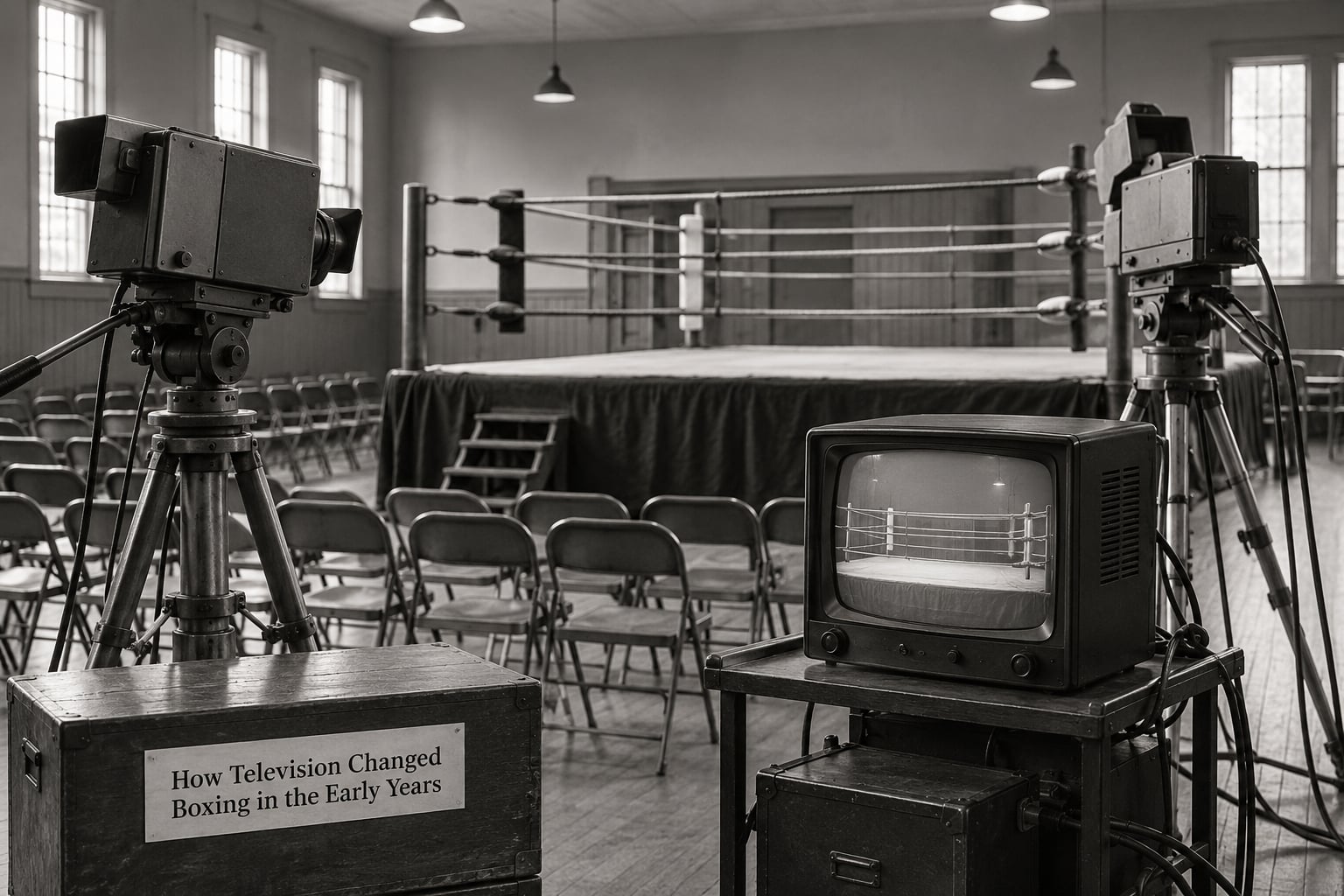
Early television did not invent televised boxing so much as make it repeatable. A fight that used to be a one-night local event, watched by whoever happened to be in the hall, became a scheduled broadcast that a family could plan around. That is the single most important change: not more viewers, but the same viewers returning on a known night.
Closed-circuit television, where a venue paid for the equipment and admitted paying audiences, was the crucial early step. The Muhammad Ali Act of 1962 required broadcasters offering closed-circuit events to give home-television audiences a chance to see the same card, and that rule shaped the modern fight business more than most people realise. Before it, a promoter could fill a hall and broadcast the fight to a few rooms; after it, the same event had to be sold to households as well.
The chronology below is approximate on purpose. Dates for the earliest telecasts vary by region and by definition, and boxing history is full of fights that were filmed, shown in short clips, or shown only in the host country.
| Approximate period | Broadcast development | Why it mattered |
|---|---|---|
| 1940s | Occasional experimental telecasts of local club and military bouts | Proved the picture and the audience existed, but nothing was built on it yet |
| 1950s | National network coverage, including weekly sports anthology shows on the networks that would carry boxing for decades | Regular weekly slots turned scattered fights into a season a viewer could follow |
| 1950s to 1960s | Closed-circuit venues in major cities, plus the 1962 requirement that home viewers be served | Big fights moved into arenas sized for cameras, and gate and broadcast money arrived together |
| 1960s to 1970s | Colour coverage, satellite relay and the era’s most famous matchups | Rivalries became national storylines and fighters became celebrities outside the sport |
| 1970s to 1980s | Premium cable and USA Network’s weekly fight series, alongside network sports programming | A devoted audience learned to follow a weekly broadcast, and cards started to be built for undercard exposure |
| 1980s to 2010s | Pay-per-view on premium cable, when the biggest names moved to cable and closed-network deals | Revenue shifted from gate receipts to rights fees and buys, and promoter power grew sharply |
| 2018 onward | HBO leaves boxing, Showtime Sports closes its boxing operation, and events migrate to dedicated streaming services | Access fragments; the biggest fights are often on a platform a viewer must subscribe to separately |
How Television Changed Boxing Fights
Watch a fight on television and you see something a local crowd never could: the whole arc of the night. Promos run for days. The undercard is given real names and records. The main event is announced, the crowd noise is there, and then the bell ends it and the broadcast wraps with a result. The viewer gets a complete, scheduled story rather than a highlight reel picked out by a newsreel camera.
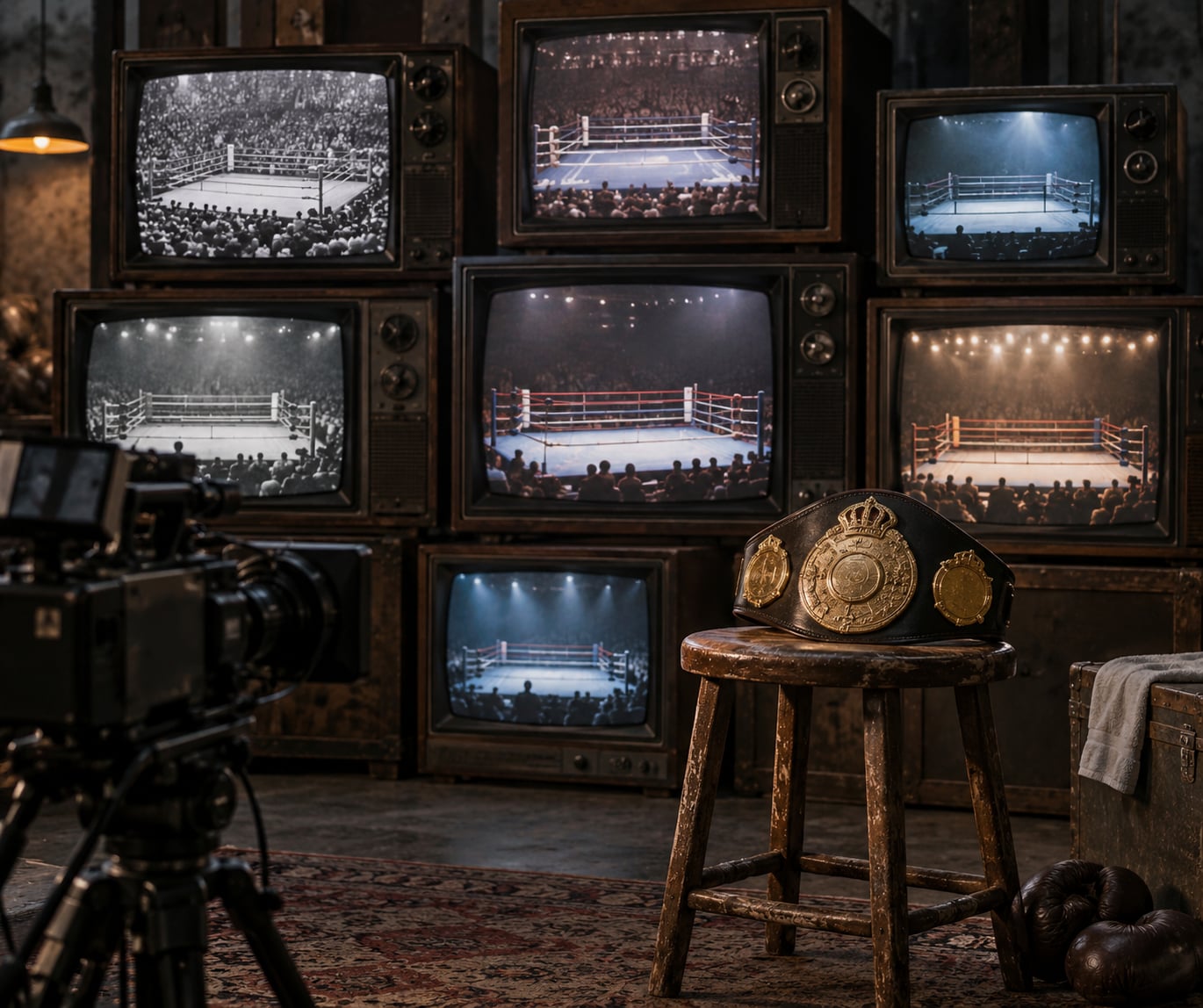
Commentary turned that into something more. Two voices explaining what they are watching taught a huge new audience the vocabulary of the sport, and the same pairs of voices became part of the broadcast itself. A regular Tuesday night or Friday night became a habit with a fixed address in the weekly schedule, which is exactly how a viewing culture forms.
Older fans still describe those weekly series as the formative TV memories of their youth, and the same pattern shows up in present-day r/Boxing threads where people argue about which era of weekly coverage was best. The reason the nostalgia is so specific is that television made boxing a routine rather than an event. Once it was routine, viewers had opinions about commentary, cards and promotions, not just about the punches.
How Broadcast Stars Made Fighters Household Names
Television made fighters household names by removing the need to win every fight. Before national coverage, a fighter built a following by working a circuit and beating people in front of the people who came to see him. After it, a single memorable performance in front of a national audience could do more than a decade of steady regional wins. A fighter could lose and still grow, as long as the fight was watched and the personality was there.
That is the shift from regional scenes to one-man narratives. Where several healthy local traditions once competed for the same audience, a national feed could concentrate all of it on a single fighter. The person became the draw, the story and the product, and promoters and networks organised entire cards around a single name.
Broadcast boxing made other skills matter too. Entrances, press conferences, interviews, weigh-ins and post-fight celebrations all became part of what a viewer was watching. An opponent who could talk well drew attention that a purely technical boxer struggled to earn, and that has stayed true ever since: the fighters who last longest on television are rarely the ones who only fight.
The downside is a kind of narrowness. One-man narratives concentrate attention and income, and they leave less room for the rest of the card. Viewers who came for a specific fighter rarely watched the rest of the evening, which is one reason so much good work in boxing has never been widely seen.
How Pay-Per-View Transformed the Business of Boxing
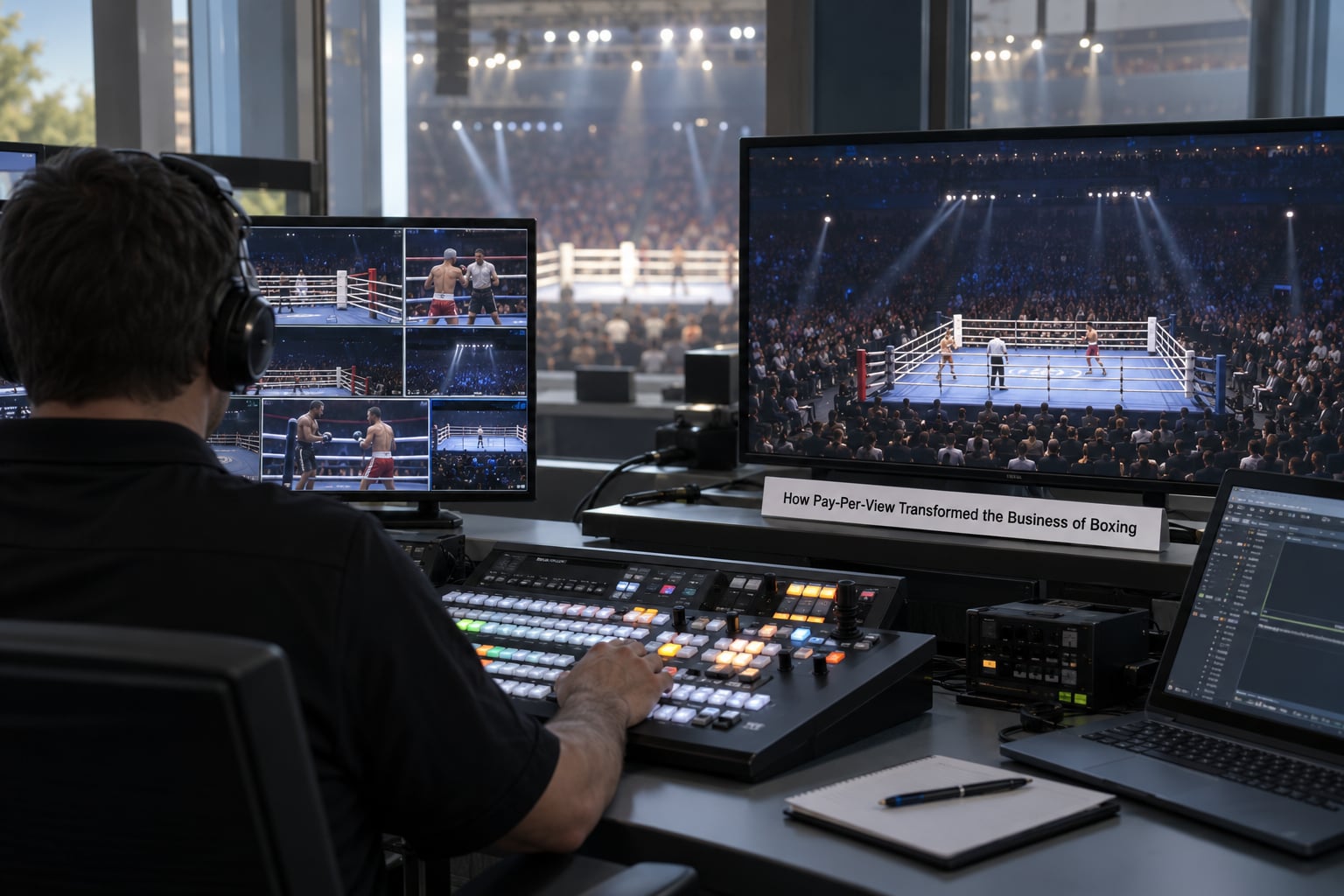
Pay-per-view changed where a fight’s money came from. A promoter used to count tickets sold, sponsorship money and a rights fee. After PPV, the central question became how many households would buy the event, and the negotiation moved from a season of coverage to a single Saturday night. Gate receipts became the smaller half of the story, and the number that decided whether a fight happened at all was the projected buy.
The table below compares the four broad money models boxing has run on. It is a simplification, but it is the shape most writers mean when they describe boxing’s business as television-shaped.
| Era | Main income sources | Scheduling | Risk | Who reaches the audience |
|---|---|---|---|---|
| Pre-television and local club era | Gate receipts, local sponsors | Whenever a hall was free | Low financial risk, small ceilings | Whoever was in the building |
| National broadcast era | Rights fees, gate, sponsorship | Fixed network slots, often prime time | Network decided what was worth airing | Entire national audience, free to watch |
| Pay-per-view on premium cable | PPV buys, subscription revenue, gate, rights | PPV nights, often late on Saturday | High; an unsold card can lose badly | Subscribers who also buy the event |
| Streaming era | Direct subscription, exclusive rights deals, sponsorship | Flexible, sometimes built around a single franchise | Concentrated in a few platforms | Whoever holds the subscription for that service |
Two numbers explain the shape of the PPV business. HBO’s average non-PPV boxing audience fell from about 856,000 in 2016 to about 701,688 in 2017, a drop of roughly eighteen percent, and industry reporting treated it as a warning sign. Individual events still do enormous numbers, with the Pacquiao-Mayweather fight reported at around 4.6 million buys and Canelo-Kirkland at a little over two million. The pattern is the point: a few very large nights surrounded by a shrinking average.
Rights money then flowed back into fighter purses in a way that had no precedent. Reported guarantees attached to long-term promotional and media deals became a normal part of a boxer’s career, so much so that a fighter’s contract situation now shapes which fights can even be attempted. Fighters in long exclusive deals are effectively unavailable to rivals, and the phrase fans use for it, the best do not fight the best, is a media-arithmetic problem rather than a sporting one.
How Television Altered Tactics, Judging and Fouls
Broadcast fights run to a clock. A start time is announced weeks ahead, the network schedule is fixed, and anything that happens inside the ring has to fit a window that was set by programmers rather than by either corner. Styles adapted to that constraint, sometimes deliberately.
It shows up in fight length. Three-round and short-round formats have existed almost as long as boxing, but the period when televised cards were built around quick finishes and when world title fights were routinely short produced a distinct style: fighters who attacked hard, moved forward, and treated the first clean shot as the one that mattered. When the format later returned to longer scheduled title fights, styles had to change again, and the two eras look like different sports on paper.
Judging is the other pressure point. A televised knockdown gets instant replay and instant argument, so anything the judges are shown twice gets discussed for a week. Clipping the glove, head movement, holding, and the treatment of a fighter who is clearly hurt all draw more attention when millions are watching. Officiating consistency became a public issue precisely because the audience grew.
It is worth being clear about the limit here. Television does not score fights and does not dictate decisions; it changes what is seen, how often it is seen, and how long it stays in the news. Claims that television itself dictates judging usually confuse cause and effect. What it genuinely does is remove the option of a quiet, unexamined decision.
How Satellite Television and Streaming Expanded Access
Satellite and cable did two things at once. They carried fights across borders and time zones that linear broadcast never could, and they moved boxing behind a paywall, because a channel the viewer had to pay for was the only way a network could justify the rights fee. Access got wider and narrower in the same motion.
The regional picture varies a lot, and US-centred accounts miss most of it. In the United Kingdom, boxing was a staple of free-to-air television for decades before moving to Sky Sports and then BT Sport; longtime British fans still point to the paywall as the moment casual viewers stopped watching. In Japan, New Year’s Eve bouts on terrestrial television have drawn audiences in the tens of millions, which is a standing reminder that a boxing broadcast can still deliver a mass audience outside the United States. Latin American audiences have long followed the same fights on their own networks and tape, often before US viewers did.
Reported viewership data tells the same story in the other direction, and it is the kind of figure that gets quoted for a reason:
| Measure | Figure | What it shows |
|---|---|---|
| HBO boxing average, 2016 | About 856,000 viewers | The high-water mark of premium-cable weekly coverage |
| HBO boxing average, 2017 | About 701,688 viewers | Roughly an eighteen percent fall in one year |
| Pacquiao-Mayweather | About 4.6 million reported buys | How far a single mega-fight can exceed the average |
| Canelo-Kirkland | A little over 2 million reported buys | The 2 million tier that a healthy card can now reach |
| Japanese New Year’s Eve bouts | Over 50 million viewers in peak years | Boxing still scales outside the US market |
Streaming then rearranged the map again. HBO stopped carrying boxing in 2018, Showtime Sports closed its boxing operation in 2023 after running more than two thousand bouts over nearly four decades, and dedicated streaming services plus one-off platform events took over the biggest nights. The economics differ from cable: a direct subscriber who never buys an event is worth more than a spike on one Saturday, so platforms sell subscription rather than a single fight.
Fragmentation is the cost. Fans describe needing several subscriptions plus a pay-per-view purchase to follow the top fighters, and the frustration is not about price so much as the search. A fight hidden on a service a viewer does not have is not a fight that has lost viewers; it is one that has lost the chance to find them.
Where to watch classic boxing fights today
Old fights are scattered, and most of the ones people want are somewhere in this list. Free and ad-supported streaming services carry licence-fee revivals and occasional classic cards. Paid streaming platforms hold a rotating selection of older bouts alongside their live coverage. Region-specific on-demand services often have deep catalogues of fights that were never sold individually. Official promotion and network channels post anniversary footage and full fights on their own platforms, usually for a limited window. Digitised archives, most of them unofficial, hold a long tail of older bouts with inconsistent quality.
The honest caveat is preservation. A great deal of pre-1990 footage was never archived properly, was recorded off-air by collectors, or exists only in degraded copies. Before planning an evening around a specific classic, check that the platform actually holds that fight rather than assuming it is there.
How Television Reshaped Boxing Culture and Rivalries
Broadcasts created the grammar of a modern rivalry. Two fighters are announced months ahead, the matchup is sold as a story before either of them throws a punch, and the rivalry is built in press conferences and weigh-ins as much as in the ring. That convention is a television invention in practice if not in origin, and a fighter who refuses to participate in it is usually described as boring.
It also made the surrounding week part of the event. Prelim coverage, open workouts, interviews and the weigh-in are all content now, produced for an audience that will decide whether to buy the fight. The fight itself is one part of a larger product, and promoters plan accordingly.
The contrast with the older model is stark. Traditional local boxing was a communal evening in a hall: noisy, close, imperfect, and largely unremarked. Televised championship boxing is a global production with a broadcast narrative, a sponsor presence and a rights structure. Both are legitimate, but they produce different fighters, different crowds and different expectations about what a good night is.
Frequently Asked Questions
Did television save professional boxing?
Partly. Television gave boxing national reach, steady work for fighters and, in the cable era, a dependable weekly audience that supported hundreds of broadcasts a year. It also built the star system and the pay-per-view model that let promoters earn larger purses. What it did not do was fix the sport’s dependence on one or two names; when those names retired, the audience went with them.
How has streaming changed televised boxing compared with cable?
Streaming changes what is being sold. Cable leaned on pay-per-view, so most viewers needed a subscription plus a purchase for the biggest fights. Streaming platforms usually sell the subscription and treat a marquee event as a way to win subscribers, with the event itself included. That shifts revenue toward long-term subscribers but concentrates boxing on a few platforms, which makes access harder to find.
Did television make boxing fighters fight more aggressively?
In some periods, yes. When broadcast slots were short and cards were built around finishes, forward pressure and quick exchanges suited the format and became a style in their own right. Styles have followed the broadcast window throughout: longer scheduled title fights and rematch eras produced patient, tactical boxing again. Television shapes the incentive, but each corner decides how to answer it.
Why does the television era matter to boxing history?
Because it explains almost everything modern about the sport. The superstar model, exclusive contracts that stop rivals from meeting, the Saturday-night schedule, the reliance on buys rather than gate receipts, and the current streaming migration all follow from decisions made in the first decades of televised coverage. Understanding how television changed boxing makes the rest of the sport’s history readable.
What can boxing fans learn by watching classic fights?
You can hear the difference between eras before you can measure it. Commentary cadence, crowd size, the length of the undercard and the way a fighter handles a scheduled start time all shift across decades. Comparing a 1960s broadcast with a recent one makes it clear how much of today’s sport was designed for television rather than discovered in a gym.
Conclusion: What Changed Most About Boxing on TV
Television did more than make fights easier to see. It reorganised how boxing is paid for, when it is scheduled, how long fighters are asked to work, who gets promoted, and what a crowd is expected to feel. The superstar, the pay-per-view Saturday and the exclusive contract are all the same invention wearing different clothes.
Start by putting one classic broadcast next to a modern one. Take a fight from any decade you like against a recent card, watch the pacing, the undercard, the commentary and the crowd, and the shift across seventy years lands in a single sitting.