Cuts in boxing are treated between rounds by a licensed cutman who works in a strict order: cold pressure and a coagulant to slow the bleeding, petroleum jelly to seal the wound, then an ice-cold enswell pressed to the face to control swelling. It all happens in about sixty seconds, and a ringside physician can end the contest at any point.
I’ve watched enough corners to know that the minute between rounds looks chaotic from the crowd and feels clinical from inside the stool. A cutman knows the exact order to work in, and the referee is watching the whole time.
What follows is what actually happens in that minute, what the referee is checking, and where the line sits between treating a cut and stopping a fight. This is general information about ringside practice, not medical advice; anything involving an actual wound belongs with a doctor or an emergency department.
Table of Contents
- What Happens When a Boxer Gets a Cut?
- Why Do Boxers Bleed More After a Cut?
- What Does the Referee Check Before Continuing?
- Can a Trainer Apply Vaseline or a Cold Towel?
- What Makes a Boxing Cut a Stoppage?
- How Should the Cut Be Treated After the Fight?
- How Does a Cut Differ From a Swelling Stoppage?
- Frequently Asked Questions
- Can a boxer continue after getting a cut between rounds?
- Is petroleum jelly allowed on a boxing cut?
- How much time does a cutman have between rounds?
- Why does a boxer’s eye keep bleeding after the bell?
- When does a cut force a referee to stop the fight?
- Should a cut be cleaned and dressed after the bout?
- What to Do First After a Boxing Cut
What Happens When a Boxer Gets a Cut?
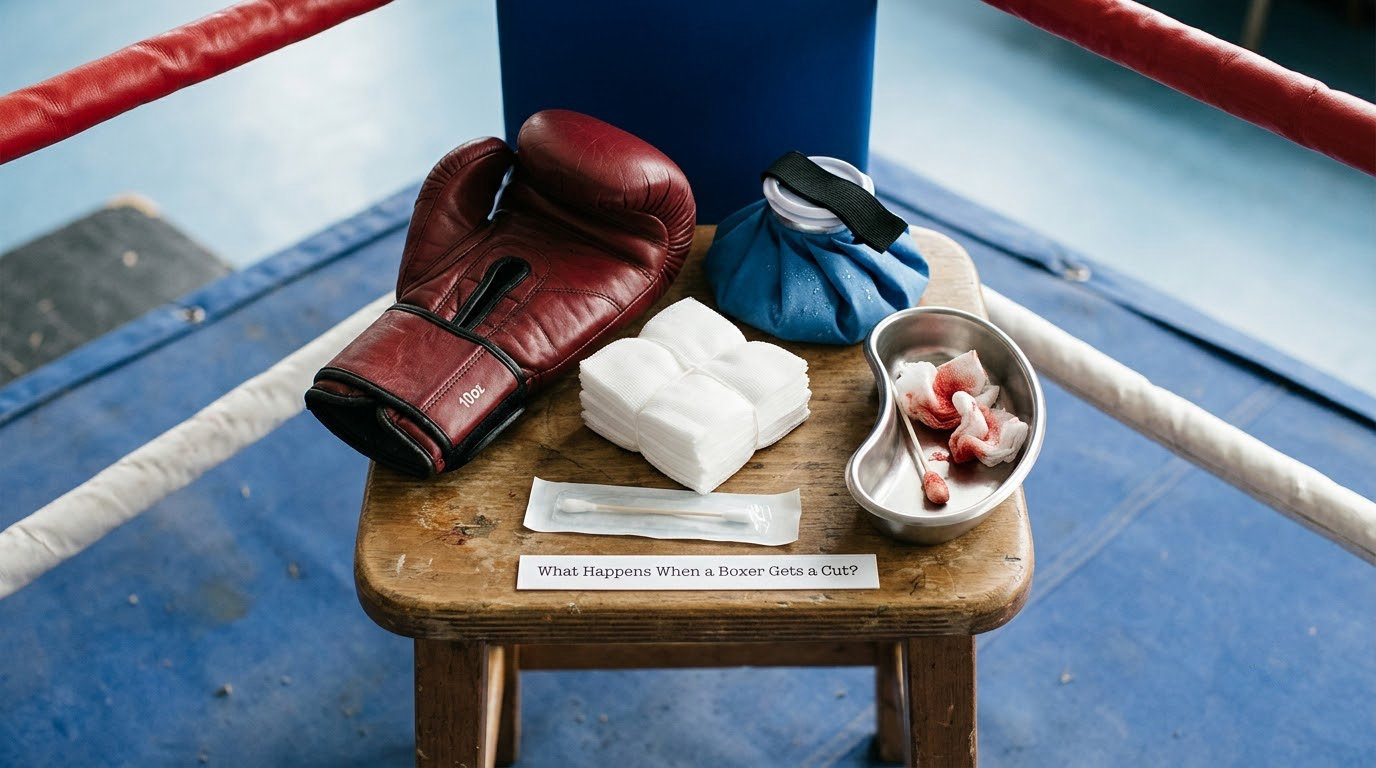
The sequence starts the moment the bell rings. The referee steps in, walks the fighter to the neutral corner and takes a look at the cut, and if the fighter’s corner has been told about it, the cutman gets thirty seconds of working time inside the one-minute interval.
From there the corner works, and the referee keeps an eye on the whole thing. What nobody in the ring can do is force a cut to close. Some bleed through the entire round and the boxer is told to fight anyway.
Whether the bout continues is not the cutman’s call alone. The referee can stop it, and so can the ringside physician, who holds independent authority in most jurisdictions to end a contest on medical grounds.
How Cuts Are Treated Between Rounds, Step by Step
This is the order a cutman works in, and it stays the same whether the cut is a split brow or a gash over the cheekbone.
- Stop the bleeding first. A cold wet towel goes over the face to wipe away blood and slow the flow, and the cutman finds every source of bleeding rather than just the obvious one.
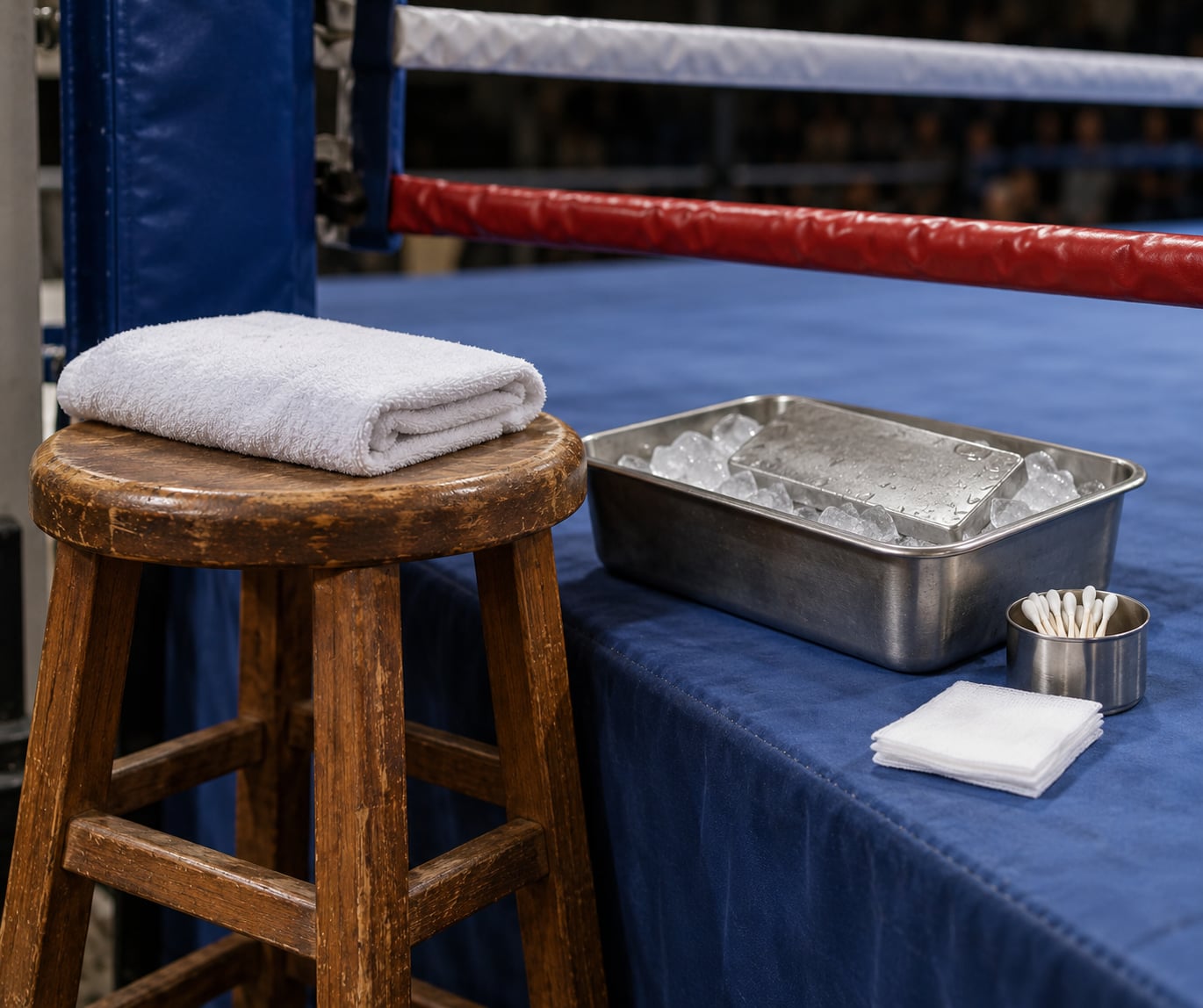
- Swab the cut with a coagulant. Adrenaline chloride 1:1000, which is epinephrine, is dabbed onto the wound with cotton swabs. It constricts the small blood vessels at the surface so a clot can form.
- Seal it with petroleum jelly. A thick plug of Vaseline is pressed into the cut and smeared over it. It forms a waterproof barrier, and it also makes the skin slippery enough that a glove sliding across the brow can’t reopen the wound.
- Apply cold pressure. An ice-cold enswell, a flat metal slab shaped like an oversized thumb, goes over the cut and over any swelling. Vaseline acts as a sealant here, but the real work is vasoconstriction plus cold.
- Brief the fighter. The cutman tells the boxer not to touch the cut, to breathe through the mouth, and to fight with the eyes open. Hands get re-wrapped if the swabs soaked them.
Veterans describe the procedure as being about ninety percent pressure. Cold does most of the swelling control, and the coagulant does most of the bleeding control. The petroleum jelly is the part everyone remembers.
Why Do Boxers Bleed More After a Cut?
Facial bone is the reason. There is very little soft tissue between the skin and the brow, cheekbone or nose, so a clean head clash shears skin directly across bone and opens a lot of small vessels at once.
Weight cutting makes it worse for a lot of fighters. Dropping weight fast means less subcutaneous fat and less water under the skin, and a thinner layer over the same bone tears more easily. It also explains why the same punch opens a bad cut in October and nothing at all in the same fighter two months later.
The one-minute interval is part of the problem too. Blood flow is already high after a round of punching, blood pools in the swollen tissue around the eye, and a cut that sealed halfway can reopen the moment the boxer stands up. Fighters describe blood creeping toward the eye and getting worse, not better, in the corner.
Some blood in a wipe-down towel is expected. Blood that soaks through gauze repeatedly, blood that the fighter cannot clear, a cut that spurts rather than seeps, or a boxer who becomes confused, drowsy or unusually uncoordinated are all reasons to stop and get a doctor rather than run the round.
What Does the Referee Check Before Continuing?
The referee is looking at four things, in this order: is the fighter answering questions, can the fighter see, can the fighter defend themselves, and is the bleeding under control.
Alertness comes first. A referee will put the fighter in a neutral corner and ask simple questions about the fighter’s name, where they are and what round it is. Slurred answers or a delay that was not there a round ago stop the process right there.
Vision matters because a cut above or under the eye fills with blood as well as swelling. A fighter who can see out of the eye can often continue. One who cannot see the opponent’s hands, no matter how well the cutman has sealed things, is usually done.
The referee also talks to the corner and to the ringside physician before waving the boxers back in. If the physician has any doubt about a cut, that doubt is enough. Referees are told to err toward the doctor, not away.
Can a Trainer Apply Vaseline or a Cold Towel?
In a professional bout, no. Corner assistance during the interval is limited to a licensed cutman working inside the commission’s rules, and the products they are allowed to use are approved agents, not whatever happens to be in the trainer’s bag.
A cold wet towel to wipe blood off the face and a properly prepared enswell are standard. Beyond that, improvised products are a problem. Supermarket skin glue, household superglue and off-the-shelf antiseptics are not commission-approved, and forum discussions about crews using drugstore glue in the ring describe a different setting from a sanctioned professional bout.
Petroleum jelly is not banned. It is a plain sealant with no active drug in it, and it is used in every corner in the sport. What it is not is a treatment for the wound itself, and putting petroleum jelly into an open eye causes burning and irritation rather than helping anything.
Amateur boxing is looser than the professional rulebook, where coaches and helpers may have more latitude and there may be no physician at ringside at all. That flexibility is exactly why amateur cuts get managed with improvised methods and why more of them end up needing stitching afterwards.
What Makes a Boxing Cut a Stoppage?
Under the unified rules used across most professional boxing, a cut that leaves a boxer unable to continue results in a technical knockout. Nobody has to be dropped for that to happen.
The practical triggers are consistent across commissions even where the wording differs. A cut that will not stop bleeding. A cut that has closed and reopened several times in the same round, which is treated more seriously than one fresh opening.
Blood that a boxer cannot clear from the eye and a referee cannot clear for him is another. So is swelling that has closed the eye completely, and any sign that the boxer is not tracking, is responding slowly, or cannot see.
One rule is specific to cuts and worth knowing. If a boxer is dropped three times in a single round from a legal blow and on any of those occasions a cut was the reason he could not continue, the contest ends there. That is the three-knockdown cut rule, and it exists so a badly cut boxer cannot be given the benefit of repeated eight counts.
A cut stoppage is recorded differently from other stoppages, and it is also the one most likely to be a no-contest rather than a loss. The distinction matters for a fighter’s record, so it is not a technicality.
How Should the Cut Be Treated After the Fight?
The between-round work is triage. The real treatment happens once the fighter is backstage, and the corner hands over to medical staff rather than continuing on its own.
Expect the wound to be cleaned and assessed, then closed if it needs it. Deep lacerations get stitched, and there is generally a limit on how many stitches can be placed at one time, which sometimes means a cut is closed on one day and the rest of it a few days later.
Some wounds are glued instead of stitched, and a swollen ear or a cut over a bony ridge may be left open to drain on purpose. Anyone with a fresh facial wound, a tetanus status they are unsure about, or a fight that ended in hospital should be seen by a doctor.
Scars from boxing cuts tend to fade over months rather than weeks, and early scarring is more pronounced in the first few weeks. No one should stitch their own cut, and no one should treat a fight wound at home with a product from a bathroom cabinet.
How Does a Cut Differ From a Swelling Stoppage?
A cut stoppage and a swelling stoppage are often confused, and they are decided differently. Both can end a bout, but they have different causes and different timelines.
| Factor | Cut stoppage | Swelling stoppage |
|---|---|---|
| Main cause | Laceration and continued bleeding | Periorbital fluid accumulation |
| Corner response | Coagulant, petroleum jelly seal, cold | Cold pressure, drain technique |
| Vision effect | Blood pooling in or around the eye | Eye physically closed by tissue |
| Typical time to resolve | May not close within the bout | May soften within a round or two |
| Who decides | Referee, usually after consulting the physician | Referee after a clear look at the eye |
| Recorded as | TKO, often a no-contest | TKO or technical decision |
Frequently Asked Questions
Can a boxer continue after getting a cut between rounds?
Often, yes. A cut is not an automatic stoppage. What matters is whether the bleeding can be controlled, whether the boxer can see, and whether he is alert and able to defend. If the cutman can seal the wound and the referee is satisfied that vision and response are intact, the fight continues. A ringside physician can end the contest at any point on medical grounds.
Is petroleum jelly allowed on a boxing cut?
Petroleum jelly is not banned in boxing. Cutmen use it as a sealant, pressed into the cut and smeared over it so the skin cannot snag and reopen. It is a barrier, not a treatment, and it carries no active ingredient. The important part is that it must not be worked into the eye, where it causes burning and irritation rather than helping.
How much time does a cutman have between rounds?
Roughly one minute, and in most professional rulebooks the corner has about thirty seconds of that interval for assistant work. That is the entire budget for a wipe-down, coagulant swabs, a petroleum jelly seal, an enswell and the fighter instructions. The tightness is why experienced cutmen pre-cut swabs and work in a fixed order rather than improvising.
Why does a boxer’s eye keep bleeding after the bell?
Blood flow stays high after a round of punching, and a swollen area around the eye traps and pools whatever seeps out. A cut above the eye can also reopen every time the brow is wiped or a swab drags across it. The boxer is told to breathe through the mouth and not touch the cut, because touching it pulls the clot away. Bleeding that never reduces across two or three rounds is a stoppage.
When does a cut force a referee to stop the fight?
A referee stops a fight over a cut when the bleeding cannot be controlled, when blood obscures vision the boxer cannot clear, when the eye is swollen shut, or when the boxer is not answering, tracking or responding normally. Under the unified rules a cut that leaves a boxer unable to continue is a technical knockout, and the three-knockdown cut rule can end a contest when a cut is part of why a downed boxer cannot continue.
Should a cut be cleaned and dressed after the bout?
Yes, and that should be done by medical staff rather than by the corner. Expect the wound to be cleaned, assessed for depth, and closed with stitches or medical glue if it gapes, though there is a limit on how many stitches can go in at one sitting. Anyone unsure about their tetanus status, or who needed hospital care after the fight, should be seen by a doctor promptly.
What to Do First After a Boxing Cut
Stop and get a qualified medical assessment. Between-round treatment is triage in a sixty-second window with a licensed cutman and a ringside physician present, and it is not a substitute for care that a doctor would give.
If you have just taken a cut anywhere, treat it the same way: clean it, cover it, and have a clinician decide whether it needs closing. Get urgent care for a wound that will not stop bleeding, one that gapes or goes deep, any cut involving the eye itself, a face that swells rapidly, or headache, vomiting, confusion or loss of consciousness after a fight. Those last ones are not a cut problem at all, and no corner should be handling them.