If you have ever wondered why high guard defense works, the answer is short: it puts bone, gloves and forearms between incoming punches and the parts of you that cannot take them. Both hands rise to the temples, the elbows close against the ribs, the shoulders rise behind the chin, and the whole shape turns your head into the smallest, hardest target on the ring. That position closes off the straight punches that most fighters rely on, saves the energy you would spend moving your head, and leaves you set to answer anything that lands on your gloves.
It is not a shield, and treating it like one is how a lot of beginners get hurt. The guard works because of what it limits, not because it stops everything.
The short version, if you want the mechanics before the details: the guard presents a large protected surface, spreads the force of a punch across bone and shoulder instead of your skull, blocks the highest-value attacking lines, and keeps your eyes on the opponent long enough to see the next punch. Here is how each piece works, where the openings are, and when to reach for something else.
Table of Contents
- What Is High Guard Defense in Boxing?
- Why High Guard Defense Works
- How the High Guard Blocks Common Punches
- The Key Benefits of a High Guard
- High Guard vs. Other Defensive Styles
- How to Use a High Guard Without Getting Trapped
- When a High Guard Can Fail
- Safety and Coaching Considerations
- Frequently Asked Questions
- Conclusion: Start With Position, Not Panic
What Is High Guard Defense in Boxing?
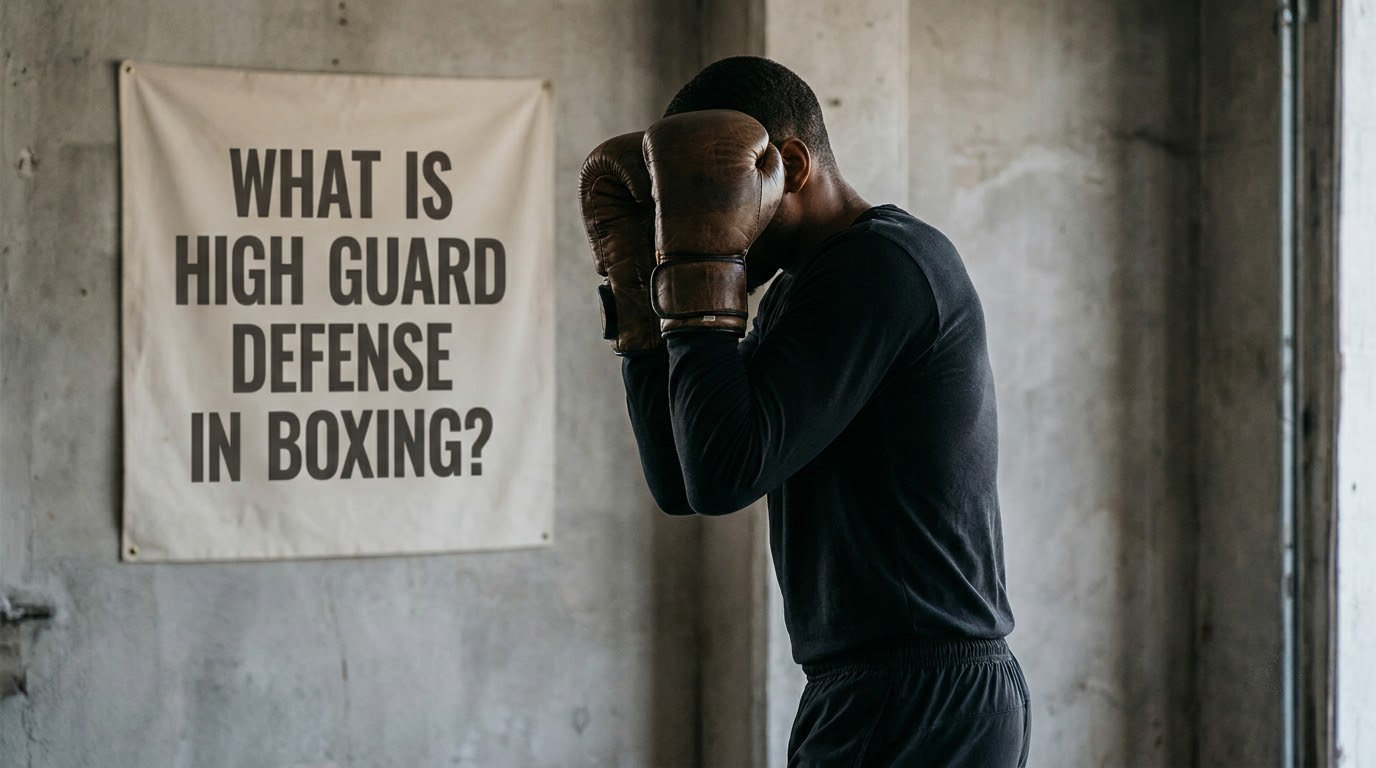
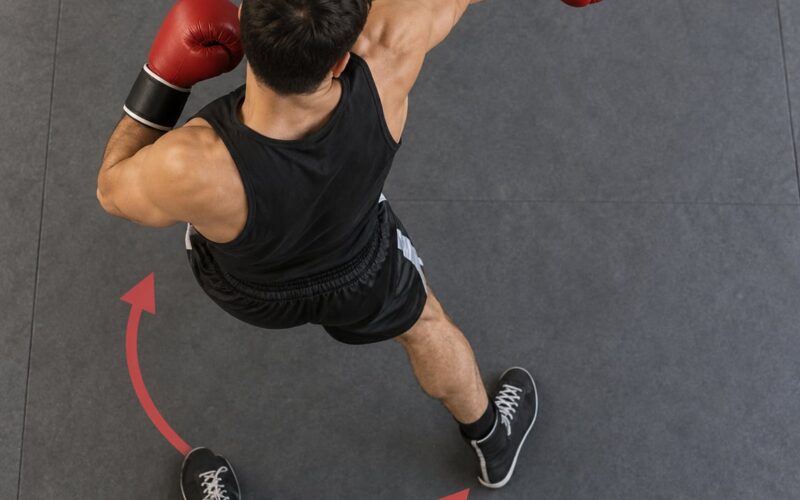
High guard is a defensive position where both gloves sit at or just above the temples, the elbows are tucked down and in against the ribs, and the chin is buried behind the shoulder and glove line. Your feet stay where they are in your normal stance, weight balanced, because the position is defensive without being a retreat.
It is more than covering the face with two gloves. A boxer hiding behind flat, floating hands is not high guarding. The real position has the elbows closed to shut the ribs, the shoulders lifted to protect the chin, the gloves pressed into the sides of the head rather than hovering in front of it, and the hands staying soft enough to move.
For a beginner watching tape, the tell is the elbow. If the elbows are out, the body is open and the guard is really just a hand position. If the elbows are in and the shoulders are up behind the chin, the whole structure is doing the work.
High guard also shows up under other names depending on the gym and the fighter. You will hear it described as the amateur guard, the shell guard or simply high guard defense. Bivol and other modern fighters use a looser, moving version of it rather than the fixed version beginners are taught.
Why High Guard Defense Works
Five things are going on at once when you hold a proper high guard, and each one covers a different failure point of the alternative.
Bone and gloves take the hit instead of your skull
The surface facing your opponent is forearm and glove. Those are tougher than a temple, and a punch landing on a forearm loses a good chunk of its force before it ever reaches bone underneath. Your head behind that surface gets rattled far less than it would on a clean shot.
A bigger target area means more punches miss
Hands held low leave a wide open channel down the center line. Hands up close that channel and add coverage on both sides of it. A punch has to be accurate, angled and fast enough to thread past your gloves instead of landing on them.
It saves energy compared with constant head movement
Slipping and weaving for twelve minutes is exhausting. Holding a compact guard costs almost nothing, so fighters can keep it for a full round and still have something left to answer with. That matters most in the later rounds, when tired arms make a guard collapse and the counter never comes.
It controls the straight punches
Jabs and crosses travel down the same line your gloves are occupying. Blocking those two punches is straightforward, which is why a high guard is such a solid answer against a straight-punch-heavy fighter.
Your eyes stay on your opponent
The biggest practical benefit is sight. A guard built around the temples, with gloves angled slightly outward, keeps the view down the center open. You can still read the shoulders and hips of the fighter in front of you, which is what tells you the punch is coming before it arrives.
Those five points are why high guard defense works: protection, coverage, energy efficiency, line control and vision, all at the same time. The technique is only as good as the placement, though, so getting the position right matters more than holding it for a long time.
How the High Guard Blocks Common Punches
Every punch has a different answer, and knowing which is which saves you from guarding with the wrong hand at the wrong moment.
Straight punches are the easiest to shut down
The jab and the cross come straight down the line your gloves cover. Meet them with the lead glove turned slightly outward, or catch them on the forearm, and you can slip the punch forward as it lands. A clean catch means your opponent’s arm is out of position for a moment, which is a counter opportunity on the spot.
Hooks need the elbow and shoulder, not just the glove
A hook goes around the side of your guard, so a glove alone will not stop it. Close the elbow down, raise the shoulder into the line of the punch, and turn your head out of the path. Tightening the elbow against the ribs is what blocks the wide hook; a raised glove with the elbow flared open does nothing.
Uppercuts and body attacks find the seams
An uppercut travels upward under the elbow line, and a body shot goes straight down under the guard. Neither is blocked by hands held at the head. The answers are elbow closure, shoulder pressure and footwork that moves the target, which is exactly why a high guard is a complete answer for the body and a partial one for everything else.
Lower-body attacks and kicks have nothing to do with the guard at all. If your opponent is kicking, the guard is not a solution.
The Key Benefits of a High Guard
The reason a coach puts a beginner in a high guard first is that it buys thinking time. While you are learning to read punches, the guard absorbs the ones you do not read yet, so you spend sparring working on judgement instead of panic.
Beyond survival, the practical benefits stack up. Head protection comes first, with the forehead, temples and chin covered by gloves, forearms and shoulders. The ribs and upper body get protection too as long as the elbows stay down. Then there is energy: a guard held properly costs far less than continuous head movement, which is the difference between being sharp in round ten and surviving it.
Composure matters more than most people expect. A fighter who trusts the position stops flinching and starts watching. Watching is what turns defense into offense, because a punch caught on the guard leaves the sender’s weight forward and their rear hand away from their face.
Control of distance is the last piece. A tight guard in close is a way to reset, breathe and make space, which is how a boxer wins a round without trading.
None of this makes the guard airtight. There are openings, and the sections below cover exactly where they are.
High Guard vs. Other Defensive Styles
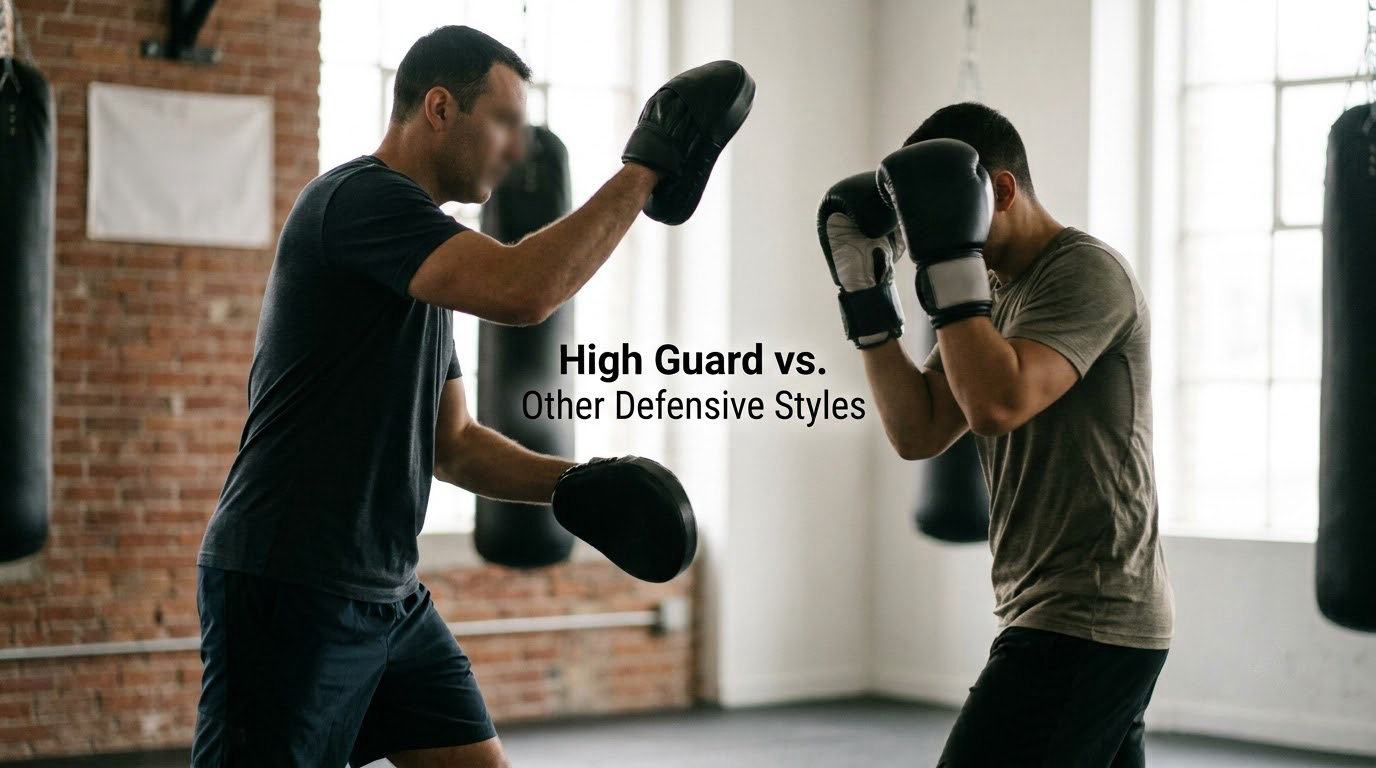
Each defensive style trades coverage for movement. The high guard gives up the ability to see clean and to hit freely, and buys protection in return. That trade suits some fighters and styles and suits others badly.
| Defensive style | What it protects | What it costs you | Best against |
|---|---|---|---|
| High guard | Head, jaw, ribs | Vision, counter speed | Straight-punchers, pressure at close range |
| Slipping and weaving | Everything, if timed | Energy, risk of timing errors | Faster opponents, counterpunchers |
| Rolling under punches | Head, sets up uppercuts | Low body position | Hookers and wide swings |
| Parrying with the hands | Straight punches, creates counters | Leaves the body exposed to hooks | Opponents who telegraph the jab |
| Shoulder roll | Head, and counters to the body | Very little against body work | Punchers who depend on the head |
The practical rule coaches give is simple: use a tight guard when you are under pressure and short on breath, and use head movement when you have the energy and the reach. Holding a high guard for twelve minutes against a fighter who moves well is giving away the one thing the guard cannot do.
How to Use a High Guard Without Getting Trapped
Most of the trouble people have with this position comes from treating it as a statue. It is a starting position that has to stay alive.
Keep the elbows controlled and low. Flared elbows are the single biggest giveaway, because they open the ribs and let hooks travel straight through the guard.
Keep the base stable. A narrow stance with the weight drifting onto the back foot turns a defensive position into a step backwards, and it removes the ability to push off into a counter.
Watch the shoulders and hips, not the gloves. Hands lie. The loading shoulder and the turn of the hips tell you what is actually coming, and if you can see them you get a head start on every punch.
Protect the body between shots. If you are bracing and absorbing for long stretches, you are taking body shots by choice. Rotate between the guard, a slip and a step off the line.
Move out instead of holding on. If you are getting hit repeatedly with the same punch, the answer is almost never a tighter guard. Step off the line, change the angle, or reset the distance, and let the pressure break.
One last practical fix. Beginners often get hit with their own gloves because the hands float in front of the face and collapse on impact. Press the gloves into the temples and cheeks, keep the forearms tight, and hold them firm without locking the arms.
When a High Guard Can Fail
Body punches are the clearest weakness. Hands at the head do nothing for the ribs, and an opponent who works the body will take points off you while your defense looks busy.
Wide hooks slip around the side of a guard that lacks elbow closure, and uppercuts come up underneath. A fighter who only ever blocks with the gloves gives away the openings that these punches need.
Forward pressure is the other problem. A tall, rangy fighter with a long jab can keep you in the guard round after round, and a pressure fighter who walks you into short range takes your best weapon, which is your own counter.
Fatigue works the same way. Once the arms get tired, the gloves drift down, the elbows open, and the position you spent twelve minutes trying to build collapses in the last round.
Becoming too passive is the least obvious failure and probably the most common. A fighter who only defends never wins, and in amateur scoring a blocked punch is not a clean punch, so a passive guard can lose you a round even when you were not hit hard.
Safety and Coaching Considerations
The high guard is a technical skill with clear physical demands. Position, elbow placement and footwork are best learned in front of a coach who can correct them in real time, and in the early stages you should be working pads and light drilling rather than trading punches.
Soreness in the forearms, wrists or shoulders during guard work is normal to a point. Sharp pain, joint pain, numbness, or a headache that does not settle is not. Stop training and get it assessed by a qualified medical professional rather than pushing through it.
Anyone with an existing injury, or returning to training after time away, should clear it with a doctor first. Head contact in sparring carries real risk, and protective gear plus a properly fitted mouthguard reduce it without removing it.
Train with supervision, respect the limits of the position, and if something hurts in a way you cannot explain, the answer is always to stop and ask a professional.
Frequently Asked Questions
Is high guard good in boxing?
Yes, as a foundation and as a short-term reset, particularly against straight-punchers and during exchanges at close range. It protects the head and jaw, blocks the highest-value punches, and costs little energy. It becomes a problem when it is held passively for long stretches, because body shots, hooks and uppercuts get through it. Good fighters use it as one option among several, not as their only answer.
What is the high guard style boxing position?
Both gloves are held at or just above the temples, elbows tucked down against the ribs, shoulders raised to shield the chin, and the head kept behind the glove line. Feet and weight stay in your normal stance so you can still move and counter. The key details are elbows closed, gloves pressed to the sides of the head rather than floating, and hands soft enough to adjust as punches come in.
Did Mike Tyson use a high guard?
Tyson was known for a high, tight guard in his younger work, with the gloves up around the temples and the elbows close, using the head position behind it rather than relying on it alone. He also moved his head constantly and leaned back, so it was never a static shell. Later in his career the hands sat lower, which was a deliberate adjustment as he aged and his style evolved.
Does Canelo use high guard?
Canelo uses a high guard selectively and blends it with head movement and footwork rather than relying on it. You will see his gloves rise to cover the head during an exchange or against a pressure fighter, then drop back to a mid-range position as he sets up his own punches. Treat high guard as one tool in his defensive set rather than a permanent stance he holds every round.
Why do gyms teach high guard if pros keep their hands lower?
Because it teaches a beginner to survive while learning to read punches, and it is easier to build than head movement. Professional fighters start lower because they have years of reads, footwork and timing that beginners do not have, and they can afford the risk. The position has not been abandoned by pros, either, since Winky Wright, Dmitry Bivol and others show versions of it that stay loose and keep moving.
Conclusion: Start With Position, Not Panic
Why high guard defense works is a short answer once you break it down: bone and gloves take the hit, a large surface closes the center line, the guard costs almost no energy, and your eyes stay on your opponent so you can answer. Used as a reset and a foundation, it is one of the most reliable positions in the ring.
Do not treat the gloves as an invulnerable shield. They do not cover the ribs, they do not stop a hook that goes around them, and they will not get tired for you. The fighters who use this position well, from Wright to Bivol, pair it with movement and make it part of a system rather than a place to hide.
Start with the position: hands at the temples, elbows down, chin behind the shoulder. Work it on pads and in the mirror until the elbows stop flaring, then step into sparring with a coach watching. That is the honest first step, and it beats guessing at it alone in 2026.