What is a rabbit punch in boxing? It is a blow delivered to the back of an opponent’s head or to the base of the skull, where the person taking it usually has no warning it is coming. It is banned in boxing and in every other major combat sport, because a punch to that spot can injure the brainstem and cervical spine in ways a punch to the face cannot.
The rule gets discussed after almost every big fight, usually because somebody turned their head at the wrong moment. That single detail — whether the puncher had a clear target — is the whole argument, and it is the part most explanations skip.
Table of Contents
What Is a Rabbit Punch in Boxing?
A rabbit punch is any punch thrown at the back of the head, the back of the neck, or the base of the skull. The name comes from hunting, where a rabbit was picked up by the loose skin at the back of its neck and struck once behind the ears to kill it quickly and leave the fur undamaged.
That hunting image is why the punch carries its name, and why rules treat it as a uniquely dangerous blow rather than just another punch. The mechanics of it matter as much as the name: the target sits where there is no muscle padding to spread the impact, no gloves in the way, and no time to turn or roll with it.
What separates a rabbit punch from an ordinary punch is the target, not the intent. A straight punch or hook thrown while the opponent is facing you is legal even if it lands on the ear or clips the side of the head. The moment the punch travels toward the back of the skull — the rear of the head, the neck, the area under and behind the ear — it is a rabbit punch and it is foul.
Why Is a Rabbit Punch Dangerous?
The danger comes down to anatomy. A punch to the face lands on bone and muscle that can absorb and spread force. The back of the head is a different structure entirely, and a blow there can affect systems that control basic functions.
- Brainstem. Sitting at the base of the brain where it continues into the spinal cord, it handles breathing, heart rate and consciousness. It is the part of the head least able to move away from an impact.
- Cervical vertebrae. The neck is a narrow column with the spinal cord running through it. A sharp blow to the base of the skull can jolt or rotate the head in a way that compresses or damages the cord.
- Vertebral arteries. These run through the neck and supply blood to the brainstem. Rotational force at the neck is the mechanism behind arterial dissection, where the wall of the artery tears.
- Subdural hematoma. Bleeding between the layers covering the brain can follow a head impact. It may not show symptoms immediately, which is why a fighter can look fine and collapse later.
The reason this is not just another painful shot is that the person receiving it cannot do anything about it. A fighter who gets hit on the chin has a fraction of a second to absorb it with a guard, a stance and a neck muscle. A fighter hit behind the ear has none of that, which is the entire reason the punch is banned.
The case that comes up most often in arguments about the rule is Prichard Colon. After being dropped by repeated back-of-the-head blows in a 2015 bout, he remained in a vegetative state for more than a decade before he died. The punches were legal on the way out. That gap is the whole point of the rule.
Rabbit Punch vs. Other Punches: What Is the Difference?
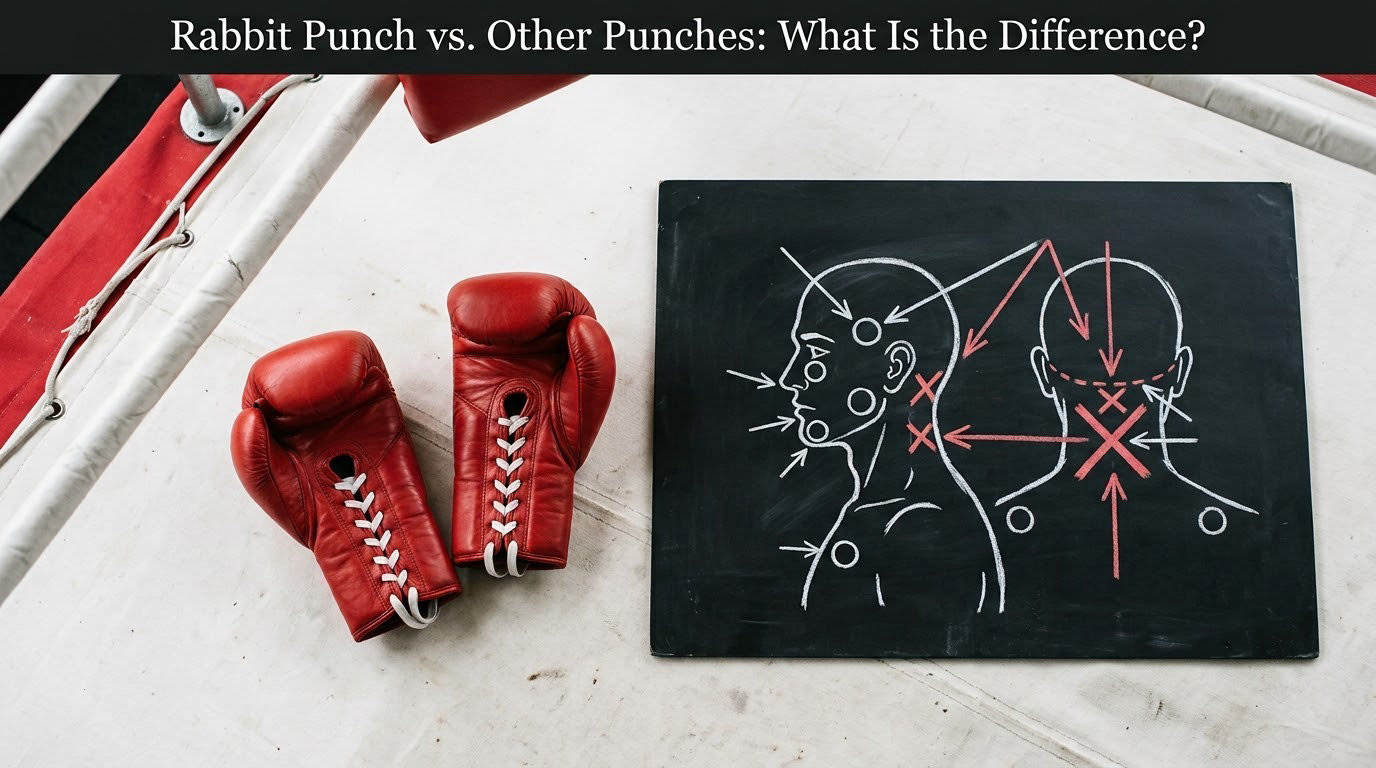
Every punch below is legal. The only variable that separates them from a rabbit punch is where it is aimed and whether the defender could see it.
| Punch | Where it lands | Direction | Can the defender react? | Status |
|---|---|---|---|---|
| Hook | Side of the head, jaw, temple | Horizontal arc from the side | Yes | Legal |
| Uppercut | Chin, nose, torso | Upward from below | Yes | Legal |
| Overhand | Top or side of the head | Downward from above | Yes | Legal |
| Backfist | Side of the head or body | Rear-facing knuckle | Yes | Legal |
| Rear straight | Guard, body, head | Direct from behind the glove | Yes | Legal |
| Rabbit punch | Back of head, neck, base of skull | Any direction into the rear zone | Rarely | Illegal |
Note the difference in the last column between the first two rows and the last. A backfist can travel in an unusual path, and an overhand comes from above rather than straight ahead, but both still arrive at a target the defender knows about. Trajectory varies. Only the target zone is prohibited.
How Referees Identify a Rabbit Punch
Officials do not use a checklist; they judge what they saw from ringside, and that is why every one of these calls gets argued. The signals they look for are consistent, though.
- The puncher moved around the outside. Stepping or leaning to an angle where the opponent’s eyes, guard and awareness are not pointed.
- The punch landed behind the head. Contact at the rear of the skull, the nape of the neck, or under and behind the ear rather than on the face or the visible side.
- The defender had no realistic chance to see it. The head was turned away, the fighter was moving forward, or the exchange began as a normal exchange and turned late.
- The follow-through shows no adjustment. A punch that was thrown on the way in and kept going past the guard is different from one the thrower stopped or redirected.
Intent matters to the penalty, not always to the call. A punch thrown straight into the back of a turned head is judged on the target; whether the puncher meant to be there changes how harshly it is scored.
Enforcement is not identical across the sport, and this is where a lot of the confusion comes from. Amateur bouts on smaller shows often produce very little action on accidental strikes — boxers and referees report the same thing, that back-of-head contact happens constantly and is usually waved through. Professional boxing runs on commission rules that vary by state, and MMA uses a single Unified Rules set, which regulars tend to find clearer.
Is a Rabbit Punch Illegal in Boxing?
Yes. It is prohibited in boxing, kickboxing, Muay Thai and MMA, and it is prohibited as a deliberate attempt rather than as an accident — which tells you where the rule draws its line.
State regulation is blunt about it. Hawaii’s boxing rules, for example, define a rabbit punch as any blow struck at the back of the neck near the base of the skull and bar it as dangerous, while still allowing a strike behind the ear when the receiver is facing away. Other states use similar wording. So the behind-the-ear question people argue about most has an answer in the rulebook, even when the referee hesitates on the call.
Other blows that are foul in boxing under most rule sets include:
- Headbutts and intentional strikes with the elbow or forearm
- Downward blows with the elbow, or blows to the back of the head from any position
- Low blows to the groin
- Punches thrown after the bell has stopped the round
- Blows with the head or the weight of the body on a grounded opponent, which is a specific MMA offence
Penalties escalate. A referee usually starts with a verbal caution. Repeat offences bring a point deduction, which decides rounds directly. A third offence, or a single deliberate rabbit punch that seriously hurts a fighter, can end the contest with a stoppage or a disqualification.
For a boxer on the receiving end, a blow like this is worth discussing with a doctor rather than pushing through. If you took a hard shot behind the ear and the symptoms — headache, dizziness, confusion, neck pain, vision changes — show up in the hours afterward, that is a reason to get checked, not to wait it out.
How Do Boxers Avoid Accidentally Throwing One?
Almost every rabbit punch starts as a normal exchange that goes wrong, which means the fix is about habits rather than rules.
- Keep the opponent in view. If you cannot see the head, you do not have a target. That includes during clinch work and after a knockdown, when bodies tangle on the canvas.
- Do not swing at a head that has turned away. The cost of missing by a few inches is higher than the reward of a landed shot.
- Pull short punches back. Committing to a short hook and finishing the arc is how a punch ends up on the back of the skull when your opponent slips off it.
- Reset when the angle is lost. Coming back to stance and re-establishing position is normal, and it looks far better than an accidental foul.
- Train the awkward rounds. Most rabbit punches land in exchanges where both fighters are off-balance or at odd angles. That is what sparring without full contact power is for.
For anyone watching rather than fighting, the habit that helps most is watching the shoulder and the foot, not just the gloves. A rabbit punch is visible from the hips up long before it arrives.
Frequently Asked Questions
Are rabbit punches illegal?
Yes, in boxing, kickboxing, Muay Thai and MMA. Rules bar a blow to the back of the head, the back of the neck, or the base of the skull. A strike behind the ear is generally allowed when the receiver is facing away from the punch. Penalties run from a verbal warning to a point deduction and, for a deliberate blow, disqualification.
What punches are illegal in boxing?
Alongside the rabbit punch, boxing rules foul headbutts, deliberate elbow or forearm blows to the head, downward elbow strikes, low blows to the groin, and punches thrown after the bell. In MMA the list adds punching or dropping onto a grounded opponent with a closed fist. Exact wording varies by commission, so the rulebook in force on the night governs.
Is a punch behind the ear a rabbit punch?
Usually not. The area just behind the ear is a gray zone, and state regulations often treat a strike there as legal when the opponent is facing away, because they can see it coming. What is not in doubt is a blow to the back of the skull or the nape of the neck. That is the zone that makes a punch illegal.
Why is it called a rabbit punch?
The name comes from rabbit hunting. A hunter would lift the animal by the loose skin behind its neck and strike once behind the ears, which killed it quickly and left the fur intact and sellable. The technique was efficient and looked harmless. The name is a reminder of the blow, not a compliment.
What happens when a rabbit punch lands?
The immediate effect is a blow the defender cannot absorb with a guard or a neck muscle. The medical concern is the brainstem and cervical spine, where a sudden impact can cause bleeding or cord injury that may show up hours later. Any symptoms that appear after the bout — headache, dizziness, confusion, vision changes, neck pain — are worth a doctor’s visit, not a nap.
How do referees judge rabbit punches?
They look at angle, target and awareness: whether the puncher moved around to the blind side, whether the blow landed behind the head or neck, and whether the defender had any chance to see or avoid it. Intent usually affects the penalty rather than the call itself. Amateur enforcement is looser than professional or MMA, where the Unified Rules apply.
Back to the first question: a rabbit punch is any blow to the back of the head, neck or base of the skull, and it is illegal because the person taking it cannot see it or brace for it. If you are fighting, keep the head in front of you and pull your hooks back when the angle goes. If you are watching, follow the shoulder. And if you took one that night, do not shrug off symptoms in the morning.