Yes, reach matters in boxing, but only when a fighter converts it into usable range. A longer arm span lets a boxer land the jab from outside the opponent’s punching range, but one step back closes the gap. Reach is a tool, not a win condition.
That distinction is where most of the argument online gets muddy. The r/Boxing consensus is blunt about it: reach puts you in a spot where you can hit your opponent and he cannot hit you, which is a real edge if you know how to use it. Older training communities reached the same conclusion back in 2008, and nothing since has changed it.
So does reach advantage matter in boxing? It matters at the level of range control, jab economy and defensive options. It stops mattering the moment a fighter with better feet takes it away. What follows is how the measurement works, what each physical advantage actually buys a fighter, and the matchups where the longer man lost anyway.
Table of Contents
- Does Reach Advantage Matter in Boxing?
- How Longer Reach Changes the Fight
- Reach Advantages by Boxing Style
- Reach Versus Height, Arm Span and Ring Size
- How Fighters Turn Reach Into an Advantage
- What Fight Footage and Statistics Reveal
- Does Reach Advantage Matter in Boxing? Final Verdict
- Frequently Asked Questions
- Conclusion
Does Reach Advantage Matter in Boxing?
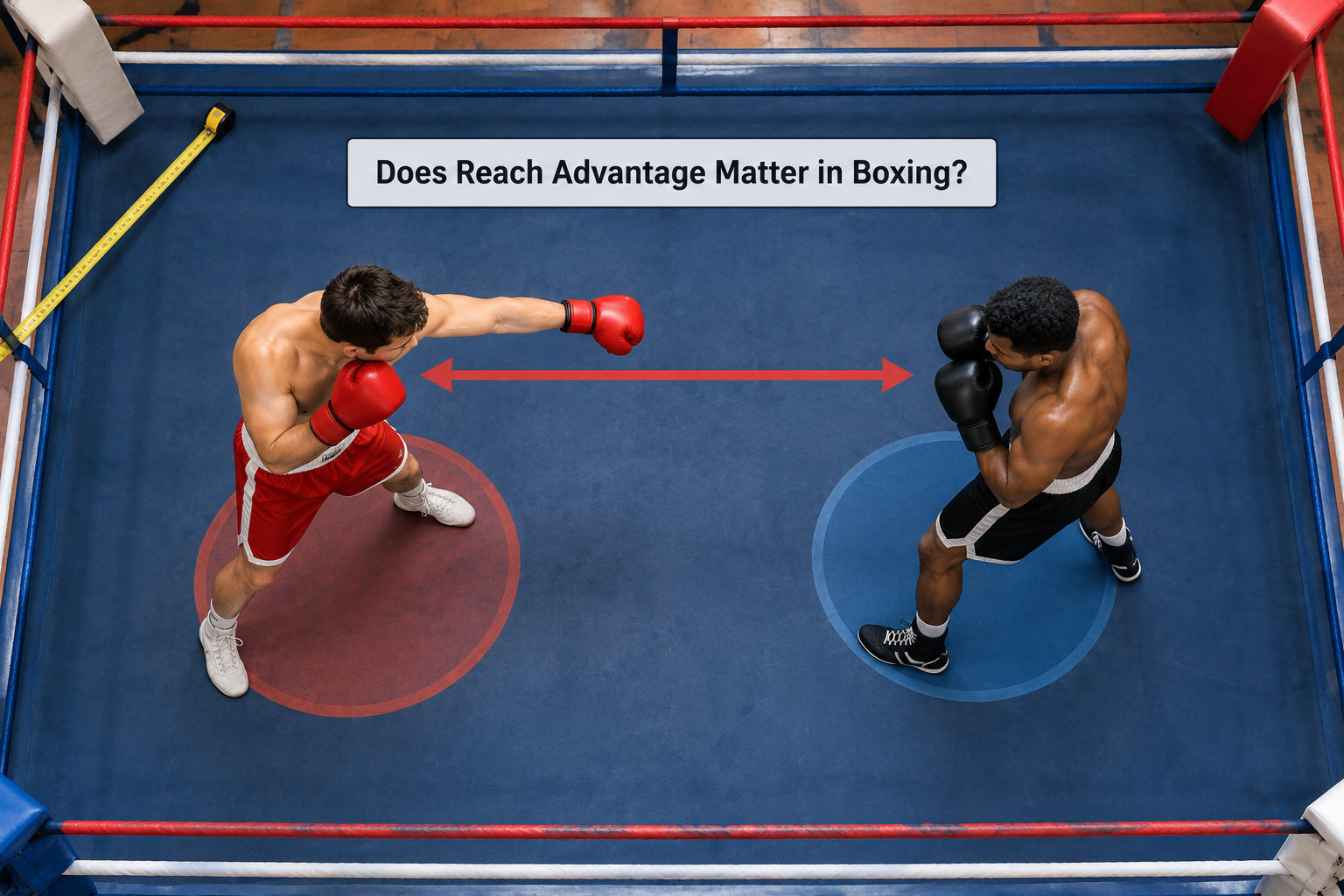
Reach matters when a boxer can use it consistently without giving up movement, accuracy or defensive control. It becomes an advantage only when arm length is turned into effective punching range.
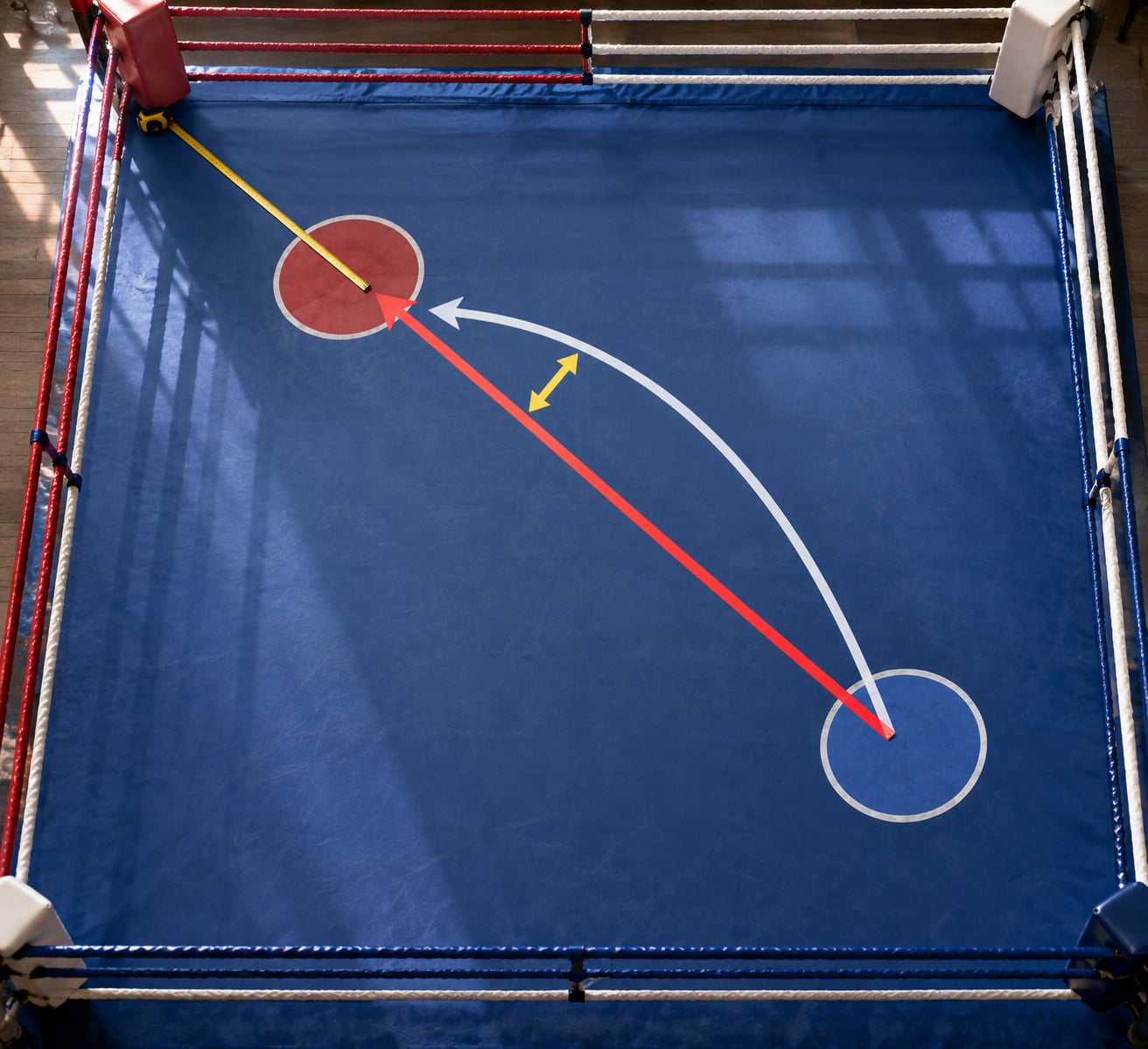
Stated plainly: a reach advantage gives a fighter first access to the outside of the exchange. From there he can jab, pivot off and reset before a counter comes back. But reach that a fighter cannot keep means nothing at all, because range is a property of the feet, not the arms.
A useful test is to watch where the feet are, not where the gloves are. If both fighters are standing at the same distance and the longer one is losing the exchange, the reach has already been neutralised.
How Boxing Reach Is Measured
Reach in boxing is arm span: the distance from the tip of one fully outstretched middle finger to the tip of the other, measured across the back with both arms extended. The average professional is commonly listed at around 71 inches, or 180 cm.
Reach is not the same as height. A 5-foot-11 boxer with a 74-inch reach has more punching distance than a 6-foot boxer with a 72-inch reach, and the taller fighter may be the harder one to hit because his torso is a bigger target.
Nor does reach tell you what happens inside the ring. A fighter can measure well and still punch short if he tucks his chin, drops his lead shoulder or plants his feet flat. Numbers are a starting point for evaluating a matchup, not a conclusion.
How Much Reach Advantage Is Meaningful?
There is no universal threshold. The same four inches are decisive against a pressure fighter who needs to get inside and irrelevant against a boxer who is already comfortable at mid-range.
| Reach differential | What it tends to mean in practice | Who it changes most |
|---|---|---|
| 1 to 2 inches | Almost never decisive on its own | Nobody; treat it as noise |
| 3 to 5 inches | One clean step of jab range, meaningful over a long fight | Pressure fighters and counterpunchers with angles |
| 6 to 9 inches | A full head of outside fighting before anyone has to commit | Slower movers who rely on entering the pocket |
| 10 inches or more | The shorter fighter must take real risk to land anything | Everyone, until the taller man fails to use it |
The step matters more than the total. Amateurs talk about a fifteen-inch advantage being erased by one foot step, and the forum version of that claim is roughly right: a single step of roughly 20 inches plus a jab recovers most of a large gap.
How Longer Reach Changes the Fight
Longer reach changes three things at once: how far away the jab starts, what angles a fighter can reach without crossing his feet, and how much warning he gets before a counter comes in.
It also changes what the opponent is allowed to do. A short pressure fighter cannot simply walk forward, because every step forward is a step into range he cannot yet reach. He has to create an opening first, and that is where most shorter fighters get picked off.
The counter is that range only works if it is held. The moment a longer fighter gets dragged into a clinch or crowded onto the ropes, several inches of reach advantage become a handful of inches of punching room.
Why Reach Can Protect a Smaller Fighter
A shorter out-boxer uses reach as a shield by keeping the fight in the space his opponent has to cross. A straight lead hand and a quick exit after each punch mean the pressure fighter spends most of the round lunging at nothing.
Longer angles are the quiet advantage. A fighter who pivots off the lead foot can land the same jab from a position his opponent’s straight line cannot answer, so each extra inch of arm becomes more than one inch of usable range.
Keeping the opponent at bay also controls the round. If the long jab lands often enough, the shorter fighter is denied the inside work he needs to hurt anyone, and fights that reach away from a good body puncher tend to be winnable by drift.
Why Reach Can Hurt a Taller Fighter
Long limbs create real problems inside. A taller fighter’s guard is harder to compress, so hooks and uppercuts travel further to reach the head, and the shorter fighter’s whole frame fits inside the arc of a punch meant for someone level with him.
Exits get awkward too. Pivoting out from a press while a smaller opponent is attached to the body is harder when the hips are further from the centre of the ring, and a fighter who cannot slip the roll often finds himself pinned against the ropes with no angles left.
Awareness is the other leak. Fighters with long reach sometimes stop watching the near hand, because it cannot reach them. That is exactly the punch that lands.
Reach Advantages by Boxing Style
Reach is not a style-independent stat. The same seven inches are worth far more to a boxer who wants to fight outside than to one whose entire game happens at close range.
| Style | What reach gives them | Where the advantage breaks |
|---|---|---|
| Out-boxer | Jab range, ability to reset, control of the outer ring | When pressed into the pocket with nowhere to exit |
| Pressure fighter | Less; they must still close the distance | Every inch longer, since they fight forward |
| Counterpuncher | More warning on incoming punches and a cleaner exit line | If they load the counter from too far back |
| Switch-hitter | Two distinct outside lanes to work from | Changing stance can cost a beat of range |
| Southpaw vs orthodox | Different angles, so a reach edge rarely lines up cleanly | The lead-hand side mismatch changes who is longer |
| Mobile inside fighter | Almost nothing, and often a disadvantage in the pocket | Long frames are hard to compress on the ropes |
The southpaw row is the one people get wrong most often. Because a southpaw leads with the rear side, a reach advantage measured fingertip to fingertip does not reliably translate into the lead hand that throws first. Sometimes the shorter fighter has the more useful jab.
Reach Versus Height, Arm Span and Ring Size
Height, arm span and reach overlap but do different jobs. Arm span is the raw measurement. Reach is the boxing term for the punching distance that measurement implies. Height adds a taller torso, a higher centre of gravity and a bigger body.
The cleanest way to separate them is the Ape Index, which is reach minus height. A positive number means a fighter is long-armed for their frame rather than simply tall.
| Fighter | Height | Commonly listed reach | Ape Index | Note |
|---|---|---|---|---|
| Mike Tyson | 5 ft 10 in | 71 in | +1 in | Average span for his height, and irrelevant to how he fought |
| Manny Pacquiao | 5 ft 5 in | 67 in | +2 in | Short and long-limbed for the division, with speed doing the rest |
| Sonny Liston | 6 ft 1 in | 78 in | +5 in | A large edge over most of his heavyweight field |
| Larry Holmes | 6 ft 3 in | 78 in | +3 in | Tall for heavyweight but not lanky, and difficult to hit |
| George Foreman | 6 ft 3 in | 79 in | +4 in | Bigger reach than Holmes, and he lost to him |
These are commonly listed measurements rather than weigh-in records, so check a fighter’s official listing before citing a figure. The pattern holds regardless: the biggest Ape Index in the table belongs to Liston, and the two fighters with the smallest both built their games around speed and angles instead.
Ring size is the third variable people skip. The same reach edge matters less in a smaller ring where a pressure fighter cannot cut an angle, and more in a larger one where there is always space to reset.
How Fighters Turn Reach Into an Advantage
Long-reach fighters are routinely told to use their reach and given no technical detail. The usable version comes down to a few concrete choices.
- Lead hand first. A jab that starts from a properly extended lead shoulder gives the full measurement. A jab thrown with the elbow tucked throws away inches for free.
- Punch in straight lines. A long straight punch travels furthest down the centre line. Hooks lose distance as they bend, so the reach advantage is largest on the jab and the straight right.
- Shoulder over the hand. Rotation, not arm extension, is what makes a long punch accurate. Reach without shoulder alignment produces fast punches that land on the guard.
- Move after the jab, not during it. The exit starts the instant the jab retracts. Fighters who stay flat after punching have already thrown away the advantage.
- Cut the ring, do not circle it. Without a leg trap, moving sideways hands over the only zone where the shorter fighter wants to work.
- Refuse the lazy jab. Meeting the jab with a dip rather than a catch keeps the distance intact instead of conceding it.
For the shorter fighter the list is defensive and positional: dip under the jab instead of blocking it, work the body where the long jab cannot protect, use the angle to make the long punch miss, and stay out of the clinch unless you have already won the exchange.
What Fight Footage and Statistics Reveal
When you want to know whether reach actually decided a fight, five things in the footage answer it faster than any preview.
- Starting distance. Where the fighters stand before the first exchange tells you who chose the range.
- Jab landing rate. A long jab that lands on the guard every time is a reach advantage being wasted.
- Counters over the lead. Watch the near hand. That is the punch reach keeps out of play, and the punch that ends most bouts.
- Punches thrown from genuine range. Count exchanges won outside rather than total punches thrown.
- Who controls the feet. If one fighter is always being moved and the other never is, the reach edge has been cancelled.
The same five checks work on a stat sheet. Jab accuracy, distance at the moment of impact and punches landed from outside the pocket tell a cleaner story than total output, which flatters the fighter who spends twelve rounds throwing from range.
Does Reach Advantage Matter in Boxing? Final Verdict
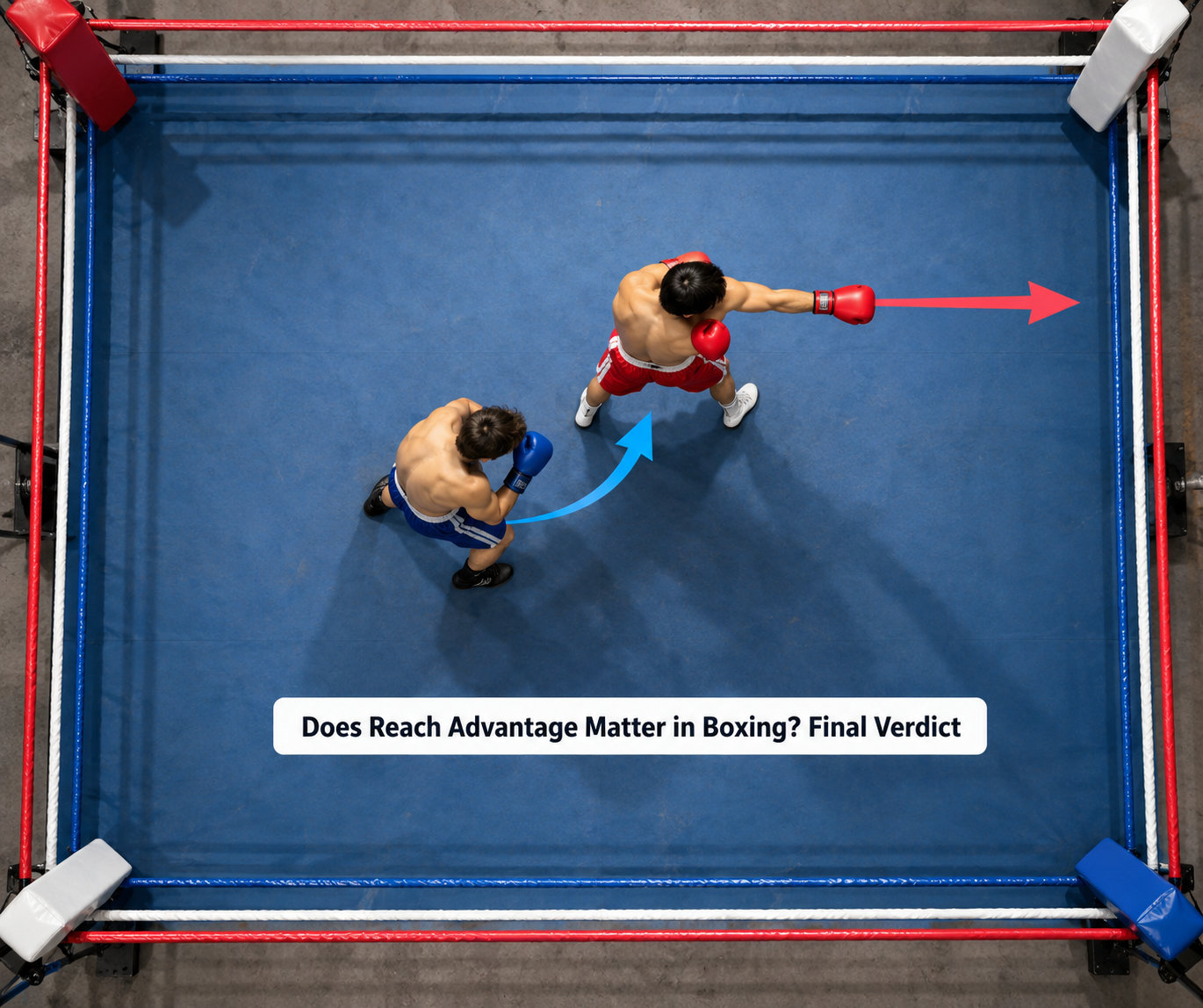
Reach pays when the fighter controls the outer ring, wins exchanges at long range and enters safely. Reach fails when it stays in the measurement sheet and never reaches the canvas.
Every matchup is different, but the pattern holds. Mike Tyson fought Eddie Richardson with an enormous height and reach disadvantage and won because he never let the fight sit at long range. George Foreman had Holmes on reach and lost because Holmes made him come forward and then took him apart after entering. Sonny Liston had a large Ape Index and used it, and that is the version of the advantage worth copying.
So the useful question is never how many inches longer one fighter is. It is whether that fighter controls the feet, lands the jab and exits without handing back the counter.
Frequently Asked Questions
Is reach more important than height in boxing?
Height adds a bigger body target and a longer torso, which matters most against a fighter who needs to work inside. Reach adds punching distance and range control, which matters most against a fighter who wants to stalk from the outside. Neither beats the other on its own. A tall fighter with average reach can beat a shorter fighter with a huge span, because the span is useless if the fighter loading it cannot land accurately.
Why can a boxer with longer arms still be outboxed?
Because arms do not create range on their own, feet do. A shorter fighter who dips under the jab, works the body and attacks off the angle can take away the outside without landing anything clean. Once the fight is at close quarters, several inches of reach shrink to almost nothing. The classic example is Mike Tyson against much taller opponents: he conceded every measurement advantage and won by refusing to fight at long range.
Does reach advantage work the same against a southpaw?
Not reliably. Because a southpaw leads with the rear side, a fingertip-to-fingertip advantage does not always show up in the lead hand that throws first. An orthodox fighter with more reach may find their jab gets intercepted by the southpaw’s rear hand. The practical answer is to watch the lead hands in sparring rather than the number on the record.
Is a two-inch reach difference significant in boxing?
Rarely on its own. Two inches is smaller than a single meaningful step back, and it disappears in any exchange where either fighter pivots. Across a twelve-round fight it can accumulate into a small cumulative advantage in jab volume. Treat it as a tiebreaker rather than a deciding factor, and look at footwork before you look at the measurement.
Can reach advantage make a fighter less effective in close quarters?
Yes. Longer frames are harder to compress, so hooks and uppercuts have further to travel, and a taller fighter’s guard leaves more space for body work. Exits also get awkward when a long fighter is crowded, because pivoting away from pressure is harder with the hips further from the centre. Plenty of long fighters have been undone simply by being made to fight where they are weakest.
Conclusion
Does reach advantage matter in boxing? It matters, and it should, because it decides who gets the first punch and who chooses the range. But it is a physical starting point rather than a prediction.
Before you call a fighter the favourite, watch three things: whether the longer fighter controls the distance, whether the jab actually lands, and whether he can leave again without giving up a counter. Those three answers tell you more than any measurement chart.