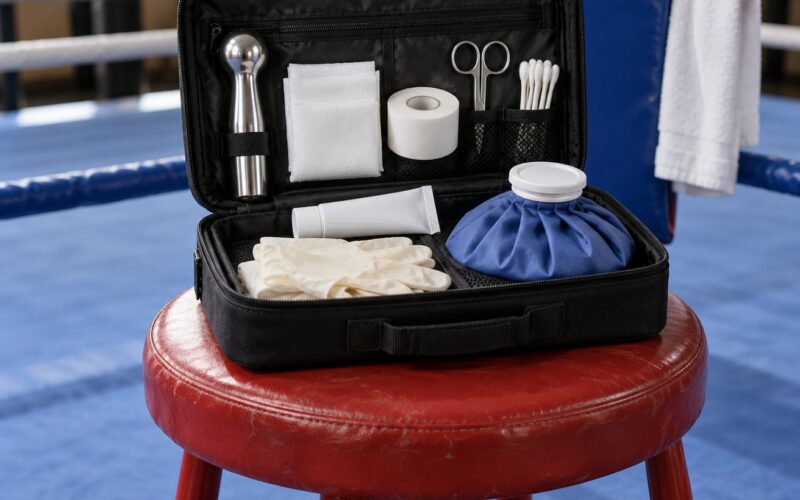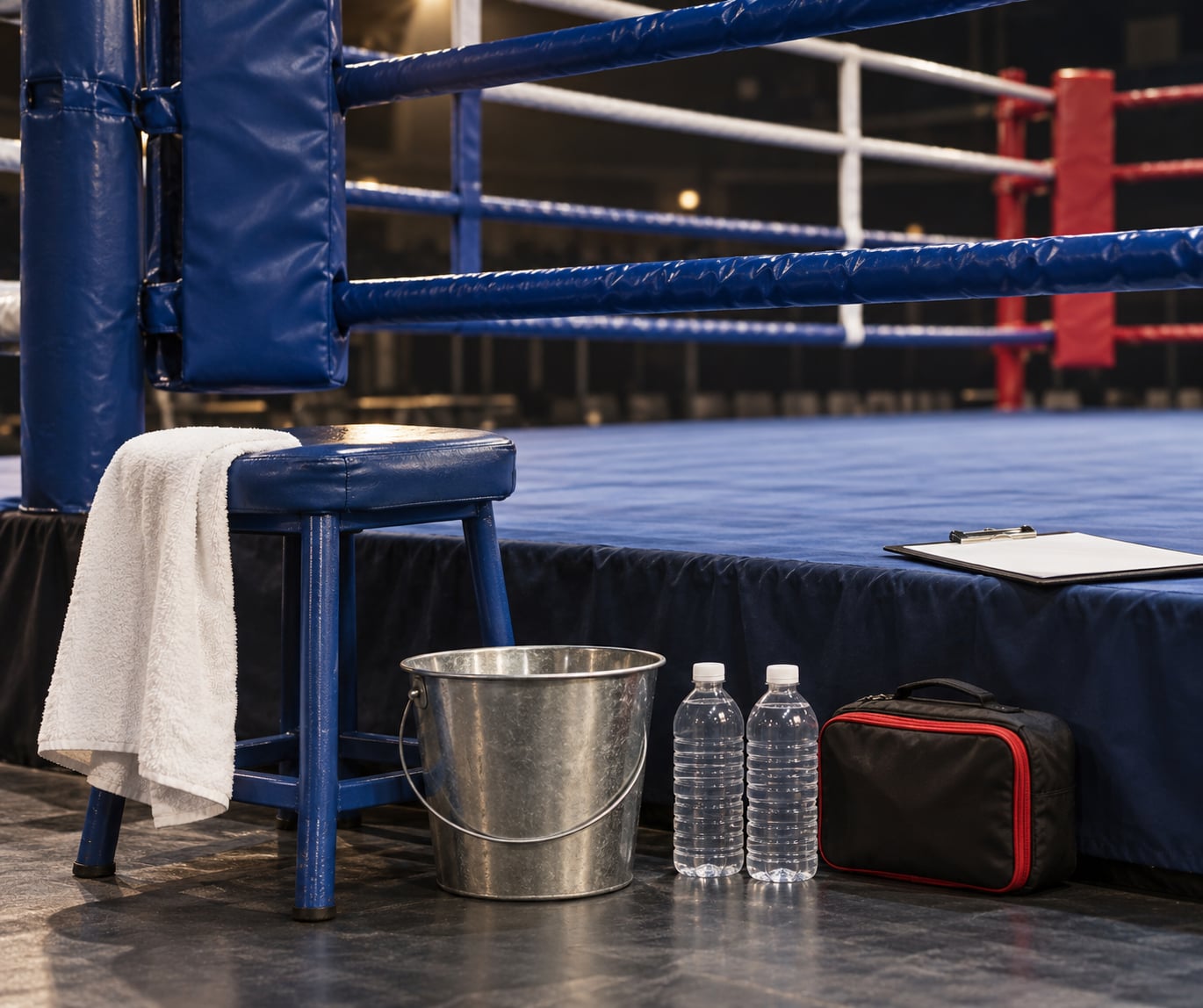
A cornerman is the person in a fighter’s corner during the one-minute rest between rounds: the trainer or chief second giving instructions, the cutman treating cuts and swelling, and whoever holds the bucket and the stool. What a cornerman says between rounds is short and specific — a single instruction, a goal for the next round, and a cue to breathe and settle.
Below are the seven lines you will actually hear in almost any professional or amateur corner:
- “Hands up.”
- “Breathe.”
- “Double jab.”
- “You’re ahead — stay busy.”
- “Step left after the cross.”
- “He’s gassing — make him work.”
- “One more round. Let’s go.”
The rest of this guide unpacks why those lines are so short, who in the corner is allowed to speak, and what happens when a corner has nothing useful to say.
Table of Contents
What Does a Cornerman Do Between Rounds?
A cornerman does four things in sixty seconds, and they compete for the same time: treat the fighter’s body, control the fighter’s breathing, give one tactical instruction, and decide whether the fighter is fit to continue. A corner that tries to do all of them at once usually manages none of them well.
The fighter sits on a stool at the corner post, still sweating, still breathing hard, still running on adrenaline. That physical state is the single most important fact about the conversation, because it explains everything about the wording. A person who has just fought three hard rounds is not in a condition to sit through a seminar.
Who is actually in the corner
Boxing commissions allow a small team into the corner, and the roles inside that team are usually split so that the person talking is not the person cutting.
| Role | What they do in the 60 seconds | What they say |
|---|---|---|
| Chief second | Sets the goal for the round, gives one or two instructions, decides if the fighter continues | The tactical calls |
| Cutman | Checks for cuts, applies haemostatic and vaseline, presses on swelling, hands over water | Routine prompts: “breathe”, “spit”, “open your eye” |
| Trainer or manager | Emotional steadying, watches the fighter’s eyes and breathing for signs of a stoppage call | Reassurance, or silence |
In amateur boxing this is usually two people, sometimes one person doing all of it badly. In professional boxing the modern corner is often three: the trainer, a dedicated cutman, and a second coach. The classic two-man corner of the mid-twentieth century is still the reference point most fighters picture when they describe a corner.
How a cut gets closed in the time available
Cut work is the reason the corner is a working team rather than a coach with a stopwatch. A superficial laceration is closed by pressing a haemostatic agent or adrenaline solution into the wound with a clean cloth, holding firm pressure, then sealing it with petroleum jelly or vaseline so the skin does not reopen on the next shot. Swelling is a separate job handled with an endswell — the metal ice-swell that a cutman fills with water and freezes overnight — pressed gently against the brow to hold the swelling down and keep the eye open.
Two details separate competent cutmen from improvised ones. Vaseline works well on the cut itself and badly on the brow bone, where a thick layer turns the fighter’s forehead into a slipping surface; experienced cutmen use it sparingly above the eye. And nobody blows a bloody nose, because the pressure drives blood toward the eye socket and the swollen lid closes the eye that was the fighter’s best one.
Boxers who corner their own fights can learn a rough version of this, but the honest statement is that a trained cutman is doing skilled medical work in sixty seconds and an untrained person improvising is the reason so many amateur bouts end up with a fighter who cannot see out of one eye.
The non-verbal half of the conversation
A lot of what a cornerman says between rounds is not said at all. The stool going into the corner is a message: sit down, you are safe here, this is over for sixty seconds. A hand on the fighter’s back is steadying, not steering. The bucket being held out, then held back, tells the fighter how much they can drink right now. And nobody who is not the chief second speaks — silence from the rest of the team is treated as correct behaviour, not as indifference.
What a Cornerman Says Between Rounds
Corners lead with tactics. Fighters and corners both know motivation matters, but a fighter who has just been hit for twelve minutes cannot be motivated into a better round; he can be told exactly what to do for the next three. That is why the seven lines above are mostly technical or situational. Here is how the common ones decode.
What a cornerman says between rounds is never a speech
Ask a fighter what their corner said after round eight and you will usually get one sentence, often just a verb. That compression is not the fighter failing to remember; it is a fair record of what was said. The corner talks for perhaps fifteen of the sixty seconds, and most of that is tactical rather than motivational.
| Phrase | What it sounds like | What the corner actually wants |
|---|---|---|
| “Hands up” | Constant reminder, almost a reflex | Guard back at the cheekbones; stop giving the chin away on the reset |
| “Breathe” | Said while the fighter is gulping air | Slow the breath so the next round doesn’t start in panic |
| “Double jab” | One word, usually repeated twice | Take the initiative again instead of waiting for the counter |
| “You’re ahead” | Reassurance, usually to a fighter who looks unsure | Stop drifting into the opponent’s rhythm out of nerves |
| “Just coast” | Sounds safe, means surrender | A trap — coasting hands over a win to the judges |
| “He’s tired” | Observation about the opponent | Press the pace now, because it will not last |
| “That’s the fight” | Meaning: that was the mistake you cannot afford | Name the pattern once, then drop it and focus forward |
| “He’s your belt” | Crowd work, quoted everywhere | Not much; enthusiasm is not an instruction |
The table matters because most of these lines mean something narrower than they sound. “Double jab” is not a request to jab twice; it is a request to be the one who decides the distance. “Breathe” is a medical instruction disguised as a motivational one, aimed at a fighter who is about to hyperventilate and start the next round without any gas left.
The corners people still talk about
Most corners are anonymous, which is why the famous ones stick. Muhammad Ali’s corner through the late 1970s was the version everyone had in mind, and the image of Ali standing beside his cornerman at Madison Square Garden during the Earnie Shavers fight is the single most reproduced photograph of the between-rounds moment. Cus D’Amato, Eddie Futch and Angelo Dundee worked the same craft from different temperaments, and the part they had in common was that the memorable line was usually the shortest one.
The failures are just as documented. A Sherdog forum thread titled around the worst advice from corner men collects decades of community recollection about corners that panicked in front of their own fighter, most of it circling the same example — Mark Coleman shouting at Gary Goodridge that he was fine while Goodridge was on the canvas taking punishment. It is community recollection rather than a verified transcript, and it is popular precisely because everyone recognises the behaviour: a corner that raises its own fear and hands it to the fighter.
Corner language is not the same everywhere
Not every corner talks in full English sentences. Thai and Cambodian camps have their own stock calls, and “oowee” is the one that reaches English-language audiences most often. It is a sharp percussive encouragement — closer to a bark than a word — and it carries no tactical content. Inside a camp it functions as a rhythm marker, something the fighter’s body recognises without the brain having to process it. Spanish-language corners in Latin America and ringside in Las Vegas run on short imperative Spanish; the vocabulary changes, the grammar does not. Two or three words, one instruction, no sentences.
How Corners Give Different Kinds of Advice
“Corner advice” is not one thing. It splits into five kinds, and the useful thing for a fan or a fighter to understand is which kind is being delivered in a given sixty seconds.
Technical corrections
This is the most durable kind, because it stays true after the adrenaline drains. A corner naming a repeated mechanical fault — dropping the lead hand on the exit, planting the rear foot on the jab, pulling the head back after the level change — is giving the fighter something they can carry into the next fight. These corrections are rarely phrased as technique jargon. They sound like “don’t drop the hand” or “chin down after you miss.”
Tactical changes
These are situational and expire within the bout. Stop going to the body after round four because the opponent has stopped bending. Stop chasing after the counter because it is emptying the tank. Slow down because the last two rounds cost more than they returned. A good corner makes maybe one tactical change per round, because a fighter can execute one new idea and not three.
Emotional reassurance
Half the corner’s job is getting the fighter’s heart rate down and their breathing under control before the bell. A fighter who thinks he is losing panics; a panicking fighter gasses out two rounds early. Forum discussion of corner work keeps circling the same point, and a podcast clip put it plainly: the best corner advice isn’t advice at all, it’s calm. That framing shows up again and again in fighter and fan discussion, and it is the opposite of a corner that hurls motivation at a hurt fighter.
Recovery cues
These are procedural and almost boring: breathe, rinse your mouth, spit, take two sips not four, open your eye for the cutman, do not blow your nose. The last one is a genuine cutman rule — blowing the nose sends blood and swelling toward the eye and can turn a manageable nosebleed into a closed one. Corners that treat recovery as housekeeping end up with fighters who cannot see out of one eye by round eight.
Urgent safety concerns
When a fighter has taken a hard shot and gone quiet, the conversation changes character completely. The corner stops coaching and starts assessing: is this fighter present, are the eyes tracking, can they answer a question, can they stand on time. That assessment belongs to the corner, the referee and the ringside doctor together, and it is the only situation in which the sixty seconds is not really about the next round.
The lines corners are told to avoid
Plenty of corners say things that sound supportive and are not. “You’re fine” after a knockdown is the standard example: fighters and forums treat it as a red flag rather than kindness, because it denies what the fighter just experienced and gives him nothing to work with. “He has no power” is the classic version — corners say it to soften a fighter who has just been dropped by a shot he previously shrugged off. “Stick to the game plan” becomes an excuse for a corner that cannot adjust. “Just coast” hands a win to the judges in a sport where most decisions are close and none are rewarded for caution.
Lennox Lewis has described the standard from his own corner’s point of view: the job is not to tell a fighter what he wants to hear, it is to tell him exactly what he needs to hear. That is a harder sentence to deliver on a stool than “kick his ass,” which is why the good corners sound flat and the famous ones sound loud.
Why Cornerman Instructions Are Usually Short
The reason instructions are short is not style. It is that a fatigued fighter can hold about one idea, and a minute is barely enough time to say three of them. Everything a corner says competes with three other things happening at once: the cutman’s hands, the fighter’s own ragged breathing, and the sound of the crowd and the referee giving the thirty-second warning.
A practitioner primer from the Science of 8’s site, aimed at Muay Thai seconds rather than boxing trainers, puts three principles on it: be relevant and be concise, know what you are talking about, and do not act out. Those three lines have aged better than almost anything else written on the topic, and the third one is aimed at a specific failure mode — a corner that gets louder every round and gradually talks itself into believing its own pep talk.
In-round calls are not between-rounds calls
There are two different voices in a corner, and people mix them up. During the sixty seconds of action a corner shouts two or three words at most — “hands up”, “breathe”, “double jab”, “left hand”. During the rest, the same chief second gets maybe two or three full instructions and a goal for the round. The in-round call is a reflex trigger; the between-rounds instruction is a decision. Treating them the same is why some corners seem loud but useless.
The same practitioner material that insists on brevity also warns against crowd catchphrases. “It’s your belt!” and “kick his ass!” are crowd work. They raise noise, they do not raise output, and a fighter who relies on them has no plan for the round where he is behind on the scorecards.
How a Boxer Should Listen and Respond
A fighter gets more out of the sixty seconds than most do, and the difference is mostly about listening rather than talking back. The pattern that works is simple.
Sit down first. A fighter who stands through the rest of the round stays in fight mode and keeps burning gas he needs. Then let the cutman work without interrupting, because pulling at a swelling eye or asking about a cut mid-treatment slows both jobs down.
Listen for the instruction, not the speech. If the chief second says one thing, do that one thing. Fighters who try to hold three instructions from three people walk back to the neutral corner having done none of them, which is exactly the failure a good corner is trying to prevent.
Ask one question, and only if it changes the round. “Am I ahead?” is a bad question, because a corner cannot see the scorecards and does not want to guess. “Is he coming forward?” is a good one, because the answer can be executed in the next sixty seconds.
Apply one adjustment. Fighters who come out of the corner and immediately revert to the same patterns that got them hurt have wasted the instruction, and the second has no way to know whether the problem was that he did not hear the note or that he did not believe it.
For amateur fighters cornering their own bouts, the realistic version is smaller: one person does the talking, one does the water and ice, and neither talks over the other. Most bad amateur corners are not dishonest, just crowded — four people shouting different tactical ideas at a tired seventeen-year-old who cannot process any of them.
When a Cornerman May Not Be Able to Help
Corners have real limits, and pretending otherwise is how fighters get hurt.
Time is the first one. Sixty seconds includes sitting down, treatment, water, the thirty-second warning and standing up. On a bad cut or a bad round, the tactical conversation is what gets dropped, and that is the correct trade.
Hearing goes next. A fighter who has been softened with repeated shots to the ear or head may take in a fraction of what is said. So can a fighter who is hypoxic and convinced he understood everything. Corners that have worked on it say the instruction twice, use the same word each time, and confirm with a hand signal the fighter can see.
Vision fails quietly. A swelling eye that looks like a minor bruise on the stool can be half-closed by round ten. If a fighter cannot make out the opponent’s stance, tactics are academic until the cutman deals with it.
Scorecards are a genuine unknown. No corner knows for certain how the fight is being scored, so “you’re ahead” is almost always an impression built on punches landed rather than an actual read on the judges’ cards. A corner claiming certainty is selling comfort.
Arguments inside the corner make everything worse. When two corner members disagree in front of a seated fighter, the fighter leaves the stool with two instructions and an order to pick one, and the raised voices cost him the calm that was the whole point.
Some situations are simply not the corner’s to solve. A fighter who cannot answer a question, whose legs will not move, or who is being hit clean and repeatedly has a problem no line of dialogue addresses. Who decides to stop a boxing fight in that case? Formally, it is the referee’s call, based on what he sees and what the ringside doctor advises. A corner can throw in the towel or signal the referee to stop the fight, and a cornerman will do that when the assessment in the corner says the danger is real, but the decision is shared with the referee and the doctor rather than owned by the corner alone.
Frequently Asked Questions
What is a boxer’s corner man called?
A boxer’s corner man is usually called a cornerman, or in older usage a second or a trainer. In a professional corner the person directing the fighter’s tactics is the chief second. The person treating cuts and swelling is the cutman. Modern commissions generally allow three people in a corner, and the classic setup used two.
What is a cornerman in MMA?
A cornerman in MMA does the same job a boxing cornerman does, with different tools. Rounds are five minutes rather than three, so there is much more time to talk and less reason to rush. Corners stand rather than sit for most of the interval, they patch and swab rather than just close cuts, and the tactical content leans toward wrestling, clinch position and pacing instead of distance and the jab.
Why do Thai fighters say “oowee”?
The sharp percussive call usually transliterated as “oowee” comes out of Thai and Cambodian camp culture, where the sound is used as an encouragement and a rhythm marker rather than a word with a fixed meaning. It is short, loud and easy for a tired fighter to register without processing language. Inside a corner it punctuates rounds; audiences elsewhere pick it up as the signature sound of a fighter’s team.
What is the 80/20 rule in boxing?
The 80/20 rule is not an official rule but a piece of coaching shorthand: roughly eighty percent of a fighter’s offence should come from the jab, the footwork and the distance control that set up the other twenty percent. Corners use the idea constantly in the rest, telling a fighter to double jab, to step off the line, or to work the jab before committing. It describes discipline and economy rather than any specific requirement.
Is taking a knee a knockdown in boxing?
In boxing a fighter going down on one knee and touching the canvas with a glove is normally counted as a knockdown, and the referee begins the count. Under unified rules a fighter who slips or falls without being hit is not given a standing eight count, though a referee may allow time to recover. Either way the opponent’s corner treats it as a round to be closed out rather than a moment to panic.
Conclusion
The answer to what a cornerman says between rounds is short, tactical and calm: one instruction, one goal, one cue to breathe. If you remember a single thing from ringside, remember that the stool and the tone matter more than the volume — the corner that talks a fighter into stillness between rounds is doing more for him than the loudest man on the apron.
Last updated October 2026.