Boxers train the neck and traps so the head stays where they put it when a punch lands. Those muscles are the only structure in the body that can resist punch-induced head acceleration, and they are what let a fighter roll with a hook instead of catching it square on the jaw.
Boxing is the one major combat sport where the head is the primary target. In kickboxing the leg is worth chasing, in judo the torso is on offer, in MMA you can end it on the floor. A boxer has nowhere to move, so the neck becomes part of the defensive system rather than an optional accessory. The traps matter for the same reason: they hold the shoulders in place so the chin sits where the fighter wants it.
I have watched enough gym sessions to know the pattern. The boxer who skips neck work develops a beautiful shoulders-first guard, drifts upright after every exchange, and complains about his chin. The boxer who does it looks boring on paper and takes the same shot twice without blinking.
Table of Contents
- Why Boxers Do Neck and Trap Work
- What Are the Neck and Traps?
- How Neck and Trap Strength Helps Boxers
- Does Neck and Trap Work Build Punching Power?
- How Do Boxers Train the Neck and Traps Safely?
- Common Neck and Trap Training Mistakes
- How Neck and Trap Work Fits Into a Boxing Program
- Frequently Asked Questions
- Where to Start
Why Boxers Do Neck and Trap Work
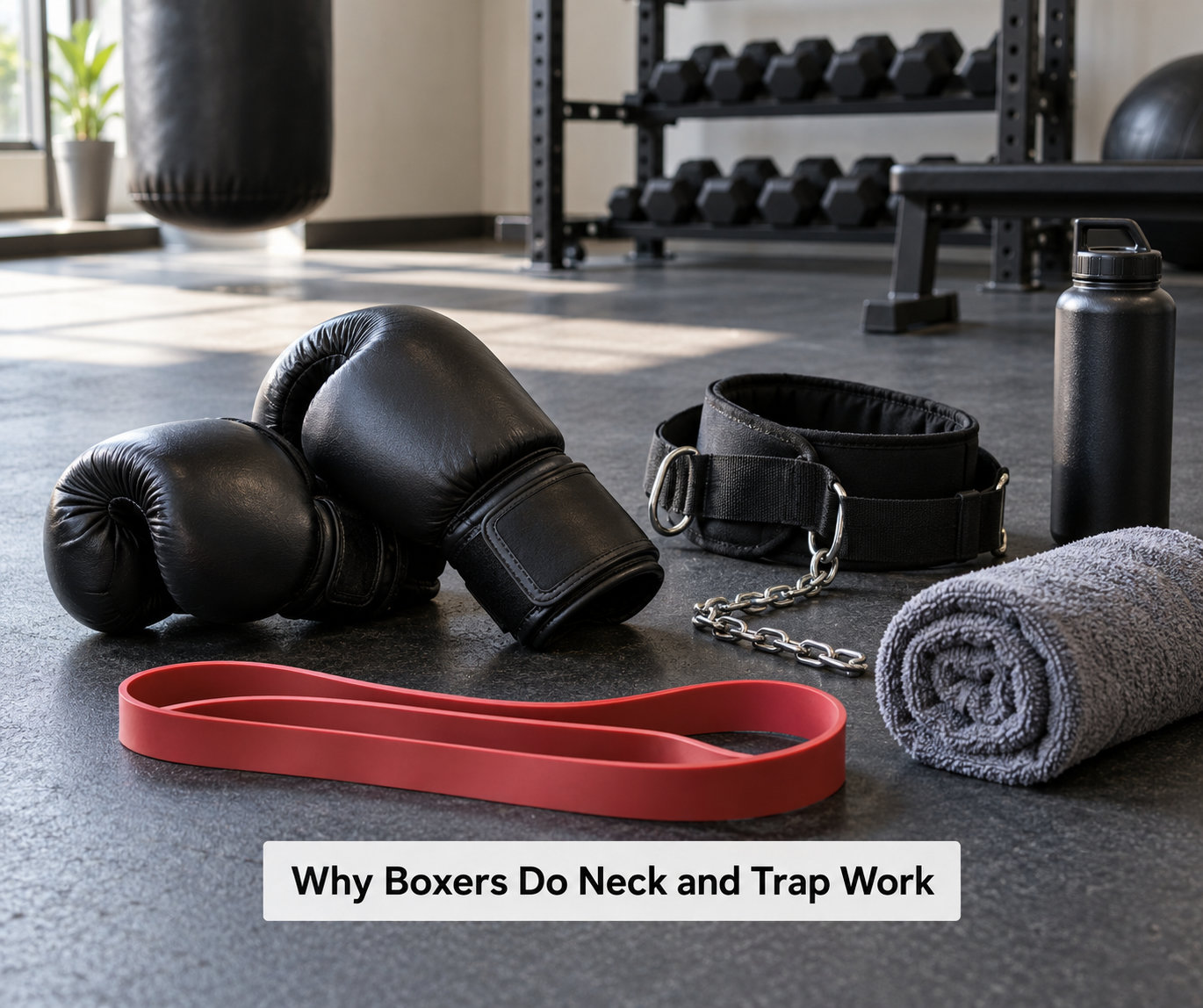
The short answer is shock. A punch does not injure the brain through force alone. It accelerates the skull, and the brain shifts inside it, and that acceleration is what does the damage. Strong, quickly-activated neck muscles stiffen the head-on-forearm system so the force travels down the spine and into the floor rather than whipping the head sideways.
The training benefit is measurable and boring: lower head acceleration for a given impact, a head that stays under control through a full exchange, and a chin that returns to guard instead of drifting. That is a performance claim, and you can feel the difference after a few weeks.
The injury-prevention claim is weaker, and honest writers should separate the two. You cannot train your way out of getting caught with your hands low, and no amount of neck work guarantees you will not be stopped. What a strong neck does do is spread load across the cervical spine and make controlled contact more survivable over a long night of sparring.
Neck stiffness is the number that predicts head acceleration
Neck stiffness means the product of muscle strength and how readily those muscles fire. Research out of the sports biomechanics literature points at stiffness, not size, as the better predictor of how much the head moves on impact. A thick neck that stays relaxed through a hook is worse in a fight than a lean neck that tightens on contact, which is why activation drills matter as much as load.
A Journal of Orthopaedic & Sports Medicine review has also linked neck size and strength with how force spreads through the head when something lands. Treat that as supporting context rather than a promise.
What neck and trap work does not replace
It does not replace footwork, a high guard, or getting your head off the line in the first place. A boxer with a strong neck still loses rounds standing flat-footed in front of a jab. Coaches who emphasise stance and posture are usually right about the priority order, and they are usually wrong that isolation work is unnecessary. You need both: the posture to avoid the punch, and the neck to handle the ones you miss.
What Are the Neck and Traps?
The phrase covers a group of muscles running from the base of the skull down to the shoulder blades. Knowing which one you are training tells you what movement will actually work it.
| Muscle | Where it sits | Job in the ring |
|---|---|---|
| Sternocleidomastoid | Front and sides of the neck | Turns and tilts the head, resists rotation on impact |
| Deep cervical flexors | Front of the neck, deep | Chin tuck and hold the head forward over the base of the spine |
| Upper trapezius | Top of the shoulders to the skull | Head extension, shoulder elevation, resists a rising punch |
| Middle trapezius | Mid upper back | Pulls the shoulder blades together for a tight guard |
| Levator scapulae | Side of the neck to the shoulder blade | Lifts and rotates the shoulder blade, controls the guard height |
| Rhomboids | Between the spine and shoulder blades | Retract the shoulder blades so the chest stays square |
| Suboccipital muscles | Where the skull meets the spine | Fine control at the top of the neck, feeds back on head position |
Why the trap half matters as much as the neck
Most general writing on this topic treats neck and traps as one block and then quietly only trains the neck. That misses the part that shows up in every exchange. The upper traps and levator scapulae depress the shoulders and hold the shoulder blades where they belong, which is what keeps the guard compact and the chin tucked behind the front hand.
It also runs the other way. A boxer who can depress and retract the shoulders through the legs has a shorter path for force to travel into the floor. For crossover athletes in MMA or wrestling, the same muscles are what make a takedown hard to complete, because a raised, shrugged shoulder is an easy handle to grab.
How Neck and Trap Strength Helps Boxers
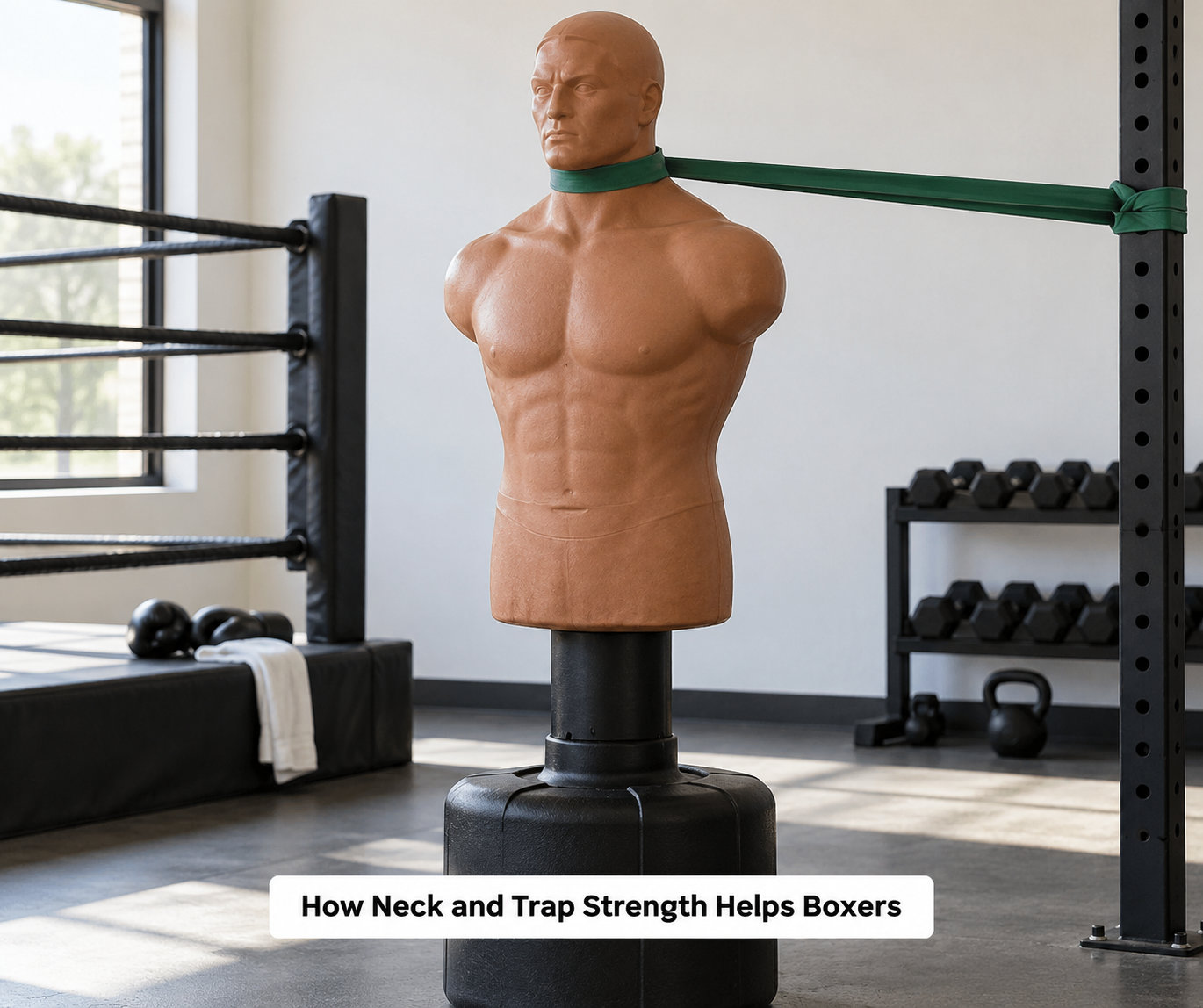
The benefits fall into two piles: things you can feel in a session, and things you hope prevent something later. I lean on the first list when programming.
Holding position when your opponent is moving
Feet, head, then the head stays where you left it. A strong neck resists the small involuntary corrections that add up over three minutes, so the fighter can commit to a step without drifting forward on the chin. It shows up most clearly against southpaw pressure, where a boxer who cannot hold his frame gets walked onto the back foot every single exchange.
Slipping, weaving and rolling with the punch
A defensive roll is a small technical movement that fails completely if the head is heavy. The roll needs the chin tucked, the spine slightly rounded, and the shoulders tightening as the fist passes. Neck strength makes that shape holdable under fatigue, which is why coaches who spend time on defense usually pair it with neck work. The strength does not replace the technique; it lets the technique survive round three.
- Lower head acceleration for the same punch, so less energy goes into the brain
- A chin that returns to guard instead of drifting after an exchange
- Better posture between rounds and, in some fighters, less upper-back discomfort
- Confidence to step forward and trade, because being hit badly stops being a surprise
- More rounds of hard sparring before the neck gives out
What none of this guarantees is fewer concussions over a career. Head contact accumulates, and the honest framing is that a strong neck lowers the severity of the hits you take while improving your ability to keep working. Anyone promising you immunity is selling something.
Does Neck and Trap Work Build Punching Power?
Not directly, and it is worth being blunt about that. Punch power comes from coordinated force generation starting at the floor and moving up through the legs, hips, torso, shoulder, and fist. The neck is not on that list.
Where punch power actually comes from
The relationship is indirect and it works through the brace. A fighter with a solid neck can tighten the whole front of the body at the moment of impact and hit into a stiff structure without the energy dissipating into wobbling. Fighters who are loose through the shoulders and neck lose a chunk of every punch as their body absorbs its own shock.
So neck and trap work supports power in two specific ways: a firmer platform at the moment of contact, and a bigger upper back to drive the shoulder through. If power is genuinely the problem, fix the legs and hips first. I have seen fighters spend a season on plate neck work and wonder why the jab never got heavier.
How Do Boxers Train the Neck and Traps Safely?
General principles only, because this is a health-adjacent topic and prescriptions belong with your coach or physio. Build slowly, keep every rep controlled, and treat the neck like a joint that has to last a career rather than a muscle you want to bulk up. Isometrics first, movement second, load last.
| Exercise | Target muscle | Plane of motion | Gear | Sets and holds |
|---|---|---|---|---|
| Chin tuck hold in stance | Deep cervical flexors | Isometric | None | 3 x 15-30 sec |
| Head forward resisted hold | Sternocleidomastoid, upper traps | Isometric | None | 4 x 10-20 sec |
| Band neck retraction | Mid traps, rhomboids, suboccipitals | Sagittal | Resistance band | 3 x 12-15 |
| Band lateral neck hold | Sternocleidomastoid, upper traps | Lateral | Resistance band | 3 x 10-15 each side |
| Neck extension hold | Upper traps, suboccipitals | Extension | Light load or towel | 3 x 10-15 |
| Neck plate curl | Deep cervical flexors | Flexion | Plate and towel | 3 x 10-12 |
| Prone Y-T-W raise | Lower and mid traps, rhomboids | Scapular | None or light dumbbells | 3 x 10-12 |
| Barbell or dumbbell shrug | Upper traps, levator scapulae | Shoulder elevation | Barbell or dumbbells | 3 x 10-12 |
How much neck and trap work is too much?
Soreness that lasts more than a day or two, a head that feels heavy in training, and a dull ache at the base of the skull are all signs you have gone past productive volume. Most people get stronger with less work than they think, because the neck tolerates intensity well and recovery poorly.
One thing to know about neck training: the movement that looks most like the classic pro routine is extension work, which is why boxers are told to extend upward even though a punch drives the head back. The ability to control the head through its full range is what lets a fighter reset quickly, and a neck trained only in the tucked position is unprepared for that.
Stop and get checked if you notice these symptoms
Sharp pain during a movement, tingling or numbness into a shoulder or arm, dizziness, visual disturbance, an unusual headache, or pain that wakes you at night are all reasons to stop that session and speak to a doctor or physiotherapist. Do not train through neck pain, and do not start accessory work on an acutely injured neck without medical clearance first.
Common Neck and Trap Training Mistakes
Most problems I see in gyms come down to intensity, timing, or copying a routine without knowing why it works.
- Jerking through range. Fast, snapping movements create momentum the muscles cannot control. Fix: slow the rep, hold the position, and keep the head stacked over the spine.
- Adding load too soon. Plate and harness work taken heavy on week one is how people end up light-headed and sore. Fix: two or three weeks of bodyweight isometrics before anything is loaded.
- Training through pain. Muscle burn is fine, sharp joint pain is not. Fix: stop at sharp pain and get it looked at.
- Chasing neck size. A thick, stiff neck built for looks often came with poor control. Fix: measure progress by holds and how composed your head stays in sparring, not by circumference.
- Neglecting the upper back. Isolated neck work without mid-trap, rhomboid and scapular work builds a stiff neck on weak shoulders. Fix: pair every neck session with two or three upper-back movements.
- Skipping the warm-up. Going straight into loaded neck work is how a cold trap gets pulled. Fix: two minutes of controlled neck motion and band retraction first.
- Placing it right before sparring. A pre-fatigued neck is a sloppy defensive roll. Fix: do neck work the day after hard sparring, or at least four hours clear of it.
- Copying pro routines unsupervised. Headstands, bridges and plate work that you have watched filmed are demonstrated by people with a coach watching. Fix: get eyes on you at least once before you load anything up.
How Neck and Trap Work Fits Into a Boxing Program
Frequency should track sparring load, because the neck’s job is to cope with contact volume. Here is roughly how it divides up by level.
| Level | Sparring load | Frequency | Placement in the week |
|---|---|---|---|
| Gym amateur, pad work only | Little or none | 2 sessions per week | After strength, or as a standalone 15-minute block |
| Amateur, weekly sparring | One hard session per week | 2-3 sessions, light on sparring days | Day after sparring, plus one mid-week session |
| Professional, regular sparring | Several rounds most weeks | 3 sessions, short and specific | Paired with trap and upper-back work |
| Fight camp | High volume, increasing | 2 sessions, volume drops in the final fortnight | Deload rather than push harder |
A typical 20-minute session looks like this: two minutes of controlled neck movement, three isometric holds of 15 to 20 seconds, two sets of band retraction work, two sets of prone Y-T-W raises, and two sets of controlled shrugs. Isometrics, then upper back, then the raise-only trap work at the end.
The amateur-versus-professional difference is mostly volume and supervision. Amateurs take a lot of head trauma in fewer, softer rounds and rarely get neck work programmed for them, so it is worth adding deliberately. Professionals tend to manage it as a periodized accessory that is reduced when sparring volume goes up, because a fatigued neck in week three of camp is a liability.
Frequently Asked Questions
Do boxers really need neck and trap work?
Most boxers who take regular head contact benefit from it. The head, neck and shoulder girdle control posture and positioning through every exchange, and training them improves stability and tolerance of contact. It does not make a boxer immune to punches or replace defense, footwork or a high guard. Treat it as support for the rest of the program rather than a substitute for it.
Does neck training make boxers harder to hit?
It improves control of the head and neck and helps a boxer hold a stable position while moving, bracing or taking controlled contact. That makes slips, weaves and defensive rolls easier to repeat under fatigue. It does not shrink the target, change your stance or do anything for a punch you walked into. Position is still the first line of defense.
What are the best exercises for boxer neck muscles?
Controlled isometric holds come first because they build stiffness without momentum. Then add slow resistance-band work in the four directions, prone Y-T-W raises and scapular retraction for the mid traps, and controlled shrugs for the upper traps and levator scapulae. Bodyweight is enough for the first few weeks. Pair every neck session with upper-back work.
How often should a boxer train the neck and traps?
Frequency should follow sparring load rather than a fixed rule. Pad-only gym boxers usually handle two short sessions a week, sparring amateurs two or three, and professionals about three during regular training. Camp is usually a deload in volume rather than an increase. Never place loaded neck work immediately before sparring, because a tired neck produces a sloppy roll.
Does a strong neck stop knockouts?
No, and anyone who says otherwise is overselling. Chin tolerance is substantially genetic, and a knockout usually comes from a clean shot, a bad angle and a tired fighter. A strong neck lowers head acceleration for a given impact and supports the cervical spine, which means better control and fewer ugly moments, but position and defense decide far more fights than neck strength does.
Where to Start
Start with the free stuff: chin tuck holds, band retraction, and prone Y-T-W raises twice a week after your strength session. Add loaded work only once the holds are boring and your head stays composed through a hard week of sparring. If anything in your neck is already sore or recently injured, get it assessed before you add a single rep, and keep a qualified coach in the loop.