A majority decision in boxing happens when two of the three ringside judges score the fight for the same fighter and the third judge scores it a draw. The fighter with two judges’ votes wins the bout, and it is recorded as a win by majority decision rather than a draw.
It sounds fussy, but the term shows up constantly in result listings, so it is worth knowing what sits behind it. Once you can read a scorecard, close fights stop being mysterious. Here is how the scoring works, where the judges disagree and why, and what the result actually does for the fighter’s record.
Table of Contents
- What a Majority Decision Means in Boxing
- How Do Boxing Judges Score the Rounds?
- Why Can a Majority Decision Have Different Scores?
- What Happens If Only One Judge Scores a Different Winner?
- Majority Decision vs. Other Boxing Results
- Can a Majority Decision Be Changed or Appealed?
- What Does a Majority Decision Mean for the Winner?
- Frequently Asked Questions
- How many judges must agree on a majority decision?
- Does a majority decision mean the judges had the exact same scorecard?
- Can a boxer win a majority decision without winning more rounds?
- What is the difference between a majority decision and a split decision?
- Can a boxer lose a majority decision despite having won more rounds?
- Do point deductions affect a majority decision?
- Conclusion
What a Majority Decision Means in Boxing
Three judges sit ringside at a professional bout and score each round separately. What a majority decision means is that two of those three cards pick the same fighter as the winner, while the third card has the round totals level at the end of the fight.
Two judges agreeing is the whole requirement. The third judge’s card does not name the other fighter, and it is not a split vote, so the result is not a split decision either. It is a win with one judge sitting on the fence.
A unanimous decision, by contrast, means all three judges wrote the same fighter’s name on their card. The difference is small on paper and large in argument, because a unanimous result closes off the claim that one official saw the fight differently.
On a fighter’s record the win is written with the method in parentheses, for example W, MD. It counts as a win. It is not half a win, and it is not a draw.
How Do Boxing Judges Score the Rounds?
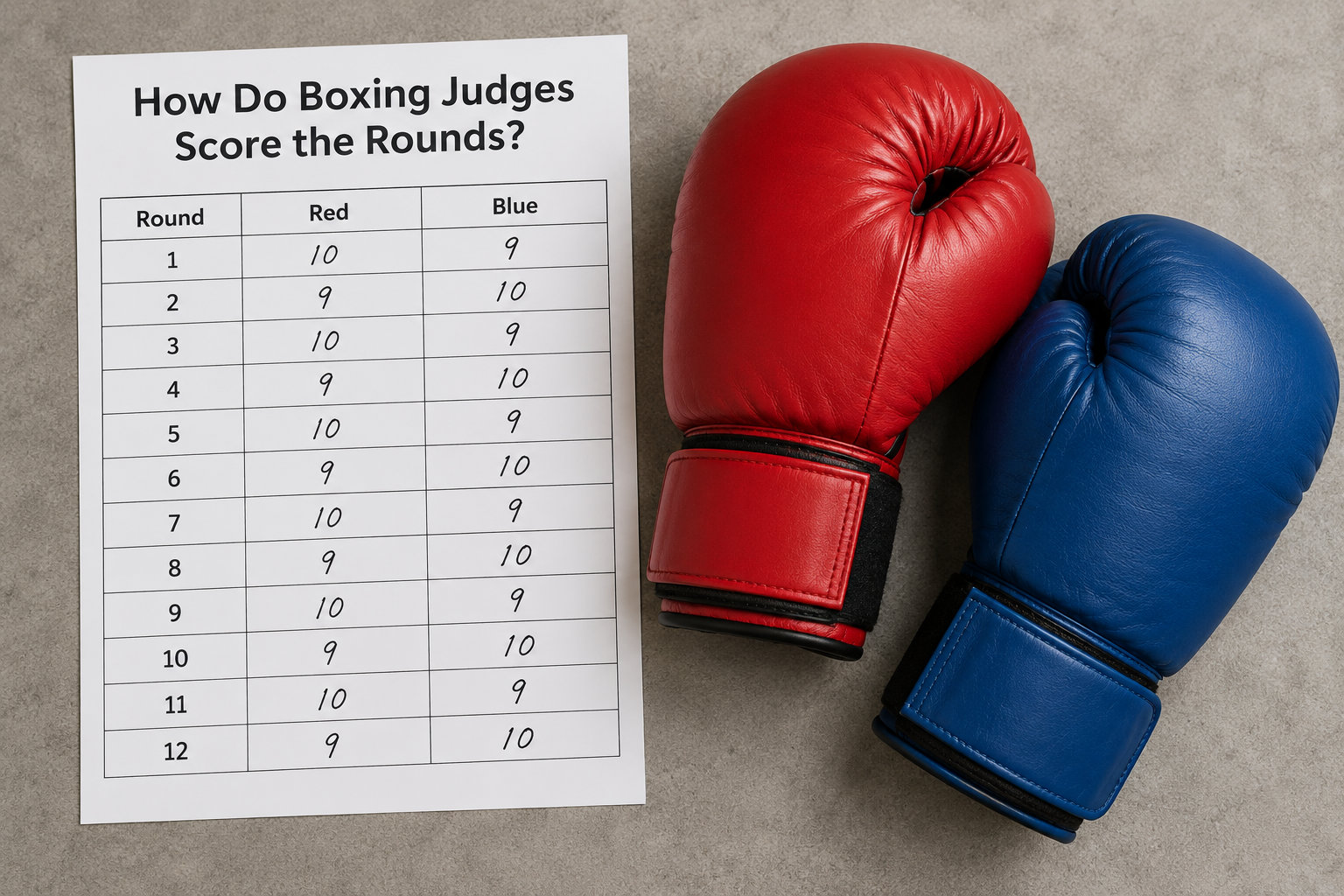
Professional boxing uses the 10-point must system. For every round, the judge who saw it more favourably gets 10 points, and the other fighter gets fewer. Add up all twelve rounds, or ten or six depending on the scheduled length, and the totals decide the bout.
Rounds in professional boxing run three minutes, with a one-minute rest between them. Judges work from ringside on a scorecard and cannot change a round after the bell, so the round-by-round marks they make during the fight are the final ones.
Four criteria drive those marks: effective aggression, clean punching, ring generalship and defense. A fighter who throws a lot but lands little usually loses the round, and a fighter who simply holds his opponent without being hit is not the one getting the 10.
What a Majority Decision Means in Boxing, Round by Round
Almost every round on nearly every card reads 10-9. That is the neutral round, and it still counts as a round the judge considered even. The margins come from the rounds that were not close.
| Round score | What the judge saw |
|---|---|
| 10-9 | A close round, slightly favoured the fighter who got the 10 |
| 10-8 | A knockdown in the round; most commissions allow up to two 10-8 rounds per card |
| 10-7 | A dominant round, usually a knockdown with the fighter hurt and out of his corner’s reach |
| 10-10 | A draw, used sparingly and mostly in the final rounds |
A fighter does not need to win rounds by knockout margin to take a bout. Ten rounds of 10-9 with a couple of clear rounds for him is enough, which is why a 30-27 card is a normal way to win and not evidence of a dominant performance.
Why Can a Majority Decision Have Different Scores?
Because the decision names a winner, it does not require three identical cards. Two judges can arrive at the same fighter by different arithmetic.
Picture a 12-round fight where the red fighter controlled the early rounds and the blue fighter rallied late. Judge one might score it 30-27 for red. Judge two, who saw the middle rounds differently, might score 29-28 for red. Judge three might see it level at 28-28. Red wins by majority decision, with three different totals on the table.
The same mechanism explains swing rounds, which forum regulars on boxing boards and Reddit frequently single out as the real source of disagreement. A swing round is one where a fighter takes the round back after losing it. Two judges may weight it slightly, and that is enough to leave one card level while the other two favour the same fighter.
Recent results show how ordinary the pattern is. Andreas Katzourakis defeated Kudratillo Abdukakhorov by majority decision with one judge scoring a draw, and Rances Barthelemy was declared the winner over Omar Juarez by majority decision after ten rounds. Both were recorded as clear official wins, and both had a judge who saw it as even.
What Happens If Only One Judge Scores a Different Winner?
Then the result is a split decision, and the majority judge decides the official outcome. Two of the three cards pick the winner, and that is the result regardless of what the third card says.
Again using a 12-round bout: judge one scores it 30-27 for red, judge two scores it 30-27 for red, and judge three scores it 29-28 for blue. Red wins by split decision. The same 30-27, 30-27, 29-28 pattern scored as a draw by the third judge would instead produce a majority decision.
The difference between the two words comes down to one question: did the dissenting judge pick the other fighter, or did they pick nobody?
Majority Decision vs. Other Boxing Results
The six official results all come from the same three cards. What changes is whether those cards name the same winner or level the bout.
| Result | How many judges agree | Do the cards match? | Example totals over 12 rounds |
|---|---|---|---|
| Unanimous decision | All three pick the same fighter | Yes, in the winner | 30-27, 30-27, 30-27 |
| Majority decision | Two pick the same fighter, one draws | No | 30-27, 29-28, 28-28 |
| Split decision | Two pick one fighter, one picks the other | No | 30-27, 30-27, 29-28 for the other fighter |
| Unanimous draw | All three draw | Yes | 28-28, 28-28, 28-28 |
| Majority draw | Two draw, one picks a fighter | No | 28-28, 28-28, 30-27 |
| Split draw | One draws, two pick different fighters | No | 28-28, 30-27, 29-28 |
A majority draw is the result people mix up most, and it is not a win for anyone. The fighter who led two judges still leaves with a draw on the record.
Two other results sit outside this table. A technical decision ends the fight early because of fouls or an inability to continue, and is scored on the rounds completed. A no contest is recorded when the bout cannot be scored fairly, and it stays on a fighter’s record without a result.
Can a Majority Decision Be Changed or Appealed?
Almost never. Once the referee reads the decision and the commission’s official announcement goes out, the result stands as scored.
What can happen is a review. A commission may look at the scorecards, check whether a judge applied the rules correctly, and examine claims about a referee or rulekeeper error during the fight. Those procedures differ by state and country, and each commission sets its own deadline for a complaint.
A disagreement about how close the rounds were is not that kind of claim. Two judges favouring the same fighter on different totals is the system working as designed, not a mistake in the paperwork. A commission will rarely overturn a decision over judging taste.
The usual response to a contentious result is a rematch, not a reversal.
What Does a Majority Decision Mean for the Winner?
It means the fighter won. The win counts on the record, and the method is written beside it so that later readers can see one judge scored the bout level.
Rankings bodies treat it as a win like any other. There is no half-weight result and no deduction from the record. Some fighters carry a majority decision on their sheet and go straight back out, which is why so few champions defend against a win that had a dissenting card.
For readers and bettors, the notation is where it matters. Draws and no contests are normally settled as pushes, while a win by majority decision settles as an outright win.
Frequently Asked Questions
How many judges must agree on a majority decision?
Two of the three judges must pick the same fighter as the winner. The third judge scores the bout a draw rather than choosing the other fighter. That is the difference between a majority decision and a split decision, where the third judge names an opponent.
Does a majority decision mean the judges had the exact same scorecard?
No. Two judges agreeing on the winner is enough, and their totals can be different. One card might read 30-27 while another reads 29-28, with a third at 28-28. The decision names the winner, not a specific set of numbers.
Can a boxer win a majority decision without winning more rounds?
It is rare but possible, because judges weigh how they won rounds and not only how many. A fighter who dominates one round and edges several close ones can take a card on the strength of the margin even when the round count looks even or slightly against him.
What is the difference between a majority decision and a split decision?
A majority decision has one judge scoring a draw while two pick the same winner. A split decision has the third judge picking the other fighter instead. Both are wins on the record, but a split decision means one official watched a different winner entirely.
Can a boxer lose a majority decision despite having won more rounds?
Yes, though it is uncommon. A fighter who wins more rounds on paper can still lose if the rounds he won were narrow and the rounds he lost were decisive, such as a knockdown round scored 10-8. Round totals on a single card do not carry the bout.
Do point deductions affect a majority decision?
Deductions by the referee do not go on the judges’ scorecards and do not change the totals a judge wrote. A majority decision reflects the judges’ round-by-round scoring only. Persistent fouling is handled separately, through point deductions, disqualification or a technical decision.
Conclusion
A majority decision means two of the three judges scored the same fighter as the winner while the third scored the bout a draw. It is a full win, written on the record with the method in parentheses.
Next time you see one, look past the label and read the three totals. If one card is level while the others are not, the fight was close, and you will know how close.