A cutman is the corner team member who prevents and treats a fighter’s cuts, swelling and nosebleeds during the one-minute breaks between rounds. In the sixty seconds he has, he closes bleeding, presses a chilled metal enswell against swelling, clears the fighter’s vision, checks the mouthguard and hands, and hands over water, so the fighter can keep going instead of being stopped by the ringside physician.
Watch a fighter with a cut eyebrow try to hide it from the doctor, and you are watching the cutman’s work in reverse. Everything he did in the corner three minutes earlier is what keeps that fight alive.
What a cutman does is narrower than most people assume. He does not call the tactics, does not make the decision to continue, and in a professional bout he is often the only person in the corner who is not a coach. That narrowness is why the job is hard.
Table of Contents
- What a Cutman Does in Boxing
- What a cutman does in the sixty seconds between rounds
- How a Cutman Prepares for a Fight
- How to Handle Cuts, Swelling and Other Injuries
- How a Cutman Supports a Fighter Between Rounds
- What Is in a Cutman’s Corner Kit?
- Cutman Skills and Training
- How a Cutman Differs from a Trainer or Second
- Frequently Asked Questions
What a Cutman Does in Boxing
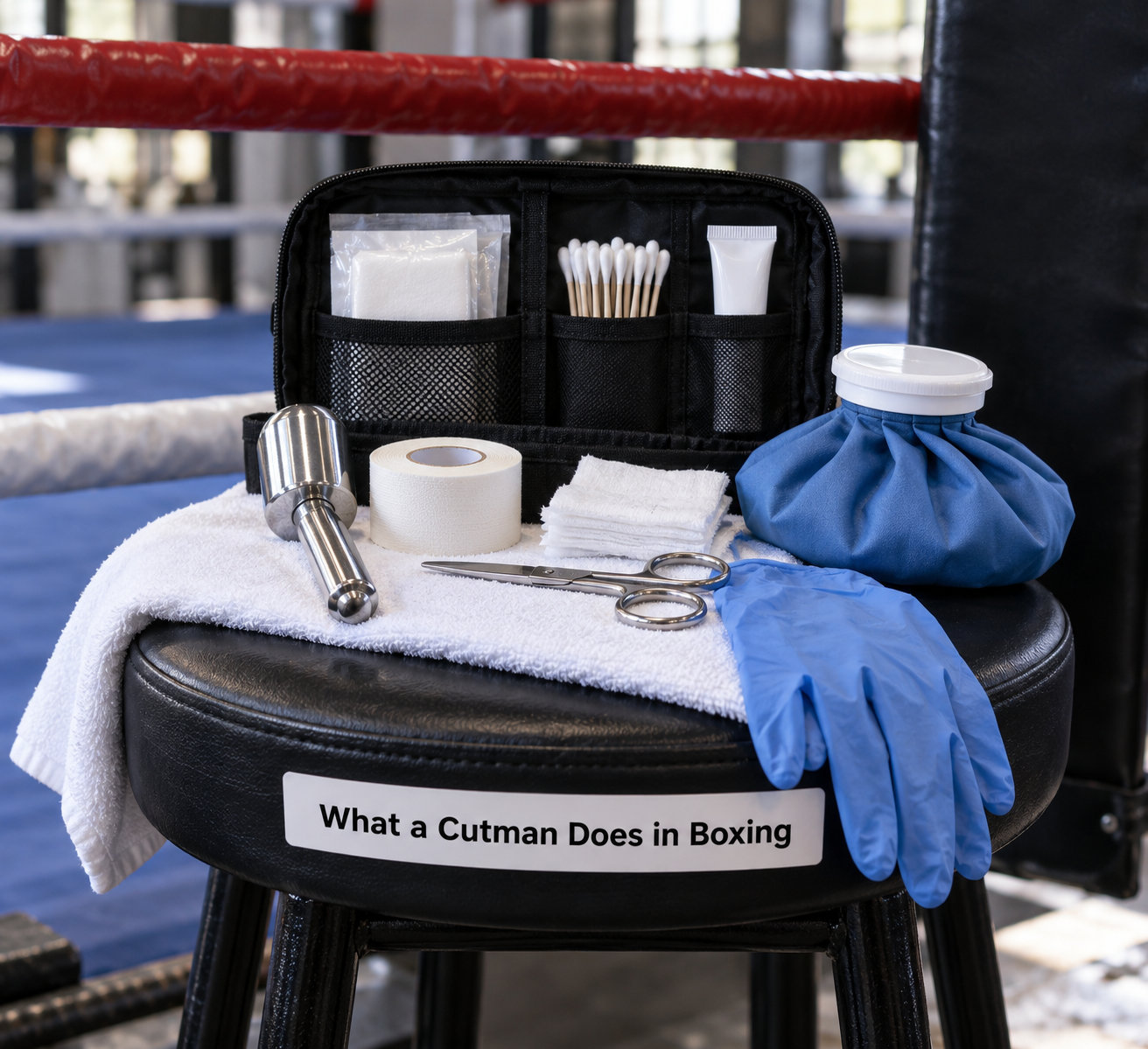
Eight things make up the job, and they happen in roughly the same order every round.
- Preventing cuts before the bell. Petroleum jelly is worked into the eyebrow, the cheekbones and the bridge of the nose, where skin is thin and tears easily.
- Stopping bleeding fast. A laceration (a cut with ragged edges) is packed with gauze and a haemostatic agent, then held under pressure.
- Controlling swelling. A chilled enswell is pressed flat against a hematoma, the pool of blood that raises the skin around an eye.
- Clearing the fighter’s vision. Blood, mucus and swelling all narrow the same field of view a fighter needs to see a punch coming.
- Managing the nose. A nosebleed is pinched off and a suspected broken nose gets cold applied and a report passed to the physician.
- Protecting the hands. Loose tape over split knuckles and finger damage is re-secured so the fighter can punch for another three rounds.
- Delivering water and hygiene. The fighter is wiped down, cooled, and given water to spit out, never to swallow.
- Reporting to the doctor. The cutman tells the ringside physician what was treated and how well it worked, because the physician, not the corner, decides whether a fight continues.
That last point is the one people miss. A cutman can describe a cut as closed or still bleeding, but he cannot overrule a doctor. Under most commission rules, an untreated cut that a referee attributes to a punch is a loss on the scorecards, so the cutman’s value is measured in whether the fight happened at all.
| Problem in the corner | Tool used | Technique | Why it works |
|---|---|---|---|
| Swelling closing the eye | Enswell, also called end-swell, stop-swell or eye iron | Chill it, lay the flat metal face against the skin and hold steady pressure | Cold shrinks blood vessels while pressure pushes fluid away from the eye socket |
| Cut above or below the eye | Sterile gauze plus a haemostatic agent | Pack the cut, press hard, then draw the edges together with adhesive strips | Blood running into the eye forces a doctor stoppage no corner can argue with |
| Bleeding that will not stop | Cotton swab dampened with epinephrine 1:1000, or a collagen haemostat | Press into the wound for several seconds, keep the pressure unbroken | Epinephrine constricts vessels; collagen gives platelets a mesh to clot on |
| Nosebleed | Gauze and a bucket | Sit the fighter forward and pinch the soft part of the nose, not the bridge | Leaning the head back sends blood down the throat where it can be swallowed or vomited |
| Split knuckle or torn finger tape | Narrow tape | Anchor the wrap at the wrist and split the tape down the back of the hand | Ends that anchor properly survive contact with a harder opponent’s body |
A couple of terms worth defining once. An enswell is a small metal bar, chilled and pressed against the skin; a hematoma is the swelling itself, not the bruise colour, and a laceration is any cut deeper than a graze. The cornerman is the second, the trainer’s helper who may double as cutman on a small card.
What a cutman does in the sixty seconds between rounds
Boxing gives the corner sixty seconds, which sounds generous until you count everything that has to happen in it. A cutman who does not work in a fixed order runs out of time before the bell.
- First ten seconds: the fighter sits or leans back, and the cutman looks at the face. Eyes first, because a swelling that closes one eye is the fastest route to a stoppage.
- Seconds ten to twenty-five: bleeding gets packed and pressed. A swab goes in, pressure goes on top, and the cutman holds it rather than dabbing at it.
- Seconds twenty-five to forty: the enswell comes off the ice and onto the swelling, and it stays there while the cutman does everything else with one hand.
- Seconds forty to fifty: nose checked, mouthguard found, water tipped into the mouth and spat back out.
- Seconds fifty to sixty: one sentence to the fighter, one sentence to the doctor, tape on the hands, stool out, corner cleared before the bell.
Most corners do not work all the way to sixty seconds. A cutman who has closed a cut early usually gives the last ten back to the trainer, because the fighter needs to hear something about the fight rather than something about the gauze.
How a Cutman Prepares for a Fight
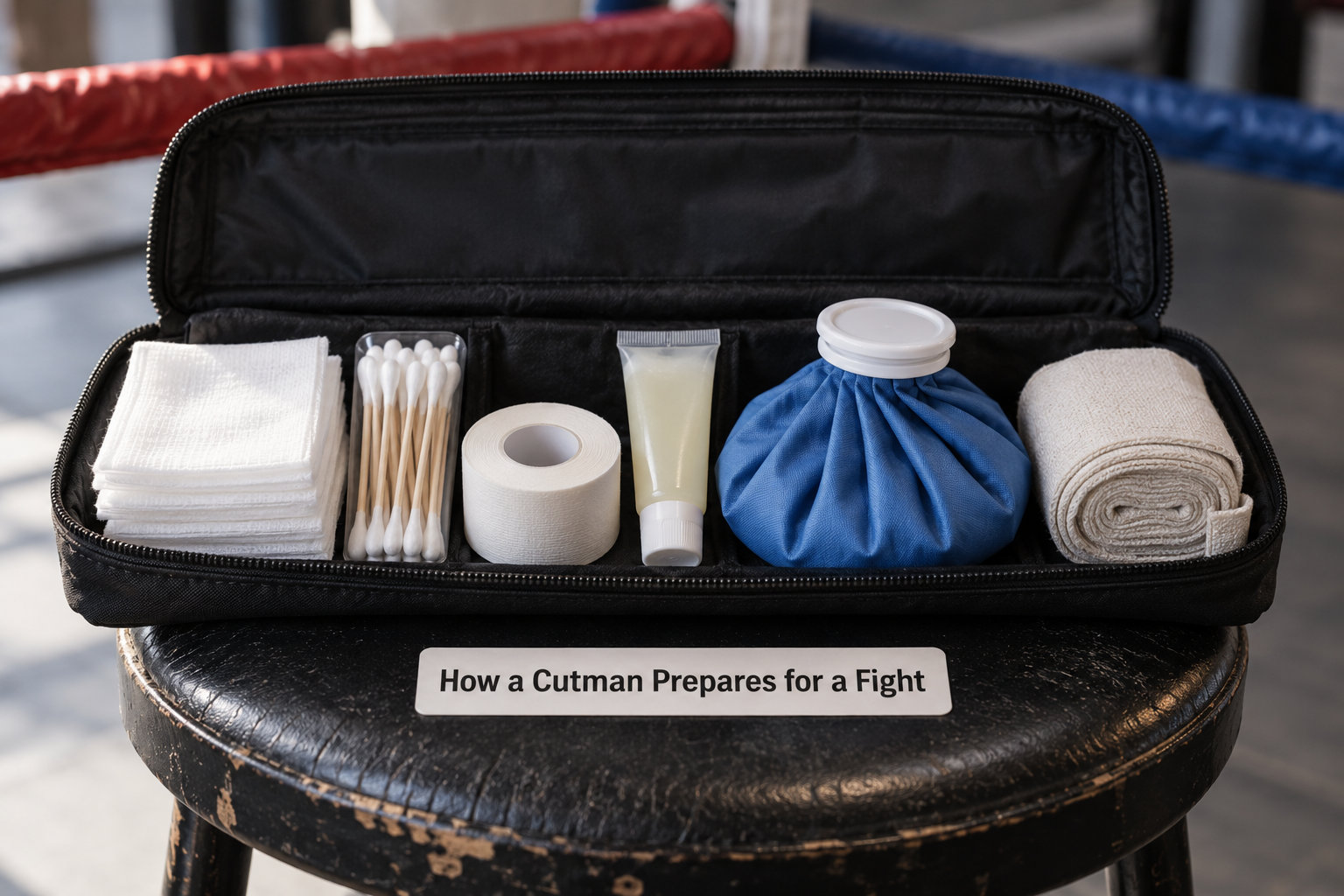
Preparation happens hours earlier and it is the part of the job nobody sees. Before the fighter walks out, the cutman applies petroleum jelly to the areas that always split first: the eyebrow, the cheekbone, the bridge of the nose and sometimes the ear.
The reason is straightforward. Skin over a bony ridge moves, stretches and catches on an opponent’s glove, and thin skin tears before thick skin does. Petroleum jelly makes those surfaces slippery, so a glancing blow slides across instead of catching and opening. It also forms a barrier over the eyebrow that stops sweat running into the eye in round one. It is not a treatment for a cut; by the time there is blood, the jelly is long gone.
In MMA the use of petroleum jelly is restricted. Because grappling puts a fighter’s face against skin and canvas, an opponent’s corner can claim the fighter was greased to soften the skin and improve the grip. Promotions therefore supply their own cutman rather than allow a fighter to bring one, and rules commonly limit the grease to the forehead.
Hand preparation happens at the same time. The cutman runs tape between and along the fingers to protect splits, and adds a thin layer over the knuckles, then checks that the wrap does not restrict the fist closing. Get that wrong and the fighter spends the next round punching with half a grip.
The rest of the preparation is logistics. The kit gets laid out in a fixed order so nothing has to be found by feel, the ice bag gets frozen rather than chilled, water and a bucket are confirmed with the timekeeper, and the cutman talks to the trainer about what to watch for in this particular opponent. A fighter known for head-butting gets a different priority than one who fights southpaw.
On a card where the cutman works several fighters, the supply volume is the thing that catches people out. One fighter’s card can absorb enough gauze and tape to treat fifteen, and running short mid-card is a real risk.
How to Handle Cuts, Swelling and Other Injuries
Swelling comes first because it is the most time-sensitive. The enswell goes in ice or cold water between rounds, and the cutman learns to read a hematoma by touch, because a swelling that feels soft and doughy is a different problem from one that feels hard and hot.
The technique matters more than the tool. The flat metal face goes straight against the skin, sits still, and takes pressure for the whole break. The common mistake is bouncing the iron on the swelling to look busy. Bouncing does nothing, and the fighter feels every bounce as another hand on a face that already hurts. Harder pressure, held longer, does the work.
Cuts are handled in the reverse order: pressure first, cosmetics second. Blood is packed, not wiped. Adhesive strips or butterfly closures go on after the bleeding slows, because a closure applied to a wet cut comes away in the next exchange. A cut over the eye is the most serious routine injury in the sport, because blood running into the eye is treated as a stoppage by most physicians regardless of how well it is cleaned.
For bleeding that pressure alone will not close, cutmen use haemostatic products. The classic is epinephrine, usually 1:1000, on a cotton swab pressed into the wound. The other family is topical: collagen haemostats such as Avitene, oxidized regenerated cellulose such as Surgicel, gelatin foam, thrombin and ferric subsulfate, better known as Monsel’s solution. Which of these are permitted depends on the commission and the promotion, and the cutman works with what the ringside doctor has cleared.
| Agent | Type | How it is used | Note |
|---|---|---|---|
| Epinephrine 1:1000 | Vasoconstrictor | Dampened onto a cotton swab and pressed into the cut | The longest-standing tool in the corner; stops bleeding by shrinking the vessel |
| Collagen haemostat | Microfibrillar collagen | Packed into the wound and held under pressure | Provides a mesh for platelets to build a clot on |
| Surgicel | Oxidized regenerated cellulose | Laid over the wound and pressed | Absorbs and swells as it sets into a gel |
| Thrombin | Enzyme | Applied directly to the bleeding point | Works fast and is kept refrigerated in some corners |
| Monsel’s solution | Ferric subsulfate | Painted onto a bleeding point with a swab | Stains skin and gauze dark brown, which is expected |
Nosebleeds get the fighter sitting forward with the head tipped down over the bucket, and the cutman pinches the soft part of the nose. Tilting the head back is the instinctive move and the wrong one; it sends blood down the throat, where it can be swallowed or come back up in the corner. A nose that stays swollen after the bleeding stops is a possible fracture, and that is a report to the physician, not something a cutman treats.
There is a firm line the job does not cross. A cutman does not reset a broken bone, does not clear a concussion, and does not decide that a fighter is fit to continue. The corner can present a fighter for inspection. The ringside physician decides whether the inspection passes, and when a cut is judged severe enough the fight ends there, no matter how well the corner argues it.
How a Cutman Supports a Fighter Between Rounds
Not every second in the corner is medical. The cutman also runs the part of the round that keeps a fighter comfortable, which is what allows the trainer to think about anything at all.
Water goes in a small amount at a time and gets spat back into the bucket, because a fighter who swallows water in the final ninety seconds of a round has to deal with it in the ring. The face gets wiped, not sprayed. The mouthguard comes out, gets checked for a cracked tooth or a bitten tongue, and goes back in before anything else is done. Petroleum jelly gets reapplied to the brow and cheekbones after every round, because a surface that has been cleaned of blood is bare again and tears more easily the second time.
Concussion awareness sits quietly underneath all of it. A cutman watches for a fighter who has stopped blinking properly, who answers a question a beat late, or who walks to the wrong side of the corner, and passes what he has seen to the physician rather than deciding anything himself. Fighters coming off a head knock often report that the corner work blurred into one long minute, so this observation is genuinely useful.
There is a choreography here too. The trainer talks, the cutman works, and neither steps on the other. The cutman’s contribution to tactics is small and specific: telling the trainer that the fighter’s left eye is closing, that the nose is bleeding sideways, or that the hands are done. What to do about it is the trainer’s call.
What Is in a Cutman’s Corner Kit?
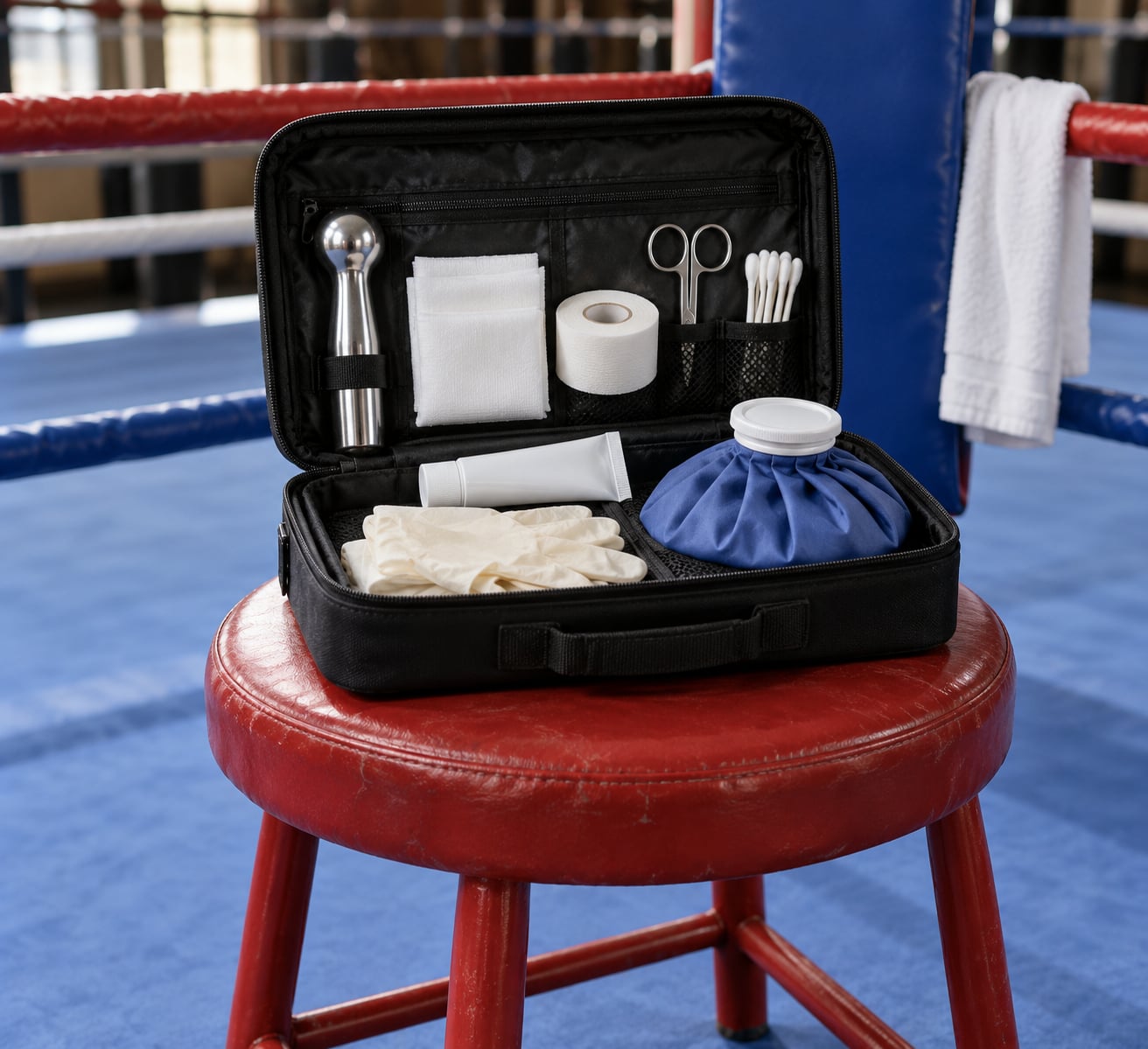
A corner kit is small enough to carry in one hand and specific enough that every item has a job.
- Enswell. A smooth metal bar, kept in an ice bag between rounds. The core of the kit.
- Sterile gauze pads and roll gauze. For packing cuts and holding pressure. Working cutmen tend to prefer a stretchy gauze roll that frays less, because a loose weave leaves fibres in the wound.
- Cotton swabs. For applying epinephrine or Monsel’s solution precisely to a bleeding point.
- Adhesive strips and butterfly closures. For drawing the edges of a closed cut together.
- Tape. White hock or hand tape grips tape laid over it better than standard one-inch boxing tape, which is the most common complaint from cutmen who work cards.
- Petroleum jelly in a small squeeze tube. Tubes rather than a shared tin, so nothing is transferred between two fighters on the same card.
- Single-use alcohol swabs. For cleaning a cut and for cleaning hands between fighters.
- Medical gloves. Worn when the cutman is not touching a fighter’s face, and changed between corners.
- Ice bag and small bucket. One cools the enswell, the other catches blood and water.
- Scissors. For cutting tape and trimming gauze. They are held at an angle rather than flat, so the tips stay out of the fighter’s face.
- Haemostatic agents. The medications cleared by the commission and stocked by the corner.
What a corner carries and what a cutman keeps in a medical bag on a bigger card are two different lists. On a small show the whole kit might fit in a gym bag, and the trainer might be the cutman. At a professional event the cutman may have a second person assisting, a full case of medications, and a formal rule that anything applied to a fighter is first shown to the physician.
Two habits from working cutmen travel well. Bring roughly twice the supplies the card seems to need, and pack a card with your first-aid, first responder or tactical combat casualty care credentials on it, because a corner will ask what you are qualified to do before they let you near their fighter.
Cutman Skills and Training
Nobody trains you to be a cutman. There is no degree, no school, and on most cards the answer to “how do I become a cutman” is an apprenticeship under someone who has done it for years. The pathway runs like this.
- Get certified in first aid and first responder care, and consider a tactical combat casualty care course, which is the credential that teaches wound packing and tourniquet use under pressure.
- Get licensed with the state commission that regulates the event. Requirements vary by commission and often include a background check and an application fee.
- Apprentice at amateur shows. Cards need volunteers, and a beginner paired with an experienced cutman learns the sixty-second rhythm faster than any manual.
- Learn the techniques on people, not just in theory, and get a physician or a qualified trainer to check your pressure and haemostasis work before a promoter trusts you with a professional fighter.
- Build the credentials into a card and approach gyms and promoters directly, since no one is going to call you.
In MMA the employment route runs through the promotion rather than the gym, because the promotion supplies the cutman to keep the greasing question out of the corner. In boxing the cutman is usually the fighter’s own man and the most experienced second on the card, which means the busiest cornermen are often the busiest cutmen.
The skills themselves are unglamorous and learnable. Hygiene and single-use supplies prevent cross-contamination between two fighters. Ordered work under a hard deadline beats frantic work. Observation is the quiet one: knowing that this fighter’s eye closes badly on the left, or that he stops answering questions after a right hand, is worth more than any technique in the bag. And communication runs both ways, since a cutman who tells the trainer nothing is wasting the most valuable thing in the corner.
It helps to know the names. Jacob “Stitch” Duran has worked corners from Wladimir Klitschko to Mike Tyson, and his lead picture in almost every dictionary entry on the role is him working. Chuck Bodak’s list runs from Muhammad Ali through Sugar Ray Marciano, Thomas Hearns, Julio Cesar Chavez, Evander Holyfield and Oscar De La Hoya. Rafael Garcia is known for his long association with Floyd Mayweather, and Uncle Al Gavin and Mike Rodriguez are names that come up constantly in the modern sport.
How a Cutman Differs from a Trainer or Second
Three roles sit in the corner, and sometimes one person does all of them. Knowing which is which explains most arguments about what a cutman is allowed to do.
| Role | What they are | What they decide | Who employs them |
|---|---|---|---|
| Cutman | Trained in the treatment of cuts, swelling and nosebleeds | How the injury is treated, and what gets reported to the doctor | The fighter’s corner in boxing; the promotion in MMA |
| Trainer and second | Coach and assistant who plan and deliver the fight | Strategy, changes of stance, whether to take the fight apart late | The fighter or manager |
| Second | Usually a cornerman whose own role is partly cutting duties | Same as the trainer, plus hands, bucket and stool | The fighter or manager |
| Ringside physician | A licensed doctor appointed by the commission or promotion | Whether the bout continues, and whether a stoppage is called | The commission or the promotion |
That last row settles the question people ask most often. A cutman cannot stop a fight and cannot insist that one continues. He can close a cut before the referee or doctor sees it, he can report that it is still bleeding, and he can hand the fighter back to the trainer in a condition to keep fighting. The decision belongs to the physician.
Frequently Asked Questions
How much do cutmen get paid?
In boxing the figure usually quoted is around two to three percent of the fighter’s purse, and on a small show the cutman is often a second doing the job for nothing. In MMA the promotion employs the cutman and pays from the event payroll, which is one of the reasons the promotion supplies its own rather than accepting one from the fighter’s team.
What do boxing cutmen use to stop bleeding?
Pressure first, with sterile gauze held firmly against the cut for several unbroken seconds. Under that sits a haemostatic agent: epinephrine 1:1000 on a cotton swab, a collagen haemostat such as Avitene, Surgicel, thrombin, or ferric subsulfate. Once the bleeding slows, adhesive strips pull the edges together.
Why do cutmen use vaseline, and is it illegal?
Petroleum jelly makes the thin skin over the brow, cheekbone and nose slippery, so a glancing blow slides off instead of catching and tearing. It also blocks sweat running into the eye. It is legal in boxing and is not a treatment for an existing cut. In MMA it is restricted, usually to the forehead, because of the greasing rule.
Who is the most famous cut man in the world?
Jacob Stitch Duran is the name most people picture, with a corner career running from Wladimir Klitschko back to Mike Tyson and beyond. Chuck Bodak is close behind, having worked Ali, Marciano, Hearns, Chavez, Holyfield and De La Hoya. Rafael Garcia is known for his long run with Floyd Mayweather, and Uncle Al Gavin is a fixture of the modern ringside.
How do you become a UFC cutman?
You are usually hired by the promotion rather than by a gym, since promotions supply their own cutmen to remove any greasing argument. Get first aid and first responder certification, add a tactical combat casualty care course, then work amateur and regional shows until a promoter sees you. Expect to start on the card you are least wanted at.
Can a cutman stop a fight?
No. A cutman can close a cut before the referee or the physician sees it, report whether it is still bleeding, and describe the swelling honestly. Whether a bout continues is decided by the ringside physician, and in most commissions a cut judged to be from a punch counts against the fighter on the scorecards. The corner’s job is to make that decision never come up.
Next time a fight goes the distance, watch the corner at the end of round one rather than the knockdown. The answer to what a cutman does is visible in about ten seconds of a broadcast: a fighter with a closed eyebrow and clear vision at the start of round two is a cutman who did his job in sixty seconds. That work happens whether or not anyone ever notices it, and it decides more fights than the broadcast gives it credit for.