How boxers get undefeated records comes down to being very hard to beat and very hard to hurt, then protecting that status with matchmaking choices that limit risk. The real mechanics sit in six places: defensive fundamentals, tactical adaptability, a credible punching threat, the quality of opposition, durability and recovery, and career timing. No fighter holds all six at once for long, which is why almost every unbeaten run eventually ends.
Last updated October 2026.
Table of Contents
- Key Takeaways
- What Does an Undefeated Record Mean in Boxing?
- How Boxers Get Undefeated Records Over a Career
- The Key Factors Behind an Unbeaten Professional Career
- Why Do Undefeated Boxers Eventually Lose?
- Does an Undefeated Record Make a Boxer Great?
- How Boxers Get Undefeated Records in Practice: A Career Example
- Frequently Asked Questions
- Does a draw affect a boxer’s undefeated record?
- Do stripped titles count as losses on an undefeated record?
- Who is the best undefeated boxer in professional boxing history?
- Why do some undefeated boxers avoid dangerous opponents?
- How are two undefeated boxers compared when they never met?
- Can a boxer remain undefeated by fighting mostly lower-ranked opponents?
- Conclusion
Key Takeaways
- Unbeaten is not the same as dominant. It means no losses on the record. Wins against journeymen and draws count the same as wins against champions.
- Defense does most of the work. Slipping, rolling, footwork and distance management reduce the number of clean punches a fighter allows.
- Adaptability beats one game plan. Fighters who change rhythm and distance mid-fight are much harder to solve.
- A knockout threat changes behaviour. Opponents who believe they can be stopped take fewer risks, which hands the unbeaten fighter the fight.
- Opponent quality decides meaning. The same record means very different things in different decades.
- The streak ends eventually. Age, accumulated damage, a weight move or one misjudged fight usually does it.
What Does an Undefeated Record Mean in Boxing?
An undefeated record is a professional boxing record with zero losses. Draws and no-contests do not break it. Amateur bouts are not counted at all, and neither is any pro bout a governing body later overturned.
Stripping a title does not put a loss on a record. Terry Marsh was stripped of his WBA middleweight belt in 1995 after a seizure diagnosis and never fought again, so he finished 37-0-1 with no defeat. A vacated belt is a paperwork event, not a defeat.
That strictness matters, because readers often treat unbeaten as a synonym for greatness. A 20-0 built mostly against fighters who never won anything is a different document from a 20-0 built against ranked opponents. The number tells you one thing: the fighter never got past unbeaten.
How Boxers Get Undefeated Records Over a Career
Boxers get undefeated records over a career by layering defensive skill on top of tactical flexibility, keeping enough punching power to discourage risk, staying healthy, and choosing opposition carefully. The sequence matters. Skill gets you through the early opposition, tactics get you through awkward matchups, and matchmaking decides how often a genuinely dangerous fight ever happens.
There is a difference worth naming between building a career and protecting a record. Building a career means taking the fight that makes you remembered, win or lose. Protecting a record means optimizing for one number. Fighters who do the first often finish with losses; fighters who do the second often finish unbeaten and less discussed.
Defensive Skill Is the Foundation
Every unbeaten run starts with punches avoided, not punches landed. Footwork that creates angles, head movement, a high guard, clean exits from the pocket and accurate distance management all shrink the target a fighter gives away.
Rogers Bresnahan finished 75-0-6 with 53 knockouts and was rarely outboxed, because his defense kept exchanges short. Joe Calzaghe spent whole rounds walking opponents onto counters and rarely got caught clean, which is why he could win rounds without absorbing damage.
The practical effect is bigger than it sounds. A boxer who gives up 20 clean punches a fight is still winning. One who gives up 60 is gambling every round on out-punching someone.
How Boxers Get Undefeated Records With the Right Tactics
The second ingredient is the ability to change a fight after it starts. Style matching matters most in the first two rounds, when both fighters are still testing. After that, adaptability decides whether a fighter adapts or gets adapted to.
Unbeaten fighters tend to do a few things well: control the center or the ropes depending on which suits them, vary rhythm so the opponent cannot time anything, move between a patient game and an aggressive one without telegraphing, and use feints to make an opponent commit early. Changing tempo is more effective than simply throwing more punches.
Rigid game plans lose to flexible ones. A boxer with one answer gets solved around round six.
Punching Power Creates a Deterrent
A credible knockout threat is a defensive weapon. When an opponent believes a punch can end things, they respect the jab, keep their guard tighter and settle for safe exchanges. That hands the unbeaten fighter the initiative without throwing a single dangerous shot.
There is a difference between earned deterrence and borrowed reputation. Earned deterrence comes from accurate, repeated power that opponents have seen in real fights. Borrowed reputation comes from highlight reels and rumour, and it tends to stop working the first time someone finds out.
The practical measure is simple: how many opponents have looked uncomfortable and declined to engage? That number tells you whether the power is real.
Matchmaking and Opponent Quality Matter
No fighter controls every opponent on their schedule. Division depth, promoter decisions, mandatory challengers, injuries and the fighter’s own risk appetite all shape who turns up in the ring next.
That gives two very different kinds of unbeaten run. One fighter repeatedly meets ranked opposition and gives up height, reach and ranking to keep climbing. Another accumulates a long record against lower-ranked names, then declines the matchup that would have settled the argument. Both finish undefeated. Only one tells you something.
Wilder before the first Fury fight is the textbook case of an unbeaten record shaped by avoiding one specific opponent, and Beterbiev gets cited as an elite fighter his own division seemed to work around.
Ask readers what they want from an unbeaten fighter and one thing comes back above all else: names, records and rankings. Who did this person actually fight, and how good were those people at the time? A record without that context is just a number with a name attached.
Durability, Recovery, and Career Timing
The least glamorous factor is probably the most important. Weight cuts, travel, sparring volume, injuries and long stretches without a meaningful challenge all compound quietly, and the bill arrives late.
Floyd Mayweather Jr. finished 50-0 and retired in 2017, having controlled his schedule and his weight for two decades. Andre Ward retired unbeaten at 32-0 in 2016 after years at super middleweight and light heavyweight, where the weight itself became the deciding factor. Joe Calzaghe retired at 46-0 in 2007 rather than move up again.
Each made a different version of the same calculation about how much body the career could absorb.
The Key Factors Behind an Unbeaten Professional Career
Every long unbeaten run is some mix of these seven factors, and no single one carries a career on its own.
| Factor | What it contributes | How to evaluate it |
|---|---|---|
| Defensive ability | Fewer clean punches conceded over a long schedule | Watch how often the fighter is caught flush and how they recover |
| Tactical adaptability | Survival against styles that do not suit them | Compare round-by-round plans across different opponents |
| Punching threat | Caution from challengers, structural control | Look at whether opponents actually engaged, not the highlight reel |
| Opponent quality | The single biggest driver of what a record means | Pull the record of each opponent at the moment they faced |
| Consistency | Steady work rate across long and short fights | Look for repeated wins over the same tier, not one career-best performance |
| Durability | Surviving a schedule that accumulates damage | Note timeouts, layoffs and how long gaps between meaningful fights run |
| Career longevity | More chances to lose, or more chances to prove it | Note the number of elite-level fights, not total fights |
Run those seven rows against a fighter you are curious about and the shape of the record usually becomes obvious. A dominant fighter scores well on opposition and power. A protected one scores well on total wins and badly on opposition. A durable late-career one scores well on consistency and longevity with a short, unusual schedule.
Why Do Undefeated Boxers Eventually Lose?
Undefeated boxers eventually lose because the sport keeps producing better opponents than the ones already beaten. Age is the obvious factor and the least interesting one on its own.
The pattern behind a first loss is usually visible years earlier. Accumulated damage reduces the recovery window between fights, so output falls and defense gets slower. A division move adds reach and height the fighter never had to solve before. A stylistic counter emerges that the fighter’s habits cannot answer, often a southpaw angle or a jab the fighter has never had to respect.
Some runs end without a fight at all. Injuries force retirement, as with Dmitry Pirog, who gave up a career in progress because of chronic spinal problems. Others end because the champion decides the risk has outgrown the reward, which is retirement dressed as strategy.
Inactivity is underrated here too. A fighter who takes eighteen months off returns to a division that has moved on, and unbeaten status makes that return more dangerous, not less, because the pressure to protect the zero is loudest exactly when the fighter is least sharp.
Does an Undefeated Record Make a Boxer Great?
No, and boxing history is full of proof on both sides. Muhammad Ali, Mike Tyson and George Foreman are not remembered for their records. They are remembered for what they did to champions over long careers, including the losses in between.
An unbeaten record becomes strong evidence of greatness when three things are true: the opposition was genuinely elite, the wins were convincing rather than fortunate, and the fighter adjusted between opponents instead of repeating one performance.
Rocky Marciano retired 49-0 in 1956 and remains the most cited example, though historians still argue about him on style rather than results. Terence Crawford finished 42-0 in 2025 after beating opponents at several weight classes. Joe Calzaghe went 46-0 while operating in a division that had emptied out behind him.
Compare those with an unbeaten run built entirely at regional level, and the gap is obvious. Both records are perfect. Only one of them is a résumé.
How Boxers Get Undefeated Records in Practice: A Career Example
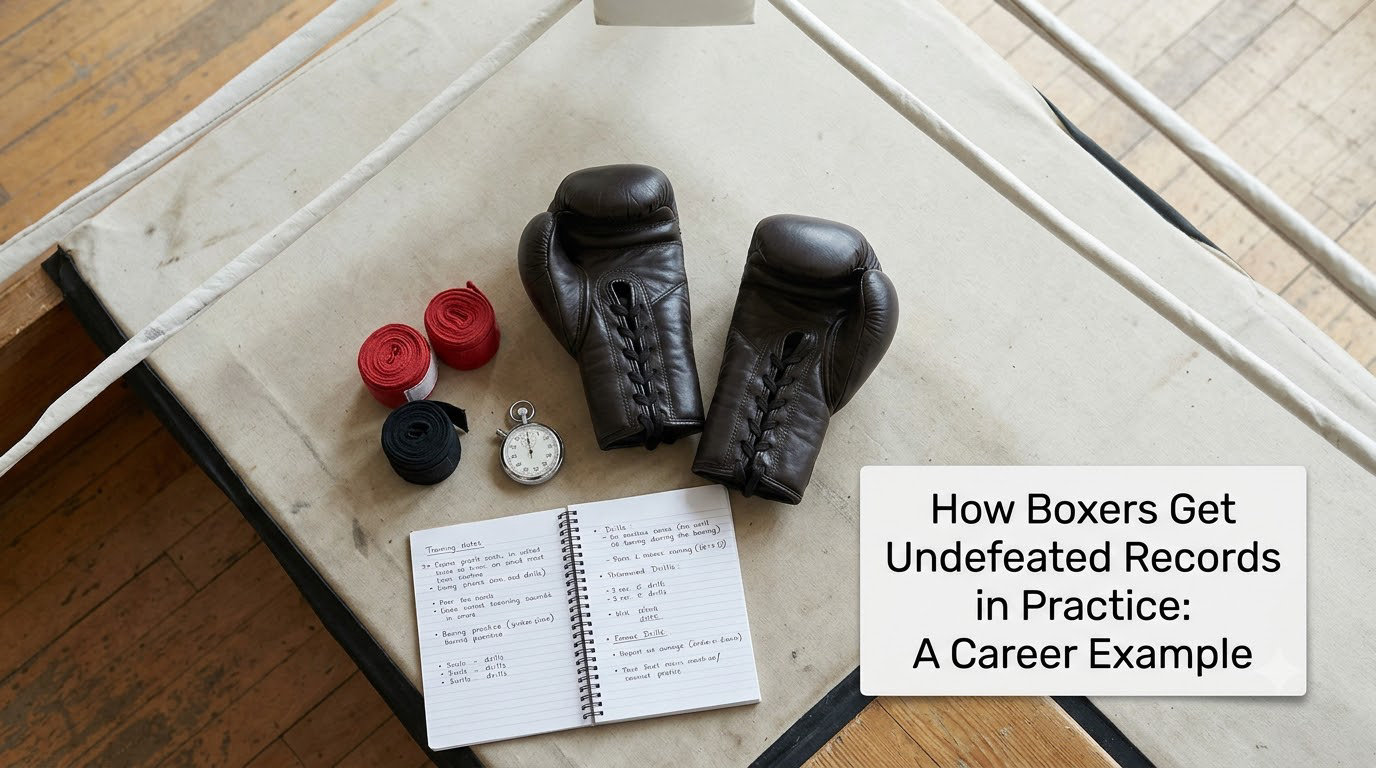
Here is how it works in a career, using a fictional unbeaten fighter so the mechanics are visible without pretending to predict anyone.
Call him a 24-year-old southpaw with 14-0 and one contested decision. He wins the regional title by stopping a veteran in eight, and at this stage the record is cheap. Nobody dangerous has come looking.
His first real unbeaten test is a ranked opponent on the undercard of a bigger event. He wins a narrow split decision and takes damage doing it. The camp was built around defense because he cannot yet overpower anyone, which is the honest version of how a record gets built at that stage.
A year later a mandatory challenger with a losing record arrives. Taking it means risking the streak against inferior opposition; declining it means a long wait and criticism from the division. Most managers resolve this by accepting it, and the unbeaten fighter does the same, because a champion’s career is worth more than a number.
The pressure now changes. Opponents see him as the ticket, his manager starts protecting him from a real step-up, and two years pass with soft opposition. He is 26-0, undefeated, and less proven than at 22.
Then a champion-sized fight arrives, the one fight that would settle the argument. Taking it risks everything the record represents. Not taking it guarantees a comfortable finish and an asterisk. This is the decision that defines the career, and no system tells you in advance which way a real fighter will go.
Frequently Asked Questions
Does a draw affect a boxer’s undefeated record?
No. A draw is not a loss, so a fighter with three wins and one draw is still undefeated. That is why so many records are written in the 30-0-1 format rather than 30-1. Draws matter when you compare resumes, since a fighter who has been repeatedly out-pointed has shown something a perfect record hides, but they never break the unbeaten status itself.
Do stripped titles count as losses on an undefeated record?
They do not. A title is stripped when a champion misses a deadline, fails a medical, or is ruled unfit, and none of that is a defeat in the ring. Terry Marsh was stripped of the WBA middleweight title in 1995 and finished his career 37-0-1. Treat a stripped belt as a fact about scheduling and administration, not about a fighter’s ability to win.
Who is the best undefeated boxer in professional boxing history?
There is no clean answer, and that is the point. Floyd Mayweather Jr. finished 50-0, Rocky Marciano 49-0, and Terence Crawford 42-0 across three weight classes. Marciano’s run happened in an era with thinner matchmaking, Crawford’s came with far deeper opposition available. Most fans settle it by asking one question: which version of that fighter would have beaten which version of the other.
Why do some undefeated boxers avoid dangerous opponents?
Because the unbeaten record is a business asset for everyone around the fighter. Promoters can sell tickets with it, bettors find it compelling, and a manager can argue for a safer next fight indefinitely. A loss can be survivable as a contender, while a win moves a fighter up the division toward worse opponents and harder punchers. When the financial upside stops justifying the risk, matchmaking gets cautious, and caution looks like avoidance.
How are two undefeated boxers compared when they never met?
Compare the opposition each one actually faced, not the win totals. Pull the record of every opponent at the moment they met, count how many ranked or titled fighters were on the schedule, and check whether the wins came by knockout or by decision. That is the only defensible way to read how boxers get undefeated records when the two never shared a ring, and it explains most of the arguments fans have about them.
Can a boxer remain undefeated by fighting mostly lower-ranked opponents?
Yes, and it happens constantly at regional and domestic level, where a strong prospect can win twenty fights in a row against names who never won anything meaningful. The record is real, the wins are real, and the technique required is often genuinely good. It simply does not prove much about facing a champion, which is why elite opposition, not the win count, is the number worth checking.
Conclusion
Boxers get undefeated records by being difficult to hit, flexible enough to change a fight, dangerous enough that opponents hesitate, healthy enough to absorb a long schedule, and selective enough to control how often a real test arrives. Every one of those is a skill, and the last one is a business decision rather than a boxing one.
So judge the record the way you would judge a résumé. Look at who was beaten, how, and at what point in each opponent’s own career. The number tells you the fighter was never past unbeaten. The names tell you whether that was as good as it looks.