
Each of the four major sanctioning bodies — the WBC, WBA, IBF and WBO — publishes its own divisional rankings using its own committee, criteria and update cycle. There is no single body that ranks boxing as a whole, which is why the same boxer can sit at No. 1 on one list and outside the top ten on another. Nothing has gone wrong in those cases; the methods are genuinely different.
What confuses newcomers is that all four ranking pages look identical. Blue links, a number, a record, a country flag. Read side by side, the differences are stark, and once you know what each body is weighting you can predict most of the arguments before they start.
Table of Contents
- How Boxing Rankings Differ Between Organizations at a Glance
- Who Controls Each Major Boxing Ranking?
- What Criteria Do Boxing Organizations Use?
- How Should You Interpret a Split Between the Rankings?
- Which Ranking System Is Best for Fans?
- Which Boxing Organization Should You Follow?
- Frequently Asked Questions
- Why does one boxer have a different ranking in each boxing organization?
- Is the WBC, WBA, IBF or WBO ranking considered the official world ranking?
- Does being ranked number one guarantee a title shot?
- How do boxing organizations rank unbeaten fighters?
- Why do online boxing rankings sometimes show outdated positions?
- Conclusion
How Boxing Rankings Differ Between Organizations at a Glance
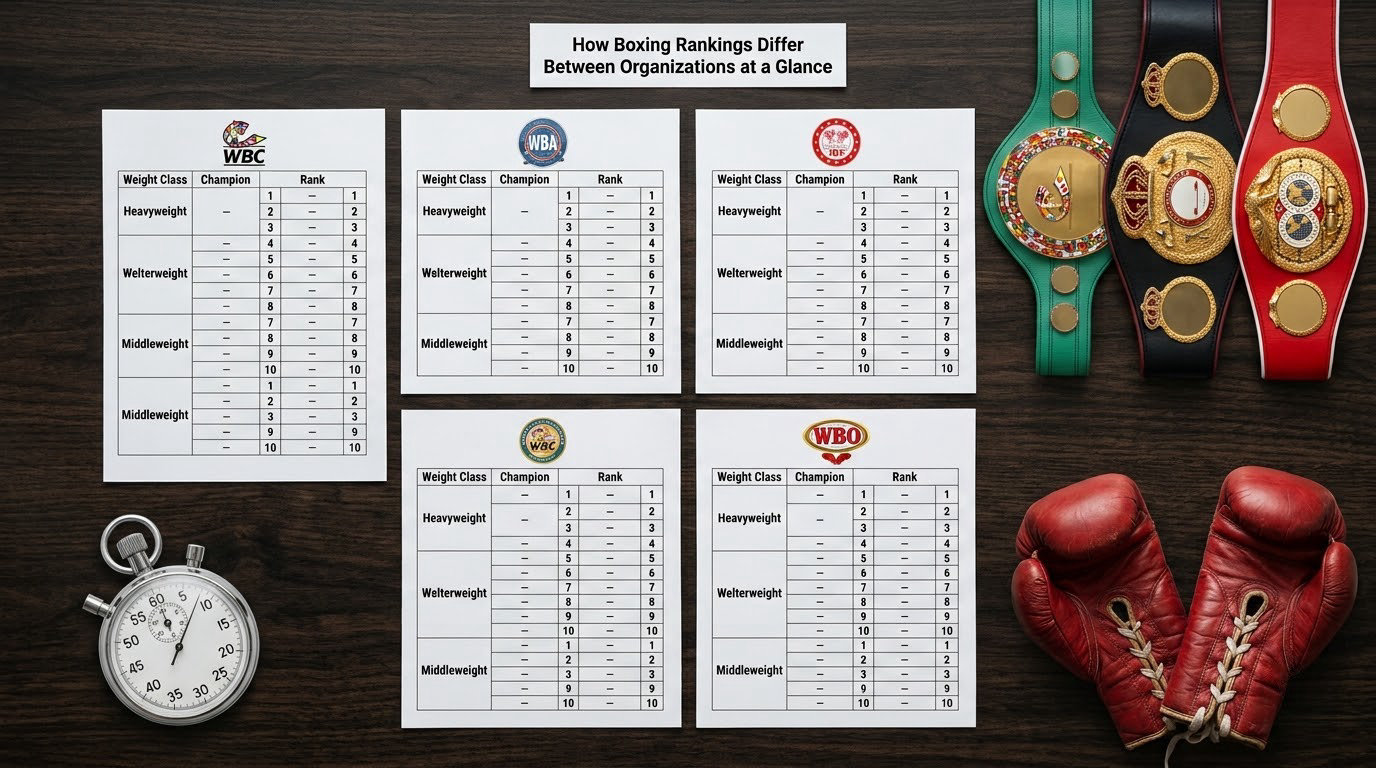
The table below is the shortest version of the whole story. Each column is a body, each row is the part of its method that changes the order you see.
| What changes | WBC | WBA | IBF | WBO |
|---|---|---|---|---|
| Governing base | Mexico, with a wide international membership | United States and Puerto Rico, with federations across several continents | United States | United States, built on an international membership base |
| Who decides order | A ratings committee, reviewed publicly at an annual convention | A ratings committee working on a fixed calendar | A boxing commission made up of member nations and officials | A rating committee |
| Ranking method | Championship-first; ring results weighed heavily, list runs deep | Regular scheduled cycles with formal challenger slots | Commission-led assessment, historically tied to title activity | Contender-first, weighted toward recent quality wins |
| How many fighters per division | Up to roughly 40 rated | A shorter top tier, often around 15 or fewer | A moderate list with title-related positions at the top | A moderate list |
| Champions on the list | Yes, plus Franchise and interim holders | Yes, including Regular and Super titleholders | Yes, and the body’s own title picture is often the starting point | Yes |
| Unbeaten fighters | Placed by results and competition level, and eligibility now ties into its Clean Boxing Program | Promoted on wins and level of opposition, sometimes before a full record develops | Judged heavily on the quality of opposition faced | Judged on opposition and activity; a shorter list means fewer unbeaten names surface early |
| Update schedule | Periodic, with appeals heard at the annual convention | Frequent and calendar-driven | Periodic, often tied to events the body sanctions | Periodic, tied to its own sanctioning calendar |
| Opponent information it prioritizes | Headline results, especially title fights | Recent bouts inside a scheduled window | Records and results of the opposition, one division per fighter | Quality of the wins, not just the win itself |
Read that last row carefully. It is the row that explains most of the arguments you see in fight threads.
Who Controls Each Major Boxing Ranking?
The four recognized sanctioning bodies are the WBC, WBA, IBF and WBO. Each one appoints titleholders, orders mandatory challengers and publishes ratings. Below those world titles sit regional and continental bodies such as the EBU belt in Europe or the WBO’s regional belts in Asia, and those regional titles feed into the world lists in ways that differ by organization.
WBC Rankings: A Traditional Championship-First System
The WBC is the most transparent of the four in one specific sense: its process is public. The body runs a ratings committee, and its annual convention is where fighters, managers and camps argue for movement on the list, often in front of everyone else. That is a real difference from systems where changes simply appear on a webpage.
The WBC also publishes the deepest list, rating on the order of 40 fighters per division. Depth cuts both ways: you can see exactly where a rising prospect sits, but the lower reaches carry far less weight than the top ten in practice. Its Clean Boxing Program adds another gate — a place in the top 15 now depends on the fighter being enrolled in year-round anti-doping testing through VADA.
WBA Rankings: Regular Updates and Multiple Divisions
The WBA updates on a published calendar, which is the practical appeal for anyone who wants a list that reflects this weekend rather than last month. It also keeps Regular, Super and other title tiers in play, so you will see several ranked names attached to the same division, each with a title of a different weight attached to it.
That belt structure changes how you read the list. A fighter can be ranked highly inside the organization’s own frame while a different body’s No. 1 sits at No. 3 on this one, simply because the positions reflect different title situations.
IBF Rankings: A Commission-Led Approach
The IBF publishes its ratings through a boxing commission made up of officials and member nations, and the commission rather than a promoter sets the order. In practice the IBF’s list has leaned heavily on title activity, so when a champion holds a belt, the body’s list tends to follow that champion closely.
The IBF is also the body most associated with stripping a title on a fine technicality — inactivity, weight missed, or refusal to accept an ordered opponent. Each stripping reshuffles the top of the division for everyone who follows it.
WBO Rankings: A Broad International Perspective
The WBO grew out of an international base, and its list reflects that. It runs both world and regional titles, and its ratings are organized around contenders as much as around champions.
Critics focus on the size of its regional structure and on the wording of its published rating inputs, which go beyond ring results. Supporters answer that the list still tracks real wins over real opposition. Both sides agree the list often reads as more contender-heavy than the others.
What Criteria Do Boxing Organizations Use?
Every body uses some version of the same input list: win-loss record, level of opposition, activity, weight class, age and title experience. None of them publishes a simple formula you could run yourself, and all of them are bound by a shared regulatory benchmark.
That benchmark is the Association of Boxing Commissions, the body that certifies state commissions and, through them, holds sanctioning organizations to written rules. Its published criteria are strikingly concrete: a fighter should have two bouts of ten rounds or more, or four of eight rounds or more, to be rated; at least one bout in the past twelve months; a top-rated opponent within the past eighteen months; one division per fighter; and a rating that drops at least one position after a loss to an unrated boxer. On top of that sit disclosure duties — publish the criteria, publish the bylaws, publish the appeal procedure, name the raters, and post any change with an explanation within seven days.
Why does that matter to a fan? Because it gives you something to check a body against. When an unexplained move happens, you have a written standard to point at rather than an opinion.
Why Do Champions and Top Contenders Receive Different Ratings?
Because a champion’s position is earned by defending, and a contender’s is earned by challenging. Imagine two undefeated heavyweights in the same division. Fighter A has defended twice against ranked opposition; fighter B has won three fights, all against unrated opponents, with one long layoff in between. The WBC is likely to place A higher because the wins carry more information. The WBA may move B quickly because B fought recently and is trending. Neither is wrong.
Ratings also move on the fight itself rather than on the date. A fighter who wins a narrow decision over a ranked name can rise two places; the same fighter can fall if the win comes against someone the committee never rated.
How Do Undefeated Fighters and Upset Wins Affect Rankings?
An unbeaten record is a starting point, not a ranking. It carries no information about who was beaten, and committees weight that gap heavily. Two 12-0 fighters can sit eight places apart if one has shared a ring with a former champion and the other has only faced club-level opposition.
Upset wins are read the same way in reverse. Beating a rated favourite can move a fighter up several places in one cycle, because the committee treats it as evidence against a previous rating. Beating an unrated fighter usually moves nobody. Movement is not a measure of ability; it is a change in what a committee believes.
When and How Often Are the Rankings Updated?
Each body publishes its own cadence, and that cadence alone explains a lot of apparent conflict. A fight on Saturday might sit in one body’s current list while another body has not closed its cycle, so the same result appears to produce two different outcomes.
Between cycles, movement still happens. Title vacatings, medical withdrawals, weight misses and administrative decisions all shift a list without a fight. Always check the date on the page you are reading — an uncached screenshot is the most common reason people think a body has made a mistake.
How Should You Interpret a Split Between the Rankings?
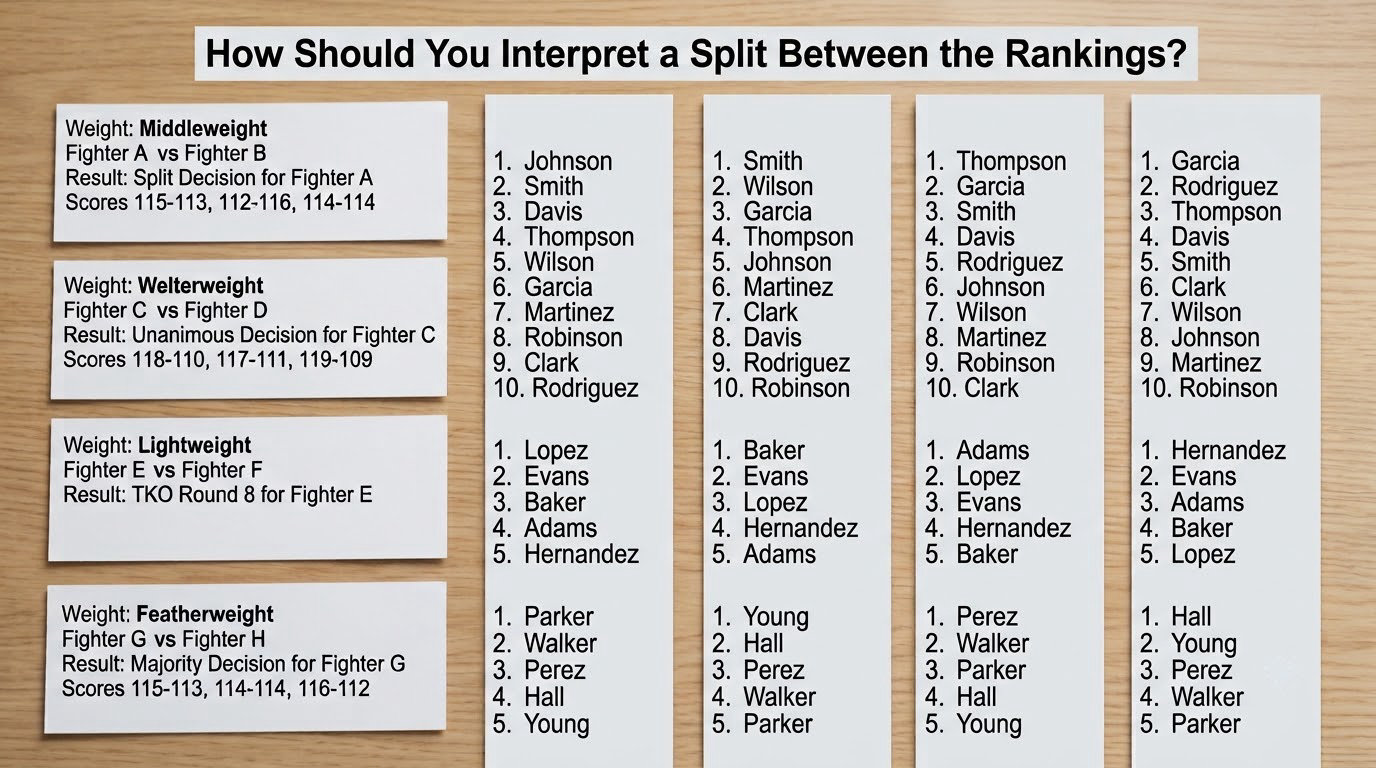
A split between the ratings is usually methodological, not an error. When one body has a fighter at No. 1 and another at No. 5 after the same weekend, the likely causes are a different cycle date, a different read on the opponent’s quality, or an extra belt tier that changes what the position means.
Here is the routine I use. First, compare dates, not screenshots. Second, confirm you are looking at the same weight class and the same fighter, since a fighter who moves up is listed in two places at once. Third, check whether one of the positions is a mandatory or optional challenger slot, which describes status inside that organization rather than ability. Fourth, look at the opponent column — that is where the disagreement almost always lives.
It also helps to remember what the rankings are for. A divisional order exists to choose opponents for a title, so it rewards activity, availability and willingness to accept terms, not purely ability. Pound-for-pound lists sit outside all of this; they combine weight classes, and they are the least standardized product in the sport. Ringside and media figures publish their own, and fans on r/boxing routinely open two or three of them side by side and call the result ridiculous. That reaction is fair — those lists are opinion, and they are labelled as opinion.
Which Ranking System Is Best for Fans?
None of them is best in general, because they answer different questions. If your interest is the traditional championship picture and you want the deepest list plus a public appeals process, the WBC is the most useful page. If you want a list that reflects the most recent results, the WBA’s regular cycles suit you.
If you want to understand who holds titles and on what basis, the IBF’s commission structure is the clearest to follow. If you follow fighters outside North America and want a contender-led view with regional context, the WBO is where to look. And for fight records rather than opinions, treat a database such as BoxRec as the record layer and the bodies as the news layer — BoxRec logs results, while the bodies decide what those results mean for a title.
The honest answer is to read two of them. A single list will always look like an order; two lists tell you what is agreed on and what is not.
Which Boxing Organization Should You Follow?
Pick the one that matches what you actually watch. Follow a body closely when you track a specific division, because that body’s mandatory orders decide who fights next, and its ratings page tells you why a matchup was requested or blocked.
Follow a second body for breadth. Cross-checking is what turns a fan into someone who understands title fights rather than just reacting to them, and it makes the arguments in the comments a lot less tiring.
If you only want the results, use a database. If you want the arguments, pick a body, learn its cycle, and read its criteria page once. That last habit — reading the published criteria before the ranking — is the single thing that most improves how quickly you work out why the four lists disagree.
Frequently Asked Questions
Why does one boxer have a different ranking in each boxing organization?
Because each sanctioning body rates fighters with its own committee, criteria and update cycle. One may value a ranked win more heavily, another may reward recent activity, and a third may follow its own title picture. The criteria overlap, but they are not identical, so positions can diverge by several places after the same night of boxing.
Is the WBC, WBA, IBF or WBO ranking considered the official world ranking?
None of them is a single official world ranking. The WBC, WBA, IBF and WBO are separate sanctioning bodies, each recognized in its own right, and each publishes its own ratings. What exists as regulation is the Association of Boxing Commissions framework, which requires published criteria, named raters and an appeal process rather than one agreed list.
Does being ranked number one guarantee a title shot?
No. A number one position makes a fighter an obvious mandatory challenger, but orders also depend on availability, weight, medicals, broadcast plans and whether an existing champion accepts the fight. Fighters decline mandatory bouts and take optional ones instead, which is how a top-ranked contender can sit still for a year or more.
How do boxing organizations rank unbeaten fighters?
An unbeaten record counts for less than most fans expect, because it says nothing about the opposition. Committees weigh who was beaten, how recently the fighter competed, and whether the wins came at championship distance. A 10-0 fighter with ten ranked opponents will usually rate far above a 10-0 fighter with the same record against unranked opposition.
Why do online boxing rankings sometimes show outdated positions?
Usually because the page is cached, not because the body moved quietly. Screenshots and aggregator sites update on their own schedule, and a body’s own list may not have closed its cycle after a recent event. Check the date printed on the rankings page, then look for a dated note explaining any change, which most bodies are required to publish within a week.
Conclusion
Each organization applies its own criteria, on its own schedule, with its own definition of what a good win looks like — and each is also answerable to a different set of commercial and political pressures. That is why contradictory positions are normal rather than exceptional.
Start by opening the same division on all four sites on the same day, note the dates, and read each body’s published criteria before you decide who is wrong. Last reviewed for 2026, and the rankings move weekly, so treat anything older with suspicion.