How important is height in boxing? More than the slogans on either side suggest, and considerably less than the tape measure implies. Tall boxers tend to have longer arms, and reach is what actually decides fights: it lets you land first, control distance and save energy. Skill, timing and accuracy still decide far more bouts than size ever has.
That is the honest short answer, and the rest of this guide unpacks it. We look at what height gives you, what it costs you, which styles exploit a long frame, and how a shorter boxer builds a real game plan against a taller opponent.
One caveat before we start, because it affects everything below: officially recorded fighter heights are frequently estimates, and promoters have inflated them for decades. Fighters themselves have disputed their listed heights. Read the numbers as ranges, not gospel.
Table of Contents
- How Important Is Height in Boxing?
- Is There a Height Advantage in Boxing?
- What Advantages Does Height Give a Boxer?
- How Does Height Affect Range, Punching Angles, and Defense?
- Can a Shorter Boxer Defeat a Taller Opponent?
- Does Height Matter More in Some Boxing Styles?
- What Else Determines a Boxer’s Effective Height?
- How Should Fighters Use Their Height?
- Is There a Height Limit in Boxing?
- Frequently Asked Questions
- Is being taller always an advantage in professional boxing?
- What is the ideal height for a professional boxer?
- Does a taller boxer usually have more punching power?
- Can a shorter boxer beat a taller boxer, and what should they exploit?
- Why can a tall boxer with poor footwork lose to a shorter opponent?
- Is height more important in boxing than reach?
- Conclusion
How Important Is Height in Boxing?
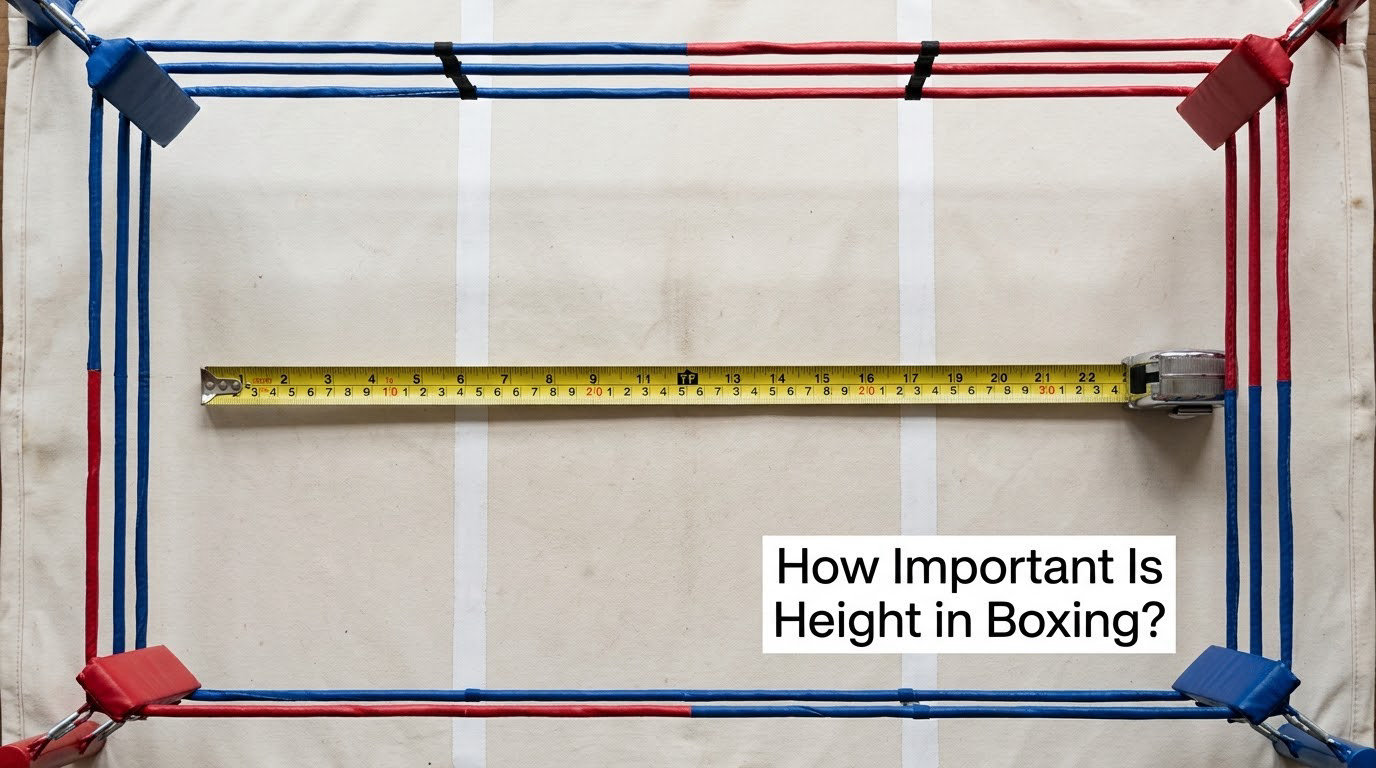
Height is important, and it is a genuine advantage in maybe six or seven bouts out of ten before skill decides anything. But it is a proxy advantage. Height itself does nothing in the ring except make you a bigger target and give you longer limbs; reach is the part that punches.
Two boxers of identical height can have completely different fights in front of them, because reach and height are not the same measurement. A fighter with a long frame who measures well short of his height has less punching range than a compact fighter whose arms make up most of his stature.
It also depends on where you are. In a bout decided at long range, height is close to a decisive factor. In a bout decided by pressure and body work, it can become almost irrelevant.
So how important is height in boxing? Important enough that coaches build game plans around it, and not important enough that it predicts winners on its own. Anyone who tells you size never matters is quoting a slogan; anyone who tells you the bigger man usually wins has not watched long enough.
Is There a Height Advantage in Boxing?
Yes. A height advantage in boxing shows up as extra arm length, which gives you a longer jab, a bigger striking range, easier access to the head from above, and more leverage in the clinch. The same advantage also hands your opponent a larger target and gives you a longer way back to safety when you miss.
Both sides of that trade are real. Which one wins for you depends on your style and your skill.
What Advantages Does Height Give a Boxer?
The honest way to look at this is as two mirrored lists, because almost every advantage of height has a matching cost for a shorter fighter, and the reverse is true too.
What being taller gives you
- A longer jab. You can establish contact from outside your opponent’s punching range, which means you often get to be the one who decides the distance.
- Better angles from above. Downward punches arrive on shorter arcs and are harder to see coming, which is why tall fighters are fond of the hook coming over the top.
- Energy conservation. Punching at range is cheaper than walking into a clinch. A taller boxer can pot shots all round and spend very little.
- Defensive spacing. You can slip away with a straight back step because your reset distance is longer.
- Clinching leverage. Longer limbs give you more ways to push, frame and smother, and taller fighters rarely get dragged into deep water in the clinch.
What being shorter gives you
- A lower centre of gravity. You are harder to push and you can drive forward without being moved off your line.
- Inside fighting. Hooks and uppercuts lose much of their power when thrown from outside, and a shorter fighter is already there.
- Clean access to the body. The lower ribs and the belly of a taller opponent are at a comfortable height for you and awkward for them.
- Shorter steps forward. You cover ground with quick, small steps, which costs a fraction of the energy of a long boxer’s walk.
- Ring geometry. Corners and ropes are height advantages. A shorter fighter backed into a corner can level the fight in three steps.
Notice that the shorter fighter’s advantages are all about volume and proximity, while the taller fighter’s are about range and economy. Boxing bouts are decided by who gets to choose which fight is happening.
How Does Height Affect Range, Punching Angles, and Defense?
Height changes the distance at which a boxer is comfortable and the shapes that distance allows. The table below is the short version.
| Factor | Taller boxer | Shorter boxer |
|---|---|---|
| Preferred range | Long, just outside the opponent’s reach | Close, inside the opponent’s strongest shots |
| Vertical punch angle | Downward hook and uppercut arcs | Level and rising arcs |
| Reset after punching | Long back step, low cost | Short step or no step at all |
| Best targets | Body, which sits higher for the opponent | Body, which sits lower for the opponent |
| Corner and ropes | Tries to avoid them | Uses them |
| Stance options | Wider base when spread out | Narrower base when driving in |
The single biggest practical effect is on outside range. A jab that lands for the taller fighter is a punch the shorter fighter simply cannot answer, because his arms do not reach. Once that punch is established, the shorter fighter has to spend energy every time he wants to do anything.
Defense changes with it. A tall boxer defends by creating distance and peeking above a high guard. A shorter boxer defends by rolling under, bending the knees and turning the shoulders, which makes him a harder target at the same time that he is already inside.
Why Is Height Not the Same As Reach?
Height is how tall you stand. Reach is the distance between your fists when your arms are extended, measured in inches, and it is the number that decides who can punch first.
The two are related but not interchangeable. Four fighters of the same height can have four different reaches depending on arm length, shoulder width, wing span and the distance they hold between their feet. A boxer who stands in a wide stance and holds his lead hand further forward has more usable range than one measured in a neutral pose.
The clearest example is Sam Langford, listed at 5 feet 7 inches with a reach of roughly 74 inches, which is about what you would expect from a man standing 6 foot 2 inches. He compensated for a small frame with disproportionate arm length, and that ratio, not his stature, is the currency he fought with.
Rocky Marciano, listed at 5 feet 10 inches, had a reach of about 67 inches. That is short for his height, and it forced him into a completely different game: he could not out-point men with longer arms, so he walked them down instead.
Both men won heavyweight titles. Neither did it the same way. That is the argument for treating reach as a separate skill.
Can a Shorter Boxer Defeat a Taller Opponent?
Yes, and it is not a fluke outcome; it is a well-trodden path. The tactic is always the same in outline: remove the fight your opponent wants, then impose yours.
- Cut the angle, do not walk straight in. Rush the centre line and you meet his jab and his best punch. Step off at an angle, ideally onto his lead foot, so his straights travel past you.
- Make him fight backwards. Advance with short, quick steps and constant feints. A tall boxer retreating onto his own range loses the thing that makes him dangerous, which is the ability to settle and pick shots.
- Go to the body early. Hooks to the lower ribs and uppercuts under the elbow do not need reach and they do not lose power at distance. Body work is the shortest fighter’s best friend and the tall man’s hardest punch to see coming.
- Target the lead leg. Repeated shots to the thigh cost a taller fighter the lateral movement that keeps you out. A heavy fighter who cannot circle has to fight on a straight line, where he is easier to reach.
- Break his rhythm with volume. High-combination pressure denies the taller boxer the pause he needs to jab and reset. Short rounds and flurries make his reach irrelevant because there is no time to use it.
- Use the ropes. Every taller boxer alive prefers open space. When you have him on the ropes, his reset distance disappears and his defence compresses.
Be honest about the cost. A shorter fighter is always using more energy closing the gap, which is why conditioning matters more for you than for your opponent. If the fight goes the distance and you have not made it uncomfortable early, you probably lose.
Two famous examples show the range of outcomes. Mike Tyson, listed around 5 feet 10 inches, fought Tyrell Biggs at 6 foot 5 inches in 1987 and dismantled him with speed and inside pressure. Floyd Mayweather, around 5 feet 8 inches, fought Diego Corrales in a bout where he was expected to be the shorter underdog by reach, and won a majority decision after knocking Corrales down in the tenth and getting up with a broken nose.
Does Height Matter More in Some Boxing Styles?
Enormously. Height is close to decisive in some styles and close to irrelevant in others, which is why two fighters with identical measurements can end careers in opposite directions.
| Style | Value of height | Why |
|---|---|---|
| Out-boxer | Very high | The style is built on owning long range, so arm length is the whole plan |
| Counter-puncher | Moderate | Longer arms cover more of the ring, but timing still decides the exchange |
| Pressure fighter | Low to moderate | Short steps and a low centre of gravity offset the reach advantage |
| Body puncher | Low | Hooks and uppercuts lose power from outside, which favours the shorter man |
| Inside fighter | Very low | The fight is already at the range where height does nothing |
A tall out-boxer such as Wladimir Klitschko or Tyson Fury is using their frame every second of the fight. A tall pressure fighter is wasting most of what makes them tall, and plenty of heavyweights have found that out the hard way.
Style is also learned, not just born. Fighters with long arms are usually trained young to out-box, because the obvious way to use a long frame is to keep opponents at the tip of it. Shorter fighters are pushed toward pressure styles out of necessity, and often get better at them as a result.
What Else Determines a Boxer’s Effective Height?
Effective height is the sum of your physical frame and everything you do with it. Two boxers with the same measurements can be separated by a full division of ability by technique alone.
Start with the numbers. These are commonly recorded heights for fighters whose size mattered to how they fought, and they are a reasonable guide rather than gospel.
| Weight | Typical range | Nameable example |
|---|---|---|
| Bantamweight | 5 ft 3 in to 5 ft 7 in | Short frames dominate here |
| Featherweight | 5 ft 4 in to 5 ft 9 in | Pernell Whitaker, about 5 ft 9 in |
| Lightweight | 5 ft 6 in to 5 ft 10 in | Floyd Mayweather, about 5 ft 8 in |
| Welterweight | 5 ft 8 in to 6 ft 0 in | Joe Calzaghe, about 5 ft 10 in |
| Middleweight | 5 ft 9 in to 6 ft 1 in | Julio Cesar Chavez, about 5 ft 10 in |
| Light heavyweight | 6 ft 0 in to 6 ft 4 in | Reliable long range |
| Heavyweight | 6 ft 0 in to 6 ft 9 in | Vitali Klitschko, about 6 ft 7 in |
The pattern is that height climbs with weight class, but never cleanly. Heavyweights have ranged from the shortest champions in history to men above 6 foot 9 inches, and that spread is precisely why the division is so compelling to watch.
Now add the technical qualities, which is where bouts are actually decided.
- Accuracy. A jab that misses advances you for free. Nothing about height makes it land.
- Footwork. Controlling the distance is a skill before it is a physical gift. A tall boxer who cannot manage his feet will be walked down, and forum regulars point to exactly this when they ask why long-armed fighters lose.
- Head movement. Moving the head while a taller fighter is punching shrinks his target without costing him anything.
- Ring intelligence. Knowing when to leave the ropes and when to trap an opponent in them is worth more than several inches of reach.
- Balance and durability. Being moved by a shorter fighter’s body work ruins a game plan faster than any punch.
- Conditioning. The shorter fighter’s plan costs more energy, so the deeper gas tank matters most to the fighter with less reach.
- Timing. The counter-puncher who is half a second early beats the taller man whose jab is longer but arrives after the shot has been thrown.
Reach-to-height ratio deserves its own mention. Divide reach in inches by height in inches: above about 1.0 means disproportionately long arms for the body. Langford sat well above that, Marciano below it. The ratio is a rough number rather than a scouting report, but it explains more about a matchup than height alone.
One more caution: recorded heights and reaches are estimates gathered at weigh-ins, sometimes years apart, sometimes by promoters with an interest in the look of the fighter. Treat a two-inch discrepancy as noise and a seven-inch gap as real.
How Should Fighters Use Their Height?
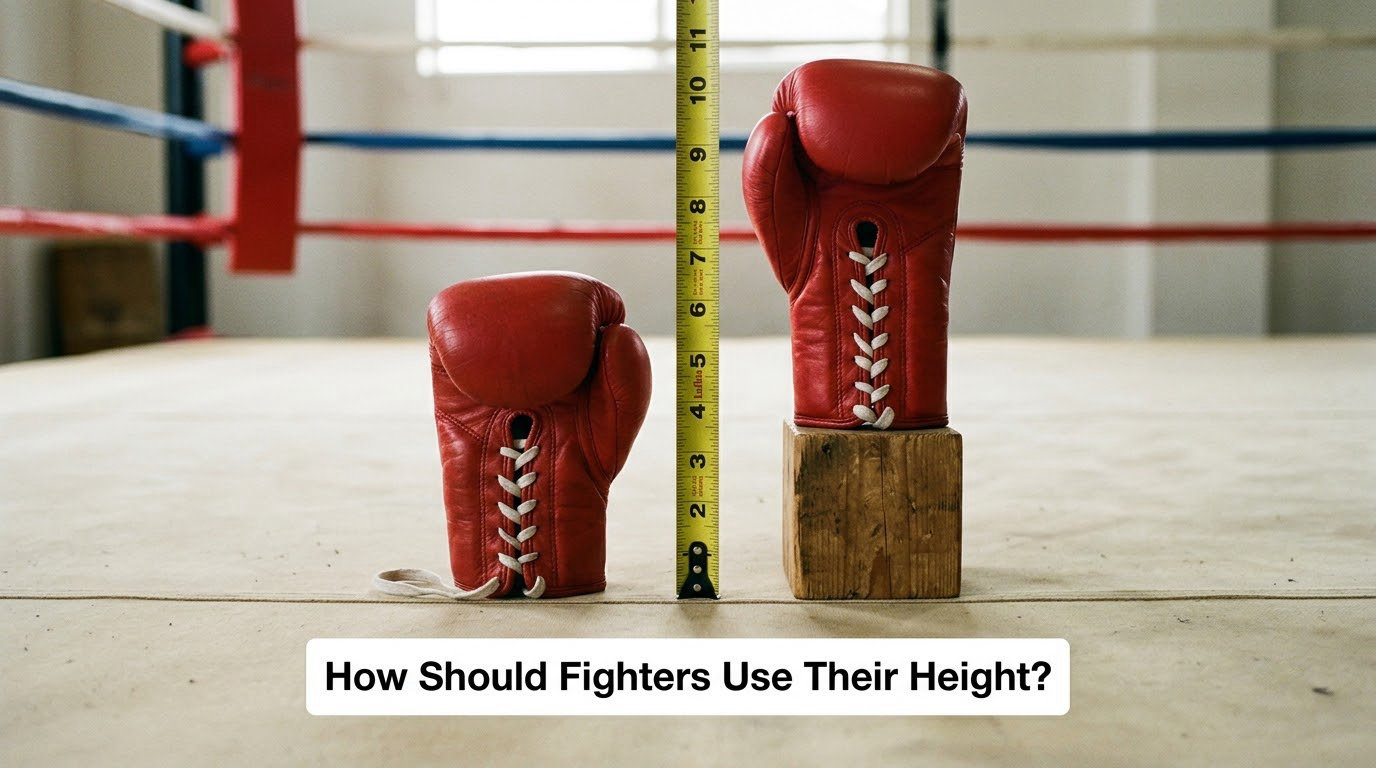
Height is a tool, and like any tool it is wasted by people who do not know what it is for. Four practical applications cover most of it.
Control the distance before the fight starts. The jab is not there to hurt anybody. It is there to make your opponent respect a specific measurement, and once he respects it, his counters travel further than they need to. Fighters who jab to win rather than to measure tend to run out of ideas.
Own the high line. If you are taller, the downward hook is nearly free. Joe Calzaghe built a career on punches thrown from above that shorter opponents could not even see being loaded.
Do not stand where you can be trapped. A taller fighter who has his back to the ropes has given up the only advantage he reliably has. Back to the canvas, the reset distance collapses and his frame becomes a liability.
Shorter fighters: make the first three rounds yours. If the plan is pressure, the plan has to work early, while the legs are fresh and the taller man’s reset distance is still a burden rather than a habit. Late-round pressure against a fighter with longer levers usually loses.
Coaches reading a mismatch should ask one question before anything else: which range is this opponent built to fight in, and who gets to choose? Height shifts the odds at range and does very little once a fighter is inside.
For fans, the same lens works when you assess a matchup. Ignore the listed height and ask what each fighter’s reach is, how each one gets to work, and who forces the other into uncomfortable territory. That is the fight. The rest is biography.
Is There a Height Limit in Boxing?
No governing body sets a height limit in professional boxing. Sanctioning bodies set weight limits only, and fighters regularly compete across many inches of height difference inside the same division. Some amateur federations in parts of Asia have experimented with minimum height rules at the lightest weight classes, largely to protect very small athletes, but no such rule exists in the professional ranks anywhere.
Some promoters and matchmakers will quietly avoid pairing extreme mismatches, but that is a commercial judgement, not a regulation.
Frequently Asked Questions
Is being taller always an advantage in professional boxing?
No. A height advantage in boxing is really a reach advantage, and reach only pays off if the boxer can use it: accurate jab, good footwork, straight punches and the sense to stay out. Taller fighters with flat feet and no plan lose regularly to shorter opponents who pressure well. Height is an advantage in the range it applies to, not a blanket advantage across a whole fight.
What is the ideal height for a professional boxer?
There is no ideal height, only ideal measurements for a style. Heavyweights tend to stand between 6 foot 0 inches and 6 foot 4 inches, while bantamweights sit closer to 5 foot 5 inches. What matters is reach relative to height: a fighter whose arms are long for his frame fights longer than his stature suggests. Weight class, style and conditioning matter far more than a number.
Does a taller boxer usually have more punching power?
Not reliably. Punch power comes from technique, hip rotation, foot placement, timing and how much of the body is behind the shot. Height can add reach and a downward angle, and a long lever can generate real force, but a shorter boxer landing cleanly on the jaw with his whole body behind it will usually do more damage than a tall boxer poking at range. Power is a skill before it is a measurement.
Can a shorter boxer beat a taller boxer, and what should they exploit?
Yes, regularly. Rocky Marciano, listed at around 5 foot 10 inches with a 67 inch reach, made a career of walking down larger heavyweights. A shorter boxer should exploit angles instead of fighting straight in, take the body with hooks and uppercuts, target the lead leg, break rhythm with high volume, and use the ropes and corners to erase the reset distance. Conditioning matters most because closing the gap costs more energy.
Why can a tall boxer with poor footwork lose to a shorter opponent?
Because reach without movement is only a punching range, and a punch you cannot leave is a punch you cannot take back. If a taller boxer cannot move laterally, a shorter pressure fighter can cut the angle, step inside and make every long punch travel past his head. Managing distance is a skill first. Fighters with impressive reach who cannot control their feet are the ones amateurs most often ask about, because the mismatch looks unfair until you see the footwork.
Is height more important in boxing than reach?
Reach. Height is only the source of reach, and plenty of tall fighters do not convert their height into usable length. Sam Langford was listed at 5 foot 7 inches with roughly a 74 inch reach, while Marciano at 5 foot 10 inches had about 67 inches. Measure the arms, not the stature, and you will understand a matchup far better. Frame, stance and style all sit between the two numbers as well.
Conclusion
Height in boxing is a real but incomplete advantage. It produces reach, and reach produces range, range produces first-strike control, and first-strike control produces wins in fights decided at distance. That is the whole case for it, and it is a good case.
It is also the whole case against it. Reach costs you speed, disguise, balance and the ability to move backwards, and a fighter who cannot use what he has gets beaten by a fighter who only has to use what he has.
So when you assess any matchup, start with the arms, not the height. Then look at accuracy, footwork, conditioning and style, and ask who is making the fight happen at the range where they are best. That question settles more bouts than the tape measure ever will.