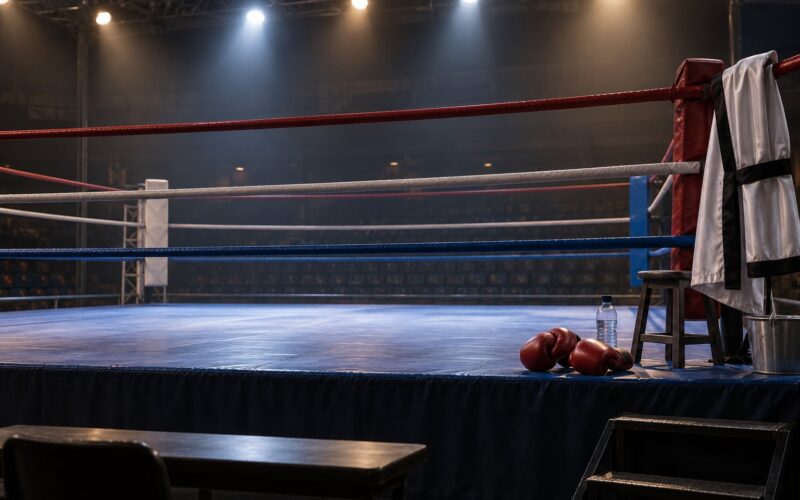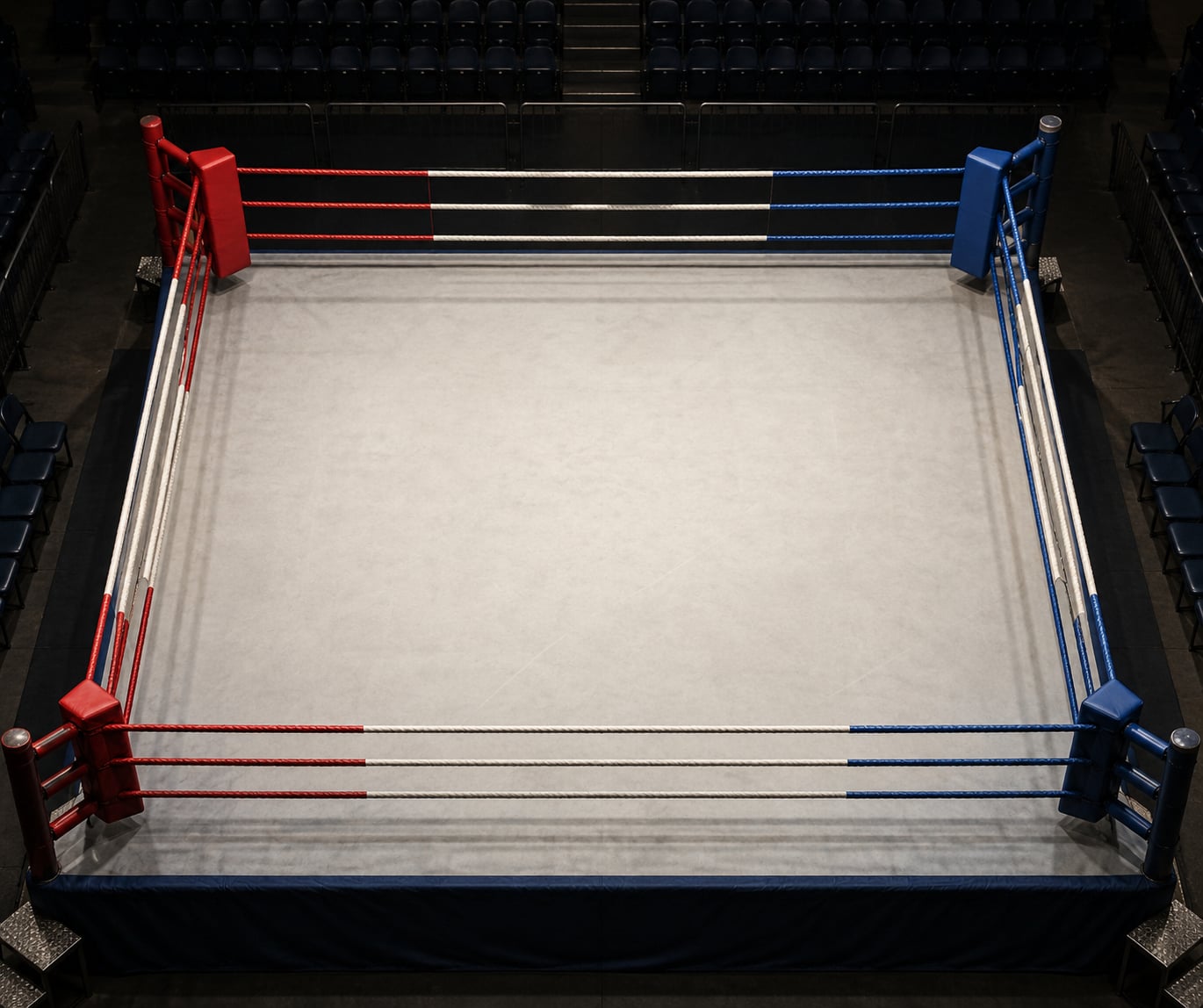
How ring size affects a fight is really a question about escape routes. More space gives a boxer room to circle, open an angle and reset; less space removes those options and forces the action toward the ropes. A 16-foot ring hands pressure fighters their best weapon, a 20-foot ring gives out-boxers and tall jabbers room to work, and the ropes on any of them decide how often a fighter ends up pinned.
Most professional bouts happen somewhere between those extremes. The Unified Rules of Boxing set the standard range at not less than 16 feet and not more than 20 feet on a side within the ropes, so the space a fighter gets on any given night is a choice made by the promoter and approved by the sanctioning body and the state commission, not a fixed fact.
What follows is how that geometry plays out in a fight: the dimensions first, then movement, then styles, then what to watch for when you sit down in front of a broadcast.
Table of Contents
- How Ring Size Affects a Fight, Mechanically
- What Are the Standard Boxing Ring Dimensions?
- How Does More Space Change Boxers’ Movement?
- Why Ring Size Matters for Different Boxing Styles
- How Does Ring Size Affect Punching Angles and Defense?
- What Are the Tactical Effects of a Smaller Ring?
- What Are the Tactical Effects of a Larger Ring?
- Does Ring Size Change the Importance of Ropes and Corners?
- How Ring Size Affects Fight Analysis and Prediction
- Frequently Asked Questions
- What Ring Size Actually Decides
How Ring Size Affects a Fight, Mechanically
Ring size changes four things, and they interact. First, how far a fighter can move before hitting a rope. Second, how many angles he can open without crossing into another fighter’s path. Third, how long a reset takes after a combination. Fourth, how often the fight simply has to stay in one place.
The effect is not uniform. A tall boxer-puncher uses space very differently from a pressure fighter, a 16-foot ring in a hot hall is not the same as a 20-foot ring in an arena, and a cage with eight angled panels plays out differently again. Ring size is a variable, not a verdict.
Here is the definition that matters most. Cutting off the ring means advancing behind forward footwork until the opponent has nowhere left to go, so every punch they throw comes from a bad position. Ring generalship is the ability to control which part of the canvas the fight lives in.
What Are the Standard Boxing Ring Dimensions?
A professional boxing ring is a square of not less than 16 feet and not more than 20 feet on a side within the ropes, with the ring floor extending at least 18 inches beyond the ropes. Most major promotions use a 20-foot ring for televised main events, because the extra room keeps the fighters in frame and makes the fight easier to watch.
| Rule source | Fighting area within the ropes | Floor beyond the ropes |
|---|---|---|
| Unified Rules of Boxing (Wisconsin SPS 192.72) | 16 to 20 feet square | At least 18 inches |
| Ohio Administrative Code 3773-2 | 18 to 24 feet square | Specified by the code |
| New York 19 NYCRR 206-214 | 20 feet square up to 32 feet square | At least 24 inches |
| International Amateur Boxing rules | Not less than 17 feet square | 18 inches |
| Unified Rules of Mixed Martial Arts (ring) | No smaller than 20 feet square | Per the commission rules |
| Standard MMA cage build | About 30 feet across the fighting area | About 4 foot podium plus a 4 foot catwalk |
That spread is the first clue about how ring size affects a fight. A New York commission can sanction a 32-foot ring, which is effectively open space, while an amateur tournament may run at 17 feet. Two fighters can prepare identical game plans and then meet in very different arenas.
Ring construction specs that change fights
The International Amateur Boxing rules publish a level of detail that is useful, because rope height and post padding alter how a fight feels. A ring carries no fewer than four ropes, each at least an inch in diameter, with the bottom rope no more than 18 inches above the canvas and the top rope no more than 52 inches above it. Ropes are tied with soft ties roughly every six feet and kept tight.
Corner posts are metal, no more than four inches in diameter and no more than 58 inches above the ring floor, with padded turnbuckles. A tighter rope line gives a slipping fighter less travel, and a padded corner is where a lot of knockouts are finished. Sanctioning bodies also allow smaller rings only with prior approval for the event, which is why the same fighter can face a different canvas from one fight to the next.
How Does More Space Change Boxers’ Movement?
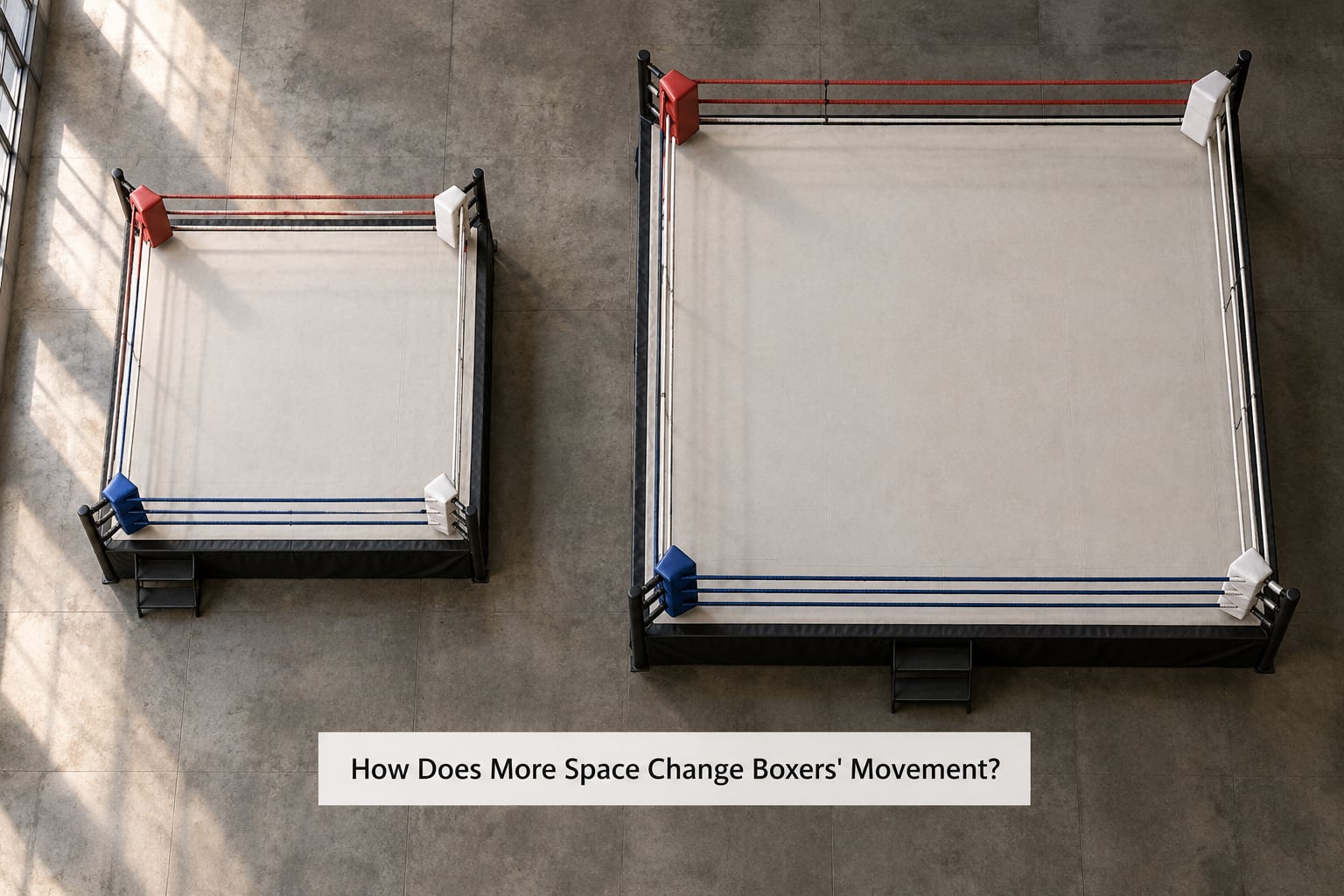
More space means more ways to move without committing. A fighter can circle at a wider radius, open the angle between himself and an advancing opponent, and take a reset that actually takes him somewhere. Distance also becomes a resource he can spend, because stepping back resets the clock on a puncher’s rhythm.
In a smaller ring, the same movements produce shorter arcs. A 16-foot square gives a fighter about a fifth less usable width than a 20-foot one, and that difference is paid out in a handful of steps. Lateral movement that would clear an opponent in a big ring ends with a shoulder against the ropes.
Trainers notice this fastest in the gym. Fighting in a deliberately tight space exposes weak range management, which is one reason coaches use reduced-space rounds even when the fight itself will happen in a large ring.
Why Ring Size Matters for Different Boxing Styles
Styles that win by removing angles get weaker as the ring shrinks. Styles that win by refusing to give up ground get stronger. That is the whole trade.
| Style | Gains from a small ring | Loses from a small ring |
|---|---|---|
| Pressure fighter | Fewer steps to trap an opponent; constant forward work becomes free | Corners turn into fire escapes if the opponent defends well |
| Out-boxer | Opponent has nowhere to reset to | Longest tool, the jab, has to be thrown at close range |
| Counterpuncher | Opponent must advance into a small space | Fewer chances to invite the attack and pick it off |
| Tall rangeboxer | Reach advantage matters even at short range | Cannot use footwork to keep the distance that makes reach useful |
| Southpaw or switch-hitter | Fewer angles to read, simpler reads at close range | Relies on changing rhythm and direction, both harder without room |
| Tall, mobile boxer-puncher | Little | Nothing, which is why bigger rings are usually requested for these fighters |
Height amplifies this. A taller fighter with longer limbs is hurt more by a cramped ring, not less, because the extra reach only pays off at a distance he is no longer allowed to hold. Amateurs ask constantly whether a shorter fighter can beat a much taller one, and the honest answer is that ring size decides how much of the size gap ever comes into play.
How Does Ring Size Affect Punching Angles and Defense?
An angle in boxing is the lane between your opponent’s shoulder and your own. In a large ring, a fighter can keep creating lanes. In a small ring, the lanes collapse and both fighters are forced to punch on the same line, which makes counters easier and makes the slip that usually creates an angle impossible.
Ropes change defense in three ways. They remove the option of simply backing out. They make the pivot, where a fighter turns on a back foot to leave the ropes, easier to start and easier to escape. And they mean a fighter who is over-committed to a combination has a shorter distance to slide out over.
Corners are worse than open ropes, because a fighter pinned in a corner cannot circle out at all. Getting out of a neutral corner usually costs more than getting out along a side. That is the single biggest reason a pressure fighter targets corners rather than just backing someone up.
What Are the Tactical Effects of a Smaller Ring?
Less escape is the headline, and everything else follows from it. When a fighter has few options, he takes worse ones. Combinations that would be broken up in open space now land, because the fighter cannot circle off the line. Defensive footwork gets shorter because there is nowhere to travel.
Reset distance drops sharply. After a combination in a 16-foot ring, a reset might be a single step instead of a full pivot across the canvas, which means the pressure fighter is back on you before the guard settles. Corner traps happen more often, and fights spend a much higher share of the round on the ropes.
Heat is the quieter effect. Enclosed rings with limited air movement push sweat loss that forum fighters and coaches regularly put at 5 to 10 pounds over a night, and that cost lands in the later rounds. A smaller ring also means more time at close range, which is harder work per minute than moving in open space. Fatigue arrives sooner, and it arrives unevenly, usually hurting the fighter whose style depends on cleaner movement late.
What Are the Tactical Effects of a Larger Ring?
A bigger ring gives the defensive fighter his weapons back. Circling, angle work, reset distance and lateral movement all come in proportion to the extra width, and a fighter who is good at those things can neutralise a pressure fighter without ever going backward.
The cost falls on the attacker. A pressure fighter has to cover more ground to trap a moving opponent, and each pursuit spends more energy without producing a knockdown. Against an out-boxer with strong legs, that arithmetic often decides the fight late, because the man chasing has already done the harder work.
Smaller fighters benefit from the extra room in a less obvious way. A compact fighter with a low centre of gravity can disappear inside a taller opponent’s reach in a large ring, where angles open up behind the jab. In a small ring that disappearing act has nowhere to happen.
Does Ring Size Change the Importance of Ropes and Corners?
Yes, and the reason is simple: as space shrinks, the ropes do a larger share of the ring’s job. In a 20-foot ring the ropes are mostly a boundary. In a 16-foot ring they are a wall you fight off four times a round, and the top rope at 52 inches is high enough to hold a taller fighter’s head still.
Corners matter for rotation. A fighter who can send an opponent consistently to the same corner is not just applying pressure, he is removing that corner as a safe place to stand. Neutral corner control, where one fighter decides where the fight happens, is the clearest sign of ring generalship.
Construction plays in too. Fewer ropes than the four most rules require would leave a gap at the bottom, and a fighter who learns he can go through it will. Padded posts mean the corner is survivable, which is why the IAB specification treats turnbuckle covers as a safety requirement rather than a cosmetic one.
How Ring Size Affects Fight Analysis and Prediction
Watch five things and most tactical shifts stop being mysterious. First, find out what the ring actually measures, from the commission rules for that state or from the broadcast build. A 16-foot ring and a 24-foot ring produce completely different expectations from the same matchup.
Second, judge each fighter against the space rather than in the abstract. Ask what range each one wants to fight at, then ask whether the ring lets them have it. Third, track rope time across the early rounds. A fighter who spends the first two rounds on the ropes and then starts walking the other fighter back has either solved the geometry or found a rhythm worth copying.
Fourth, separate tactical change from decline. When a pressure fighter slows in the sixth, it is usually the smaller ring and the distance he has covered, not a sudden loss of fitness. The same man in a large ring looks fresher at the same point because he has spent less of the fight walking.
Does ring size affect judging?
Judges are told to score clean punching, defence, ring generalship and effective aggression, and none of those are defined in square feet. Still, ring size leaks into all four. Work in a small ring looks busier because there is nowhere else for it to happen, and ring generalship can only be rewarded if there is a ring to control.
For prediction models, the practical effect is on pace and cut rates. Fights held in tight rings carry more inside exchanges and more corner pressure, and a fighter whose whole game is getting the opponent out of the ring is disadvantaged in a way that head-to-head records rarely capture.
Frequently Asked Questions
What size ring do boxers fight in?
A professional boxing ring is a square of not less than 16 feet and not more than 20 feet on a side within the ropes, with the floor extending at least 18 inches beyond the ropes. Most televised main events use the full 20 feet. Regional and amateur bouts often sit at 16 or 18 feet, and some state commissions allow larger rings.
What is the regulation size of a boxing ring?
The Unified Rules of Boxing, adopted by state commissions including Wisconsin, set the ring at not less than 16 nor more than 20 feet on a side within the ropes, with an apron of at least 18 inches. New York rules allow 20 to 32 feet, Ohio allows 18 to 24 feet, and the IAB sets a 17 foot minimum. The commission for the event has the final say.
Does ring size matter a lot in a fight?
More than most pre-fight coverage suggests, though it is never decisive on its own. Space sets how often a fighter is forced onto the ropes, how long a reset takes, and how many angles exist. It can flip a matchup between a pressure fighter and an out-boxer. But skills, style and preparation still decide far more rounds than the canvas dimensions do.
How do boxers move in a 16 foot ring?
In a 16-foot ring, lateral movement covers about a fifth less width than in a 20-foot ring, so the same footwork pattern ends with a fighter on the ropes. Circles get shorter, resets get compressed, and combinations have less room to miss. Fighters who rely on circling quickly find they cannot create angles and have to fight on the straight line.
What is the typical size of an MMA cage?
Standard cage builds are commonly listed with a fighting area around 30 feet across, set on a podium of roughly 4 feet with a catwalk of another 4 feet around the outside. Under the Unified Rules of Mixed Martial Arts, a ring used for MMA instead may be no smaller than 20 feet square, which is the minimum boxing-style square, not a cage.
Is there a height advantage in boxing?
Height brings reach, which matters most at a distance the smaller fighter can escape to. In a tight ring that advantage shrinks, because the taller fighter has to fight inside the shorter fighter’s preferred range. Weight and skill still outweigh reach, but ring size decides how much of the height gap a fighter actually gets to use.
What Ring Size Actually Decides
Ring size decides how much room a fighter has to be wrong in. It sets how often he meets the ropes, how quickly he can get away from them, and how much of his game depends on space he may not get.
Before you watch a fight, find the ring size and ask one question: whose preferred range does it allow? Everything else, the rope time, the corner traps, the way a tired fighter changes his plan, follows from that.