Boxers build cardio for 12 rounds by stacking three things in order: a deep aerobic base from roadwork, threshold work that raises the pace you can hold, and round-specific work that trains you to output hard for three minutes, recover for sixty seconds, and do it again. Most amateurs skip the first two and go straight to hard sparring, which is why they feel finished by round six. Give the plan below ten weeks and a coach’s eye on the process, and the round-11 problem stops being dramatic.
One note before we start: this is general training information, not medical advice. If you have a heart condition, uncontrolled blood pressure, a history of eating disorders, or a weight cut that is affecting you badly, talk to a doctor before adding any volume.
Table of Contents
- What You Need
- Step-by-Step: How Boxers Build Cardio for 12 Rounds
- Common Mistakes
- Frequently Asked Questions
- How long does it take to build cardio for a 12-round boxing fight?
- Is running the best way to prepare for 12 rounds?
- How often should a boxer do hard conditioning sessions?
- Should I try to finish every sparring round at full speed?
- How do I know if my cardio training is too much?
- What should a boxer do during a 60-second corner break?
What You Need
You need four things before the first session, and none of them are expensive.
A baseline. Time yourself honestly. Run or cycle for as long as you can and note the distance, then do six rounds of three minutes of work on a heavy bag with a sixty-second break. Write both numbers down. That is your starting line, and without it you cannot tell whether the plan is working.
A way to track sessions. A notebook or phone note is fine. Record the date, the session, the distance or rounds, and how you felt at the end of each round rather than just at the end of the session. Fighters who track round-by-round output catch a bad week three days before it becomes a bad fight.
A progression rule. Increase one thing at a time: distance, interval speed, or rounds, never two. Most people who injure themselves on hill sprints were also adding roadwork mileage in the same week. The amateur boxing community passes around a prescription of six to twelve rounds of three-minute hill sprints with 60 seconds of rest, and it works for some people, but done unsupervised it is a fast route to a calf strain or a burnt-out nervous system. Supervise it or scale it back.
Recovery tools. A foam roller, a decent night’s sleep schedule, and food with enough carbohydrate in it before hard sessions. Training through a sore joint is not toughness; it is a limp in round four.
A coach matters more than any of the rest, especially for the pacing work in step four. If you cannot afford one, a training partner who has done 12-round bouts is the next best thing, because the judgment calls in a fight are not something you can read off a screen.
Step-by-Step: How Boxers Build Cardio for 12 Rounds
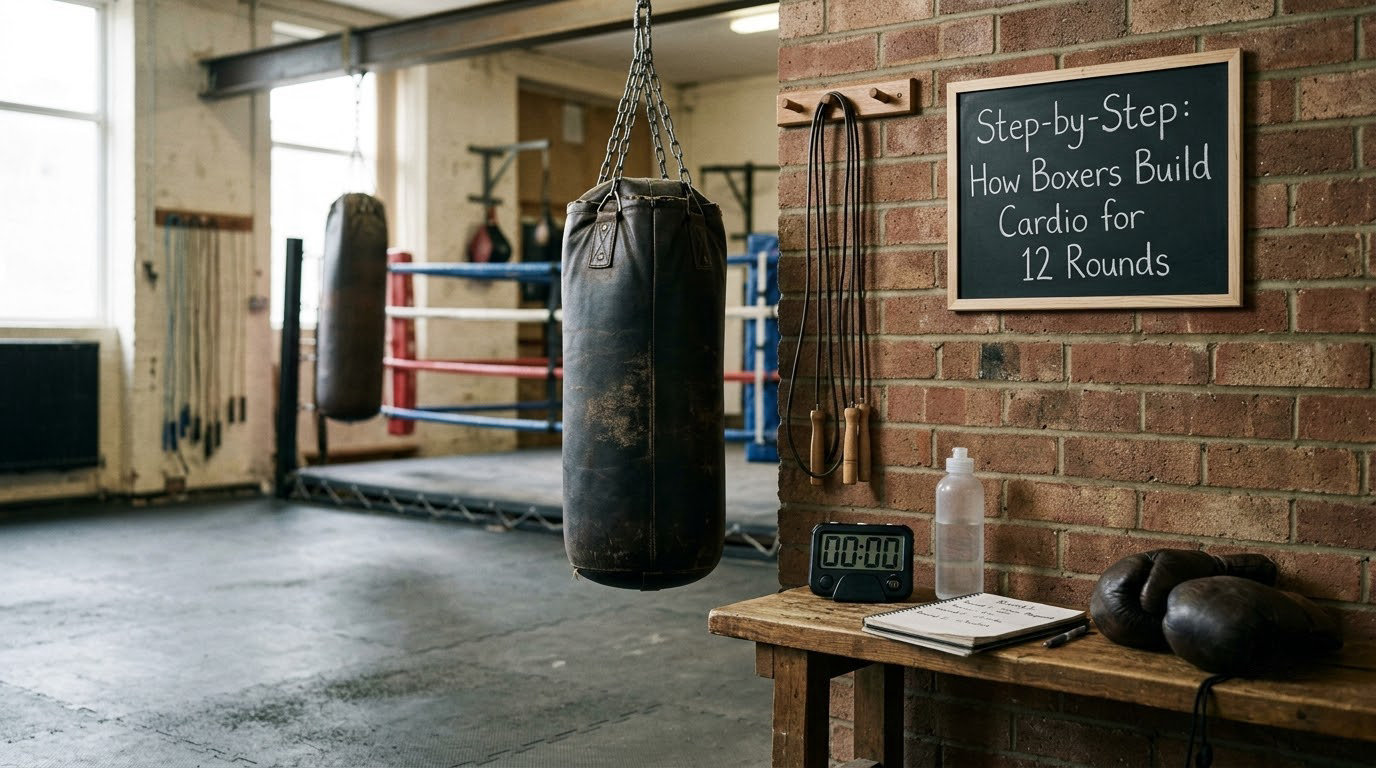
Here is the order that works, with roughly two weeks on each early stage. Rounds are three minutes of work with a sixty-second break unless I say otherwise.
Step 1: Build an Aerobic Base
The aerobic base is the boring part that decides everything else. It is the engine that clears lactate between rounds and carries your legs through round ten when your arms are gone.
Start with three runs a week at a pace where you can hold a conversation. If you can run 20 minutes, run 20 minutes. Add 10 percent to your weekly distance, and take a rest day after every harder session. The goal over six to eight weeks is a continuous 45 to 60 minutes of easy running, roughly 5 to 8 miles for most people, without your heart rate climbing anywhere near uncomfortable.
Boxers who skip this and jump to intervals end up with a strong-looking engine that has no bottom to it. The easy running is what lets you recover, and the recovery is what the sixty-second corner is really about.
Step 2: Improve Threshold Capacity
Once the base is there, add threshold work: efforts that are hard enough to matter but sustainable enough that you could speak a few words between them.
A good first prescription is 3 to 5 minutes of fast walking, 2 minutes easy, repeated 5 to 8 times. Or 4 minutes of steady tempo running with 90 seconds of easy jog. Do this once a week for the first month, then twice. Keep your round-by-round notes: the useful signal is that the gap between the first effort and the fifth one gets smaller over weeks.
This stage is where the phrase “anaerobic threshold” becomes practical. The threshold is roughly the pace at which fatigue starts dictating your technique rather than your decisions. Raising it means you can work at a hard pace and still think clearly, which is exactly what a round-nine exchange requires.
Step 3: Practice Repeat Rounds
Now you start reproducing the actual demand: hard work, short recovery, repeat.
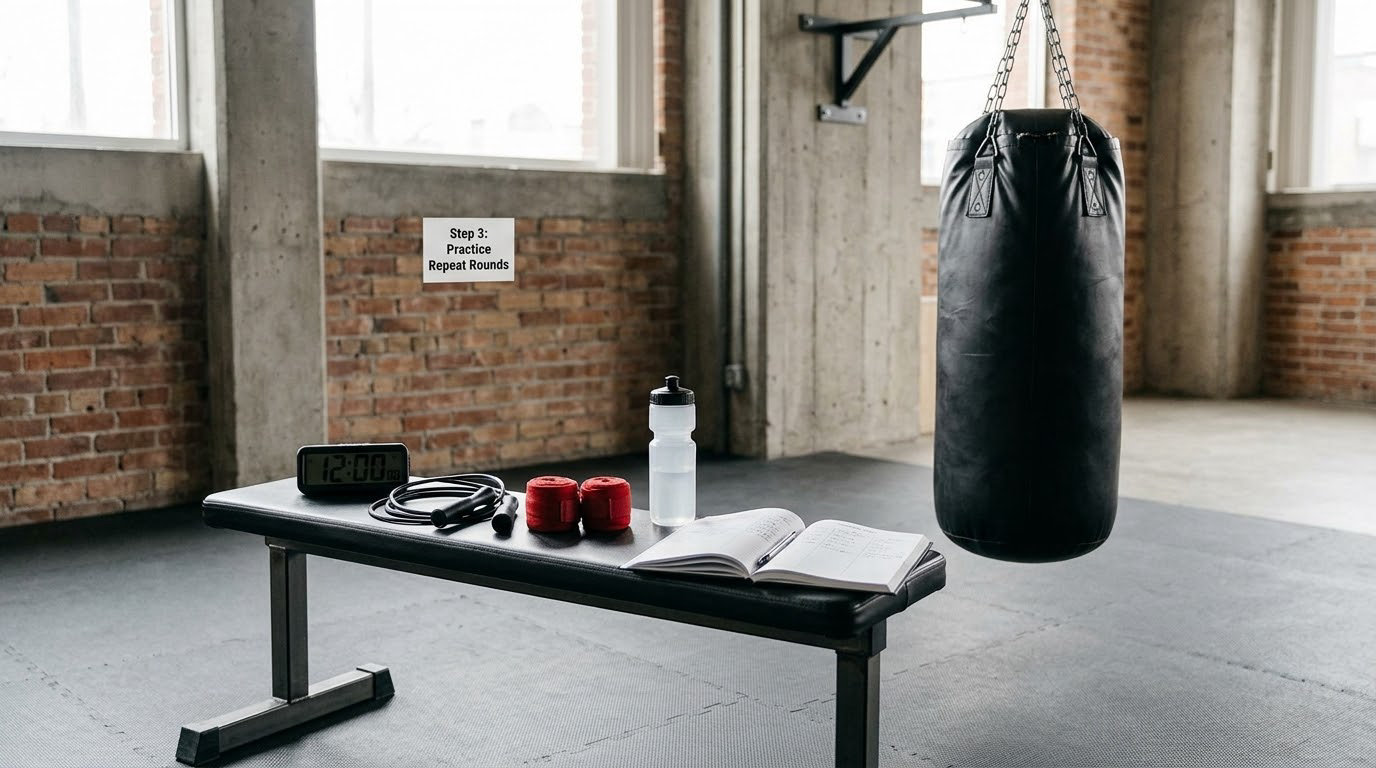
Here is a simple ladder you can walk up over the camp.
- Weeks 1 to 2: 4 rounds, 2 minutes on, 60 seconds off, bag or pads, then double-unders for the off period.
- Weeks 3 to 4: 6 rounds, 2 minutes on, 60 seconds off, mixing bag work with rowing or cycling.
- Weeks 5 to 6: 8 rounds, 3 minutes on, 60 seconds off. Full round length, full corner length.
- Weeks 7 to 9: 10 to 12 rounds, alternating 3 minutes on and 60 seconds off, with the low-impact work in the rest period so your heart rate stays up.
The off period is where most people cheat. Standing against a wall for a full sixty seconds means you start each round with a lower heart rate than you would in a real fight. FightCamp and other coaching apps make the same point in their round-format workouts: keep moving in the break, lightly, and the adaptation you want is the one that happens while your heart rate is still high.
Low-impact options matter more than people expect. Rowing, cycling, an assault bike or swimming let you accumulate hard minutes without wrecking your knees and ankles, which is where roadwork and sparring tend to catch up with you. Fighters training three or four sessions a week usually need both.
Step 4: Train Your Pacing and Recovery
Pacing is the skill nobody teaches beginners and everybody needs. Twelve rounds is not twelve identical rounds. A fighter who goes out at race pace in the first two has spent his best output before the hard part starts.
| Round | Target output | What to do |
|---|---|---|
| 1 to 2 | About 75% | Feel the timing, land your jab, do not chase knockouts. Measure the round, do not win it. |
| 3 to 4 | About 85% | Start working the body and start building the lead you will need later. |
| 5 to 6 | About 95% | Highest output of the fight so far, but stay inside your technical range. |
| 7 to 8 | About 90% | The dip usually starts here. Shorten your combinations, keep the jab. |
| 9 to 10 | About 80% | Trade in bursts, then reset with footwork. Stop throwing to catch up. |
| 11 to 12 | 70 to 80% | Stay busy, stay sharp defensively. Fatigue punishes standing still more than it punishes moving. |
Train this in pad work before you try it in sparring. Have your coach call a pace for each round and give you a score out of ten for output and technique. Doing it in the gym removes the adrenaline and the stakes, which is exactly the environment you want for learning something new under fatigue.
Breathing is the most overlooked part of fight cardio. The rule is simple and most people break it: exhale sharply on every punch. It empties the lungs, keeps you from holding your breath on impact, and gives you a rhythm to move behind. Hold your breath and your output falls within a round or two, well before the legs are the problem.
Watch the length of your rest, too. Training with a full 90-second break between rounds because your coach is not ready to call time does not prepare you for 60 seconds in a real corner. Work both lengths, then favour the shorter one as the fight gets closer.
Step 5: Connect Every Session to Fight Fitness
Cardio that does not show up in the ring is wasted time. Every conditioning session should attach to something technical.
Pair intervals with combinations you will actually use, and you get skill under fatigue, which is where fights are decided. A session of 3-minute pad rounds where you are adding a new variation every round teaches far more than a solo bike ride, because your body learns the movement while it is tired.
Keep strength work light and frequent. Two or three sessions a week of squats, presses, rows and carries keeps the legs durable without creating fatigue you cannot train through. Heavy lower-body work the day before a hard interval session is a self-inflicted wound.
Sparring is where the plan meets reality, and the order of the build matters. Work up to the number of rounds gradually. Fighters who describe their preparation usually talk about adding a round every week or two rather than jumping to a full 12-round simulation in week two. If you are at a point in camp where you have never sparred more than eight rounds, do not fix that with a single brutal 12-round session. The r/BoxingTheSweetScience thread about Moses Itauma raised exactly this question: what does a 12-round record actually tell you if the fighter has never gone twelve in the gym?
Step 6: Taper Without Losing Your Edge
The last two weeks are about arriving fresh, and most fighters get this wrong by staying flat out until fight week.
Cut your long run and your interval volume by roughly 40 to 50 percent. Keep the intensity of the sessions you keep, so that when you step in the ring your body still recognises hard effort. Keep sparring, but shorten it: eight to ten shorter rounds instead of twelve long ones, and finish each camp week with a session where you feel like you had something left.
The last hard session is usually about five or six days out. After that, light shadowboxing, easy roadwork, mobility, and sleep. Fight week is for weight management and feeling sharp, not for proving anything to yourself.
Scaling It for Amateurs, Beginners, and Older Fighters
Not everyone is heading to a 12-round title fight, and pretending otherwise is how people get hurt. An amateur fight is three rounds; a regional or national card might be six. If your target is six rounds, your ladder stops at step 3 and you spend the remaining weeks on quality work at that distance.
Beginners need the reverse order of patience. Anyone who is gassed after 20 minutes of gym time is not ready to add a 12-round goal; they are ready to walk or cycle three times a week for a month. That is unglamorous and it works.
Over 40, or coming back to a bad knee or ankle, swap roadwork for cycling, rowing, swimming or low-impact shadowboxing. You can build a fight engine without impact. The FightCamp low-impact format is a reasonable template: repeated four-round blocks of shadowboxing with a burnout at the end of each, building to an eight-round session with no equipment at all.
Common Mistakes
Doing everything at race pace. If every session is maximal, nothing recovers and you stall by week four. Most of your weekly volume should be easy enough to recover from within a day.
Adding volume and intensity in the same week. Increase one, not both. This is the single most common reason a boxer ends a camp with a hamstring problem instead of a cardio problem.
Skipping the easy aerobic work. The easy running is not wasted time. It is the part that builds the capacity to clear lactate in the sixty seconds you actually get.
Training only on the bag. Bag rounds build output and endurance, but they do not teach you to spend energy wisely against a person who is taking it away from you. Pacing is a skill you learn in sparring and pad work with a coach calling the shots.
Standing still during the rest interval. A full 60 or 90 seconds of standing hands-on-knees means you start every round more recovered than you will on fight night. Move lightly through your break.
Ignoring what the weight cut does to rounds 9 to 12. This one gets overlooked constantly. Cutting weight means losing water, and your blood volume drops with it. A dehydrated boxer has less to pump with and heats up faster, which is why some fighters look superb for six rounds and disappear by the ninth. If you are making weight, your coach or doctor should be monitoring it, and the answer is never to compensate by cutting more water or training hotter. Fighters who struggle late in fights often trace it back to the week of the weight cut rather than the run program.
Adding a new supplement, a heat protocol, or a 5am roadwork session. Some of these help. None of them fix a plan you have not run for eight weeks.
A useful rule for the whole build: if your output and technique hold up in round eight of a hard sparring session, your cardio is fine and your problem is somewhere else, usually the jab, the feet, or your defence.
Frequently Asked Questions
How long does it take to build cardio for a 12-round boxing fight?
For a boxer who already has a base, ten weeks is a realistic timeline. Most of that time is not running hard; it is steady aerobic work, weekly threshold sessions, and adding a round every week or two to sparring. Beginners should start with the aerobic base alone and expect three to four months before a full 12-round effort makes sense. Amateur fighters heading to three or six rounds need far less.
Is running the best way to prepare for 12 rounds?
Running is the best aerobic base most boxers can use, but it does not build fight cardio on its own. It carries your legs and your recovery between rounds without teaching you to output hard for three minutes on your feet while working. Pair roadwork with round-format intervals on the bag and pads, and with sparring, and you get both halves of the engine.
How often should a boxer do hard conditioning sessions?
Two hard sessions a week is plenty for most fighters, and beginners should start with one. Everything else can be easy aerobic work, technique, or strength. The reason is simple: hard conditioning produces fatigue that takes days to clear, and if you stack two hard days together you are training tired rather than fit. Keep at least 48 hours between them, and keep a day between hard sessions and sparring.
Should I try to finish every sparring round at full speed?
No. Full-speed sparring every round teaches you to open up early and gas out by round six. Instead, have your coach set a target for each round, roughly 75 percent in the opening pair and climbing to around 95 percent in the middle rounds. Holding a lower pace early is a skill, and rounds nine to twelve are won by fighters who kept something back.
How do I know if my cardio training is too much?
Watch your round-by-round output, not just how tired you feel at the end. If your punch counts drop noticeably from round one to round three in the same session, your recovery is not keeping up with the load. Resting heart rate that stays elevated in the morning, poor sleep, and constant soreness are other signs. Cut volume by a third, keep the intensity, and build back slowly. Persistent symptoms deserve a doctor’s visit.
What should a boxer do during a 60-second corner break?
Sit down if you can, drink water in small sips, and get your breathing back under control with long exhales. The cut should come from the coach, not from you arguing for it. Use the time to reset your stance and your game plan, and do not spend the break standing still the whole time, because staying lightly on your feet keeps you closer to the pace you will need in the next round.
If you do one thing this week, time yourself properly: a continuous easy run, and six rounds of bag work with a sixty-second break. Write both down. That number is the whole plan’s starting point, and everything after it is progression. Give it ten honest weeks and the second twelve rounds will feel like rounds nine and ten used to.