A final press conference is the last media event before a bout, usually a day or two out, where the fighters, their trainers and the promoter take questions, make their final statements and pose for the face-off photos. What happens at a final press conference follows a loose format rather than a script: opening remarks, fighter answers, media questions, and a closing staredown before everyone steps off the dais.
It is a strange event if you have never watched one. Nobody is in a ring, nobody is throwing a punch, and yet the room feels tense. That is because the press conference is the last time the two men share a space before they try to hurt each other, and everyone in the room understands that.
Table of Contents
- What Happens at a Final Press Conference?
- Why Promoters Hold a Final Press Conference
- What Happens During the Opening Remarks
- What the Final Face-Off Is For
- What Questions Fighters Usually Answer
- What Questions the Media Usually Ask
- How Long Does a Final Press Conference Last?
- Press Conference Customs That May Differ Between Promotions
- What Can You Learn by Watching a Final Press Conference?
- Frequently Asked Questions
- Do fighters always pose at a final boxing press conference?
- Is a boxing press conference the day before the fight?
- Are boxing press conferences open to the public?
- Can you watch a final press conference after an event?
- Why do boxers get asked the same question repeatedly?
- Does a confrontation at a final press conference affect the result?
- Key Takeaways
What Happens at a Final Press Conference?
Short version: the promoter opens the event, both fighters are introduced, questions come from media outlets, trainers often add technical detail, and the two fighters finish by standing shoulder to shoulder for the final face-off. Nothing about the running order is sacred, so you will see variations between promotions.
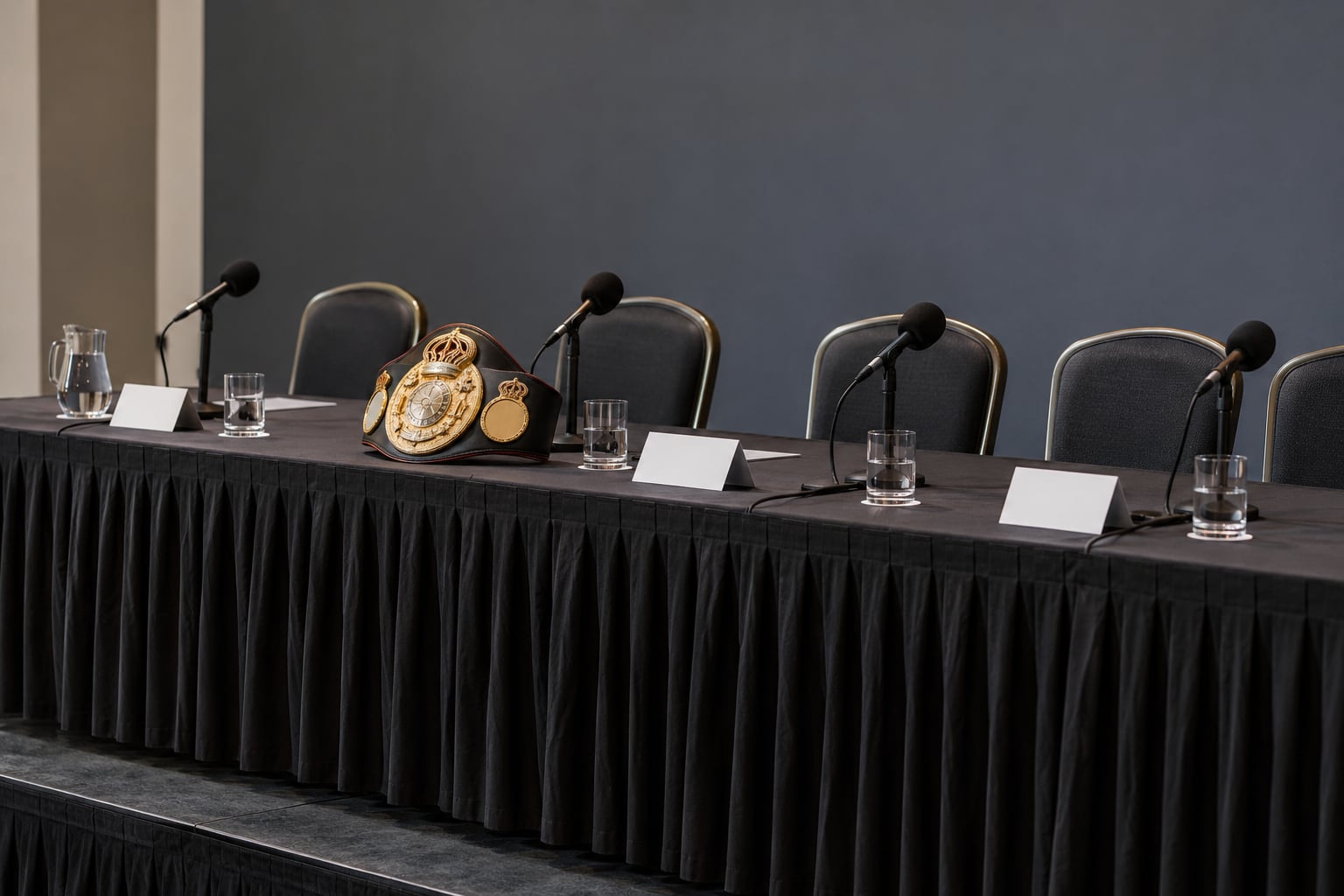
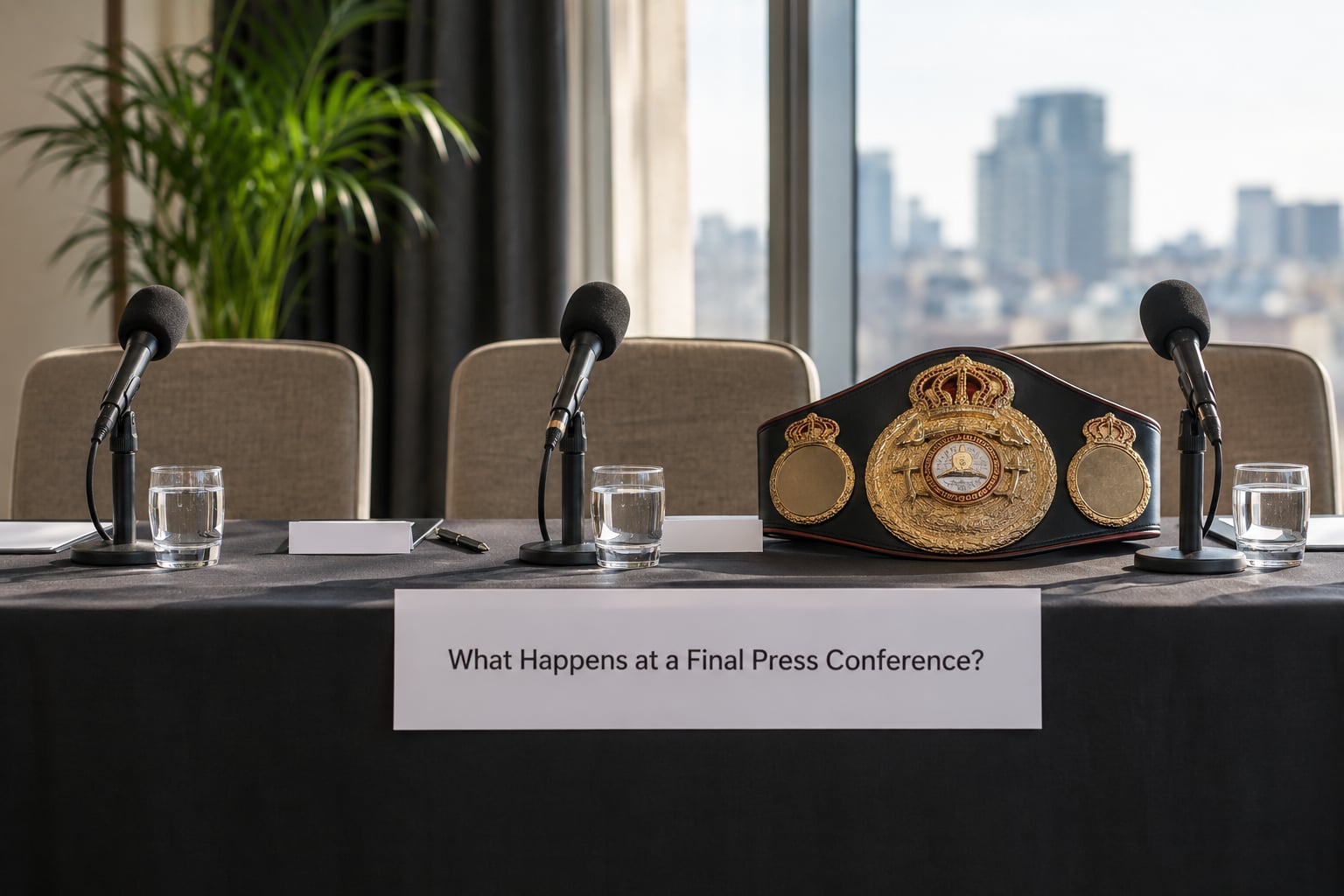
Typically you will find a long table on a stage with two chairs at the centre, one for each fighter, and microphones running along the front edge. Trainer, manager and promoter seats sit behind or to the side. Reporters fill the first rows, cameras sit at the back, and at high-profile events you can see security standing along the walls and near the exits.
Fighters often wear team clothing rather than a suit, and they arrive separately, sometimes minutes apart. The undercard champions are usually introduced first so the main event pair walk in last. If you only want the face-off, the last two minutes of the stream is where it lives.
Why Promoters Hold a Final Press Conference
Two reasons, and a promoter will only admit to one of them. The public reason is media access: fight coverage in most countries is thin, so the press conference is where a promotion feeds reporters enough material to write about all week.
The other reason is sales. A final press conference is the last scheduled event before fight night, which makes it the natural place to plug the broadcast, the streaming platform and any remaining tickets. Promoters who run big pay-per-view cards often mention the buy-in number right there on the dais.
It also gives both fighters a stage to shape the story before the first bell. A challenger with nothing to lose has an incentive to talk big, and a champion with a long unbeaten run has every reason to stay calm and let the questions do the work. The narrative set at the press conference tends to follow the fighters through fight week.
How much control the promoter has depends on the promotion. Some events are tightly produced, with a moderator handing out one microphone at a time and a hard stop on every answer. Others are looser, with the promoter wandering the floor and reporters shouting follow-ups. Big cards in the United States and the United Kingdom tend to be formal and heavily sponsored. Regional promotions often run something shorter and closer to a gym Q&A.
What Happens During the Opening Remarks
The opening is housekeeping with a soundtrack. A ring announcer or the promotion’s own host welcomes the crowd, reads sponsor messages, and explains any format rules worth knowing, such as a two-minute limit per answer or a rule that questions come only from the media risers.
Then the promoter speaks. Expect thanks to the venue, the sanctioning body and the broadcast partner, a nod to the undercard, and a plug for fight night. Promoters are on message here, and the message is usually about the size of the event rather than the fight itself.
Undercard champions and their trainers are introduced first, and they usually take a few questions so the card has some promotional cover. The main event fighters are then announced by name, often with a belt or trophy carried out and set on the table in front of them. Nobody in the room is pretending that object is not there to be photographed.
What Happens at a Final Press Conference, Minute by Minute?
- Doors open and seats fill. Media check in, cameras are positioned, and the fighters’ corners are kept away from the stage until their cue.
- Undercard introductions. Champions from the supporting bouts take a seat, say a few words and often answer one or two questions each.
- Promoter and host opening remarks. Welcome, sponsor reads, format explanation, and a plug for the broadcast.
- Main event fighter introductions. Names, records, nicknames and titles announced, with the belt or trophy placed on the table.
- Opening statements. Each fighter gets roughly one prepared remark before questions begin. Promoted feuds tend to be written here.
- Media questions. Reporters take turns, usually two or three questions per fighter. Trainers and promoters are pulled in for strategy and promotion questions.
- Closing remarks and the face-off. Brief closing statements, the two fighters stand and pose together at centre table, photographers get their shots, and the event ends.
Major fights depart from this format more often than you would expect. Broadcasters sometimes hold a longer sit-down interview before the dais event, and a few cards now run the presser as a single remote video call with no audience at all.
What the Final Face-Off Is For
The face-off is the bit everyone came for. Two fighters stand shoulder to shoulder, look into the cameras, hold a stare, and pose while photographers fire away. It is a photo call with a hostile soundtrack.
For the promotion it is the most shareable image of fight week. A single frame from a face-off tends to travel further than any quote from the same event, which is why the photographers are front and centre and why the host keeps announcing that they need one more from each side.
For the fighters it is a controlled version of mind games. A staredown lets a boxer look at his opponent without absorbing a punch for it, and plenty of fighters say in interviews that they use it to see how the other man reacts under pressure. Some will hold the stare far longer than necessary. Others will grin through it, or refuse to look at all.
A scripted face-off is not the same as a staredown. When the two men square up, jaw tight, and lean in with nobody speaking, that is unscripted, and it is the moment most fans describe as the real heat of the night. Promoters who want a controlled image usually keep a moderator close enough to step between the pair.
Not every promotion runs it. Some keep the fighters seated for the whole event, some allow only a brief shoulder-to-shoulder pose, and a few have cancelled the face-off entirely after a fighter’s camp or contract dispute. When you tune in expecting the stare and it never comes, that is usually why.
What Questions Fighters Usually Answer
The questions in the middle of the session are where the useful information sits. Six themes cover almost every final press conference in the sport.
Camp and confidence. Reporters ask how the training went, whether the fighter feels sharp, and how the last sparring session looked. The honest version of this answer is rare. Most fighters give a version of the same line: ready, felt good, best shape of the career.
Game plan. Questions about what the fighter intends to do in the ring usually get aimed at the trainer more than the fighter. Trainers are often more willing to explain a tactic, a body attack or a defensive habit, which is one reason fans pay more attention to the corner than to the man on the dais.
The opponent. Expect questions about the other man’s style, his recent form, and what changed between their two meetings. Fighters who fought each other before get asked to compare versions of themselves, and that question produces some of the best material of the whole week.
Predictions. Almost every reporter asks for a knockout call or a round number. It is a softball question, which is exactly why it gets asked, and the answer tells you very little.
Injuries and setbacks. Missing fights, cancelled sessions, travel problems and weight-cut difficulties all come up when there is a recent story to chase.
Emotion and legacy. For champions, questions about pressure, motivation and what the win would mean drift toward personal territory. For fighters with a redemption arc, the press conference becomes an interview about character rather than boxing.
What you will not get is a straight answer about a weakness. Fighters are media-trained long before they ever sit at a final press conference, and most of them have rehearsed the answers that keep the narrative intact.
What Questions the Media Usually Ask
The media side of a final press conference runs on a short list, and knowing it helps you tell a real question from a filler one.
Fight questions come first: what happened in camp, what the fighter expects from the other man, and how the fight will be won. Then the room moves outward to the event itself, asking about the venue, the undercard, the running order and whether anyone expects an early finish.
Commercial questions follow. Reporters ask about broadcast partners and start times, and about ticket availability, which is often the last question the promoter wants but a fair one to ask.
Career questions are standard too. Will this be the last fight? What is next if the result goes the right way? Is there already a date or an opponent being discussed? Fighters give careful answers here, because a retirement comment at a final press conference becomes a headline by breakfast.
Contractual questions are the awkward ones. Rematch clauses, purse bids, mandatory challengers and sanctioning body requirements come up when there is a live dispute, and promoters usually take those questions rather than let a fighter answer. The venue and the undercard also get cross-examined, because a bad story about the card sells tickets just as well as a good one about the fight.
How Long Does a Final Press Conference Last?
Most run somewhere between 30 and 60 minutes. That is the range you should plan around rather than a fixed schedule, since the running time depends on who is on the dais and how much the promotion wants to say.
A regional show with one fighter, one trainer and a handful of local reporters can be done in 15 minutes. A pay-per-view card with undercard champions, two trainers, a promoter and a broadcaster in the room can run past an hour, especially if the host allows follow-ups.
Two things stretch a session. The first is a format where the moderator gives each fighter a long block of consecutive questions, which front-loads the interesting part but removes the back-and-forth. The second is any sponsor or broadcaster segment that comes in after the opening remarks.
Remote press conferences run shorter, usually 20 to 30 minutes, because nobody wants to sit on a video call for an hour. So do sessions where the two camps have agreed to keep it civil, which tends to cut both the questions and the answers down to short.
Press Conference Customs That May Differ Between Promotions
The bones of the event are the same everywhere, but the details change with the promotion, the venue and the size of the card. This is the general shape of what you can expect and where the variation sits.
| Element | Common practice | Where it varies |
|---|---|---|
| Fighter arrivals | Both fighters walk in separately to a set time | Large events stage the entrances with an intro package; small shows let fighters arrive at the same time as the media |
| Opening speeches | Host welcome, promoter remarks, sponsor reads | Belt or trophy presentations are added on title fights and dropped on undercard-led events |
| Press-only sessions | Reporters ask from fixed positions or risers | Some promotions hand out single shared microphones; others let reporters stand and shout follow-ups |
| Fan questions | Rare at a final presser | More common at regional and charity events, where a fan is brought up for a question or two |
| Sponsor displays | Branding on the stage, backdrop and microphones | Heavier at big cards, where the sponsor sometimes gets its own short segment |
| Remote media | Reporters on a video call, or a broadcast partner joining remotely | Used more after travel disruptions, which shortens the session and cuts most of the back-and-forth |
| Final face-off | Shoulder to shoulder at centre table with photographers | Skipped, shortened or moved to a separate staged event when the promotion wants a controlled image |
One more difference worth knowing: some cards hold the final presser in the fight city and others stream it from the promotion’s headquarters. A hometown card tends to bring louder crowds and more local reporters, which changes the tone more than the format.
What Can You Learn by Watching a Final Press Conference?
The honest answer is a little more than you would expect, and a lot less than the internet claims.
Tone. A fighter who is relaxed and joking is usually controlling the room. One who answers in flat, short sentences is often concentrating, or uncomfortable. Promoters who interrupt their own fighter usually know something.
Preparation. Watch what a fighter chooses not to say. Repeated refusals to discuss a topic usually mark a weakness the camp does not want public.
Media strategy. Some fighters promote an opponent publicly and keep it warm in private. Others do the reverse. A final press conference shows which way the camp is leaning, because that is the message the whole team agreed on weeks earlier.
Camp context. When a trainer speaks instead of the fighter, it often means the fighter was told not to answer that question.
The famous sessions stay memorable for atmosphere rather than information. The Mayweather and McGregor final presser in Las Vegas drew a room full of celebrities and produced an hour of performance, and the Fury and Wilder sessions in recent years are remembered for verbal exchanges as much as for the fight. More recent events, such as the Taylor and Catterall rematch meeting in Leeds, were noticed precisely because both men kept their emotions under control, which was the story.
What none of it tells you reliably is who wins. Behaviour at a dais has never been a decent predictor of what happens after the bell. Watch it for the story, the mood and the personal detail, and then judge the fight on the fight.
Frequently Asked Questions
Do fighters always pose at a final boxing press conference?
No. The shoulder-to-shoulder face-off is a strong tradition rather than a fixed rule. Some promotions keep both fighters seated for the whole event, some allow only a brief pose, and a few cancel it entirely, often after a camp or contract dispute. An unscripted staredown is a different thing again, and only happens when the moment creates itself.
Is a boxing press conference the day before the fight?
Usually close to it, but there is no rule. A final press conference is commonly held on the eve of a bout or about two days out, and some promotions add an earlier announcement event weeks ahead. The final one is the last scheduled media gathering before fight night, so it lands in the final week of the build-up.
Are boxing press conferences open to the public?
Rarely. Access is usually credentialed, with seats given to accredited media, broadcast partners, promoters and invited guests. Some regional promotions run a public session where fans can watch from a seated area or submit written questions. Larger cards are studio events with an invited audience, so check the promotion’s announcement before making a trip.
Can you watch a final press conference after an event?
Yes, and it is usually the better way to watch one. Most promotions upload the full session or extended highlights to their own channel, and clips get reposted widely afterwards. Written recaps and live blogs also carry the quotes, though fighters and trainers speak more freely in person than they do in a written answer, which is part of why the video is worth finding.
Why do boxers get asked the same question repeatedly?
Because the questions are shared across every outlet covering the card, and because the most interesting answers come from whoever was on the dais at that moment. A reporter cannot follow up on a fighter who finished his block, so the next questioner repeats the one that worked. Predictable questions also give the promoter control, which is the point of the format.
Does a confrontation at a final press conference affect the result?
Rarely, and it is hard to read either way. Verbal exchanges are good publicity and can rattle a fighter, but plenty of heated pressers belong to men who go on to win calmly, and plenty of quiet ones belong to fighters who then get stopped. Treat the dais as a story beat rather than a preview of fight night.
Key Takeaways
A final press conference runs promoter remarks, fighter introductions, opening statements, media questions and a closing face-off, usually inside 30 to 60 minutes. Watch the speeches for the narrative each camp wants pushed, watch the answers for what they keep dodging, and watch the trainer rather than the fighter when the strategy talk starts.
Then remember the format belongs to the promotion. Remote sessions run shorter, face-offs get cut, and some cards skip half the ritual. The words are worth hearing, but nothing on that dais settles what happens once the bell rings.