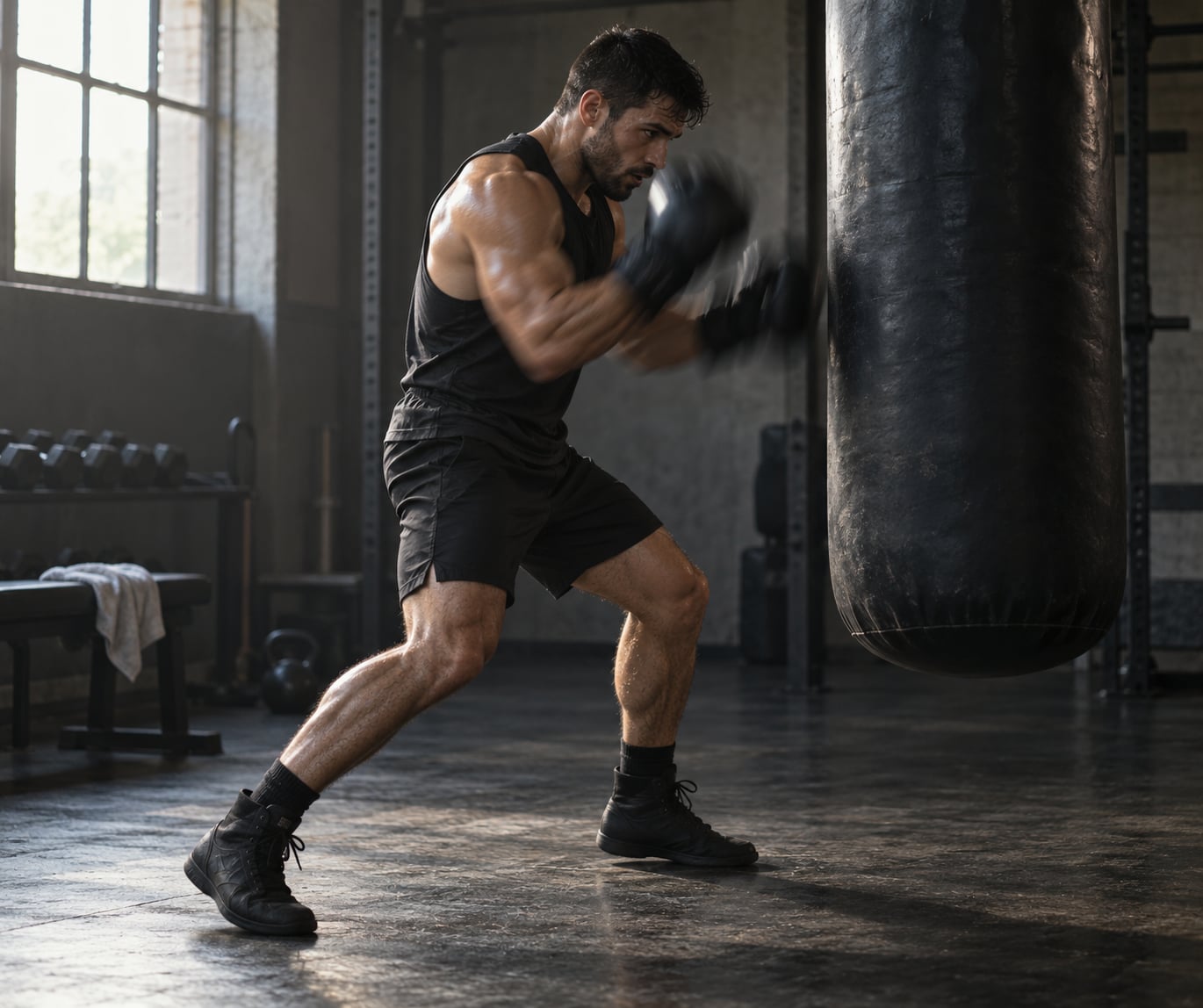
A shoeshine combination is a rapid, close-range flurry of short punches, usually short uppercuts or hooks thrown straight up and down in a vertical rhythm, where the emphasis is speed and volume rather than power. You keep bouncing or shuffling underneath yourself and throw one punch per bounce, so your hands and feet stay in sync.
The technique lives somewhere between a drill and a real weapon, and most beginners only ever learn the first half of it. Here is what it actually is, how the name arrived, how to throw it, and what to do when somebody throws one at you.
Table of Contents
- What Is A Shoeshine Combination?
- Why Is It Called A Shoeshine?
- What Punches Make Up A Shoeshine?
- How To Throw A Shoeshine Combination
- Hand And Foot Synchronization
- Shoeshine Punch Count Progression
- Shoeshine Drill Vs. A Standard Hook Flurry
- Where To Do The Shoeshine Drill
- How To Defend A Shoeshine Flurry
- Common Mistakes And How To Fix Them
- Does The Shoeshine Actually Hurt?
- Are Shoe Shiners Still A Thing?
- Who Should Use It In Their Game?
- Frequently Asked Questions
- Conclusion
What Is A Shoeshine Combination?
At its core, it is a flurry built for the inside. Instead of swinging big hooks from range, you crowd the opponent and chop short, fast punches up the middle and toward the body.
- Volume: lots of short punches, most of them weak, all of them fast.
- Vertical motion: the hands travel up and down, not out across the target.
- Hand-foot rhythm: one punch per bounce keeps everything connected.
- Purpose: raise the guard, split the arms, lift the head, steal a round.
- Side effect: serious conditioning work for the lungs and shoulders.
One thing to clear up early: it is not a 1-2-1-2. A commenter on r/amateur_boxing put it plainly, calling it a flurry of close-range hooks that change levels rather than a set combination you count out loud.
Why Is It Called A Shoeshine?
Because of what your hands look like while you do it. They stay vertical, close to your chest, and pump up and down in a tight, repetitive motion, which looks exactly like a shoe shiner working a brush up the front of a shoe.
The name stuck because it is easy to recognise from the crowd. You do not need boxing knowledge to see it, which is probably why it survived decades of coaches telling fighters to stop doing it.
What Punches Make Up A Shoeshine?
Mostly uppercuts, both from the lead and rear hand, with the knuckles coming up toward the centreline at roughly a 45-degree angle. Short hooks work too, and so does mixing the level, dropping to the body and coming back up to the head.
The common thread is shortness. Long punches are faster to land, but they are also slower to throw and they telegraph. Short punches survive the awkward angles you get when somebody is holding your arms down.
Body work is the strongest option in a real fight. A fighter who is already covering up will not stop covering up because you hit his head, but he will drop an elbow when you get underneath his ribs.
How To Throw A Shoeshine Combination
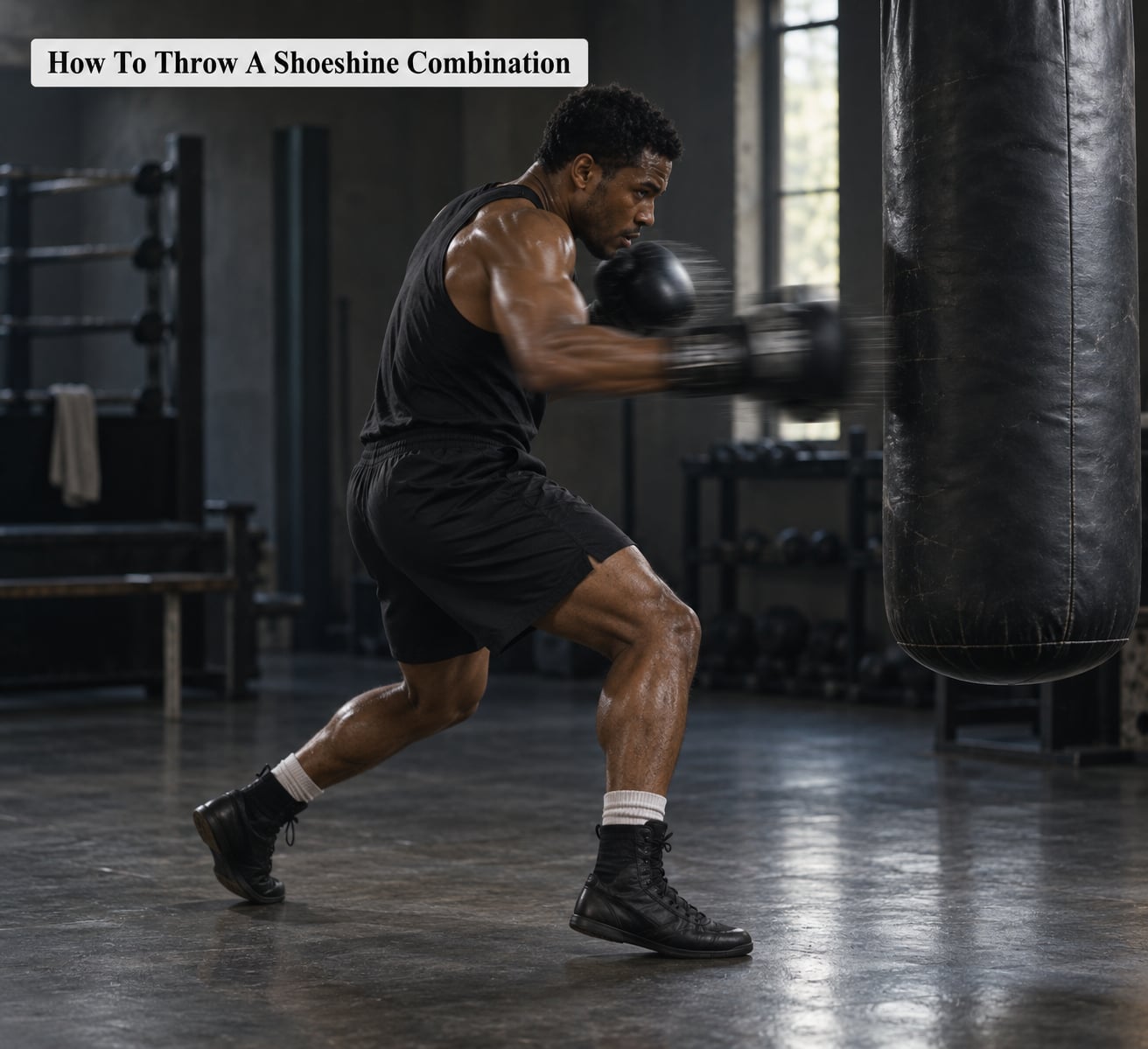
This is the sequence I would give a fighter in their first session with it. Speed comes last, and it comes from repetition rather than effort.
- Set your stance. Feet shoulder width, weight forward on the balls of the feet, knees soft, hips sitting low. Chin tucked behind the lead shoulder.
- Start slow without punches. Bounce in place for a full minute and let your shoulders relax. Grooved shoulders kill hand speed before the first punch lands.
- Add the hands, still slow. Hands stay vertical at chest height and pump up and down with the bounce. Exhale on each bounce.
- Add the punches. One short uppercut per bounce, knuckles angled toward the centreline. Let the elbow finish rather than driving with the arm.
- Lock the rhythm. Your lead heel lifts as your lead uppercut rises. That one detail separates a shoeshine from ordinary shadowboxing.
- Build speed in rounds. Fifteen seconds on, fifteen seconds off, eight to ten sets. Rest first, then double the work interval.
- Finish with a power punch. Cap every flurry with one real hook or uppercut. Small punches set the head up; the last one does the damage.
That last habit is what separates a useful flurry from just being busy. Flurries that end on nothing often leave you open for the counter, and the counter is where the damage actually comes from.
Hand And Foot Synchronization
The whole exercise is a coordination drill wearing a punching bag’s clothes. If the hands and feet run separately, you get two tired people instead of one boxer.
Keep the bounce shallow, more ankle than hip. Think of your feet shuffling on a hot floor rather than jumping, and keep the head still, because a head that bobs up and down is a head your opponent can track.
Once the rhythm holds for a full round without thinking about it, it stays. That is the muscle memory part, and it is the reason coaches still use this drill even for fighters who will never use the technique in a fight.
Shoeshine Punch Count Progression
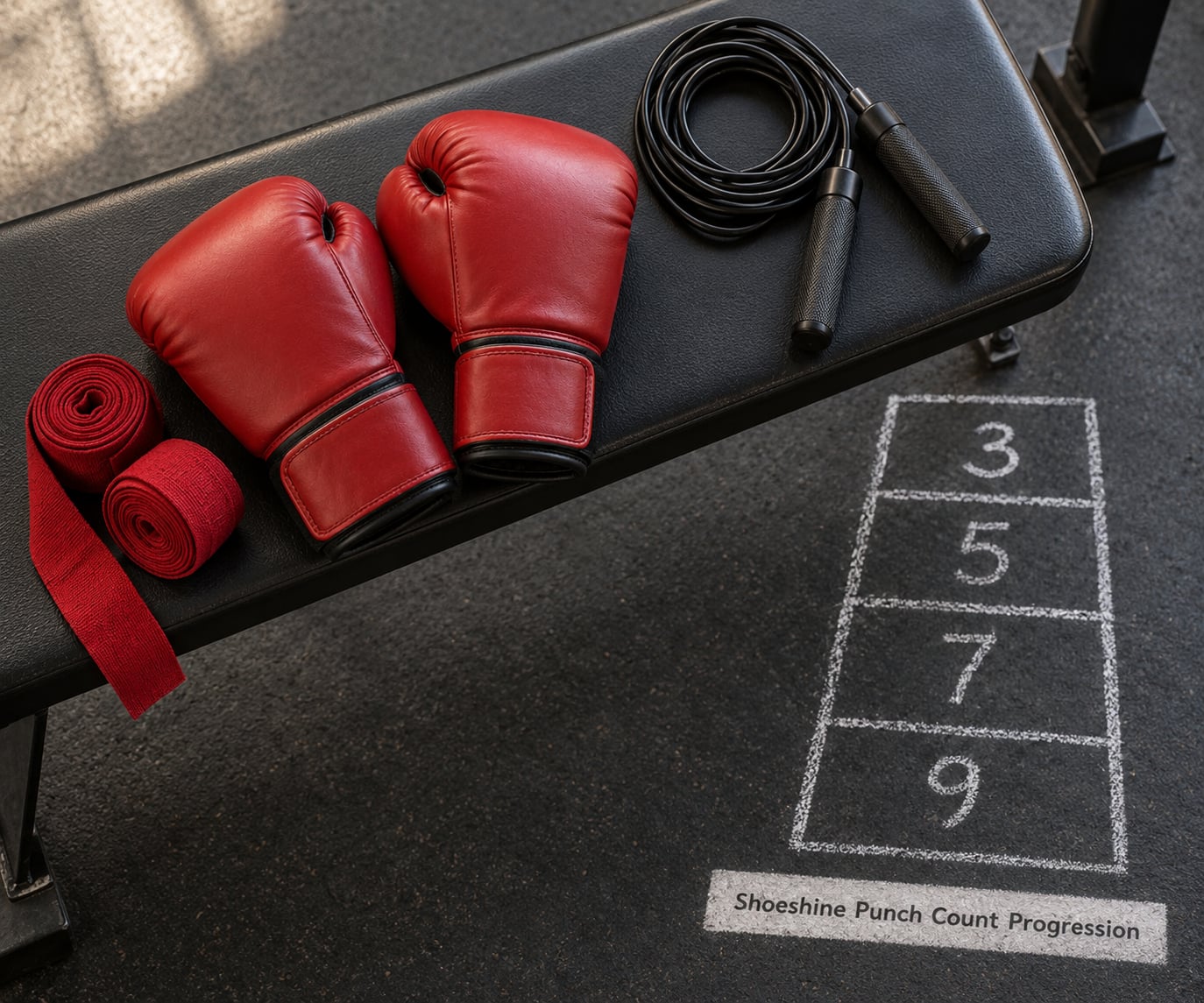
Counting removes the judgement call. If you cannot say how many you threw, you were probably sloppy. This ladder is the standard progression.
| Round | Punch count | Finisher | Goal |
|---|---|---|---|
| 1 | 3 uppercuts | One hook | Clean rhythm, correct form |
| 2 | 5 uppercuts | One hook | Hold the count under fatigue |
| 3 | 7 uppercuts | One hook | Relaxed shoulders, full exhale |
| 4 | 9 uppercuts | One hook | Speed without wild feet |
| 5 | 19 uppercuts | One hook | A full two-minute round of work |
Nineteen feels impossible when you start, and it is the round that actually builds you. Most gyms cap it at nine and stop there, which is why so many fighters can do five and nothing more.
Shoeshine Drill Vs. A Standard Hook Flurry
| Element | Shoeshine | Standard hook flurry |
|---|---|---|
| Range | Very close, chest to chest | Mid to long range |
| Punch choice | Short uppercuts, short hooks | Full-length hooks and crosses |
| Power per punch | Low | Moderate to high |
| Purpose | Raise the guard, work the body, steal rounds | Finish or stun |
| Hand speed needed | Very high | Average is fine |
| Main risk | Getting hit coming in | Standing in range of a counter |
If you have ordinary hand speed, you can still make the shoeshine work for you by bringing your hands closer, shortening the punches and aiming at the body. It becomes a grinding inside game instead of a speed game.
Where To Do The Shoeshine Drill
Most of the value is in the ordering. Shadowboxing first because it teaches rhythm with no impact to absorb, then the heavy bag for power and counts, then the double-end bag for accuracy, and pads last because a pad holder will not tolerate sloppy form for long.
The heavy bag is where most progress happens. Stand close enough that the bag barely moves, work the body, and let the bag absorb your mistakes. The double-end bag punishes a drifting hand position immediately, which is exactly the fault you are trying to remove.
Spar is the last step and it is the least useful for learning. Nobody throws a shoeshine at full speed in a sparring session, so the application has to be drilled as a sequence on pads instead.
How To Defend A Shoeshine Flurry
This is the question that comes up most on every boxing forum and the one nobody answers properly. Covering up and hoping it ends is the default, and it is exactly what the fighter wants.
- Do not go to the body. Resist the instinct to drop both elbows into the ribs. One elbow is enough; drop both and you have just defended the uppercuts.
- Check with a long jab. A straight punch to the chest interrupts the bounce far more reliably than a counter you are too tired to make.
- Step off the line. Give ground diagonally. A flurrying fighter throws where he was a moment ago, so movement beats punches here.
- Clinch and tie up. Once the flurry is spent, close the distance and make him work to reset. Referees will break the tie, which is your reset.
- Counter with the check hand. When he slows down, one hook over the top finishes what his flurry started.
Step three is the one most fighters skip. It feels like running, but an opponent throwing nine or nineteen short punches cannot chase you without dropping his own guard.
Common Mistakes And How To Fix Them
- Standing up straight. The bounce is what keeps you low. Flatten out and you eat every counter.
- Dropping the hands when tired. The flurry stops the moment your elbows drop to breathe, so practise breathing on the exhale of each punch.
- Leaning forward. Slight forward lean, hands coming up under the chin rather than down and around.
- Punching with the palm. One commenter in an Expert Boxing thread was warned by a referee for landing shots with the palm on the forehead. Land on the knuckles.
- Wearing rings on your fingers. Another poster in that same thread picked up an eye abrasion from metal rings during a flurry. Take them off.
- Wrapping loose hands. Wrap the wrist snug and keep the knuckles lined up before the set starts, not after the first sting.
Does The Shoeshine Actually Hurt?
Not much, and anyone who tells you otherwise is selling a video course. Short punches thrown at full speed carry a fraction of the force of a properly landed hook, and the palm-heel contact many fighters default to does almost nothing at all.
What it does do is fill the space in front of your opponent’s face, which is worth a lot when you are the shorter fighter and cannot get to his chin. Treat it as a tool for creating an opening, then land something real.
Are Shoe Shiners Still A Thing?
Yes, though you will see it more often than you hear about it. It survives mostly with pressure fighters and with shorter boxers who need an inside game, and it appears in sparring and pad work far more often than in championship rounds.
Veteran amateurs on r/amateur_boxing tend to be blunt about the limits. They point to Sugar Ray Robinson, Joe Louis, Muhammad Ali, Sugar Ray Leonard, Roy Jones, Meldrick Taylor and Floyd Patterson as the fighters for whom it genuinely worked, and they are right that hand speed decides the outcome.
Who Should Use It In Their Game?
Pressure fighters get the most from it, since the flurry fits naturally with forward movement. Shorter boxers get the most practical benefit, because it creates an answer to a taller opponent who leans away or shoots straight forward.
Beginners should still drill it, because the hand-foot rhythm transfers into everything else they learn, even the combinations they will actually fight with. Tall out-boxers will get less from it and should treat it as conditioning work rather than a signature move.
Frequently Asked Questions
Are shoe shiners still a thing?
Yes, mostly in the gym rather than on championship cards. It shows up in pad work, heavy bag sessions and sparring, and pressure fighters and shorter boxers still use it in real rounds. You will not see it much on broadcast because it wins through accumulation rather than a single knockout blow, and it only works at full speed with elite hand speed.
Do shoeshine punches hurt?
Less than most fighters like to admit. A short punch thrown at speed carries a fraction of the force of a properly landed hook, and palm-heel contact does almost nothing. What the flurry does well is occupy your opponent’s attention, fill the space in front of their face and raise their guard, which is why you always finish the sequence with one real power punch.
How do you counter a shoeshine flurry?
Four options work. Check with a long jab to interrupt the bounce, step diagonally off the line rather than backing straight up, drop only one elbow so the uppercuts still miss, and clinch to force a referee break. Counting on your own counterpunches is the worst option, because a flurrying fighter is already moving his shoulders into the shot.
What does shoe shine mean in slang?
Outside the ring, shoe shine is slang for excessive flattering or sucking up to somebody, as in throwing someone the shoe shine. Some people also use it loosely for a flashy show of effort that is more performance than substance. Neither usage has anything to do with the boxing combination this guide covers.
Do I need to be fast to use a shoeshine?
You need enough speed that your punches land before your opponent can read them, but not world-class speed. Slower fighters get more out of it by bringing their hands closer, shortening the punches and targeting the body. Treat it as a grinding inside game rather than a speed game, and finish with one real punch every time.
How much to tip a shoe shine guy?
That question is about the shoeshine boy who works the corner outside a barbershop, not about boxing. Tipping there is usually small and depends entirely on the local crowd and how long you have been a regular. If you were looking for the punching technique, the shoeshine combination is a fast flurry of short uppercuts thrown in a vertical rhythm.
Conclusion
A shoeshine combination is a close-range flurry of short uppercuts thrown up and down in a steady rhythm, one punch per bounce, with speed rather than power doing the work. The name comes from the way the hands move, pumping vertically like a brush on a shoe.
Start with the basic version: shadowbox the bounce without punches for a minute, add three short uppercuts, and cap the set with one real hook. Hold that count on the heavy bag for two or three sessions before you touch the double-end bag, and never end a flurry on a weak punch.
Then spend as much time on defence as you do on offence. Knowing how to step off the line and check with a jab is what will keep you out of trouble when somebody decides to shoeshine you.